Seller Profit Guard · How it works · CSV privacy
Supplier MOQ calculator
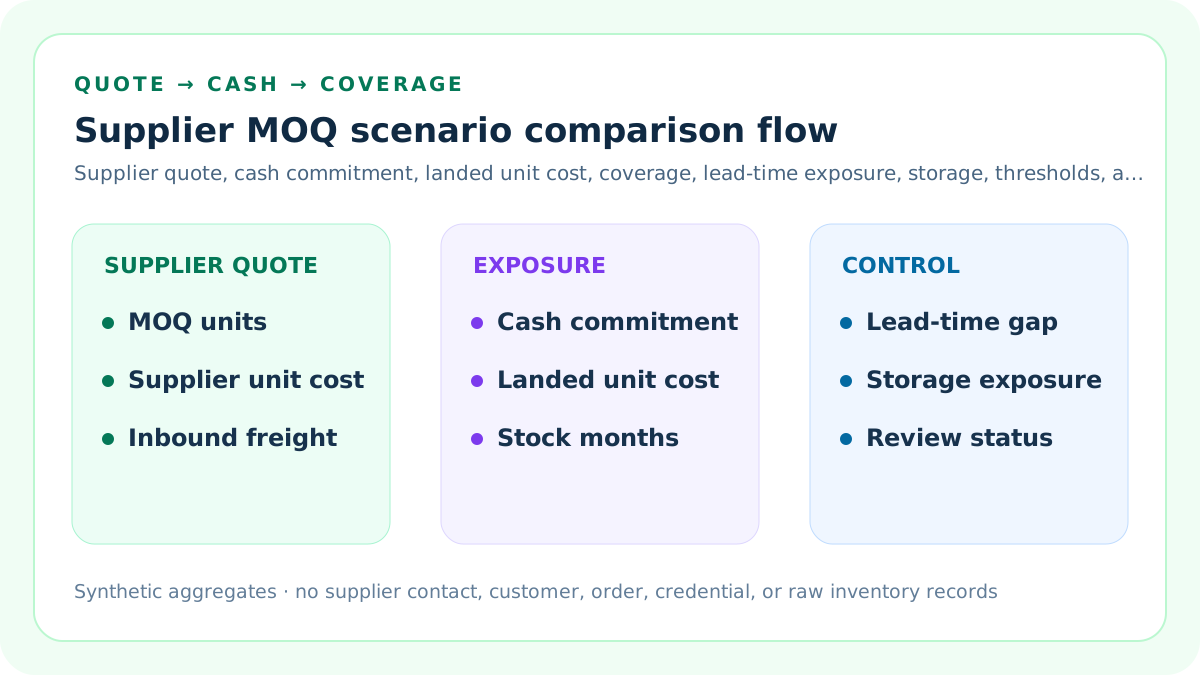
Compare two distinct supplier minimum-order offers by calculating cash commitment, landed unit cost, sell-through time, post-receipt stock months, lead-time exposure, and projected storage cost. Ready requires dated evidence, seller-owned cash, stock-month, and evidence thresholds, plus nine confirmations. Block masks every derived output; no result selects a supplier or authorizes a purchase.
Maintained by Seller Profit Guard Editorial Team. Last reviewed: 2026-07-31.
Start with the exact supplier constraint
Record whether the supplier requires a minimum unit quantity, minimum order value, case multiple, color minimum, variant minimum, carton count, or combined-order minimum.
A verbal minimum without unit and scope is not usable.
Calculate merchandise cost
Merchandise cost equals MOQ units multiplied by the quoted unit cost in one declared currency and purchase unit.
Do not mix pieces and cases.
Calculate cash commitment
Cash commitment equals merchandise cost plus inbound freight, handling, and other documented landed costs payable for the order.
Payment timing remains separate.
Calculate landed unit cost
Divide total cash commitment by accepted MOQ units. This exposes when a lower quoted unit price is offset by freight or other landed costs.
It is not accounting inventory valuation.
Calculate MOQ sell-through time
Divide MOQ units by comparable monthly demand. This estimates how many months the incremental order represents under one declared demand baseline.
It is a scenario, not a forecast guarantee.
Calculate months of stock after receipt
Add existing Available units to MOQ units, then divide by monthly demand. The result describes total coverage immediately after receipt.
Exclude inventory that is unavailable or already committed.
Estimate lead-time demand
Multiply comparable monthly demand by lead-time days divided by 30. Compare it with existing Available units to expose a possible pre-arrival gap.
This tool does not set a reorder point.
Estimate storage cost
Assuming linear depletion, average incremental MOQ inventory equals half the order quantity. Multiply it by MOQ sell-through months and storage cost per unit-month.
Run a non-linear sensitivity when demand is seasonal.
Read Scenario A
A 120-unit MOQ at USD 8 plus USD 240 freight requires USD 1,200 cash and yields a USD 10 landed unit cost. With 60 units of monthly demand and 20 existing units, post-receipt coverage is 2.33 months.
Projected incremental storage is USD 24.
Read Scenario B
A 360-unit MOQ at USD 6 plus USD 360 freight requires USD 2,520 cash and yields a USD 7 landed unit cost. Post-receipt coverage is 6.33 months.
Projected incremental storage is USD 216.
Compare price with inventory exposure
Scenario B saves USD 3 of landed cost per unit but commits USD 1,320 more cash and carries four additional months of incremental MOQ stock.
Lower unit cost is not the whole decision.
Keep payment terms separate
A deposit, balance on shipment, net terms, letter of credit, platform payment, or early-payment discount changes cash timing but not the underlying quantity.
Model timing in a separate cash-flow schedule.
Keep freight scope consistent
Confirm whether freight covers factory pickup, export handling, international freight, duties, brokerage, domestic delivery, insurance, and accessorial charges.
Do not compare EXW with delivered cost silently.
Keep lead time evidence current
Separate production, quality inspection, consolidation, transit, customs, receiving, and availability delays. Use confirmed terms and recent performance.
A quoted best case is not guaranteed.
Use comparable demand
Choose complete periods at one SKU-location and channel grain. Document stockouts, promotions, price changes, seasonality, launches, discontinuation, and ranking changes.
Observed sales during stockouts understate demand.
Keep existing inventory on one state
Use Available inventory under a documented field definition. On hand can include committed or unavailable units, while Incoming is not yet sellable.
Reconcile the snapshot before coverage math.
Use a seller-owned cash threshold
The maximum cash commitment is an escalation control based on liquidity, payment obligations, contingency reserve, and portfolio concentration.
Clearing it does not authorize payment.
Use a seller-owned stock-month threshold
The maximum months of stock reflects shelf life, obsolescence, storage, demand volatility, product lifecycle, and seller risk tolerance.
There is no universal safe value.
Require dated evidence and nine confirmations
Record a real source-review date no earlier than the seller policy date, then confirm the written offer, purchase unit, landed-cost scope, lead-time definition, demand comparability, Available inventory, threshold owner, aggregate privacy boundary, and purchasing-authority boundary.
Any missing confirmation blocks derived outputs.
Classify Block, Review, and Ready
Block covers invalid MOQ, costs, lead time, demand, evidence, scope, currency, or conflicts. Review covers short evidence or exceeded cash/coverage thresholds.
Ready only clears the entered worksheet.
Run one-input sensitivity
Change MOQ, unit cost, freight, lead time, demand, existing availability, storage cost, cash ceiling, and stock-month ceiling one at a time.
Record which term drives the decision.
Separate MOQ from order multiple
A supplier may require both a minimum and a case, pallet, or production multiple. Microsoft documents minimum order quantity and order multiple as separate modifiers.
Round the accepted quantity according to the actual rule.
Separate MOQ from EOQ
EOQ balances estimated ordering and holding costs under assumptions. A supplier MOQ is a contractual or operating floor that can constrain an otherwise preferred quantity.
This calculator does not optimize EOQ.
Separate MOQ from reorder point
A reorder point addresses when inventory position triggers replenishment review. MOQ addresses the minimum size or value of an accepted supplier order.
Do not merge timing and size.
Separate MOQ from supplier qualification
Price and quantity do not establish quality, compliance, intellectual property rights, reliability, capacity, ethics, insurance, security, or dispute terms.
Due diligence is a separate gate.
Separate MOQ from profitability
Cash commitment and months of stock do not prove the product price covers fees, fulfillment, returns, ads, labor, tax, or overhead.
Use contribution and price-floor tools separately.
Protect quote and supplier data
Use aggregates and redacted terms in the public calculator. Keep supplier identities, contacts, bank details, contracts, invoices, customer rows, credentials, and raw exports in authorized systems.
The browser does not upload source records.
Preserve an evidence ledger
Record quote version, incoterm, currency, purchase unit, MOQ, multiple, costs, payment terms, lead-time definition, demand period, inventory state, owner, reviewer, and timestamp.
A result without lineage is not auditable.
Monitor actual receipts and sell-through
Compare quoted and actual quantity, cost, freight, lead time, defects, receipts, storage, sales, adjustments, and remaining inventory with the accepted scenario.
Correct future assumptions explicitly.
Set stop and restoration rules
Stop when quotes expire, units change, freight scope is incomplete, payment terms conflict, demand evidence drifts, or supplier risk emerges.
Preserve the prior purchasing plan.
Use ten support artifacts
Formula, low-MOQ example, high-MOQ case, mistakes, sources, threshold, comparison, routine, interpretation, and audit pages solve separate queries.
They are not keyword substitutions.
Release only after quality gates
Validate arithmetic, direct answers, sources, metadata, schema, images, links, similarity, privacy, mobile behavior, backups, build, deployment, and live behavior.
Search signals are measured later.
Document the boundary
This browser-local scenario compares entered supplier offers. It does not contact suppliers, negotiate terms, forecast demand, choose an order quantity, create a PO, authorize payment, or guarantee sell-through.
A human owner remains responsible.
Sources and further reading
- Microsoft Learn: Handling reordering policies: Official minimum-order, maximum-order, order-multiple, lot-for-lot, time-bucket, safety-stock, and demand-planning context.
- Shopify Help: Purchase orders: Official purchase-order fields for supplier, quantity, cost, payment terms, currency, incoming transfer, receipt, and cost adjustment.
- Shopify Help: Choosing suppliers: Official supplier-evaluation context including minimum order sizes and minimum order values.
- Oracle NetSuite: Inventory Management: Official supply-planning, lot-sizing, purchase-order, and availability context.
- GAO: Economics of Inventory Control: Government source defining holding and ordering cost components and the trade-off between order size and inventory investment.
- GAO Inventory System Checklist: Government checklist covering holding cost, ordering cost, unit cost, demand, EOQ, and other sound order-quantity calculations.
- Seller Profit Guard methodology: Evidence, formula, privacy, correction, release, monitoring, and rollback controls.
- Seller Profit Guard data privacy: Local-first boundaries for supplier, quote, purchase, inventory, customer, order, and raw export data.
Related Seller Profit Guard tools
- Etsy CSV profit calculator: Run a local order profit check with editable fee and SKU cost assumptions.
- Payment reconciliation tool: Compare order rows with statement activity and flag unmatched rows.
- SKU cost library: Save or import material, labor, packaging, shipping, and target margin assumptions.
- Variant risk checker: Find missing SKUs and variation cost risks before a listing scales.
- Etsy title checker: Review listing-title clarity, repetition, keyword chains, and mobile scanning.
- Etsy tag checker: Review all 13 tag slots for duplicates, repeated meaning, and truthful coverage.
- Free shipping threshold calculator: Estimate when a shipping subsidy can still meet a target margin.
- Return window loss estimator: Model expected reverse shipping, restock work, recovery, and replacement loss.
- Etsy Ads break-even calculator: Estimate target-safe Etsy Ads spend, ACOS, and ROAS after fees, fulfillment, and expected return loss.
- CSV data privacy: Understand what the local-first workflow needs and what it does not need.
- Supplier MOQ Formula and Inputs: Define MOQ, purchase unit, landed costs, lead time, demand, existing availability, stock months, storage, thresholds, and evidence.
- Low MOQ Supplier Worked Example: Reperform a 120-unit supplier offer through cash commitment, landed unit cost, coverage, lead-time exposure, and storage.
- High MOQ Lower-Price Supplier Scenario: Reperform a lower-price 360-unit offer through higher cash exposure, stock months, lead time, storage, and review thresholds.
- Supplier MOQ Modeling Mistakes: Find quote, purchase-unit, freight, landed-cost, lead-time, demand, inventory-state, storage, threshold, and privacy errors.
- Supplier MOQ Data Sources and Evidence: Map MOQ, multiple, cost, freight, terms, lead time, demand, inventory, storage, currency, and evidence to controlled sources.
- Supplier MOQ Decision Threshold: Set cash and stock-month thresholds with evidence, liquidity, shelf-life, concentration, approval, monitoring, stop, and restoration controls.
- Low vs High Supplier MOQ Comparison: Compare low- and high-MOQ offers across cash, landed cost, lead time, stock months, storage, uncertainty, and decision authority.
- Weekly Supplier MOQ Review Routine: Run a weekly quote, cost, lead-time, demand, inventory, threshold, approval, monitoring, exception, and restoration cycle.
- Interpret Supplier MOQ Results: Interpret cash commitment, landed cost, sell-through months, total coverage, lead-time gap, storage, threshold status, and uncertainty.
- Supplier MOQ Audit Checklist Template: Audit quote terms, units, MOQ, multiples, costs, freight, lead time, demand, inventory, storage, formula, approvals, privacy, and rollback.
Use the interactive tool
Enable JavaScript to open the calculator and process browser-local inputs. The explanatory content and source links remain available without JavaScript.
Related guide: Define MOQ, landed cost, cash commitment, demand, inventory coverage, lead-time exposure, storage, thresholds, and evidence controls.
This tool provides operating estimates, not tax, accounting, legal, financial, or marketplace-policy advice. Verify current official sources and your own records before changing prices or operations.