Seller Profit Guard · How it works · CSV privacy
Shipping Subsidy Calculator
A shipping subsidy calculator subtracts buyer-paid shipping, platform credits, and carrier credits from postage and packaging after seller-entered fee effects. The remaining positive gap is seller-funded shipping; a negative gap becomes a separately reported shipping surplus.
Maintained by Seller Profit Guard Editorial Team. Last reviewed: 2026-07-31.
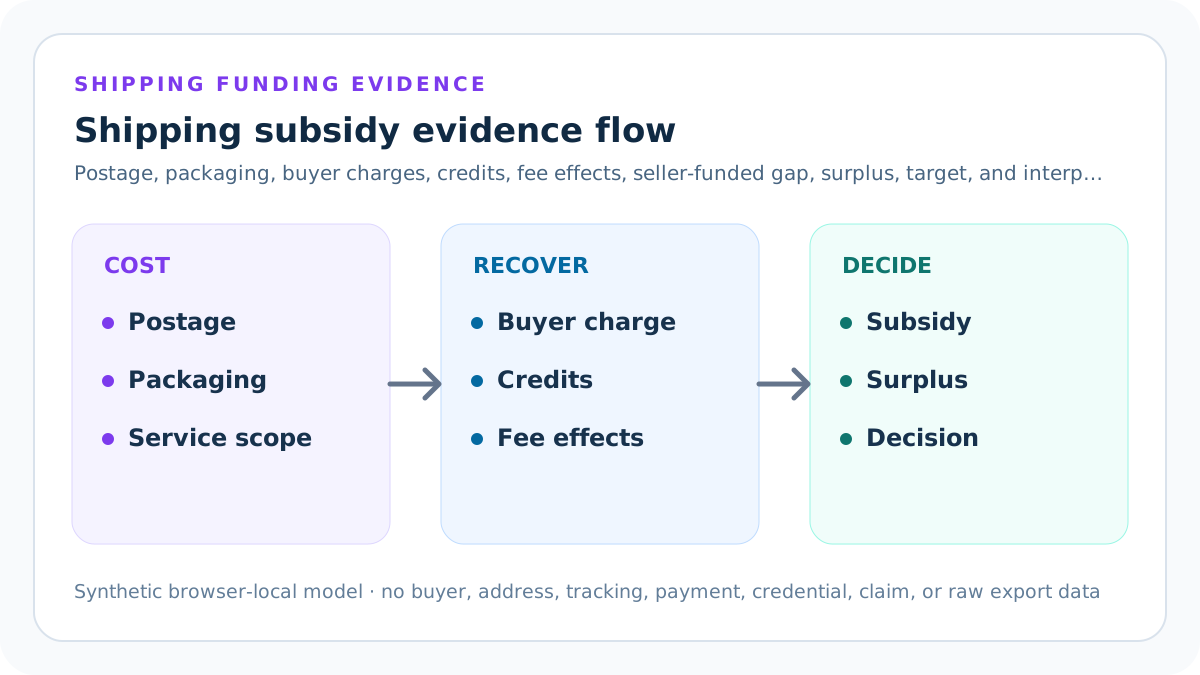
Define one comparable shipment
Choose one seller, marketplace, currency, evidence month, origin, destination band, package specification, shipping service, and order treatment. Every cost, recovery, credit, and fee assumption must describe that same shipment.
Do not average domestic, international, upgraded, oversized, returned, refunded, reshipped, and carrier-adjusted orders into one convenient value. Separate materially different populations before comparing subsidy.
Start from evidenced postage
Enter the actual carrier charge or shipping-label cost for the declared parcel and service. Preserve the purchase date, billed weight, dimensions, zone or destination band, service level, adjustment status, and protected source pointer.
A quoted rate, dashboard estimate, printed label, carrier invoice, and final adjusted charge may differ. Use the evidence appropriate to the decision and mark provisional amounts until adjustment windows close.
Keep packaging visible
Add packaging cost assigned to the same order: mailer, box, label, tape, insert, protective fill, or another evidenced component. The amount should follow a documented per-order or batch allocation rule.
Do not duplicate packaging already embedded in another cost model. Packing labor, product materials, damage reserve, storage, and recurring overhead remain separate unless the seller deliberately defines and documents a broader shipping boundary.
Record buyer-paid shipping exactly
Buyer-paid shipping is the shipping amount charged to the buyer for the modeled order, not item price, tax, gift wrap, discount, or total checkout value. Use the final order evidence under the chosen currency and refund state.
A free-shipping order has zero buyer-paid shipping even when the item price was increased. Price recovery belongs in a separate price and contribution comparison; do not relabel item revenue as shipping revenue.
Separate platform-funded credits
Enter a platform-funded shipping credit only when it is evidenced for the same order and does not come from the buyer or seller. Preserve campaign, eligibility, effective dates, cap, settlement timing, currency, and reversal conditions.
A displayed promotion, projected incentive, coupon, advertising credit, seller-funded discount, or unrelated account adjustment is not automatically a shipping credit. Unknown funding remains unresolved rather than reducing subsidy.
Separate carrier refunds and adjustments
Enter a carrier refund or adjustment credit only after its relationship to the modeled shipment is confirmed. Preserve original charge, claim or adjustment identifier, reason, approval, settlement date, currency, and whether the credit is final.
Do not net an unrelated carrier credit against the parcel. Surcharges and debits increase postage evidence rather than appearing as negative credits. Pending claims belong in a scenario, not the approved result.
Enter the fee percentage as seller evidence
The seller-entered percentage represents only the fee convention applied to buyer-paid shipping in this model. Confirm which platform transaction, payment-processing, regulatory, advertising, or other fee components actually use a shipping-inclusive base for the seller's country and order.
Etsy's current help and policy pages explain that transaction and payment-processing fee bases can include shipping. Rates and market rules differ and may change. The calculator never supplies or certifies a current fee rate.
Use fixed fee allocation cautiously
A seller may enter a fixed fee allocation only when a documented internal convention assigns part of an order-level fixed fee to shipping. State the total fixed fee, allocation basis, denominator, purpose, and why this view supports the decision.
A fixed payment-processing charge often belongs to the order as a whole. Allocating all of it to shipping can overstate subsidy. A positive fixed allocation with zero buyer-paid shipping triggers Review.
Calculate gross shipping cost
Gross shipping cost equals evidenced postage plus assigned packaging. The default parcel uses USD 6.50 postage and USD 1.20 packaging, producing USD 7.70 before buyer payments, credits, and fee effects.
This subtotal is not full order cost. It excludes product, labor, recurring overhead, marketplace fees unrelated to the shipping charge, refunds, returns, advertising, tax, and seller compensation unless separately modeled.
Calculate fee effects
Percentage fee effect equals buyer-paid shipping multiplied by the seller-entered fee percentage. Add any documented fixed allocation. USD 4.00 buyer-paid shipping at 6.5% produces USD 0.26 of percentage fee effect.
Retain full precision until display. Verify whether tax, gift wrap, item price, currency conversion, regulatory fees, advertising, and country-specific payment rules require a separate order model rather than changing this shipping-only figure.
Calculate net shipping recovery
Gross recovery equals buyer-paid shipping plus platform and carrier credits. Net recovery after fees subtracts the modeled shipping-related fee effect. The default produces USD 3.74 from USD 4.00 buyer-paid shipping after USD 0.26 fee effect.
Net recovery can be negative when a fixed allocation exceeds recovery, or exceed shipping cost when legitimate credits and buyer charges are larger. Either result requires explanation rather than automatic truncation.
Calculate seller-funded subsidy
Signed seller funding gap equals gross shipping cost minus net shipping recovery. Seller-funded subsidy is the positive portion of that gap. The default USD 7.70 cost minus USD 3.74 recovery produces USD 3.96.
If recovery exceeds cost, subsidy is zero and the difference appears as shipping surplus. The calculator does not move that surplus into item profit, tax, or accounting income.
Read a partially paid shipping case
The default case represents a buyer contributing USD 4.00 toward USD 7.70 shipping and packaging. After the modeled percentage fee, the seller funds USD 3.96 and retains USD 1.04 of headroom against a USD 5.00 maximum.
This is one synthetic domestic parcel, not a recommended price or shipping charge. Repeat the calculation for actual service, zone, package, credit, fee, and refund populations.
Read a fully free-shipping case
With buyer-paid shipping and shipping-charge fee effects set to zero, the same parcel produces USD 7.70 seller-funded shipping. A USD 8.00 maximum leaves USD 0.30 headroom.
Free shipping is a buyer-facing charge policy, not evidence that shipping has no cost. Etsy describes options for free-shipping guarantees and profiles and notes that sellers may adjust item prices, but each seller owns the commercial decision.
Compare the seller-owned maximum
Target headroom equals maximum seller-funded subsidy minus calculated subsidy. Positive headroom clears one operating threshold; a negative value quantifies the full-precision gap and triggers Review.
The maximum does not prove acceptable margin, item price, conversion, demand, tax treatment, accounting profit, cash sufficiency, or delivery performance. Record its owner, purpose, effective date, and expiry.
Read recovery rate without overstating it
Net shipping recovery rate divides net recovery after fees by gross shipping cost. It shows how much of this defined shipment cost is recovered by the modeled charge and credits after the chosen fee convention.
Recovery rate is not conversion rate, margin percentage, carrier discount, or buyer value. A rate above 100% may be legitimate or may expose duplicated credits, mismatched scope, or fee omission.
Apply Block, Review, and Ready precedence
Block blank, non-finite, or negative amounts; nonpositive postage or target; invalid recovery threshold; a fee percentage outside zero to 100; impossible source date; invalid currency or month; inadequate shipment scope; incomplete confirmations; or declared conflicts. Invalid evidence cannot be compensated by favorable subsidy.
After structure passes, Review subsidy above target, a fixed allocation with zero buyer charge, or recovery above the seller-entered maximum share of cost. Ready means only that this bounded packet clears those gates.
Build a privacy-safe evidence packet
Store aggregate inputs, protected source pointers, service and package identifiers, period, currency, fee convention, credit status, both seller thresholds, source review date, nine yes/no confirmations, owner, reviewer, expiry, and unresolved issues. Public examples remain synthetic.
Keep buyer names, addresses, order identifiers, tracking numbers, payment details, credentials, private invoices, carrier claims, tax records, and raw exports outside public pages and screenshots.
Test the contract before release
Reproduce partially paid Ready, fully free Ready, above-target Review, configurable recovery-share Review, incomplete-confirmation Block, and invalid-structure Block fixtures. Test blank and non-finite values, zero buyer charge, fee and threshold boundaries, impossible dates, negative values, credit surplus, rounding, currency, period, scope, and conflicts.
Then run typecheck, focused and full unit tests, integration, build, SEO, duplicate, schema, image, link, mobile, accessibility, route, download, and live checks with isolated synthetic data and a rollback identifier.
Observe and correct without claiming causality
After release, verify canonical, indexability, schema, sitemap membership, guide-hub discovery, tool interactions, mobile layout, event integrity, and strict 404 behavior. Record Day 0/7/14/28 evidence.
Search impressions, engagement, tool completion, qualified intent, and AdSense status can lag. A same-day deployment is not evidence of ranking, conversion, approval, or revenue impact.
Choose the next decision from the driver
If Block, repair source, scope, sign, fee, target, context, or conflict. If Review, isolate postage, packaging, buyer charge, credit, fixed allocation, or threshold. If Ready, carry the subsidy into a broader contribution analysis.
Preserve the prior packet and explain every material change. Never hide a shipping gap by editing the fee convention, moving item revenue into shipping, or blending incompatible routes.
Sources and further reading
- Seller Profit Guard methodology: Comparable-grain evidence, deterministic calculations, validation, correction, release, and rollback.
- Seller Profit Guard data privacy: Local-first boundaries for seller, customer, order, payment, credential, invoice, address, and raw export data.
- Etsy Help: How to Offer Free Shipping: Official source reviewed 2026-07-31 for free-shipping guarantees, profiles, buyer charges, price adjustments, service levels, and seller recovery choices.
- Etsy Help: What are the Fees and Taxes for Selling on Etsy?: Official source reviewed 2026-07-31 explaining that Etsy transaction and payment-processing fee bases can include shipping, subject to the seller's market and order facts.
- Etsy Payments Policy: Official policy reviewed 2026-07-31 for country-specific payment-processing context; sellers must verify the applicable rate and effective policy rather than treating this calculator as a fee schedule.
Related Seller Profit Guard tools
- Etsy CSV profit calculator: Run a local order profit check with editable fee and SKU cost assumptions.
- Payment reconciliation tool: Compare order rows with statement activity and flag unmatched rows.
- SKU cost library: Save or import material, labor, packaging, shipping, and target margin assumptions.
- Variant risk checker: Find missing SKUs and variation cost risks before a listing scales.
- Etsy title checker: Review listing-title clarity, repetition, keyword chains, and mobile scanning.
- Etsy tag checker: Review all 13 tag slots for duplicates, repeated meaning, and truthful coverage.
- Free shipping threshold calculator: Estimate when a shipping subsidy can still meet a target margin.
- Return window loss estimator: Model expected reverse shipping, restock work, recovery, and replacement loss.
- Etsy Ads break-even calculator: Estimate target-safe Etsy Ads spend, ACOS, and ROAS after fees, fulfillment, and expected return loss.
- CSV data privacy: Understand what the local-first workflow needs and what it does not need.
- Shipping Subsidy Formula and Inputs: Define postage, packaging, buyer-paid shipping, credits, seller-entered fee effects, target, currency, period, and comparable shipment scope.
- Shipping Subsidy Worked Example: Reproduce a partially buyer-funded parcel with USD 6.50 postage, USD 1.20 packaging, USD 4 buyer shipping, and a 6.5% fee effect.
- Free Shipping Subsidy Scenario: Model a fully seller-funded free-shipping parcel without treating zero buyer charge as zero shipping cost or guaranteed commercial benefit.
- Shipping Subsidy Calculator Mistakes: Find scope, sign, fee, credit, packaging, adjustment, refund, privacy, rounding, target, and interpretation errors before release.
- Shipping Subsidy Evidence Sources: Build protected source lineage for postage, packaging, buyer charges, credits, fee rules, targets, scope, periods, and corrections.
- Shipping Subsidy Decision Thresholds: Apply Block, Review, and Ready gates to shipment evidence, fee effects, credits, target headroom, recovery surplus, privacy, and release.
- Partially Paid vs Free Shipping Subsidy: Bridge partially paid and free-shipping cases without hiding item-price, fee-base, service, package, credit, or conversion differences.
- Shipping Subsidy Operating Routine: Run a recurring label, package, buyer-charge, credit, fee-policy, exception, approval, release, correction, and close control loop.
- How to Interpret Shipping Subsidy: Read gross cost, fee effect, net recovery, subsidy, surplus, recovery rate, target headroom, decision state, and uncertainty safely.
- Shipping Subsidy Audit Template: Audit evidence lineage, formula identity, fee-policy applicability, scenarios, privacy, accessibility, release, production, correction, and rollback.
Use the interactive tool
Enable JavaScript to open the calculator and process browser-local inputs. The explanatory content and source links remain available without JavaScript.
Related guide: Define shipment cost, recovery, fee effects, target, evidence scope, and subsidy boundaries.
This tool provides operating estimates, not tax, accounting, legal, financial, or marketplace-policy advice. Verify current official sources and your own records before changing prices or operations.