Seller Profit Guard · How it works · CSV privacy
Return shipping cost calculator
Estimate seller-side reverse-logistics cost per outbound order under comparable seller-paid and buyer-paid return-shipping scenarios. Use an evidence-based return rate, used-label charges, handling labor, packaging, pickup, verified customer fee recovery, adjustments, and a seller-owned maximum without deciding customer rights or responsibility.
Maintained by Seller Profit Guard Editorial Team. Last reviewed: 2026-07-31.
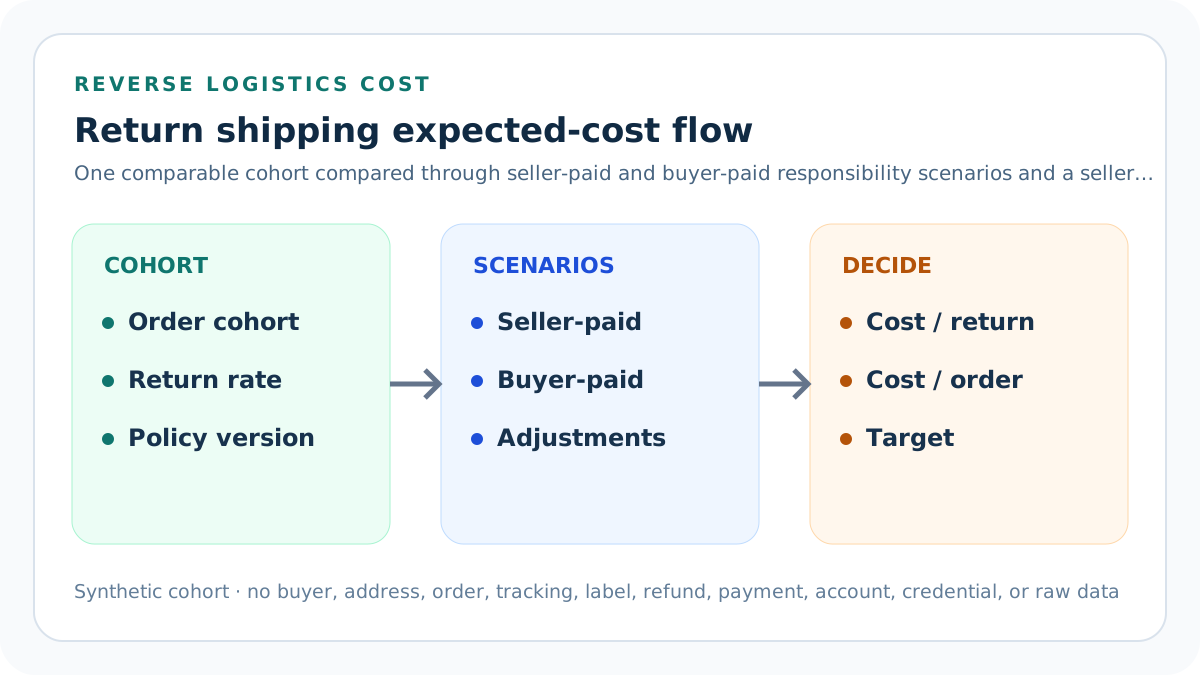
Freeze one comparable order cohort
Start with one physical product or product class, one finished-package profile, one destination or service band, one currency, one policy version, one responsibility pair, and one evidence period.
Do not blend domestic and international returns, oversized and small parcels, defective and discretionary reasons, different legal markets, or policy versions. Mixed cohorts corrupt the return rate, label cost, handling time, and responsibility comparison.
Separate return eligibility from cost
The calculator begins only after current policy, agreement, platform process, and applicable legal review establish that a comparable return may occur. It estimates seller-side reverse-logistics cost.
A cheaper scenario cannot remove customer rights, change an earlier promise, deny an eligible return, create a refund deduction, or decide who should pay.
Use a complete outbound-order denominator
Return rate should use all comparable fulfilled outbound orders in the declared cohort and period, with exclusions recorded before calculation.
Do not divide by return requests, approved returns, issued labels, scans, or received parcels. Those are funnel stages, not the outbound-order denominator.
Define the return-rate numerator
Count comparable orders that meet the chosen returned-order state, such as carrier-scanned returns or physically received returns, and use the same state across scenarios.
A request, authorization, label creation, carrier scan, receipt, inspection, refund, and restock are different events. Mixing them inflates or suppresses expected cost.
Record evidence coverage
Store numerator, denominator, reason coverage, market coverage, source version, extraction date, exclusions, and unresolved records in an aggregate evidence log.
A precise percentage from incomplete data is not reliable. Keep missing or disputed orders visible as uncertainty instead of silently dropping them.
Price only used seller-paid labels
Enter the final billed label cost for comparable seller-paid returns when possible. Keep label estimates, issued labels, unused labels, scans, adjustments, and final invoices in separate fields or logs.
Pay-on-scan and prepaid workflows differ. Do not assume every created label becomes a seller charge or that the displayed estimate equals the final carrier amount.
Keep carrier adjustments visible
Package weight, dimensions, dimensional weight, service, pickup, address correction, and carrier adjustment can change final return-shipping cost after label creation.
Use final reconciled charges for historical cohorts. If only estimates exist, label them as estimates and route large uncertainty to review.
Measure seller-paid handling minutes
Time the seller work to authorize, generate or upload a label, send instructions, answer questions, monitor tracking, receive the parcel, and reconcile the charge for one comparable seller-paid return.
Do not treat owner time as free. Use a documented labor rate and avoid adding inspection or restocking work already modeled in another calculator.
Add seller-paid packaging supplies
Enter only seller-funded packaging or label-delivery supplies attributable to reverse logistics, such as permitted mailers, tape, inserts, printed labels, or protective materials.
Do not automatically repeat outbound packaging cost. Record whether the customer reuses packaging, buys packaging, receives supplies, or uses a box-free service.
Add pickup and accessorial cost
Include documented pickup, call-tag, label-delivery, printing, special handling, consolidation, or other reverse-logistics charge that the seller bears in the seller-paid scenario.
Carrier services and availability vary. A generic pickup assumption is not a quote and should not be copied across services, countries, or package classes.
Record verified customer fee recovery
When current policy, agreement, platform workflow, and legal review permit a return-shipping fee, enter only the amount actually and verifiably recovered from the customer for this scenario.
A stated fee is not collected cash. Keep displayed fee, customer payment, refund deduction, disputed amount, credit, waiver, and reversal separate.
Calculate seller-paid gross cost
Add used label, handling labor, packaging supplies, pickup, and other seller-paid reverse-logistics cost for one returned order.
This gross cost excludes product refund, outbound loss, inspection, repair, restocking, disposal, resale, and replacement unless the declared model deliberately extends scope.
Calculate seller-paid net cost
Subtract verified customer fee recovery from seller-paid gross cost. Preserve negative or unusual results for review rather than hiding credits or reversals.
Do not subtract planned fees, uncollected deductions, pending carrier claims, expected inventory recovery, or unrelated platform fee credits.
Model buyer-paid seller labor
Buyer-paid postage can still create seller work for authorization, instructions, questions, tracking, receipt, exception handling, and reconciliation.
Entering zero requires evidence that the seller performs no incremental work at the modeled scope. Buyer-paid does not mean seller-cost-free.
Model buyer-paid packaging cost
Record packaging, printing, supplies, pickup, consolidation, or service cost that remains with the seller even when the buyer purchases the postage label.
Do not move buyer cost into the seller model. This calculator compares seller-side cost, not total social cost or customer burden.
Model buyer-paid exceptions
Add seller charges caused by failed delivery, wrong address, noncompliant packaging, special handling, support escalation, reimbursement, or seller-provided fallback labels when supported by the cohort.
Separate recurring cost from rare incidents. Large outliers may need their own stress scenario rather than being hidden in a simple average.
Apply one documented labor rate
Convert handling minutes to hours and multiply by the seller-entered labor rate for both scenarios.
The planning rate is not payroll, wage compliance, tax, or accounting treatment. Keep currency and effective date explicit.
Calculate per-return scenario costs
Seller-paid net cost and buyer-paid net seller cost are calculated at the same returned-order grain before applying the return rate.
Comparing a per-label seller-paid number with a per-outbound-order buyer-paid number is a denominator error.
Calculate expected cost per outbound order
Multiply each scenario's net cost per returned order by the evidence-based return rate, then add any documented adjustment or exception cost allocated per outbound order.
Expected cost spreads reverse logistics across comparable outbound orders. It is not the cash cost of the next individual return.
Keep adjustment cost separate
Use the adjustment field for documented unused-label, carrier-adjustment, billing-delay, or exception cost allocated per outbound order when it is common to both responsibility scenarios.
If adjustments differ by scenario, run separate versions or extend the model transparently. Do not use one shared number to conceal a meaningful policy difference.
Compare scenario difference
Subtract buyer-paid expected seller cost from seller-paid expected seller cost. Positive means buyer-paid is lower for the seller; negative means seller-paid is lower; a near-zero result is a tie.
Cost difference alone cannot select policy. Customer rights, promises, service, conversion, abuse, accessibility, market rules, and operational control require separate evidence.
Set a maximum expected-cost target
Enter a dated seller-owned maximum reverse-logistics cost per outbound order. Target headroom equals the maximum minus the lower modeled scenario cost.
Do not tune the target after seeing the preferred result without recording the decision owner, rationale, affected cohort, and effective date.
Require a material scenario difference
Divide the absolute seller-paid versus buyer-paid expected-cost difference by the larger absolute scenario cost, then compare the rate with the seller-entered minimum.
A small difference routes to Review even when one scenario is technically lower. The rate is an operating materiality control, not evidence that a public responsibility change is lawful or beneficial.
Cap seller-paid label concentration
Divide the used-label cost by seller-paid gross return cost before customer recovery. Route the packet to Review when that share exceeds the seller-entered maximum.
High label concentration signals sensitivity to package weight, dimensions, service, carrier measurement, scan state, and delayed adjustment. It is not a carrier quote or price guarantee.
Date and confirm the responsibility packet
Record a real source-review date and confirm return cohort, seller-paid label billing, seller-paid handling, buyer-paid responsibility, buyer-paid handling, adjustments, recovery and refund state, source lineage, and planning boundaries.
Every confirmation must be an explicit yes from the authorized evidence owner. Missing or ambiguous confirmation Blocks the comparison instead of becoming a silent assumption.
Use Block, Review, and Ready correctly
Block means evidence or structure is invalid. Review means scenario costs tie or the lower cost exceeds the maximum. Ready means one scenario is lower and clears the seller cost target.
Ready means the arithmetic is decision-ready; it is not legal approval, policy authorization, customer-experience proof, or instruction to change return responsibility.
Validate the default example
At a 10% return rate, USD 6 label, 12 seller minutes at USD 24 per hour, USD 1 supplies, and USD 0.50 other cost produce USD 12.30 seller-paid net cost per return.
The seller-paid expected cost is USD 1.23 per outbound order. Six buyer-paid handling minutes plus USD 0.70 remaining cost produce USD 3.10 per return and USD 0.31 per outbound order.
Stress buyer-paid handling
If buyer-paid returns require 45 seller minutes, their seller-side cost becomes USD 18.70 per return and USD 1.87 per outbound order at the same 10% return rate.
Seller-paid then becomes lower by USD 0.64 per outbound order. This illustrates sensitivity; it does not prove which responsibility rule is appropriate.
Model flat-fee recovery carefully
A platform may display a flat return-shipping fee or require manual refund treatment. Treat the fee as recovery only after it is permitted, applied, collected, and reconciled.
Do not infer legal validity or automatic deduction from a settings screen. Keep rule configuration and realized payment evidence separate.
Account for pay-on-scan timing
When applicable, reconcile label creation, customer receipt, carrier scan, measured package, final charge, invoice timing, and expiration.
Do not classify a created label as a used cost before the relevant billing event. Conversely, do not ignore delayed charges merely because they missed the first report.
Protect buyer and label data
Keep names, addresses, emails, messages, order identifiers, tracking, labels, QR codes, payments, refunds, carrier accounts, and credentials in authorized systems.
Use aggregate cohort counts, redacted cost evidence, approved aliases, access controls, retention rules, and synthetic fixtures in public pages and tests.
Measure realized outcomes
Compare predicted return rate, label use, final label charge, handling minutes, packaging, pickup, adjustments, fee recovery, and expected per-order cost with privacy-safe realized cohorts.
Record sample size, missing stages, delays, outliers, policy changes, source versions, corrections, and decision impact. Do not call a selected cohort causal proof.
Release and restore safely
Preserve local and remote backups plus a rollback identifier. Run typecheck, tests, integration, build, content, duplicate, SEO, image, link, browser, mobile, keyboard, privacy, and restore checks.
After release, verify status, canonical, indexability, schema, answers, tool scenarios, assets, strict 404, sitemap policy, events, and Day 0/7/14/28 evidence. Restore on regression.
Sources and further reading
- Seller Profit Guard methodology: Evidence, cohort denominators, expected-cost calculations, privacy, correction, release, and rollback.
- Seller Profit Guard data privacy: Local-first boundaries for buyer, address, message, tracking, label, payment, refund, and raw-order data.
- Etsy Help: How to Ship Your Items on Etsy: Official seller guidance to communicate whether the seller or buyer pays return shipping.
- Shopify Help: Setting up return and cancellation rules: Official free, flat-fee, and customer-purchased return-shipping choices plus refund-handling context.
- Shopify Help: Buying return labels: Official pay-on-scan, carrier, estimated-versus-final charge, expiration, and billing context.
- Shopify Help: Billing for shipping labels: Official threshold billing, delayed adjustments, carrier measurement, credit, tax, and invoice context.
- USPS: Label Broker: Official QR-code and Post Office return-label printing context.
- UPS: Simplify Customer Returns: Official printed, emailed, barcode, drop-off, and pickup return-service context.
Related Seller Profit Guard tools
- Etsy CSV profit calculator: Run a local order profit check with editable fee and SKU cost assumptions.
- Payment reconciliation tool: Compare order rows with statement activity and flag unmatched rows.
- SKU cost library: Save or import material, labor, packaging, shipping, and target margin assumptions.
- Variant risk checker: Find missing SKUs and variation cost risks before a listing scales.
- Etsy title checker: Review listing-title clarity, repetition, keyword chains, and mobile scanning.
- Etsy tag checker: Review all 13 tag slots for duplicates, repeated meaning, and truthful coverage.
- Free shipping threshold calculator: Estimate when a shipping subsidy can still meet a target margin.
- Return window loss estimator: Model expected reverse shipping, restock work, recovery, and replacement loss.
- Etsy Ads break-even calculator: Estimate target-safe Etsy Ads spend, ACOS, and ROAS after fees, fulfillment, and expected return loss.
- CSV data privacy: Understand what the local-first workflow needs and what it does not need.
- Return Shipping Cost Formula and Inputs: Define cohort return rate, used-label cost, handling labor, packaging, pickup, customer fee recovery, buyer-paid residual cost, adjustments, and target.
- Seller-Paid Return Shipping Worked Example: Work a complete 10% return-rate example from used-label, labor, packaging, pickup, and recovery through seller-paid expected cost and target.
- Buyer-Paid Return Shipping Scenario: Model buyer-purchased return postage while retaining seller handling, supplies, support, exception, fallback-label, and policy costs.
- Return Shipping Cost Calculation Mistakes: Diagnose wrong denominators, issued-versus-used labels, estimated charges, free labor, missing exceptions, false recovery, and mixed responsibility.
- Return Shipping Cost Data Sources: Map return rate, label lifecycle, final charge, handling, packaging, pickup, customer recovery, buyer-paid residual cost, policy, and target to evidence.
- Return Shipping Cost Decision Thresholds: Set evidence blocks, maximum cost, scenario difference, uncertainty, carrier-adjustment, capacity, customer-impact, policy-review, and rollback thresholds.
- Seller-Paid vs Buyer-Paid Return Shipping: Compare seller-paid and buyer-paid return shipping at one return rate, package cohort, labor rate, responsibility boundary, adjustment convention, and target.
- Weekly Return Shipping Cost Routine: Run a privacy-safe weekly loop for order denominator, return states, label charges, handling, supplies, recovery, exceptions, reconciliation, and policy review.
- Interpret Return Shipping Cost Results: Read per-return and expected per-order cost, scenario difference, target headroom, evidence state, and uncertainty without turning cost into policy authority.
- Return Shipping Cost Audit Template: Audit cohort, return states, label lifecycle, final charges, labor, supplies, recovery, buyer-paid residual cost, formulas, privacy, release, and rollback.
Use the interactive tool
Enable JavaScript to open the calculator and process browser-local inputs. The explanatory content and source links remain available without JavaScript.
Related guide: Define the cohort, return rate, scenario costs, target, and authority boundaries.
This tool provides operating estimates, not tax, accounting, legal, financial, or marketplace-policy advice. Verify current official sources and your own records before changing prices or operations.