Seller Profit Guard · How it works · CSV privacy
Restocking decision calculator
Estimate expected net recovery from restocking one returned SKU and condition grade after markdown, resale probability, fees, seller-funded shipping, inspection, cleaning, repackaging, supplies, and storage. Compare the result with one verified alternative and a seller-owned minimum before changing inventory.
Maintained by Seller Profit Guard Editorial Team. Last reviewed: 2026-07-31.
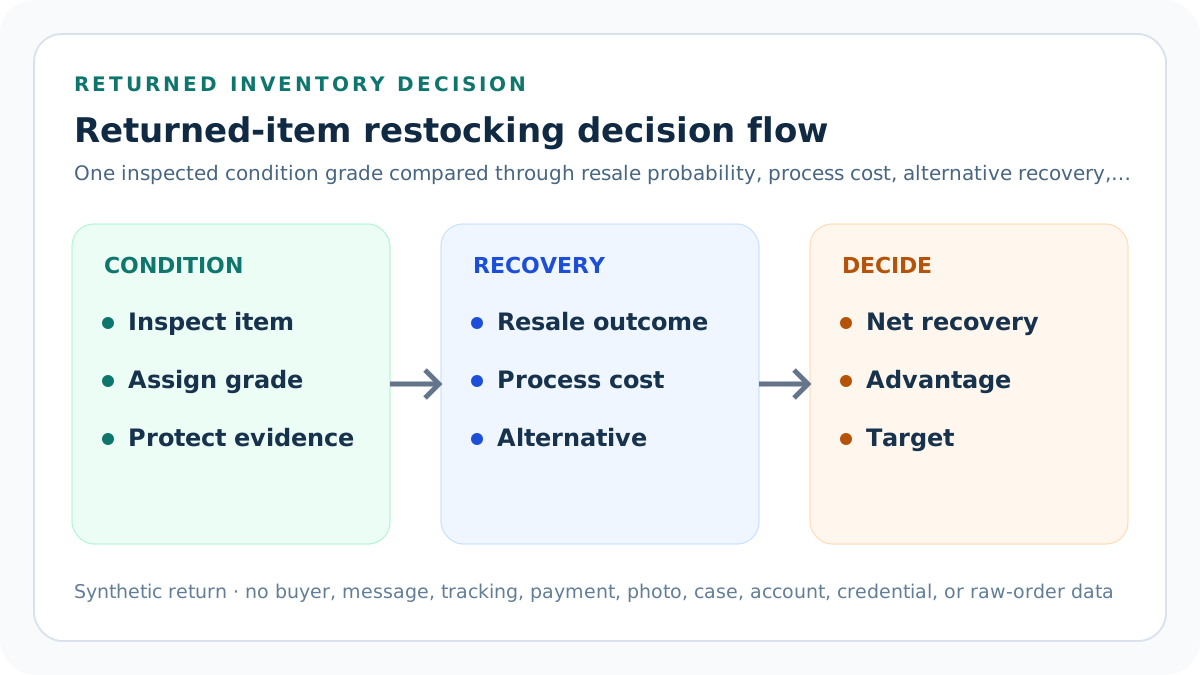
Freeze one SKU and condition grade
Start with one returned physical SKU, one inspected condition grade, one inventory location, one resale channel, one currency, one price sample, one decision window, and one alternative recovery route.
Do not blend like-new, opened, used, damaged, incomplete, personalized, expired, unsafe, or legally restricted items. Condition mixing makes resale probability, labor, markdown, storage, and safety evidence meaningless.
Separate customer return from inventory recovery
The customer refund, exchange, return agreement, shipping responsibility, and legal or platform obligations are resolved outside this calculator. The model starts after the item is received and classified.
A favorable recovery estimate cannot delay a required refund, change an agreement, or turn an unsafe or ineligible product into sellable inventory.
Inspect before assigning inventory state
Use an authorized condition checklist for identity, completeness, function, contamination, damage, wear, packaging, personalization, expiration, recalls, and channel restrictions before choosing a grade.
If safety or eligibility is unresolved, Block. Expected value cannot replace inspection, professional judgment, manufacturer rules, legal requirements, or platform policy.
Record returned quantity at one grade
Enter only items that share the same SKU, condition grade, resale channel, and evidence window. Quantity scales the total but should not hide unit-level defects.
Split mixed lots into separate runs. One unusable item must not borrow the resale probability or price of a like-new item.
Source a current comparable resale price
Use recent first-party realized sales or a documented current channel sample for the same SKU and condition. Record sample date, channel, currency, and exclusions.
List price, original price, competitor ask, replacement cost, payout, and hoped-for price are not realized comparable evidence.
Apply an explicit condition markdown
Expected resale price equals the comparable price multiplied by one minus the condition markdown. The markdown reflects inspected condition and channel evidence.
Do not use markdown as a hidden disposal probability. Price reduction and probability of successful resale are separate assumptions with separate evidence.
Estimate resale probability for one window
Probability means the chance that this conditioned item sells in the declared decision window at the expected price and channel, not its lifetime chance of any sale.
Use privacy-safe realized cohorts when available. Small samples, seasonality, stockouts, promotions, search visibility, and channel changes remain named uncertainty.
Enter resale fees explicitly
Record the seller-entered variable fee percentage and fixed fee that apply if the returned item sells again. The calculator does not infer marketplace or payment rules.
Keep listing, payment, advertising, tax, currency conversion, and other fees separate unless intentionally included and sourced in the declared fee convention.
Enter seller-funded resale shipping
Record expected shipping subsidy for the resale transaction. Use zero when the buyer fully funds postage and the seller has no shipping-side loss under the stated convention.
Do not substitute original outbound postage, return label cost, or free-shipping price lift. Those are different decisions and evidence rows.
Calculate net proceeds if resold
Subtract variable fee, fixed fee, and seller-funded shipping from the markdown-adjusted resale price. This is conditional proceeds if the item sells.
It is not expected recovery until multiplied by the evidence-based resale probability and combined with the failed-restock outcome.
Define failed-restock recovery
Enter what one item yields if it does not sell within the decision window after restocking: verified liquidation, component, donation, recycling, or disposal recovery after its own boundary.
Do not enter the original retail price, optimistic future sale, or an unverified claim. A negative disposal cost should be modeled through the alternative route or a named extension.
Calculate expected pre-processing recovery
Expected recovery before processing equals resale probability times net proceeds if resold plus failure probability times failed-restock recovery.
This is an expected value across comparable cases, not a promise for the current item. Preserve full precision and validate the probability with realized outcomes.
Measure inspection minutes
Time the identity, completeness, function, condition, hygiene, safety, photo, and routing checks required for one returned item at the declared grade.
Do not assume inspection is free because the owner performs it. Use a documented labor rate and separate inspection from cleaning and repackaging.
Measure cleaning or repair minutes
Record only work permitted by product, safety, manufacturer, legal, and channel rules. Include actual cleaning, testing, minor repair, or restoration labor for this grade.
If work changes the product identity, warranty, disclosure, safety, or legal status, route the item outside the restock model until authorized.
Measure repackaging minutes
Record time to verify components, replace permitted packaging, relabel condition, photograph, update inventory, and prepare the item for the resale channel.
Do not hide new consumables inside time. Packaging and cleaning supplies remain a separate currency input.
Apply a seller labor rate
Convert total inspection, cleaning, and repackaging minutes to hours and multiply by the seller-entered labor rate. Use one currency and an effective-date record.
The result is a planning cost, not payroll, tax, wage compliance, or accounting treatment. Those questions require authorized rules.
Add supplies per item
Enter cleaning materials, protective materials, replacement packaging, labels, inserts, seals, and other consumed supplies required to make the item eligible for the declared channel.
Only include permitted restoration. Missing proprietary parts, unsafe substitutions, and undisclosed condition changes cannot be fixed by a low supplies estimate.
Add storage cost over the decision window
Storage cost equals expected days before resale or exit multiplied by seller-entered storage cost per item per day.
Use a documented allocation for space, handling, or capital when relevant. Zero is valid only when the decision deliberately excludes storage and states that boundary.
Calculate restocking process cost
Add labor, supplies, and storage per item. This is the incremental cost required before expected resale or failed-restock recovery can occur.
Original production cost and customer refund are outside this post-return recovery decision. Adding them again would mix order loss with inventory disposition.
Calculate expected net restock recovery
Subtract restocking process cost from expected pre-processing recovery. Multiply the per-item result by returned quantity only after the grade remains homogeneous.
A negative result can be valid. It means the modeled process destroys recovery under current evidence, not that every possible resale route is impossible.
Define one alternative recovery route
Enter verified gross recovery and handling cost for a specific alternative such as liquidation, supplier return, parts recovery, donation benefit where appropriate, recycling, or disposal.
Do not blend several alternatives. Compare additional routes in separate versions with their own safety, legal, tax, and operational authority.
Calculate alternative net recovery
Alternative net recovery equals entered alternative recovery minus alternative handling cost. This gives the opportunity-cost benchmark for restocking.
The tool does not determine legal donation value, tax deduction, hazardous disposal, supplier entitlement, or channel eligibility.
Read restocking advantage
Subtract alternative net recovery from expected net restock recovery. Positive advantage favors restocking economically; negative advantage favors the entered alternative; a near-zero difference is a tie.
Economic advantage does not override safety, hygiene, legal, manufacturer, platform, warranty, disclosure, or inventory-control requirements.
Set a minimum recovery target
Enter the seller-owned minimum net restock recovery per item. Target headroom equals expected net restock recovery minus this minimum.
Use a dated product-class or operations decision. Do not tune the target after seeing a preferred result without recording owner, rationale, and effective date.
Require a material restock advantage
Divide the restocking advantage by the larger absolute recovery result, then compare that rate with the seller-entered minimum. This prevents a tiny currency difference from being treated as a decisive win.
The denominator is a comparison control, not a statistical confidence interval. Small or drifting cohorts still require a separate evidence review.
Cap process-cost exposure
Divide labor, supplies, and storage cost by expected recovery before processing. Route the result to Review when the share exceeds the seller-entered maximum.
A nonpositive expected recovery before processing cannot support a meaningful share and must remain Review even if another input creates a superficially positive total.
Date and confirm the evidence packet
Record one real source review date and confirm return condition, safety and resale eligibility, price and probability, fees and shipping, labor and supplies, storage window, alternative recovery, source lineage, and planning boundaries.
Every confirmation must be an explicit yes from the authorized evidence owner. Missing, ambiguous, or stale confirmation Blocks the calculation instead of becoming a silent assumption.
Use Block, Review, and Ready correctly
Block means evidence or structure is invalid. Review means the alternative wins, the scenarios tie, or restocking misses the minimum. Ready means restocking wins economically and clears the target.
Ready is not safety clearance, resale permission, demand proof, inventory adjustment, accounting value, or guaranteed sale.
Validate the like-new example
A USD 40 comparable price with 10% markdown gives USD 36 expected resale price. After fees and shipping, conditional proceeds are USD 28.10.
At 80% resale probability and USD 2 failed-restock recovery, expected recovery before processing is USD 22.88. Subtract USD 8 labor, supplies, and storage to obtain USD 14.88.
Stress a damaged return
A 35% markdown, 30% resale probability, 45 labor minutes, USD 3 supplies, and longer storage can make expected net restock recovery negative.
The stress case demonstrates sensitivity; it does not label an actual item damaged or authorize disposal.
Protect return and buyer data
Keep buyer names, addresses, emails, messages, tracking, photos, payments, case logs, return labels, account details, credentials, and raw orders in authorized systems.
Use return aliases, SKU and condition cohorts, redacted evidence pointers, access controls, retention rules, and approved synthetic fixtures in public artifacts.
Measure realized restocking performance
Compare predicted probability, resale price, days to sale, labor, supplies, storage, failed recovery, and alternative recovery with privacy-safe realized cohorts.
Do not call a small or selected sample proof. Record coverage, exclusions, uncertainty, source versions, and corrections.
Release and restore safely
Preserve local and remote backups plus a rollback identifier. Run typecheck, tests, integration, build, content, duplicate, SEO, image, link, browser, mobile, keyboard, privacy, and restore checks.
After release, verify status, canonical, indexability, schema, answers, tool scenarios, assets, strict 404, sitemap policy, events, and Day 0/7/14/28 evidence. Restore on regression.
Sources and further reading
- Seller Profit Guard methodology: Evidence, expected-value calculations, privacy, validation, correction, release, and rollback.
- Seller Profit Guard data privacy: Local-first boundaries for buyer, return, message, tracking, payment, photo, and raw-order data.
- Etsy Help: Help a Buyer With a Return: Official return coordination, receipt, label, and refund timing context.
- Etsy Help: Refunds, Returns, and Exchanges for Sellers: Official seller-policy, buyer-agreement, legal, and platform-protection context.
- Shopify Help: Returns and exchanges: Official return receipt, inspection, refund, exchange, and return-rule context.
- Shopify Help: Adjust inventory quantities: Official distinction between return restock for resellable items and damaged inventory adjustments.
- U.S. CPSC: Stopping the Online Sale of Recalled Products: Official recall-search and recalled-product resale boundary for U.S. consumer products.
Related Seller Profit Guard tools
- Etsy CSV profit calculator: Run a local order profit check with editable fee and SKU cost assumptions.
- Payment reconciliation tool: Compare order rows with statement activity and flag unmatched rows.
- SKU cost library: Save or import material, labor, packaging, shipping, and target margin assumptions.
- Variant risk checker: Find missing SKUs and variation cost risks before a listing scales.
- Etsy title checker: Review listing-title clarity, repetition, keyword chains, and mobile scanning.
- Etsy tag checker: Review all 13 tag slots for duplicates, repeated meaning, and truthful coverage.
- Free shipping threshold calculator: Estimate when a shipping subsidy can still meet a target margin.
- Return window loss estimator: Model expected reverse shipping, restock work, recovery, and replacement loss.
- Etsy Ads break-even calculator: Estimate target-safe Etsy Ads spend, ACOS, and ROAS after fees, fulfillment, and expected return loss.
- CSV data privacy: Understand what the local-first workflow needs and what it does not need.
- Restocking Decision Formula and Inputs: Define condition grade, markdown, resale probability, fees, shipping subsidy, labor, supplies, storage, failure recovery, alternative, and target.
- Like-New Restocking Worked Example: Work a complete like-new return from a comparable price and markdown through resale probability, fees, process cost, alternative recovery, and target.
- Damaged Return Restocking Scenario: Model a damaged or lower-grade return with deeper markdown, lower resale probability, longer processing, and a verified alternative recovery.
- Restocking Decision Calculation Mistakes: Diagnose mixed grades, retail-price salvage, lifetime probability, free labor, omitted storage, duplicated recovery, unsafe inventory, and false certainty.
- Restocking Decision Data Sources: Map condition, comparable price, resale outcome, fee, shipping, time, labor, supplies, storage, failure, alternative, and target inputs to evidence.
- Restocking Decision Thresholds: Set safety blocks, condition controls, minimum recovery, alternative advantage, probability confidence, storage limits, and escalation thresholds.
- Like-New vs Damaged Restocking: Compare like-new and damaged return grades at their own price, probability, labor, supplies, storage, and alternative recovery assumptions.
- Weekly Restocking Decision Routine: Run a repeatable returned-inventory loop for receipt, privacy, inspection, condition grading, evidence, calculation, routing, realization, and prevention.
- Interpret Restocking Decision Results: Read expected recovery, process cost, alternative, advantage, total, target headroom, and uncertainty without claiming safety or guaranteed resale.
- Restocking Decision Audit Template: Audit return grain, condition, safety, price, probability, fees, shipping, labor, supplies, storage, alternatives, formulas, privacy, release, and rollback.
Use the interactive tool
Enable JavaScript to open the calculator and process browser-local inputs. The explanatory content and source links remain available without JavaScript.
Related guide: Define condition, expected recovery, process cost, alternative, and authority boundaries.
This tool provides operating estimates, not tax, accounting, legal, financial, or marketplace-policy advice. Verify current official sources and your own records before changing prices or operations.