Seller Profit Guard · How it works · CSV privacy
Refund vs Replacement Calculator
A refund vs replacement calculator subtracts verified credits and recoveries from each seller-funded resolution path, compares incremental loss, and shows contribution after resolution. It supports cost review only; current policy, agreement, law, platform process, coverage, and customer evidence still control the remedy.
Maintained by Seller Profit Guard Editorial Team. Last reviewed: 2026-07-31.
Define one order issue
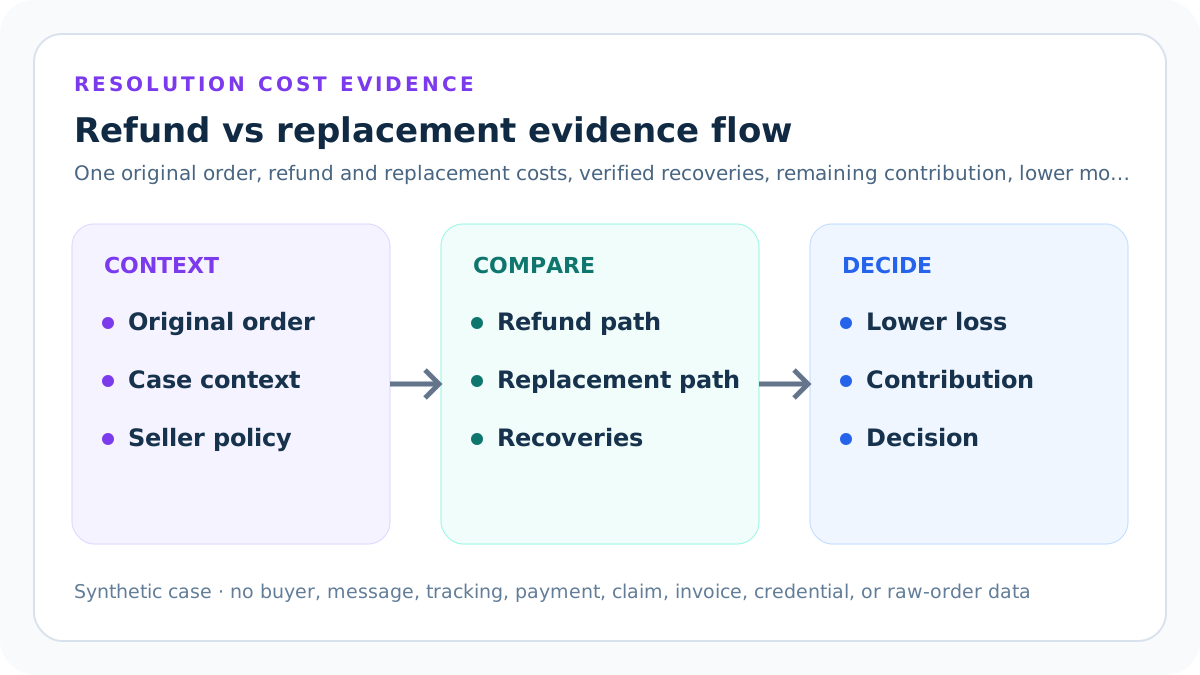
Start with one physical order, one item population, one current case state, one shop policy, one buyer agreement, one platform process, one coverage state, one currency, and one evidence month. Those fields establish the comparison grain.
Do not combine an unfulfilled cancellation, delivered return, lost package, damaged item, partial refund, exchange, chargeback, and protection claim. Each process has different obligations, costs, timing, and evidence.
Separate cost comparison from remedy authority
This tool compares seller-entered incremental costs. It does not decide what the buyer is entitled to, what law requires, whether a platform will cover a case, or whether an agreement must be fulfilled.
Verify current policy, platform instructions, messages, case status, consumer law, payment rules, carrier claim, and professional advice where appropriate before acting. A lower modeled loss cannot override an applicable obligation.
Reconstruct original gross buyer amount
Original merchandise revenue equals item quantity multiplied by selling price per item. Add literal buyer-paid shipping to obtain the original gross buyer amount.
Do not substitute payout, tax, discount list price, refund total, or replacement value. Preserve the completed transaction version and currency.
Reconstruct original seller cost
Original seller cost contains direct product cost, original outbound shipping, and entered platform and payment fees. These are already incurred before the resolution scenarios begin.
Keep sunk original cost visible so contribution after resolution can be understood. Do not count the same product or postage again inside the refund scenario.
Calculate contribution before resolution
Subtract original seller cost from original gross buyer amount. The remainder becomes the starting point for both refund and replacement scenario losses.
This is bounded seller contribution, not net profit. It excludes unentered overhead, ads, financing, taxes, support time, chargeback exposure, and other business costs.
Define merchandise refund
Enter the merchandise amount returned to the buyer in the refund scenario. The tool blocks a merchandise refund above original merchandise revenue because that would require a different payment or goodwill model.
Full and partial refunds are distinct scenarios. Etsy and Shopify processes, payment methods, timing, permissions, and legal requirements can differ; preserve the exact current evidence.
Define shipping refund
Enter only original buyer-paid shipping returned in the refund scenario. The tool blocks an amount above the original shipping charge entered.
Return-label reimbursement, replacement postage, customs charges, or external payments are not the same line. Model them separately with source and responsibility.
Define expected fee credit
Enter only a currently supported platform or payment fee credit and cap it at the original fees represented in the packet. Preserve source, refund path, transaction, currency, status, and expected timing.
Etsy states that specified fees may be credited when a refund is issued through Shop Manager, while Shopify documents payment and transaction fee treatments that vary by provider and context. Never assume universal recovery.
Define seller-paid return shipping
Enter the return label or agreed reimbursement paid by the seller for the refund path. Preserve carrier, service, package, responsibility, quote, label, adjustment, and invoice state.
Etsy return guidance distinguishes who purchases or pays for return shipping. The calculator cannot determine that responsibility or whether a return is required.
Define refund processing cost
Include approved inspection, customer support, restocking, disposal, cleaning, repair, relabeling, and administrative cost allocated to the refund scenario.
Do not count labor already embedded in product cost or overhead. Record the activity, rate, time, owner, evidence, and recovery boundary.
Define recovered inventory value
Enter the value the seller expects to recover from a returned product after inspection, condition grading, restocking, repair, resale discount, or salvage. Use a conservative evidence-backed value.
Recovered inventory value is not the original selling price, product cost, or guaranteed resale proceeds. Zero is valid when no return occurs or recovery is unsupported.
Define other refund recovery
Use a separate line for a verified carrier claim, insurer reimbursement, platform coverage, supplier credit, or other refund-path recovery not already included.
Expected recovery is not cash received. Preserve eligibility, application, approval, amount, currency, timing, dispute, and denial states; do not count one recovery twice.
Calculate refund incremental loss
Add merchandise refund, shipping refund, seller-paid return shipping, and refund processing. Subtract verified fee credit, recovered inventory value, and other refund recovery.
The result measures incremental seller-side loss after the original order costs have already been recognized. It is not a legal damage amount, accounting entry, or customer remedy recommendation.
Define replacement quantity and product cost
Multiply replacement quantity by current replacement unit cost. A like-for-like example uses one replacement item, but upgraded, partial, or multi-item replacements require their own packet.
Use the current cost version rather than assuming the original item cost still applies. Inventory availability and production timing remain separate operational evidence.
Define replacement outbound shipping
Enter the qualified seller-paid postage for the replacement parcel. Preserve carrier, service, origin, destination evidence, package, account eligibility, quote, label, adjustment, and invoice state.
The tool does not quote shipping, promise delivery, or determine who must pay. A high-shipping-cost replacement should be modeled explicitly rather than hidden in original postage.
Define replacement packaging and handling
Enter the replacement mailer, box, label, tape, protection, insert, waste, packing, documentation, and approved handling allocation.
Do not reuse the original package cost unless the replacement actually consumes new materials and work at the same convention. Replacement presentation and goodwill additions belong in documented scenario lines.
Define replacement processing cost
Include current case handling, communication, picking, production setup, inspection, and administrative work not already allocated elsewhere.
Processing is not a punitive fee or customer obligation. It remains a seller-side cost assumption with activity, time, rate, owner, and evidence.
Define replacement recovery and payment
Add verified claim or platform recovery and any additional buyer payment assigned to the replacement scenario. These amounts reduce seller incremental loss.
Do not assume Purchase Protection, carrier insurance, supplier credit, or an upgrade payment will apply. Expected and received recovery require separate versions.
Calculate replacement incremental loss
Add replacement product cost, outbound shipping, packaging and handling, and processing. Subtract verified recovery and additional buyer payment.
The result excludes another refund, future return, customer lifetime value, reputation, review impact, delivery risk, tax treatment, and legal consequences unless separately modeled.
Calculate contribution after each resolution
Subtract each scenario loss from original contribution before resolution. Display both values even when negative so the order-level economic effect stays visible.
Remaining contribution does not determine the correct remedy. It shows the seller-side cost consequence under current inputs and exclusions.
Identify the lower modeled loss
Compare refund and replacement incremental loss. The smaller number becomes the lower modeled loss scenario and the absolute difference becomes the comparison gap.
A tie triggers Review because cost does not distinguish the paths. Policy, agreement, timing, inventory, delivery, customer need, legal, and risk evidence must decide the next step.
Apply the seller-owned maximum
Target headroom equals the maximum seller-planned incremental resolution loss minus the lower modeled loss. Negative headroom triggers Review.
The target is an internal planning boundary, not a refund limit, legal cap, platform rule, customer-facing promise, or permission to deny a remedy.
Set the lower-loss share limit
Divide the lower modeled incremental loss by the original gross buyer amount, then compare it with a seller-entered maximum. The default USD 22 replacement loss is 45.83% of the USD 48 original gross buyer amount.
The default 60% limit is an internal exposure control, not a consumer-rights limit, refund cap, platform threshold, coverage rule, or authorization to choose the cheaper remedy.
Set the scenario-difference minimum
Divide the absolute refund-versus-replacement loss difference by the larger absolute scenario loss. The default USD 23 difference divided by USD 45 equals 51.11%.
A low percentage routes the packet to Review because tiny cost separation is a weak basis for preferring one path. Policy, agreement, customer need, inventory, timing, delivery, and risk remain controlling evidence.
Date the resolution evidence
Enter one real YYYY-MM-DD review date covering the original order, refund balance, fee-credit rule, return state, inventory recovery, replacement costs, coverage, policy, agreement, and active case state.
A monthly label alone cannot prove which transaction, policy version, payment route, refund status, label charge, inspection result, or coverage decision was reviewed.
Confirm nine evidence families
Ready and Review require explicit yes confirmations for the original order, refund amount, fee credit, return and inventory, replacement cost, replacement recovery, policy and agreement, case state, and planning boundary.
Missing confirmation is Block rather than zero. The calculator cannot independently prove private messages, payment status, buyer agreement, item condition, platform protection, or claim approval.
Use a complete resolution scope
The scope must identify one order, current case, refund scenario, replacement scenario, policy or agreement context, and currency. This rejects polished but under-specified comparisons.
Keep buyer identity, messages, payment details, tracking, addresses, cases, claims, and raw orders outside public fields. A safe scope describes applicability without revealing a customer.
Read the default synthetic case
One USD 40 item has USD 8 buyer shipping, USD 12 product cost, USD 8 original postage, and USD 4.30 fees. Original contribution before resolution is USD 23.70.
A full refund path produces USD 45 incremental loss after a USD 4 fee credit. A like-for-like replacement costs USD 22, leaving USD 1.70 contribution and clearing a USD 25 loss target.
Read the partial-refund case
A USD 15 merchandise refund with no shipping refund, USD 1.50 fee credit, and no processing cost produces USD 13.50 incremental loss.
That path is USD 8.50 lower than the default replacement. The tool labels the arithmetic only; the seller must verify whether a partial refund is accurate, agreed, permitted, and appropriate.
Read the high-shipping replacement case
Raising replacement outbound shipping from USD 8 to USD 20 makes replacement incremental loss USD 34. It remains below the USD 45 refund path.
Because USD 34 exceeds the USD 25 seller target by USD 9, the structurally valid packet becomes Review rather than Ready.
Apply Block, Review, and Ready
Block invalid quantities, amounts, caps, currency, context, month, scope, or declared conflicts. Review ties and a lower modeled loss above target. Ready requires one lower-loss scenario within target.
Every status is subordinate to current policy, agreement, platform, legal, case, claim, delivery, inventory, and customer evidence. The calculator never authorizes the remedy.
Protect case and buyer data
Public examples are synthetic. Keep buyer names, addresses, emails, messages, tracking, case records, payment details, claims, account identifiers, invoices, credentials, photos, and raw orders outside public pages and analytics.
Use case aliases, aggregate amounts, redacted pointers, access controls, and approved fixtures. An authorized reviewer should reproduce the comparison without exposing the customer.
Version the resolution evidence
Store original order, refund, fee-credit, return, recovery, replacement, shipping, package, claim, policy, agreement, and decision versions with effective dates and owners.
Do not overwrite an estimate after a fee credit, returned-item inspection, claim decision, or final invoice arrives. Preserve variance and the prior decision.
Test, release, observe, and correct
Test full, partial, no-return, return-required, lost, damaged, high-shipping, platform-covered, denied-recovery, tie, target, and invalid cases. Run typecheck, unit, integration, build, content, duplicate, SEO, schema, image, link, mobile, keyboard, privacy, and rollback checks.
After release, verify live calculations, canonical, indexability, hub discovery, strict 404, events, and Day 0/7/14/28 evidence. Restore the prior version on formula, privacy, source, accessibility, routing, or health regression.
Sources and further reading
- Seller Profit Guard methodology: Comparable case evidence, deterministic scenarios, validation, correction, release, and rollback.
- Seller Profit Guard data privacy: Local-first boundaries for buyer, message, tracking, claim, payment, account, and raw order data.
- Etsy Help: Refunds, Returns, and Exchanges for Sellers: Official Etsy context for seller policies, buyer agreements, replacement shipping proof, and Purchase Protection boundaries.
- Etsy Help: Issue a Full or Partial Refund: Official Etsy refund workflow and current fee-credit context.
- Etsy Help: Help a Buyer With a Return: Official Etsy context for return coordination, label responsibility, receipt, and refund timing.
- Shopify Help: Refunding Orders: Official Shopify context for full and partial refunds, shipping refunds, payment methods, fee treatment, permissions, restocking, and irreversible refund actions.
Related Seller Profit Guard tools
- Etsy CSV profit calculator: Run a local order profit check with editable fee and SKU cost assumptions.
- Payment reconciliation tool: Compare order rows with statement activity and flag unmatched rows.
- SKU cost library: Save or import material, labor, packaging, shipping, and target margin assumptions.
- Variant risk checker: Find missing SKUs and variation cost risks before a listing scales.
- Etsy title checker: Review listing-title clarity, repetition, keyword chains, and mobile scanning.
- Etsy tag checker: Review all 13 tag slots for duplicates, repeated meaning, and truthful coverage.
- Free shipping threshold calculator: Estimate when a shipping subsidy can still meet a target margin.
- Return window loss estimator: Model expected reverse shipping, restock work, recovery, and replacement loss.
- Etsy Ads break-even calculator: Estimate target-safe Etsy Ads spend, ACOS, and ROAS after fees, fulfillment, and expected return loss.
- CSV data privacy: Understand what the local-first workflow needs and what it does not need.
- Refund vs Replacement Formula and Inputs: Define original contribution, refund cash, return costs, fee credits, recoveries, replacement costs, targets, and decision precedence.
- Refund vs Replacement Worked Example: Reconstruct a low-cost order through original contribution, full refund loss, replacement loss, remaining contribution, and target headroom.
- Refund vs Replacement With High Shipping: Stress a high-shipping replacement, preserve the refund baseline, explain target Review, and separate cost from remedy authority.
- Refund vs Replacement Calculator Mistakes: Diagnose double-counted sunk cost, unsupported credits, inflated recovery, mixed cases, privacy leaks, false precision, and remedy overreach.
- Refund vs Replacement Data Sources: Build protected lineage for original orders, refunds, returns, fee credits, recovered inventory, replacements, claims, targets, and corrections.
- Refund vs Replacement Decision Thresholds: Separate structural Block, loss targets, tie Review, evidence confidence, timing, exposure, authority, and rollback thresholds.
- Refund vs Replacement Scenario Comparison: Bridge a low-cost and high-shipping case at consistent grain, attribute each changed input, and explain why the preferred cost path moves.
- Refund vs Replacement Operating Routine: Run a repeatable case review across intake, evidence freeze, calculations, exceptions, approvals, communication, close, and reopening.
- How to Interpret Refund vs Replacement: Write bounded cost statements, separate modeled loss from remedy authority, explain uncertainty, and route each driver to a reversible action.
- Refund vs Replacement Audit Template: Audit order, policy, agreement, refund, return, credits, inventory recovery, replacement, coverage, formula, release, and rollback.
- Shopify Refund Loss Formula and Inputs: Define the bounded refund-loss equation, payment-cost recovery, fulfillment and return costs, recovered inventory, evidence states, and exclusions.
- Shopify Full Refund Loss: A Worked Example: Work a complete invented full-refund packet with cash, retained fee, shipping, handling, app cost, inventory recovery, result, and decision.
Use the interactive tool
Enable JavaScript to open the calculator and process browser-local inputs. The explanatory content and source links remain available without JavaScript.
Related guide: Define refund, replacement, recovery, contribution, policy, and decision boundaries.
This tool provides operating estimates, not tax, accounting, legal, financial, or marketplace-policy advice. Verify current official sources and your own records before changing prices or operations.