Seller Profit Guard · How it works · CSV privacy
Product Price Floor Calculator
A product price floor calculator solves for the minimum list price required to preserve a target contribution margin after a seller-funded discount that reduces retained product revenue, buyer-paid shipping, percentage and fixed fees, unit-variable costs, order-variable costs, and non-overlapping expected return loss. It is an inverse contribution model, not a demand forecast or recommended market price.
Maintained by Seller Profit Guard Editorial Team. Last reviewed: 2026-07-30.
What does a product price floor calculate?
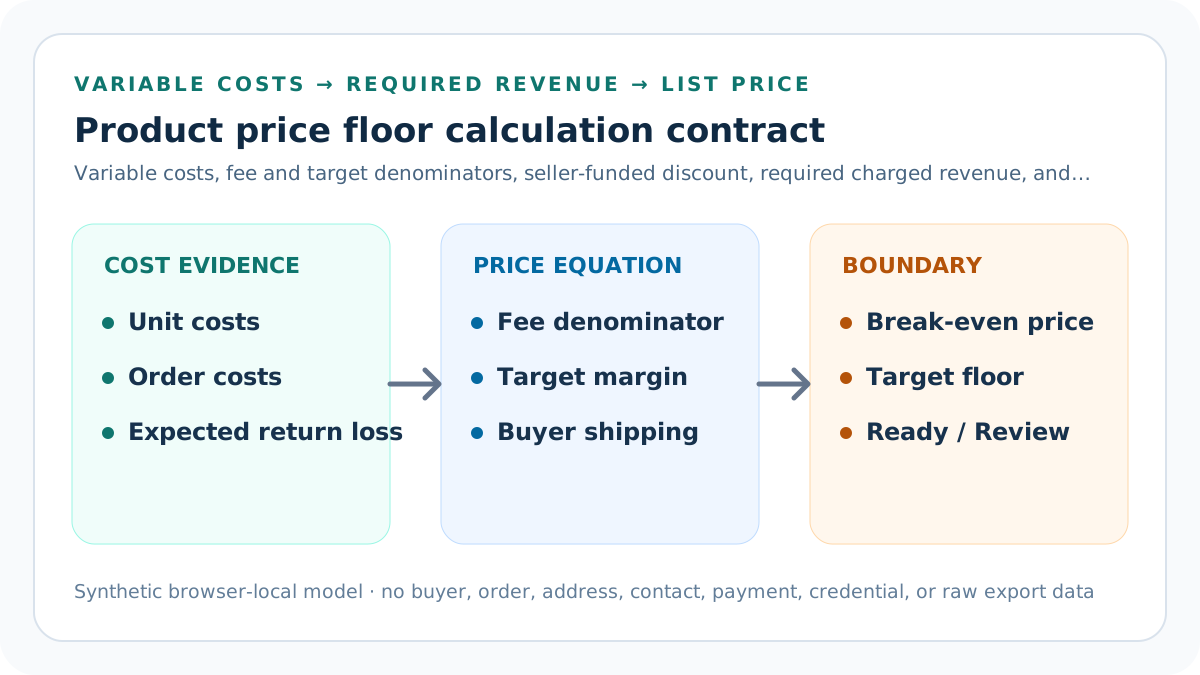
The price floor is the lowest list price that satisfies the entered target contribution margin for one defined order. The calculator begins with costs that vary with that order, adds expected return loss net of recoveries and not counted elsewhere, solves required charged revenue with fee and target percentages on the same base, then reverses buyer-paid shipping and only the seller-funded discount that reduces retained product revenue.
It is not the lowest legally permitted price, a competitor benchmark, an accounting break-even for the whole business, or a recommendation that customers will accept. Fixed overhead, owner compensation, financing, income tax, inventory investment, and demand remain outside the equation.
Confirm the inverse-pricing evidence contract
The calculator now requires a valid evidence-review date that covers the evidence month plus eight explicit confirmations: current list price and buyer shipping; discount funding and retained-revenue effect; percentage-fee base and fixed-fee timing; target contribution on the same charged-revenue base; return loss net of recoveries and not duplicated; complete nonduplicated order-variable costs; separation of mixed costs from fixed overhead; and one order, currency, and period across every input. A missing confirmation returns Block before any floor is interpreted.
These gates protect the inverse equation from a polished but unsupported output. OpenStax defines contribution and its ratio on a consistent sales base, while SBA guidance separates variable costs from fixed costs and recommends splitting mixed costs. Record the source pointer, effective date, allocation method, owner, and reviewer so a later supplier, fee, shipping, promotion, target, or return change can be traced.
Keep one order grain, currency, and period
Choose one standard order, one promotion order, or another explicitly described basket. Units, product cost, packaging, direct labor, fulfillment, payment fees, advertising, return assumptions, buyer-paid shipping, discount, target, currency, and evidence period must all describe that same calculation grain.
Do not combine a single-order product cost with monthly advertising, another country's fee, a future carrier quote, and an old return rate. Declare incompatible evidence instead of averaging it into a clean-looking price.
Build the fixed variable-cost pool
Multiply units by per-unit product, packaging, and direct labor cost. Then add outbound shipping and fulfillment, the fixed per-order variable fee, attributed advertising or affiliate cost, expected return or warranty loss, and other order-variable cost. These amounts must be funded regardless of the percentage-fee equation.
The word fixed here means fixed within one order equation, not business fixed overhead. A payment fee of USD 0.50 can occur once per transaction while still varying with order count. Studio rent remains outside because it continues when this modeled order does not exist.
Model expected return loss from frequency and severity
Expected return or warranty loss equals the entered affected-order rate multiplied by unrecovered loss per affected order. The severity can include unrecovered shipping, handling, damaged product, reshipment, and other evidenced costs after confirmed fee or inventory recovery.
Do not use the buyer refund amount automatically. A refund can include revenue that was never a cost, while a replacement can create cost without a full refund. Use a comparable category, channel, period, fulfillment path, and recovery policy.
Calculate required charged revenue
Required charged revenue equals the fixed variable-cost pool divided by one minus the percentage-fee rate and target contribution-margin rate. The denominator preserves enough charged revenue to pay percentage fees, fund the entered target contribution, and cover the remaining order-variable costs.
The fee rate plus target rate must remain below 100%. At or above that boundary, no finite charged revenue can satisfy the equation, so the calculator returns Block instead of displaying an enormous or misleading price.
Reverse buyer-paid shipping and seller-funded discount
The target list price subtracts buyer-paid shipping from required charged revenue, then divides the remaining product revenue requirement by one minus the seller-funded discount rate that reduces retained product revenue. A platform-funded buyer discount that does not reduce seller revenue must be entered as zero here rather than reversed again.
Buyer-paid shipping is revenue, while seller-paid outbound postage remains cost. Keeping both lines visible protects the declared percentage-fee and target bases and prevents a shipping charge from being mistaken for free economic value.
Compare target and break-even price floors
The target price floor reserves the entered contribution percentage. The break-even list price uses the same costs, discount, buyer-paid shipping, and percentage fee but sets target contribution to zero. Their difference is the list-price room intended to fund contribution before fixed overhead and tax.
Mathematical break-even is not business sufficiency. A price can cover variable order costs yet contribute too little to rent, software, owner goals, risk, or reinvestment. Review the target owner and effective date before treating either boundary as policy.
Trace the standard-order fixture
The standard fixture uses one unit with USD 18 product, USD 2 packaging, and USD 3 direct labor. Add USD 6 fulfillment, USD 0.50 fixed fee, USD 4 acquisition cost, USD 1.50 expected loss, and USD 1 other cost. The fixed variable-cost pool is USD 36.
With a 6% fee rate and 20% target, required charged revenue is USD 48.65. Subtract USD 5 buyer-paid shipping and apply no discount to obtain a USD 43.65 target list price. The break-even list price is USD 33.30.
Trace the promotion-order fixture
Keep the same costs, buyer-paid shipping, fee rate, and target, then add a 20% seller-funded discount that reduces retained product revenue. Required charged revenue remains USD 48.65 because the cost and target contract did not change. The pre-discount list price rises to about USD 54.56 so the discounted product charge plus shipping still funds the target.
At the default USD 50 list price, charged revenue becomes USD 45 and the order falls below the target floor, producing Review. Raising current list price to USD 55 clears the modeled promotion floor, but does not prove market demand.
Read the current-price gap
Current-price gap equals current list price minus target list price. A positive value shows modeled room above the target boundary; a negative value shows how far the current list price is below it. The gap is displayed in the calculation currency.
Do not interpret a small positive gap as safety without source precision. Fee rounding, shipping zones, material waste, acquisition attribution, return severity, currency conversion, or discount funding can exceed a few cents.
Use Block, Review, and Ready precedence
Block covers negative inputs, nonpositive or fractional units, discount at or above 100%, invalid fee or return rates, fee plus target at or above 100%, unusable current charged revenue, missing currency, period, scope, or declared evidence conflicts.
Review applies after structure passes when current list price is below the target floor or produces negative contribution. Ready means only that the entered current price clears this deterministic operating boundary; it is not permission to publish or proof of profit.
Source every price-floor input
Use checkout configuration for list price and discount, order evidence for buyer-paid shipping, bills of materials and supplier records for product and packaging, time studies for direct labor, carrier or fulfillment records for shipping, and statement evidence for percentage and fixed fees.
Use attributable advertising or affiliate reports for acquisition cost and seller-owned comparable cohorts for return or warranty loss. Record the source date, unit, currency, order grain, confidence, owner, and replacement trigger.
Test one variable at a time
Change discount, fee rate, return rate, shipping charge, unit cost, quantity, or target separately and record the resulting floor movement. This reveals which evidenced assumption drives the price boundary instead of hiding cause inside a simultaneous rewrite.
A sensitivity test is not a forecast. Use it to prioritize the next source check or bounded operating experiment, then measure actual feedback before adopting a broad price or promotion policy.
Keep contribution and market pricing separate
The calculator answers what list price funds an internal cost-and-target equation. Market pricing also depends on customer value, alternatives, positioning, demand, conversion, taxes, regulatory duties, minimum advertised price agreements, platform rules, and the seller's wider product portfolio.
A calculated floor above a plausible market price indicates an operating conflict to investigate. It does not instruct the seller to misrepresent value, coordinate prices, violate a contract, or remove a product without review.
Test boundaries and broken packets
Preserve deterministic fixtures for the USD 43.65 standard target, USD 54.56 promotion target, promotion Ready at USD 55, and a Block packet with a 100% discount, invalid fee-plus-target denominator, and declared conflicts.
A regression that returns a finite floor for a zero discount-retention denominator, ignores quantity, omits expected loss, confuses shipping revenue with cost, or calls the floor accounting profit must fail before release.
Release and recover the complete cluster
Before release, preserve narrow local and remote backups and a rollback identifier. Run queue, SVG, typecheck, unit, integration, build, SEO/AEO, content, similarity, browser, canonical, schema, link, image, and 390-pixel mobile checks.
Publish the parent tool and ten support guides as one ordered cluster. Add indexability, sitemap, guide-hub and tool backlinks, llms references, and targeted purge together. Verify every public calculation and URL, then restore after a critical failure.
Privacy and professional limits
The calculator runs locally with synthetic defaults and does not retrieve marketplace, payment, advertising, bank, accounting, tax, inventory, or buyer records. It cannot change a live listing or send a price to another system.
Keep buyer names, emails, addresses, messages, order IDs, payment rows, bank details, tax identifiers, contacts, credentials, tokens, OAuth material, and raw exports outside public pages. Obtain qualified accounting, tax, legal, or financial advice when material.
Sources and further reading
- Seller Profit Guard methodology: Evidence hierarchy, browser-local fixtures, deterministic decisions, validation, bounded release, correction, and rollback.
- Seller Profit Guard data privacy: Local-first boundaries for seller, customer, order, payment, contact, and credential data.
- U.S. Small Business Administration: Break-even point: First-party contribution-margin formula and mixed-cost separation guidance.
- IRS Publication 334: Tax Guide for Small Business: Primary tax and cost-of-goods context; this operating price floor is not an accounting or tax result.
Related Seller Profit Guard tools
- Etsy CSV profit calculator: Run a local order profit check with editable fee and SKU cost assumptions.
- Payment reconciliation tool: Compare order rows with statement activity and flag unmatched rows.
- SKU cost library: Save or import material, labor, packaging, shipping, and target margin assumptions.
- Variant risk checker: Find missing SKUs and variation cost risks before a listing scales.
- Etsy title checker: Review listing-title clarity, repetition, keyword chains, and mobile scanning.
- Etsy tag checker: Review all 13 tag slots for duplicates, repeated meaning, and truthful coverage.
- Free shipping threshold calculator: Estimate when a shipping subsidy can still meet a target margin.
- Return window loss estimator: Model expected reverse shipping, restock work, recovery, and replacement loss.
- Etsy Ads break-even calculator: Estimate target-safe Etsy Ads spend, ACOS, and ROAS after fees, fulfillment, and expected return loss.
- CSV data privacy: Understand what the local-first workflow needs and what it does not need.
- Product Price Floor Formula and Inputs: Derive a target list-price floor from variable costs, seller-funded discount, buyer shipping, fee and target bases, and expected loss.
- Standard Product Price Floor Example: Trace a synthetic standard order from USD 36 variable costs through required charged revenue to a USD 43.65 target list-price floor.
- Promotion Product Price Floor Example: Show why a 20% promotion raises the same synthetic order's required list price from USD 43.65 to USD 54.56 before discount.
- Product Price Floor Calculation Mistakes: Correct errors involving cost grain, quantity, fee denominator, buyer shipping, discount reversal, expected loss, rounding, and market interpretation.
- Product Price Floor Data Sources: Map price, discount, shipping, product, packaging, labor, fee, acquisition, return-loss, target, period, and currency inputs to reliable evidence.
- Safe Product Price Floor Thresholds: Apply non-compensating validity, break-even, target, current-price, and evidence gates before using a calculated product price floor.
- Standard vs Promotion Price Floors: Compare standard and 20% promotion orders at one cost grain to isolate charged revenue, discount reversal, list-price floor, and price gap.
- Weekly Product Price Floor Routine: Run a weekly price-floor evidence review with representative orders, source dates, fixtures, exceptions, owner, feedback, and rollback criteria.
- How to Interpret a Product Price Floor: Interpret target floor, break-even floor, required charged revenue, current contribution, and price gap without false market or profit claims.
- Product Price Floor Audit Template: Use a dated checklist and change log for cost inputs, fee and discount denominators, target and break-even floors, decision, approval, and rollback.
Use the interactive tool
Enable JavaScript to open the calculator and process browser-local inputs. The explanatory content and source links remain available without JavaScript.
Related guide: Define the inverse contribution formula, price denominator, and evidence grain.
This tool provides operating estimates, not tax, accounting, legal, financial, or marketplace-policy advice. Verify current official sources and your own records before changing prices or operations.