Seller Profit Guard · How it works · CSV privacy
Marketplace payout anomaly checker
Compare weekly and month-end aggregate payout bridges across signed opening and closing platform balances, sales, fees, refunds, reserve movements, signed adjustments, and deposits sent. The browser-local checker calculates unexplained differences, applies a tolerance, and blocks blank, oversized, stale-source, or structurally invalid evidence without connecting to a marketplace or exposing orders or bank data.
Maintained by Seller Profit Guard Editorial Team. Last reviewed: 2026-07-31.
Start with a balance bridge
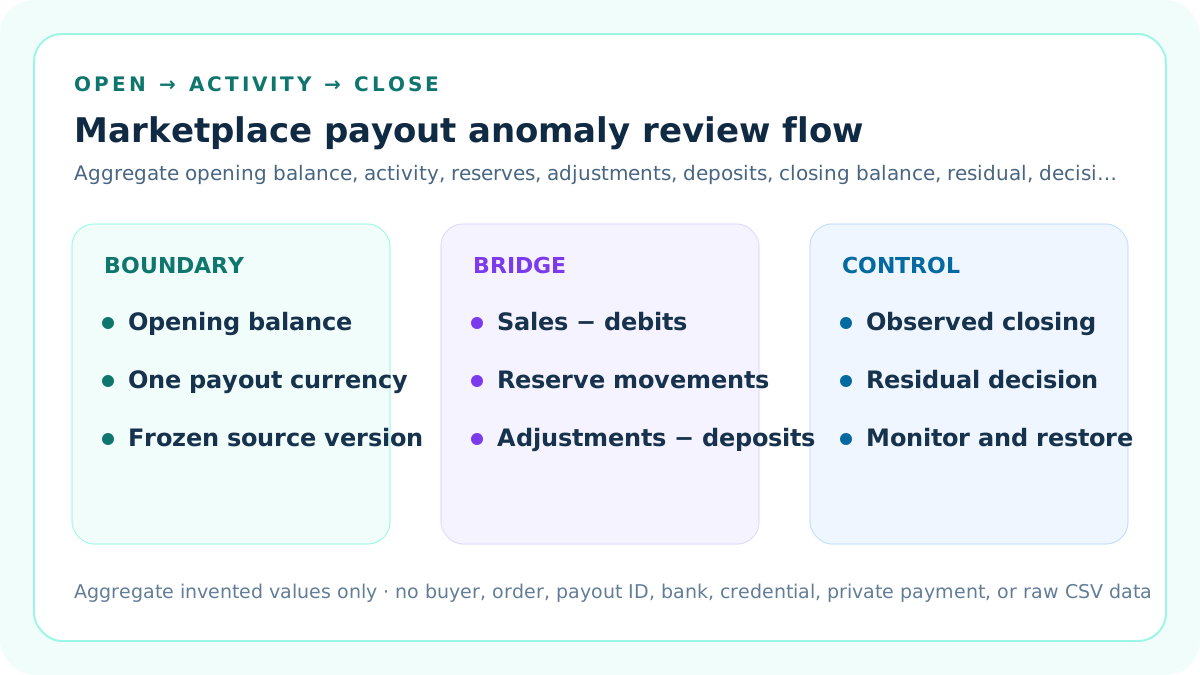
A payout anomaly is the residual after one opening platform balance is increased by sales and reserve releases, reduced by fees, refunds, new reserve holds, and deposits sent, then changed by explicitly signed adjustments. Compare the calculated closing balance with the observed platform closing balance.
This is a platform-balance bridge, not order matching, bank reconciliation, revenue, profit, or accounting close.
Keep the intent distinct from payment reconciliation
Use Payment Reconciliation to match individual activity rows and references. Use this checker only after row populations are classified, when the question is whether aggregate movements explain the reported closing balance and payout total.
A zero residual cannot prove that every row was mapped correctly.
Define opening balance precisely
Record the exact report, timestamp, timezone, payout currency, account, availability convention, and reserve treatment represented by the opening balance. A source-defined platform balance may be signed; do not replace a negative platform balance with zero or substitute a bank balance, gross sales, available-to-deposit figure, or prior payout amount.
The opening and closing balances must use the same platform definition and sign convention.
Use sales credits from one event convention
Choose transaction-event, capture, settlement, or another documented platform convention and keep it stable. Exclude taxes or marketplace-funded discounts only when the source report and bridge definition support that treatment.
Mixed event dates create timing residuals that look like missing money.
Separate fees and seller-fee taxes
Enter fee and tax debits that actually affect the platform balance during the evidence window. Do not estimate current fee schedules inside an observed bridge or net fees twice when source sales are already reported after deductions.
Model expected fees in a separate calculator, then compare to observed categories.
Classify refunds and disputes by posting date
Use the platform-balance posting event, not merely the original order or buyer-refund request date. Preserve chargebacks, reversals, partial refunds, fee credits, and subsequent recoveries as distinct evidence categories upstream.
One refund can create several dated movements.
Track reserve holds and releases separately
Newly held funds reduce the nonreserved payout bridge while reserve releases increase it. A net reserve figure hides gross movements, aging, early release, fixed reserves, or order-specific holds that may explain the apparent anomaly.
Never force reserve timing into an unexplained adjustment.
Enter signed adjustments deliberately
Positive adjustments add to the platform balance; negative adjustments reduce it. Record source category, reason, date basis, report version, owner, and approval outside the public worksheet before using this catch-all field.
A large adjustment is a classification task, not a balancing plug.
Separate deposits sent from bank arrival
The bridge deducts deposits when the platform reports them sent under the chosen convention. Bank processing, weekends, holidays, returned transfers, currency conversion, and account verification can shift arrival without changing platform activity.
A sent payout is not proof of bank receipt.
Define closing balance consistently
Use the same account, currency, reserve treatment, report basis, and timestamp convention as the opening balance. Preserve a source-defined negative balance instead of coercing it to zero, and record whether pending, available, reserved, or negative amounts are included.
A screenshot total without definition is insufficient evidence.
Calculate the expected closing balance
Expected closing equals opening plus sales minus fees minus refunds minus new reserve holds plus reserve releases plus signed adjustments minus deposits sent. Keep all values in one payout currency and one source-defined window.
Do not add customer tax, GMV, discounts, or bank movements unless the platform balance includes them.
Calculate the unexplained difference
Unexplained difference equals observed closing balance minus expected closing balance. Positive means the observed balance is higher than the entered bridge; negative means it is lower.
The sign locates a direction, not a cause.
Set an absolute tolerance
Tolerance should reflect known rounding, currency precision, report cutoffs, and controlled timing—not convenience. Use zero or one currency-minor-unit for synthetic regression fixtures; operational thresholds need documented risk and approval.
A tolerance cannot waive missing sources or open conflicts.
Version the control contract
Record a real source-review date that covers the declared evidence month, a policy effective date no later than that review, a minimum closed evidence duration, and an approved reserve-movement review threshold. Confirm the nine source, equation, reserve, cutoff, currency, counterexample, restoration, privacy, and authority boundaries before interpreting a result.
A future or stale source review and invalid governance controls mask every derived scenario output.
Read Ready
Ready means both synthetic aggregate bridges reconcile within tolerance and the entered contexts, currency, period, scope, privacy, ownership, and restoration evidence pass.
It proves arithmetic for the worksheet only.
Read Review
Review means inputs are structurally complete but at least one residual exceeds tolerance. Inspect source versions, cutoffs, sign conventions, reserves, refunds, adjustments, deposits, and balance definitions before concluding anything.
Do not post a correction merely to reach zero.
Read Block
Block means a required number is blank, non-finite, oversized, or an unsigned movement is negative, or context, tolerance, currency, source date, period, scope, or declared-conflict controls failed. Repair the evidence packet before interpreting the residual.
Signed opening and closing platform balances are allowed; a negative sale, fee, refund, reserve movement, or deposit is not.
Compare weekly and month-end windows
A weekly review emphasizes payout cadence and recent exceptions. Month-end requires opening and closing cutoffs, subsequent events, outstanding reserves, delayed refunds, holidays, and deposits spanning periods.
Reuse the formula, not the cutoff assumptions.
Use aggregate synthetic values publicly
The tool needs no order IDs, buyer names, emails, addresses, payout identifiers, bank details, tokens, credentials, or raw exports. Public examples use invented aggregate amounts only.
Keep operational evidence in authorized storage.
Preserve report versions
Record export time, date range, timezone, currency, filters, account, columns, row count, source fingerprint, platform notices, and prior accepted report version. Regenerate a bridge when any source contract changes.
A downloaded filename alone does not prove content identity.
Investigate sign errors first
Common causes include fees entered as negative and then subtracted, reserve releases entered as holds, deposits added instead of deducted, refunds netted into sales, and adjustments copied without their platform sign.
Reperform one category at a time.
Investigate timing differences second
Compare activity-event, available, scheduled, sent, and bank-arrival dates. Keep subsequent events outside a closed month until the bridge policy explicitly classifies them.
Timing differences need an aging owner, not silent deletion.
Investigate missing categories third
Look for seller services, shipping labels, dispute debits, fee credits, reserve changes, currency adjustments, returned payouts, minimum-deposit fees, or platform-specific movements supported by current official reports.
Add a named category upstream rather than expanding adjustments indefinitely.
Do not infer platform error from a residual
An unexplained amount can result from incomplete exports, wrong balance definitions, mixed currencies, duplicated or omitted rows, wrong sign, timing, rounding, or a changed report contract.
Escalate only with source-level reproducible evidence.
Do not call the payout profit
Payouts can include prior-period balances and reserve releases and exclude current-period holds or costs outside the platform. Product cost, labor, packaging, shipping paid elsewhere, overhead, advertising, taxes, and owner compensation need separate contribution analysis.
Cash transfer, revenue, and profit answer different questions.
Assign evidence owners
Name owners for platform reports, reserve policy, adjustment classification, bank arrival, exception review, correction approval, monitoring, stop authority, and restoration.
A Ready result does not assign authority.
Back up before corrections
Preserve source exports, source fingerprints, mapping rules, category totals, prior bridge, exception ledger, accounting or operational posting state, and tested restoration instructions before any downstream correction.
The public worksheet creates no backup.
Monitor bridge drift
Track residual size and age, source-schema changes, reserve movements, recurring categories, reversed reviewer decisions, payout delays, bank returns, and unexplained adjustment growth.
Stop automation on an unexplained discontinuity.
Retest counterexamples
Test exact balance, positive and negative residuals, threshold boundaries, negative prohibited inputs, signed adjustments, short context, invalid currency and period, open conflicts, reserve holds, reserve releases, and cross-period deposits.
Every failure must remain bounded and privacy-safe.
Release through ordered gates
Index the cluster only after distinct intent, official sources, tool logic, counterexamples, answer-first content, metadata, schema, original diagrams, links, privacy, similarity, mobile, backup, build, ordered deployment, and live checks pass.
Search signals are measured later, not used as a release substitute.
Keep a dated audit trail
For each accepted bridge, record version, scope, inputs, formula, residual, tolerance, classification, evidence pointers, reviewer, decision, follow-up, monitoring trigger, and restoration reference.
Never overwrite the prior accepted close without supersession evidence.
Use the result for triage
Rank protected exceptions by absolute amount, age, recurrence, evidence quality, category, and operational consequence. Resolve source and timing issues before asserting loss or platform fault.
The worksheet identifies where to look; it does not decide the answer.
Document limitations beside the result
State that the tool is aggregate, browser-local, synthetic by default, currency-bound, source-dependent, and non-advisory. Link current platform documentation and record a verification date.
Readers should not mistake a convenient bridge for an audit opinion.
Restore on unexplained control change
If a source schema, balance convention, reserve policy, formula, threshold, code path, or receiving workflow changes unexpectedly, stop, preserve the new evidence, restore the prior accepted rule and derived state, and open a controlled review.
Release again only after clean and failing fixtures pass.
Close with human review
A reviewer confirms the entered bridge matches protected source totals, explains each residual, verifies privacy minimization, approves any downstream correction, and records monitoring and rollback.
Human authority remains outside the calculator.
Sources and further reading
- Etsy Help: Manage your Payment account: Official balance, sales-fund, fee, tax, refund, reserve, negative-balance, and deposit context.
- Etsy Help: Calculate a deposit: Official deposit bridge from Payment sales and account activity.
- Etsy Help: Payment account reserve: Official reserve minimum, held-fund, release, refund, fee, and timing behavior.
- Shopify Help: Payout reconciliation report: Official balance activity, transaction, fee, refund, payout-currency, and export coverage.
- Shopify Help: Shopify Payments reserves: Official reserved-fund balances and negative and positive reserve transactions.
- Shopify Help: Payout timing: Official schedules, holds, reserves, negative balances, bank processing, weekends, and holidays.
- Seller Profit Guard methodology: Evidence, correction, release, monitoring, and rollback controls.
- Seller Profit Guard data privacy: Aggregate-only public examples and protected operational-data boundaries.
Related Seller Profit Guard tools
- Etsy CSV profit calculator: Run a local order profit check with editable fee and SKU cost assumptions.
- Payment reconciliation tool: Compare order rows with statement activity and flag unmatched rows.
- SKU cost library: Save or import material, labor, packaging, shipping, and target margin assumptions.
- Variant risk checker: Find missing SKUs and variation cost risks before a listing scales.
- Etsy title checker: Review listing-title clarity, repetition, keyword chains, and mobile scanning.
- Etsy tag checker: Review all 13 tag slots for duplicates, repeated meaning, and truthful coverage.
- Free shipping threshold calculator: Estimate when a shipping subsidy can still meet a target margin.
- Return window loss estimator: Model expected reverse shipping, restock work, recovery, and replacement loss.
- Etsy Ads break-even calculator: Estimate target-safe Etsy Ads spend, ACOS, and ROAS after fees, fulfillment, and expected return loss.
- CSV data privacy: Understand what the local-first workflow needs and what it does not need.
- Payout Anomaly Formula and Input Controls: Define the balance bridge, sign convention, source windows, reserve movements, tolerance, evidence packet, and reviewer controls.
- Weekly Payout Anomaly Worked Example: Reperform a weekly aggregate bridge with complete numbers, intermediate balances, residual, classification, and next action.
- Month-End Payout Anomaly Close: Close a calendar month without forcing reserve, refund, holiday, deposit, or subsequent-event timing differences into zero.
- Payout Anomaly Mistakes and Corrections: Diagnose sign, double-netting, balance-definition, reserve, refund, deposit, currency, and timing errors with corrected counterexamples.
- Marketplace Payout Data Source Map: Map each bridge input to current first-party reports and protected seller evidence without copying private rows into public tools.
- Safe Payout Anomaly Decision Thresholds: Set currency-precision, timing, recurrence, age, evidence, and materiality controls without hiding unresolved sources or escalation.
- Weekly vs Month-End Payout Review: Compare payout-centered and period-centered windows at the same currency, formula, and evidence grain with distinct cutoff controls.
- Weekly Payout Control Routine Checklist: Turn aggregate payout review into a repeatable source-preservation, bridge, exception, approval, monitoring, and restoration cycle.
- Interpret Payout Differences Carefully: Explain what positive, negative, zero, aged, recurring, or timing-classified residuals can and cannot prove, then define the next evidence action.
- Payout Anomaly Audit and Change Log: Provide a standalone source, formula, balance, threshold, exception, approval, monitoring, and restoration checklist for repeatable seller review.
- Refund to Order Matcher Formula Contract: Define direct references, UTC events, currency, original and refund components, prior refunds, line coverage, tolerance, match window, and evidence.
- Refund to Order Matcher Full-Refund Example: Reperform a 94.00 USD original order and full refund using direct reference, UTC events, components, zero prior refunds, and complete line coverage.
Use the interactive tool
Enable JavaScript to open the calculator and process browser-local inputs. The explanatory content and source links remain available without JavaScript.
Related guide: Define the marketplace payout balance bridge, source windows, reserve movements, tolerance, evidence, decisions, monitoring, and restoration.
This tool provides operating estimates, not tax, accounting, legal, financial, or marketplace-policy advice. Verify current official sources and your own records before changing prices or operations.