Seller Profit Guard · How it works · CSV privacy
Paid CPA limit calculator
Calculate first-order-only and measured-repeat maximum paid CPA from one comparable acquisition cohort's retained revenue, variable costs, contribution target, mature repeat contribution, recognition policy, and planned CPA. Then test the seller's repeat-funded dependence cap and minimum planned-CPA headroom while keeping conversion action, new-customer classification, attribution, delay, source date, confirmations, currency, horizon, and evidence scope explicit.
Maintained by Seller Profit Guard Editorial Team. Last reviewed: 2026-07-31.
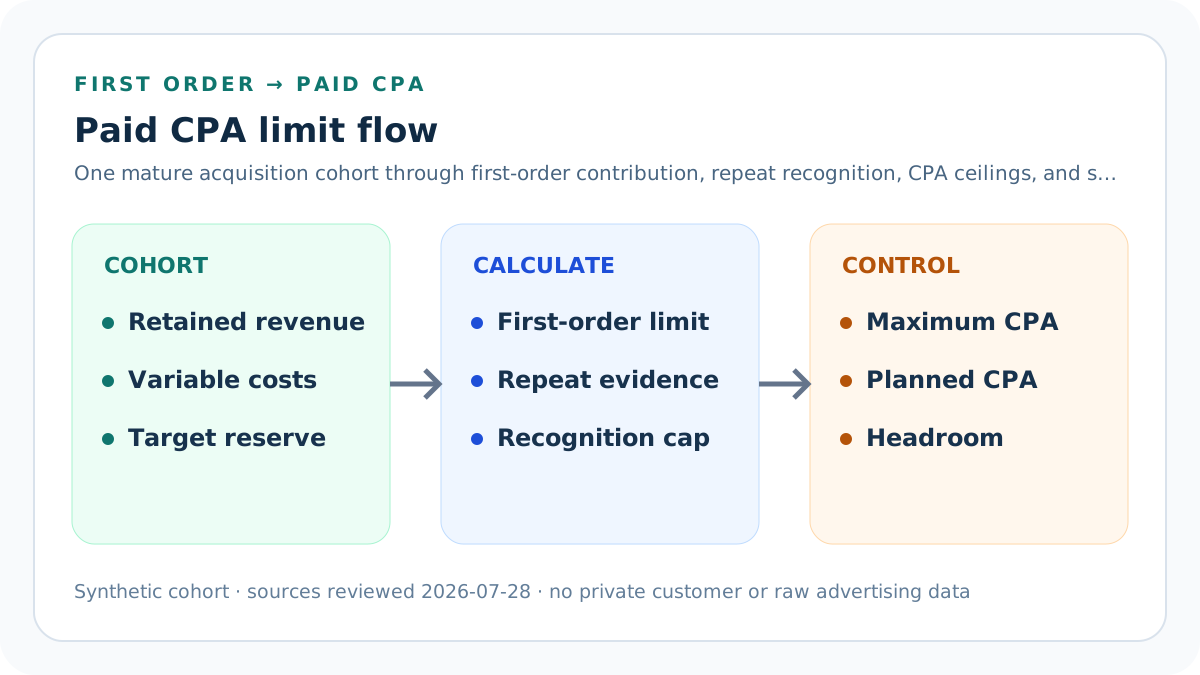
Freeze one acquired-customer cohort
Use one product or stable order profile, market, acquisition objective, conversion action, attribution convention, currency, mature first-order period, repeat-observation horizon, and cost version.
Do not blend leads with purchases, new with returning customers, different attribution windows, open with mature orders, or unrelated products. The result must govern a named cohort rather than an account-wide average.
Separate platform CPA from the seller limit
A platform can report advertising cost divided by attributed conversions and can optimize toward an average Target CPA. This model independently calculates how much retained contribution one acquired customer can fund.
Actual CPA, configured target CPA, and maximum seller-paid CPA answer different questions. Never use the configured target as evidence that the order economics can support it.
Define retained first-order revenue
Enter charged revenue retained for the first order after the seller's declared discount, cancellation, refund, tax, and shipping-revenue convention.
Do not use catalog value, cart value, unpaid amounts, cancelled revenue, or repeat revenue. Record what the retained-revenue field includes and excludes.
Record direct product cost
Use the current cost of the product quantity in the first acquired order, including purchased goods, materials, or production that changes with the order.
Split products or variants when a blended cost would hide the weakest acquisition economics.
Record packaging cost
Include order-caused mailers, boxes, labels, cushioning, inserts, tape, and other consumables.
Do not allocate reusable equipment or monthly workspace cost without a documented operating rule.
Record fulfillment cost
Include seller-funded postage, pick-pack labor, warehouse charges, handling, and other delivery cost caused by the first order.
Buyer-paid shipping revenue and seller fulfillment cost are separate evidence fields. Rebuild the packet when destination, weight, or service mix changes.
Set the variable fee rate
Use the percentage platform, processor, referral, or other included fee actually applied to the retained first-order revenue base.
Do not apply a remembered headline rate to an undefined base or merge fixed fees, advertising cost, tax on fees, currency charges, or affiliate commission into one percentage.
Set the fixed first-order fee
Enter the seller-borne fixed platform or payment charge caused by the first acquired order.
Fixed charges matter most for low-value orders. Keep cents-per-order amounts separate from percentage rates and advertising spend.
Estimate adverse-order loss
Use a mature comparable cohort to estimate unrecovered cost from cancellations, refunds, returns, chargebacks, replacements, and other adverse first-order outcomes.
Requests, approvals, refunds, received items, recovered inventory, and write-offs are distinct states. Store numerator, denominator, observation period, recovery rule, and product scope.
Add other first-order variable cost
Include verified order-caused cost not already represented, such as special handling, a per-order app charge, or campaign-required packaging.
Do not put planned CPA, sunk creative production, monthly overhead, or speculative customer lifetime value in this field.
Calculate first-order contribution
Subtract the variable fee and all fixed first-order variable costs from retained first-order revenue.
This is contribution before acquisition cost. It is not accounting profit, cash flow, taxable income, EBITDA, or total customer value.
Solve the break-even CPA
Positive first-order contribution is the outer first-order acquisition-cost boundary that would leave zero modeled contribution.
Break-even reserves nothing for operating overhead, owner policy, uncertainty, or post-acquisition contribution. It is a diagnostic edge.
Set the contribution target
Enter the contribution margin the seller wants to retain after acquisition cost, measured on retained first-order revenue.
The target is a governance input. It does not guarantee fixed-cost coverage, tax provision, inventory replacement, owner compensation, or strategic return.
Solve the first-order-only maximum CPA
Subtract the target reserve from positive first-order contribution.
A zero or negative result means the first order cannot fund paid acquisition while preserving the declared target.
Define measured repeat orders
Enter average repeat orders per acquired customer observed over one fixed, mature horizon for a comparable acquisition cohort.
Do not infer repeat behavior from visits, subscriptions, returning-customer revenue share, platform attribution, or a generic industry benchmark.
Define repeat contribution per order
Use retained contribution after repeat-order variable costs, before any new acquisition allocation, for the same product or documented repeat mix.
Repeat revenue is not repeat contribution. Rebuild the value when product mix, discount, fulfillment, fees, or adverse outcomes differ.
Cap repeat-value recognition
Apply an explicit percentage to measured repeat contribution to represent the portion authorized for the current acquisition decision.
Recognition is a seller risk policy, not a probability generated by the calculator. Use zero when the cohort is immature, incomparable, or not independently measured.
Calculate recognized repeat contribution
Multiply measured repeat orders per acquired customer by contribution per repeat order and the recognition rate.
Keep the full measured amount and the recognized amount visible. Never silently capitalize all forecast lifetime value into today's paid CPA.
Solve maximum paid CPA
Add recognized repeat contribution to first-order contribution, then subtract the first-order target reserve.
The result is a modeled acquisition ceiling for the declared cohort and horizon. It is not a bid, budget, platform recommendation, or guaranteed customer value.
Compare the planned or actual CPA
Subtract the entered paid CPA from the modeled maximum and also compare it with the first-order-only limit.
A CPA can pass only after recognized repeat value while failing on the first order. That dependence must be disclosed in the decision.
Cap repeat-funded dependence
Divide recognized repeat contribution by the maximum paid CPA and compare the result with the seller-entered maximum repeat-funded share.
The default fixture uses USD 3.60 of recognized repeat contribution in a USD 21.60 ceiling, or 16.67%. Raising measured repeat orders to 1.00 makes the share 33.33% and routes to Review under a 20% cap.
Require planned CPA headroom
Divide maximum paid CPA minus planned CPA by maximum paid CPA and compare that rate with the seller-entered minimum.
USD 20 against a USD 21.60 ceiling leaves 7.41% headroom and passes the default 5% minimum. USD 21 leaves only 2.78% and routes to Review even though it remains below the ceiling.
Confirm evidence and authority
Require explicit yes confirmations for retained revenue, first-order costs, fee and loss bases, target and planned CPA, conversion action, seller new-customer classification, attribution and delay, completed repeat evidence, and planning boundaries.
A missing or non-yes confirmation blocks outputs. This prevents a syntactically complete form from appearing decision-ready when source ownership or authority is unresolved.
Calculate payback exposure
When the planned CPA exceeds first-order-only capacity, report how much recognized repeat contribution is required to recover the gap.
A positive modeled headroom does not remove cash timing, refund, cohort-maturity, or repeat-behavior risk.
Use Block, Review, and Ready
Block invalid amounts, rates, horizons, cohort context, currency, period, scope, or declared conflicts. Review valid packets with nonpositive first-order contribution, no first-order target room, dependence on weak repeat evidence, or planned CPA above the ceiling.
Ready means the entered CPA fits the declared contribution and recognition rules. It does not approve attribution, bidding, budget, campaign launch, accounting treatment, or legal terms.
Validate the default example
USD 80 retained revenue less USD 50 of first-order variable costs leaves USD 30 contribution. A 15% target reserves USD 12, so the first-order-only maximum CPA is USD 18.
Measured repeat contribution is USD 7.20 and the 50% recognition policy permits USD 3.60. Maximum paid CPA becomes USD 21.60; USD 20 planned CPA leaves USD 1.60 headroom.
Test first-order-only economics
Set repeat-value recognition to zero while holding the default first-order packet constant.
Maximum paid CPA falls from USD 21.60 to USD 18. A USD 20 plan then exceeds the limit by USD 2 and routes to Review.
Stress repeat behavior
Lower repeat orders per customer from 0.40 to 0.15 and keep the 50% recognition policy.
Recognized repeat contribution falls to USD 1.35, maximum paid CPA becomes USD 19.35, and the USD 20 plan misses the ceiling by USD 0.65.
Stress adverse-order loss
Raise expected loss from USD 3 to USD 7 while holding repeat evidence constant.
First-order contribution falls to USD 26, the first-order-only limit falls to USD 14, and the recognized-repeat limit falls to USD 17.60.
Respect conversion and repeat delay
Close the first-order cohort only after conversions, cancellations, refunds, returns, and chargebacks mature; close repeat value only after the declared repeat horizon.
Recent acquisition cohorts can have fully billed advertising cost but incomplete conversions, refunds, and repeat behavior. Do not call provisional value a stable limit.
Protect advertising and customer data
Use aggregate cohort measures, product aliases, synthetic fixtures, redacted evidence pointers, access controls, and retention rules.
Keep buyer identity, emails, addresses, messages, order IDs, click IDs, audience membership, payment records, raw exports, credentials, tokens, and OAuth material outside public pages and logs.
Release and restore safely
Preserve narrow local and remote backups plus a rollback identifier. Run typecheck, unit, integration, build, content, similarity, SEO, image, link, browser, mobile, keyboard, privacy, and restore checks.
After release, verify calculator states, canonical, schema, indexability, direct answers, internal links, images, strict 404, sitemap policy, events, and Day 0/7/14/28 evidence. Restore on a formula, privacy, accessibility, routing, or health regression.
Sources and further reading
- Seller Profit Guard methodology: Contribution equations, evidence versions, privacy, correction, release, and rollback.
- Seller Profit Guard data privacy: Local-first boundaries for buyer, order, advertising, payment, refund, and raw customer data.
- Google Ads Help: Average CPA definition: Official definition of average CPA as conversion cost divided by conversions and its distinction from target CPA.
- Google Ads Help: About Target CPA bidding: Official context for Target CPA as a desired average conversion cost, actual variation, selected conversion actions, lag-aware recommendations, and evaluation.
- Google Ads Help: About conversion delay estimates: Official explanation that conversion lag can make recent CPA appear higher and that delay-aware estimates support target and budget decisions.
- Google Ads Help: About customer lifecycle goals: Official context for new-customer acquisition modes and first-party customer definitions; seller-side contribution evidence remains an independent boundary.
Related Seller Profit Guard tools
- Etsy CSV profit calculator: Run a local order profit check with editable fee and SKU cost assumptions.
- Payment reconciliation tool: Compare order rows with statement activity and flag unmatched rows.
- SKU cost library: Save or import material, labor, packaging, shipping, and target margin assumptions.
- Variant risk checker: Find missing SKUs and variation cost risks before a listing scales.
- Etsy title checker: Review listing-title clarity, repetition, keyword chains, and mobile scanning.
- Etsy tag checker: Review all 13 tag slots for duplicates, repeated meaning, and truthful coverage.
- Free shipping threshold calculator: Estimate when a shipping subsidy can still meet a target margin.
- Return window loss estimator: Model expected reverse shipping, restock work, recovery, and replacement loss.
- Etsy Ads break-even calculator: Estimate target-safe Etsy Ads spend, ACOS, and ROAS after fees, fulfillment, and expected return loss.
- CSV data privacy: Understand what the local-first workflow needs and what it does not need.
- Paid CPA Limit Formula and Inputs: Calculate a target-safe paid CPA from retained first-order contribution, measured repeat contribution, recognition policy, and acquisition evidence.
- Paid CPA Limit First-Order Example: Follow an USD 80 first order through variable costs, contribution reserve, first-order CPA limit, recognized repeat value, and paid CPA headroom.
- Paid CPA Limit with Measured Repeat Value: Use mature repeat-purchase contribution without turning revenue forecasts, returning-customer share, or generic lifetime value into acquisition capacity.
- Paid CPA Limit Calculation Mistakes: Correct conversion denominators, gross-margin shortcuts, repeat-value inflation, attribution mixing, delay, fee, refund, target, and payback errors.
- Paid CPA Limit Evidence Sources: Map paid CPA inputs to ad-cost reports, new-customer reconciliation, retained orders, cost libraries, mature repeat cohorts, and target policy.
- Set a Safe Paid CPA Decision Threshold: Separate break-even, first-order target, recognized-repeat, stress, warning, and stop thresholds with explicit maturity and ownership.
- First-Order vs Repeat-Funded Paid CPA: Compare a self-funding first-order CPA limit with a conditional repeat-funded limit at one acquisition cohort grain and maturity horizon.
- Weekly Paid CPA Evidence Review Cycle: Run a repeatable paid CPA review from cohort closure and contribution refresh through recognition policy, action, observation, correction, and rollback.
- Interpret Maximum Paid CPA Results: Read first-order contribution, target reserve, repeat recognition, maximum paid CPA, planned headroom, dependence, and decision state without false precision.
- Paid CPA Limit Audit Checklist: Audit acquisition scope, new-customer rules, first-order contribution, repeat cohorts, recognition, thresholds, fixtures, privacy, release, and rollback.
- How do you calculate customer acquisition payback?: Divide attributable acquisition cost by confirmed new customers under one rule, then compare that cost with mature refund-adjusted first-order contribution. If the first order does not recover cost, add probability-weighted repeat-order contribution by declared cycle, reduce probability with an explicit retention factor, stop at a finite horizon, and report the first payback cycle and day.
- What is a complete first-order acquisition payback example?: An invented cohort assigns USD 45 acquisition cost per confirmed new customer. First-order contribution is USD 55 before refund loss; a 10% mature refund rate and USD 50 loss reduce it to USD 50. The first retained order covers acquisition cost, so modeled payback is cycle zero, day zero, with USD 5 headroom.
Use the interactive tool
Enable JavaScript to open the calculator and process browser-local inputs. The explanatory content and source links remain available without JavaScript.
This tool provides operating estimates, not tax, accounting, legal, financial, or marketplace-policy advice. Verify current official sources and your own records before changing prices or operations.