Seller Profit Guard · How it works · CSV privacy
Packaging Cost per Order Calculator
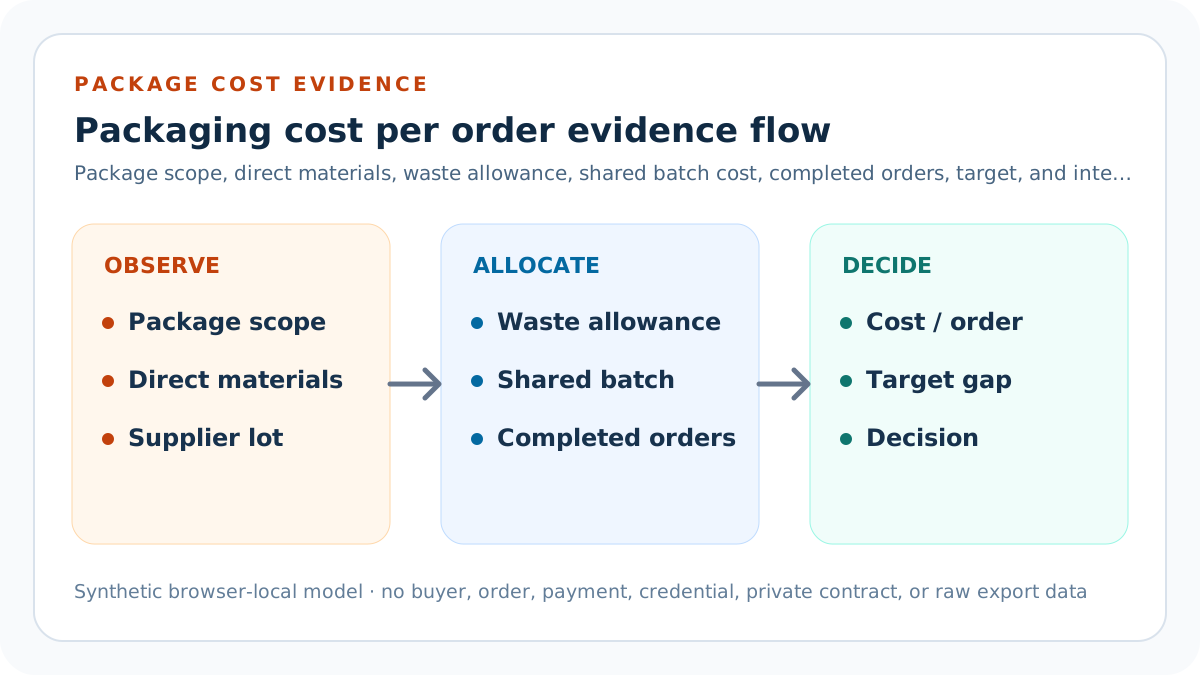
A packaging cost per order calculator adds mailer, box, insert, label, closure, protective fill, and gift-ready materials, applies a measured waste allowance, and allocates shared batch packaging cost across completed orders. It shows unit cost, batch cost, component shares, and the gap to a seller-owned target.
Maintained by Seller Profit Guard Editorial Team. Last reviewed: 2026-07-31.
Define one comparable package
Name the shipped product family, item dimensions and weight band, package format, material grade, closure, insert, label, protective-fill rule, presentation standard, supplier version, order count, currency, and evidence month. The result is comparable only while those boundaries remain aligned.
Separate lightweight mailers, rigid boxes, fragile parcels, oversized orders, temperature-controlled packs, gift-ready presentation, and regulated goods when their component lists or acceptance tests differ. Public examples should use synthetic package aliases rather than buyer or order records.
Add direct materials once per order
Enter each component consumed by one completed package: mailer, box, insert, label, tape or closure, protective fill, and optional gift-ready material. Use landed unit cost for the chosen purchase lot when freight or supplier surcharges are part of the seller's declared cost convention.
Do not count the same sleeve inside both mailer and gift packaging, or hide postage inside the box value. If one bulk component serves several orders, either convert it to a measured per-order amount or place its full batch amount in shared packaging cost—not both.
Measure material waste explicitly
Waste allowance covers ordinary cutting loss, damaged stock, adhesive failure, test pieces, print setup, unusable remnants, and similar packaging consumption supported by comparable records. Multiply the direct component total by the entered percentage and preserve the unrounded result.
A 5% allowance on USD 0.85 direct material produces USD 0.0425 per order. The interface displays USD 0.04 while calculations retain full precision. A waste percentage is not an environmental score, and a low percentage does not prove recyclability or lower lifecycle impact.
Allocate shared batch packaging cost
Shared batch cost covers packaging resources consumed once for a declared run rather than once per parcel: a print setup, label-roll setup loss, shared tissue bundle, batch sample, stencil, color change, or other evidenced batch-only amount. Divide it by completed orders sharing the same specification.
USD 6 shared across 50 orders contributes USD 0.12 per order. If only 40 comparable packages are completed, the same shared amount contributes USD 0.15. Do not use planned volume when the batch is incomplete unless the remaining packaging and allocation treatment are documented.
Calculate packaging cost per order
Add direct components, the full-precision waste allowance, and the shared allocation. The lightweight fixture combines USD 0.85 direct, USD 0.0425 waste, and USD 0.12 shared cost for USD 1.0125 per order, displayed as USD 1.01.
The output is packaging material cost at the declared scope. It excludes postage, carrier surcharges, fulfillment labor, storage, damage claims, returns, product materials, marketplace fees, customer acquisition, taxes, and fixed overhead unless a separate workflow deliberately models them.
Calculate total batch packaging cost
Multiply direct plus waste cost by the completed-order denominator, then add the shared batch amount once. The lightweight 50-order fixture produces USD 50.625, displayed as USD 50.63. This reconciles the per-order result to one batch total without multiplying the shared amount twice.
Use the batch total to check purchase and usage records, not to infer cash paid in the same period. Inventory bought earlier, unused packaging stock, supplier credits, taxes, freight, and timing differences require their own reconciliation.
Compare a seller-owned target
Target headroom equals the entered packaging-cost threshold minus calculated cost per order. Positive headroom clears that one operating boundary; negative headroom identifies the full-precision gap that requires review. The gift-ready fixture at a USD 3 target displays USD -0.33.
The target should be versioned by package type and commercial purpose. It is not automatically a sustainable-packaging target, customer promise, price recommendation, profit margin, tax rule, or damage-protection standard.
Read component shares
Direct-material, waste, and shared-cost shares divide each full-precision component by total packaging cost per order. The shares help identify which evidence class drives the result without confusing dollars and percentages.
A large box share may point to supplier or specification review; a large waste share may point to cutting, storage, printing, or damage; a large shared share may point to a small batch denominator. None of those observations proves the safest or best corrective action.
Apply Block, Review, and Ready precedence
Block a packet with blank or nonfinite numbers, no positive direct material cost, a non-whole or nonpositive order count, waste below 0% or at least 100%, invalid seller thresholds, a nonpositive target, negative structural cost, invalid currency, month, or source-review date, missing comparable scope, incomplete evidence confirmations, or a declared conflict.
After structure passes, Review cost above target, waste above the seller-entered maximum, or shared allocation above the seller-entered share of direct materials. Ready means only that the current packet is structurally valid and clears its versioned operating thresholds.
Keep packaging cost separate from postage
Packaging is the physical material and declared shared preparation resource used to create the parcel. Postage and carrier charges depend on service, zone, weight, dimensions, surcharges, insurance, address conditions, and contract terms. They need a separate shipment evidence packet.
A box change can affect both packaging cost and billable shipping dimensions. Model the new box here, then send dimensions and weight to the shipping workflow. Do not silently place postage in a packaging component to force a combined number.
Keep packaging material separate from labor
This tool prices packaging materials and batch resources, not the minutes needed to fold, assemble, wrap, label, inspect, or stage a parcel. Use a labor workflow with observed task boundaries and rate assumptions when packing time is material.
Combining material and labor in one unnamed field makes supplier changes and process changes impossible to diagnose. Preserve two components, then combine them only in a broader product-cost or contribution model at the same order grain.
Model gift-ready parcels separately
Gift-ready presentation can add a rigid box, tissue, ribbon, branded card, sticker, sleeve, premium fill, or protective outer pack. Use one explicit specification and do not assume every order chooses it.
The second fixture uses USD 2.75 direct materials, 10% waste, and USD 12 shared across 40 orders. It produces USD 3.325 per order before display rounding. Keep the gift-ready scenario distinct from the lightweight default so their targets and demand assumptions do not leak into one another.
Preserve quality and protection boundaries
A cheaper package is not an improvement if it changes compression strength, moisture resistance, tamper evidence, product presentation, accessibility, labeling, food contact, dangerous-goods handling, temperature control, or damage outcomes. Record the acceptance tests required for the modeled product.
The calculator cannot determine packaging compliance or product protection. When a specification is safety-, food-, chemical-, medical-, or transport-regulated, verify current authoritative requirements and qualified advice before release.
Avoid unsupported environmental claims
Cost, weight, recycled content, recyclability, compostability, reuse, source reduction, and lifecycle impact are different evidence questions. A lower cost or lower material quantity does not by itself substantiate an unqualified green claim.
Review current FTC Green Guides context for U.S. environmental marketing claims and use the EPA hierarchy as policy context, not as a product certification. Preserve claim-specific evidence, qualifications, disposal conditions, and geographic availability outside this calculator.
Build a packaging evidence packet
Record package alias, component SKU or protected source pointer, unit quantity, landed unit cost, supplier lot, waste observation, shared batch resource, completed-order denominator, quality test, seller-owned process thresholds, source-review date, currency, period, target owner, reviewer, and expiry trigger. Confirm each evidence contract explicitly before the calculator exposes decision outputs.
Another reviewer should reproduce the aggregate calculation without buyer names, addresses, emails, order IDs, messages, payment data, credentials, private contracts, or raw exports. Public screenshots should contain synthetic values only.
Test deterministic boundaries
Reproduce the lightweight Ready fixture, gift-ready Ready fixture, gift-ready Review below target, configurable waste and allocation Reviews, incomplete-confirmation Block, and invalid-structure Block. Test target values around full-precision cost, waste around the seller-entered maximum and just below 100%, whole-number denominators, blank and nonfinite values, negative inputs, and impossible calendar dates.
Verify positive and negative half-cent display behavior, component shares, total-batch reconciliation, reset behavior, labels, keyboard use, mobile width, static HTML, canonical, schema, images, internal links, index state, and rollback.
Use evidence-triggered refreshes
Recalculate when package specification, component quantity, supplier price, purchase lot, freight convention, waste performance, batch size, quality test, target, currency, or evidence period changes materially. Preserve the prior version rather than overwriting it.
Content frequency does not prove the package changed. A dated change register should explain why unit cost moved and which previous operating decision is superseded.
Interpret rounded output carefully
Displayed cents are a communication layer over full-precision inputs. USD 3.33 is the rounded gift-ready output from USD 3.325 under the tool's explicit half-away boundary rule; it does not mean every future parcel consumes exactly that amount.
Use low, expected, and high scenarios when unit prices, waste, or completed batch volume vary. A Ready result does not predict damage, delivery success, demand, revenue, profit, customer satisfaction, environmental benefit, or income.
Preserve rollback and correction
Before changing the public calculator, package standard, guide cluster, route state, or target, save prior inputs, formulas, outputs, screenshots, sitemap membership, analytics state, and restoration instructions. Assign a concrete rollback trigger.
Restore the prior verified version if formula, rounding, content, source, privacy, accessibility, routing, images, analytics, or live behavior regresses. Document the correction and rerun the same fixtures.
Choose the next action from the result
If Block, repair the named structural or evidence defect. If Review, isolate direct components, waste, shared allocation, denominator, or target. If Ready, pass the versioned packaging material cost into a broader price-floor or contribution workflow.
After actual fulfillment, reconcile aggregate component consumption and completed packages. Replace assumptions with comparable observations, retain exceptions, and keep all public reporting non-identifying.
Sources and further reading
- Seller Profit Guard methodology: Comparable-grain evidence, deterministic calculations, validation, correction, release, and rollback.
- Seller Profit Guard data privacy: Local-first boundaries for seller, customer, order, payment, contact, credential, supplier-confidential, and raw export data.
- USPS Domestic Mail Manual 601: Mailability: Primary U.S. postal standards for packaging and acceptable mailing containers; this calculator does not certify mailability.
- FTC: Environmental Claims — Summary of the Green Guides: Primary U.S. guidance on avoiding broad or unqualified environmental marketing claims; a cost result does not substantiate an environmental claim.
- EPA: Sustainable Materials Management Waste Hierarchy: Primary U.S. context for materials-management priorities; this calculator does not score environmental impact.
- IRS Publication 334 (2025): Primary U.S. context for business records and cost questions; this tool does not determine tax or accounting treatment.
Related Seller Profit Guard tools
- Etsy CSV profit calculator: Run a local order profit check with editable fee and SKU cost assumptions.
- Payment reconciliation tool: Compare order rows with statement activity and flag unmatched rows.
- SKU cost library: Save or import material, labor, packaging, shipping, and target margin assumptions.
- Variant risk checker: Find missing SKUs and variation cost risks before a listing scales.
- Etsy title checker: Review listing-title clarity, repetition, keyword chains, and mobile scanning.
- Etsy tag checker: Review all 13 tag slots for duplicates, repeated meaning, and truthful coverage.
- Free shipping threshold calculator: Estimate when a shipping subsidy can still meet a target margin.
- Return window loss estimator: Model expected reverse shipping, restock work, recovery, and replacement loss.
- Etsy Ads break-even calculator: Estimate target-safe Etsy Ads spend, ACOS, and ROAS after fees, fulfillment, and expected return loss.
- CSV data privacy: Understand what the local-first workflow needs and what it does not need.
- Packaging Cost per Order Formula and Inputs: Define direct materials, waste allowance, shared batch cost, completed-order denominator, target, context, and packaging decision boundaries.
- Lightweight Packaging Cost per Order Example: Reproduce a lightweight 50-order parcel example with USD 0.85 direct materials, 5% waste, USD 6 shared cost, and a USD 1.25 target.
- Gift-Ready Packaging Cost Scenario: Model a 40-order rigid gift package with USD 2.75 direct materials, 10% waste, USD 12 shared cost, and a USD 3.50 target.
- Packaging Cost per Order Calculation Mistakes: Correct duplicate components, omitted waste, false denominators, mixed packages, postage leakage, early rounding, privacy, and interpretation errors.
- Reliable Packaging Cost per Order Data: Map package specifications, component unit cost, waste, shared batch resources, completed orders, quality, target, currency, and period to evidence.
- Safe Packaging Cost per Order Thresholds: Apply package, component, waste, batch, denominator, target, context, quality, evidence, interpretation, and rollback gates.
- Lightweight vs Gift-Ready Packaging Cost: Compare lightweight and gift-ready parcels without hiding specification, component, waste, batch, denominator, quality, target, or rounding changes.
- Packaging Cost per Order Operating Routine: Run a recurring packaging evidence workflow for specifications, suppliers, usage, waste, shared batches, completed orders, targets, QA, and correction.
- How to Interpret Packaging Cost Results: Read unit cost, batch total, direct share, waste share, shared share, target headroom, decision state, uncertainty, and limitations safely.
- Packaging Cost per Order Audit Template: Audit package scope, direct materials, waste, shared batches, denominator, context, quality, privacy, formulas, routes, tests, release, and rollback.
Use the interactive tool
Enable JavaScript to open the calculator and process browser-local inputs. The explanatory content and source links remain available without JavaScript.
Related guide: Define direct packaging, waste, batch allocation, completed orders, targets, and decision boundaries.
This tool provides operating estimates, not tax, accounting, legal, financial, or marketplace-policy advice. Verify current official sources and your own records before changing prices or operations.