Seller Profit Guard · How it works · CSV privacy
Missing SKU cost checker
Check synthetic sold-item counts for exact, missing, ambiguous, and stale cost-library joins. Enter two aggregate packets, their SKU or variation mapping context, an unresolved-join threshold, maximum cost age, currency, period, and evidence scope. The browser-local checker returns coverage plus Block, Review, or Ready without uploading orders or cost files.
Maintained by Seller Profit Guard Editorial Team. Last reviewed: 2026-07-31.
Start with one sold-item grain
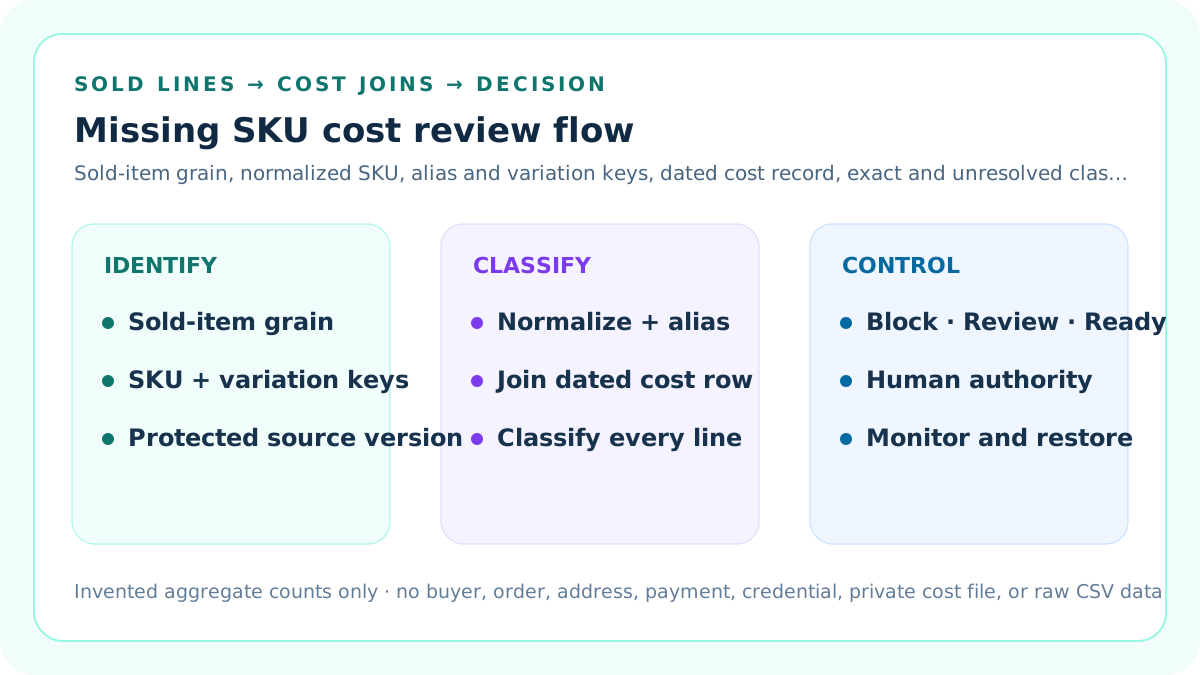
Count one row per sold item or declared line-item event before checking costs. Order totals, payment rows, shipment rows, and listing rows are different grains.
A balanced classification requires every sold line to appear once as exact, missing, ambiguous, or stale.
Keep this intent distinct
Use the CSV column mapper to normalize headers, the duplicate checker to review repeated rows, and this checker to measure cost-library coverage after those controls.
The result does not calculate contribution, accounting profit, inventory value, or tax.
Define an exact usable join
An exact join links one normalized sold-item key to one cost record that is valid on the sale date, in the declared currency, at the required variation grain.
A syntactic SKU match is not enough when the record is expired or applies to another variation.
Define a missing join
A missing join has no cost record after approved SKU normalization, alias lookup, listing fallback, and variation checks are exhausted.
Never substitute a zero cost merely to make the join complete.
Define an ambiguous join
An ambiguous join finds two or more plausible cost records with no approved precedence rule.
Do not average competing records or select the first spreadsheet row.
Define a stale join
A stale join reaches a record whose effective window or approved age has expired before the sold date.
Keep stale separate from missing so the repair owner can update rather than recreate evidence.
Normalize keys conservatively
Trim declared whitespace and apply a versioned case or punctuation rule only when that transformation is approved for the source.
Do not remove characters that distinguish genuine variants.
Preserve renamed-SKU aliases
Map legacy SKU to canonical SKU with effective dates, reason, owner, reviewer, and prior value.
An alias should not rewrite the historical sold export.
Use listing and variation keys
When a SKU is blank or reused, require a documented listing-plus-variation mapping at the same sold-item grain.
A listing-level cost can be wrong when materials, size, or personalization change unit cost.
Version the cost library
Store canonical SKU, variation scope, unit cost, currency, effective-from, effective-to, source, and reviewer version.
A current cost is not automatically valid for an older sale.
Calculate exact coverage
Exact cost coverage equals exact usable joins divided by sold item lines.
Coverage is a data-readiness measure, not a margin metric.
Calculate unresolved joins
Unresolved joins equal missing plus ambiguous plus stale joins.
Report both the count and the reason mix so repair work is actionable.
Balance the classification
Exact, missing, ambiguous, and stale counts must sum exactly to sold item lines for each packet.
An imbalance Blocks interpretation because rows are double-counted or omitted.
Version the cost-coverage contract
Record a nonfuture source-review date covering the evidence month, a policy effective date no later than that review, each packet's oldest usable cost effective date, synthetic sold date, and oldest usable cost age, plus minimum closed evidence duration and a maximum sold-line input bound. Confirm the nine grain, mapping, cost, quarantine, counterexample, restoration, privacy, and authority controls before interpreting coverage.
Invalid governance controls mask every derived join result.
Read Ready
Ready means the synthetic counts balance and unresolved joins are within the declared threshold, with complete evidence and no known conflict.
It clears only the entered coverage packet.
Read Review
Review means the packet is structurally valid but unresolved joins exceed the approved threshold.
Assign each reason class to a named evidence owner before any margin analysis.
Read Block
Block means counts, grain, context, currency, period, source scope, privacy, or restoration evidence is invalid or incomplete.
Repair the join contract before interpreting coverage.
Work a renamed SKU
Preserve the sold SKU, look it up in the dated alias table, resolve one canonical SKU, then join to the cost record valid on the sold date.
If one legacy SKU maps to multiple canonical records for the same date, classify it as ambiguous.
Work an unmapped variation
Use listing ID, variation values, canonical option order, and dated SKU assignment to identify the exact cost record.
Do not fall back to a parent listing cost without a reviewed rule.
Separate blank and unknown values
Blank SKU, unrecognized SKU, deleted listing, changed variation, missing cost row, and expired cost row need different reason codes.
A single 'N/A' bucket hides the repair path.
Control currency
The library currency, converted cost, conversion source, rate date, and rounding convention must be explicit.
This tool reports join coverage and does not convert money.
Control dates
Compare sold date with alias and cost effective windows using one documented timezone and boundary convention.
Month-only records need an explicit first-day or period rule.
Preserve source evidence
Fingerprint protected sold-line, listing, alias, variation, and cost-library sources with versions and filters.
Public examples use invented counts and labels only.
Minimize private data
The checker needs aggregate counts, not buyer names, emails, addresses, order numbers, payment data, credentials, or raw CSV rows.
Keep operational identifiers in authorized systems.
Assign human authority
Name the mapping owner, cost owner, independent reviewer, correction approver, monitoring owner, stop authority, and restoration owner.
Ready cannot authorize overwriting the source library.
Back up before repair
Preserve the sold export, normalized-key version, alias table, variation map, cost library, prior classification, exception log, and tested restoration instructions.
The browser-local public tool creates no backup.
Retest counterexamples
Test full coverage, renamed SKU, missing alias, one-to-many alias, blank SKU, unmapped variation, reused SKU, stale cost, overlapping dates, malformed counts, and open conflicts.
Every public fixture remains synthetic and bounded.
Monitor join drift
Track schema changes, new aliases, variation edits, cost-source updates, recurring reason codes, coverage shifts, and reviewer overrides.
Stop downstream profit automation when coverage degrades unexpectedly.
Do not infer zero cost
A missing join is an evidence gap, not evidence that cost equals zero.
Exclude or quarantine the row according to a documented downstream policy.
Release through ordered gates
Index only after distinct intent, current sources, functioning logic, counterexamples, answer-first content, metadata, schema, diagrams, links, privacy, similarity, mobile, backup, deployment, and live checks pass.
Search signals are measured later and are not required for release.
Keep a change log
Record mapping version, source fingerprints, counts by reason, threshold, decision, owner, correction, reviewer, monitoring trigger, and restoration reference.
Never erase the prior accepted mapping without supersession evidence.
Quarantine unresolved lines downstream
Keep missing, ambiguous, and stale cost joins in a visible exception population until the evidence owner resolves them. If a separate profit workflow excludes these lines, report the excluded count and revenue scope beside every total.
Do not silently calculate margin from the covered subset as though it represented all sold items.
Reconcile after every repair
After adding an alias, variation mapping, or dated cost record, rerun the complete closed-period packet rather than only the corrected line. Confirm that exact coverage increases, the original exception disappears for the intended reason, no new ambiguity is created, and the prior accepted mapping remains restorable.
A local correction is incomplete until population balance and counterexamples still pass.
Sources and further reading
- Etsy Help: Download sold transactions: Official order-item, order, payment-sale, deposit, title, price, and optional SKU export boundaries.
- Etsy Help: Download listing information: Official active-listing export coverage, including optional seller-assigned SKU values.
- Etsy Help: Use SKUs for inventory: Official SKU purpose, naming, variation, search, and duplicate-avoidance guidance.
- Shopify Help: Export orders: Official order CSV export and structure boundaries.
- Shopify Help: Product CSV files: Official product and variant CSV fields, including variant SKU semantics.
- W3C CSVW: Tabular Data Model: Standards-based primary-key and foreign-key reference model for reproducible joins.
- Seller Profit Guard methodology: Evidence, correction, release, monitoring, and rollback controls.
- Seller Profit Guard data privacy: Synthetic public examples and protected operational-data boundaries.
Related Seller Profit Guard tools
- Etsy CSV profit calculator: Run a local order profit check with editable fee and SKU cost assumptions.
- Payment reconciliation tool: Compare order rows with statement activity and flag unmatched rows.
- SKU cost library: Save or import material, labor, packaging, shipping, and target margin assumptions.
- Variant risk checker: Find missing SKUs and variation cost risks before a listing scales.
- Etsy title checker: Review listing-title clarity, repetition, keyword chains, and mobile scanning.
- Etsy tag checker: Review all 13 tag slots for duplicates, repeated meaning, and truthful coverage.
- Free shipping threshold calculator: Estimate when a shipping subsidy can still meet a target margin.
- Return window loss estimator: Model expected reverse shipping, restock work, recovery, and replacement loss.
- Etsy Ads break-even calculator: Estimate target-safe Etsy Ads spend, ACOS, and ROAS after fees, fulfillment, and expected return loss.
- CSV data privacy: Understand what the local-first workflow needs and what it does not need.
- Missing SKU Cost Formula and Input Contract: Define sold-item grain, normalized keys, dated cost records, exact, missing, ambiguous and stale joins, thresholds, and evidence.
- Missing SKU Cost Worked Example: Renamed SKU: Trace a legacy SKU through a dated alias to one canonical SKU and current cost record, including the failing no-alias case.
- Missing SKU Cost Checker for an Unmapped Variation: Use listing, option, variation and SKU evidence to resolve a child item without applying an unsafe parent-listing average cost.
- Missing SKU Cost Checker Mistakes and Corrections: Diagnose grain mismatches, blank SKUs, alias collisions, reused SKUs, stale costs, overlapping dates, currencies, and zero-cost fallbacks.
- Reliable Data Sources for Missing SKU Cost Checks: Map sold lines, listings, variations, SKUs, aliases, costs, dates and currencies to protected, versioned first-party evidence.
- Safe Thresholds for Missing and Ambiguous Cost Joins: Set zero-tolerance, operational, age, recurrence, materiality, source-confidence and stop controls without normalizing unknown costs.
- Renamed SKU vs Unmapped Variation Cost Joins: Compare alias resolution and variation resolution at the same sold-item grain and show why their evidence and repair owners differ.
- Weekly Missing SKU Cost Review Routine: Turn exports, schema checks, normalization, alias and variation review, cost dating, exceptions, approval, monitoring and restoration into a weekly control.
- Interpret Missing Cost Joins Without False Precision: Explain what exact coverage and each unresolved cost-join reason proves, cannot prove, and requires as the next seller action.
- Missing SKU Cost Audit Checklist and Change Log: Provide a standalone source, key, alias, variation, cost-date, classification, correction, approval, monitoring and restoration record.
Use the interactive tool
Enable JavaScript to open the calculator and process browser-local inputs. The explanatory content and source links remain available without JavaScript.
Related guide: Define sold-item grain, exact, missing, ambiguous and stale cost joins, thresholds, evidence, decisions, monitoring, and restoration.
This tool provides operating estimates, not tax, accounting, legal, financial, or marketplace-policy advice. Verify current official sources and your own records before changing prices or operations.