Seller Profit Guard · How it works · CSV privacy
International Landed Cost Planner
An international landed cost planner adds product cost, outbound shipping, insurance, packaging, handling, platform fees, expected return loss, and seller-paid border-charge assumptions. Buyer-paid duty, import tax, and brokerage remain separately labeled and excluded from seller cost.
Maintained by Seller Profit Guard Editorial Team. Last reviewed: 2026-07-31.
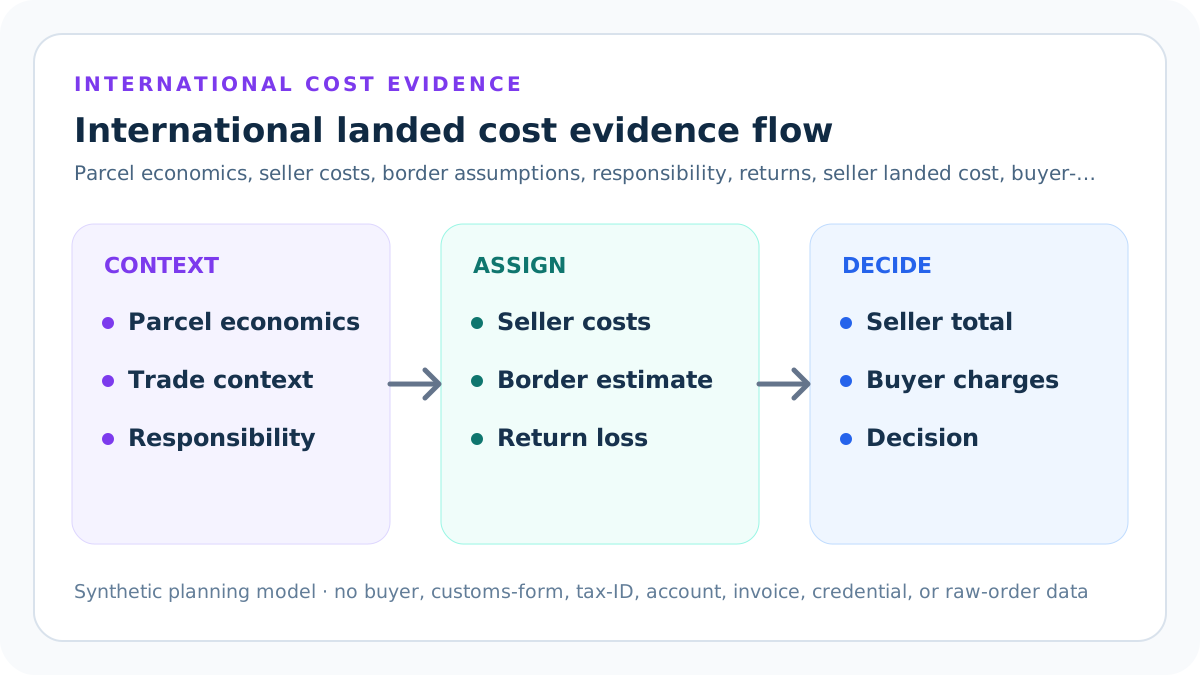
Define one international parcel scenario
Start with one physical parcel, one order state, one destination, one origin, one product-classification context, one country-of-origin statement, one carrier and service pattern, one responsibility label, one currency, and one evidence month. Those fields establish the planning grain.
Do not merge a domestic order, an international quote, a final carrier invoice, a marketplace estimate, and a customs charge from different shipments. A plausible total is not reproducible when its components describe different obligations.
Name the responsibility label first
Choose seller-paid or buyer-paid only as a planning label for the entered border-charge assumptions. Seller-paid includes modeled duty, import tax, and brokerage in seller-side landed cost; buyer-paid reports them separately and excludes them from seller cost.
The label does not itself establish an Incoterm, customs obligation, tax liability, carrier capability, checkout configuration, or legal responsibility. Verify the exact current arrangement with the carrier, marketplace, official authority, and qualified adviser where appropriate.
Separate seller cost from buyer charges
Seller-side landed cost contains only the cost lines the seller has declared responsible for in the modeled packet. Buyer-side estimated border charges remain visible as a separate output under buyer-paid responsibility.
Do not call the buyer-side estimate a delivered total, guaranteed amount due, or customer promise. Customs valuation, product classification, origin, destination, treaties, thresholds, carrier handling, and official assessment can change the actual charge.
Extend item quantity and selling price
Merchandise revenue equals item quantity multiplied by selling price per item. Buyer-paid international shipping is added separately to form the gross buyer amount used by the seller-entered platform-fee scenario.
Selling price is not customs value, taxable value, payout, profit, or landed cost. Each concept requires its own source and rule context; the calculator rejects silent substitution.
Extend direct product cost
Total product cost equals parcel quantity multiplied by direct product cost per item. Use one approved product-cost version with an effective date and a named boundary such as material, acquisition, or landed inventory cost.
If the entered unit cost already contains inbound freight, duty, or brokerage, document that inclusion so it is not counted again. Historical, replacement, standard, and fully allocated accounting cost should not be blended.
Record outbound international shipping
Use the current qualified quote, purchased label, or final carrier invoice for the declared parcel, origin, destination, service, package, account eligibility, and evidence state. Keep quote, label, adjustment, dispute, refund, and final invoice as separate versions.
The calculator does not create a carrier rate or determine service eligibility. An amount from another destination, package, period, or account is an explicit sensitivity assumption, not observed postage.
Record shipping insurance separately
Enter only the seller-paid insurance or declared-value protection cost assigned to this parcel. Preserve provider, coverage basis, amount, exclusions, currency, and evidence state outside the public packet.
Insurance price is not coverage confirmation, claim success, product replacement recovery, or carrier liability. Expected loss and insurance recovery require a separate risk model.
Assign international packaging and handling
Combine the direct package allocation and the seller-entered handling allocation only after each has its own ledger. Packaging can include mailer, box, label, tape, insert, fill, protection, and waste; handling can include documentation and consolidation time.
Do not omit customs-form preparation, special labeling, or additional protection when they are part of the seller's approved cost convention. Do not count the same labor or material in both product cost and handling.
Define the platform-fee scenario
The calculator applies one seller-entered percentage to merchandise revenue plus buyer-paid shipping and then adds one fixed fee. It is a scenario input, not a current Etsy, Shopify, TikTok Shop, payment-processor, advertising, tax, or currency-conversion schedule.
Where fee bases differ by market or transaction, calculate the applicable evidence separately or use a platform-specific tool. Preserve percentage, fixed amount, base, market, currency, source, retrieved date, and exclusions.
Define customs value explicitly
Customs value is a seller-entered planning amount used only to calculate the modeled duty line. Preserve its source, currency, valuation convention, discounts, included shipping or insurance treatment, product mix, and official-rule context.
Do not assume selling price, product cost, checkout subtotal, insured value, or marketplace tax base is automatically the correct customs value. The public calculator cannot determine valuation.
Enter a duty-rate assumption
Estimated duty equals seller-entered customs value multiplied by the seller-entered duty-rate assumption. The output is labeled estimated and retains the origin, destination, product classification, country of origin, responsibility, and effective-rule context.
A rate copied from another product or country is not transferable. HS classification, origin, treaties, additional tariffs, thresholds, exemptions, and effective dates can materially alter official assessment.
Enter import tax as a currency assumption
Import tax is entered as a currency amount rather than derived from a universal rate. This prevents the tool from pretending that every destination uses the same base, tax type, threshold, marketplace collection, or recovery rule.
If a seller creates the amount from an external official calculator or broker estimate, preserve the source inputs and result. Marketplace-collected taxes and seller-paid border taxes must not be counted twice.
Enter brokerage or disbursement cost
Brokerage and disbursement represent seller-entered carrier or broker charges for the declared responsibility scenario. Keep quote, tariff, invoice, minimum, percentage, advancement, and currency details in the protected source record.
Do not assume brokerage is included in duty collection or shipping price. Shopify's official guidance notes that carriers may charge brokerage or disbursement separately, so the public model keeps its own line.
Calculate estimated border charges
Estimated border charges equal estimated customs duty plus the entered import-tax amount plus the entered brokerage or disbursement amount. The three components remain separately visible.
The sum is not a customs decision or final invoice. It is a labeled scenario under the seller's current evidence, classification, valuation, destination, origin, carrier, and responsibility assumptions.
Apply responsibility without hiding charges
Under seller-paid, the full estimated border-charge total enters seller-side landed cost. Under buyer-paid, the same amount is shown as buyer-side estimated border charges and triggers Review because disclosure and responsibility evidence require confirmation.
This treatment prevents a buyer-paid estimate from improving seller cost invisibly and prevents a seller-paid packet from omitting a material expected expense. It does not select the commercial term for the seller.
Model expected international return loss
Expected return loss equals item quantity multiplied by expected international return rate and seller loss per return. The loss amount can include an approved combination of nonrecoverable shipping, product loss, processing, and recovery assumptions.
Return behavior differs by product, destination, policy, delivery experience, customs refusal, and evidence period. Use a comparable population and do not treat expected loss as an observed charge for one order.
Calculate seller-side landed cost
Seller-side landed cost equals product cost, outbound shipping, insurance, packaging and handling, platform fees, seller-paid border charges, and expected return loss. Each line appears once.
The result excludes overhead, advertising, financing, owner compensation outside handling, domestic taxes, income tax, refunds outside the expected-loss convention, exchange-rate changes, and other costs not explicitly entered.
Calculate landed cost per item
Divide seller-side landed cost by parcel item quantity. This output supports comparison across parcel quantities only when product mix, unit cost, shipping service, border responsibility, fee convention, currency, and evidence timing are comparable.
Per-item landed cost is an average across the parcel. It should not be assigned to unlike SKUs without a documented allocation method.
Calculate non-product international load
Non-product international load equals seller-side landed cost minus total product cost. It makes shipping, protection, documentation, fees, border assumptions, brokerage, and expected return burden visible as one supplemental measure.
The load is not a surcharge, tax bill, or avoidable waste. Use the component lines to identify the actual driver before changing a carrier, package, responsibility term, price, or destination.
Calculate seller planning contribution
Seller planning contribution equals gross buyer amount minus seller-side landed cost. Contribution margin divides that amount by gross buyer amount. Keep both figures beside the cost result.
This is a bounded planning remainder, not net profit. It does not resolve accounting recognition, tax, marketplace payout, foreign exchange, cash timing, overhead recovery, or customer demand.
Compare the seller-owned maximum
Target headroom per item equals maximum seller-planned landed cost per item minus calculated landed cost per item. Negative headroom triggers Review.
The maximum is an internal planning boundary, not a customs threshold, de minimis rule, marketplace policy, carrier limit, tax conclusion, or recommended selling price. Store owner, purpose, approval, population, effective date, and expiry.
Control border-charge concentration
Border-charge share divides the modeled duty, import-tax, and brokerage total by gross buyer amount. Compare it with a seller-entered maximum only after the customs-value, classification, origin, destination, carrier, and responsibility evidence is complete.
A high share triggers Review rather than Block because the arithmetic may be structurally valid while the exposure is commercially material. The threshold is an internal sensitivity control, not a customs threshold, exemption, de minimis rule, or official risk score.
Control expected-return-loss concentration
Expected-return-loss share divides the modeled expected international return loss by gross buyer amount. The seller chooses a maximum that matches the approved comparable cohort and loss convention.
Do not substitute a global return rate, domestic cohort, anecdotal refusal, or customer-support count. A threshold exception points to cohort and loss-evidence review; it does not predict a particular parcel return.
Require nine evidence confirmations
The packet separately confirms completed-order economics, final shipping cost, fee convention, customs value, classification and origin, border-charge assumptions, responsibility, return assumptions, and the planning boundary.
Each confirmation is a gate, not a confidence checkbox. A missing or negative confirmation Blocks all calculated numeric outputs so a plausible total cannot escape an incomplete evidence packet.
Use a real source-review date
Record the calendar date on which the seller reviewed the applicable marketplace, customs, carrier, broker, fee, return, and responsibility evidence. Impossible dates and month-only labels fail the structural gate.
The date does not make evidence current forever. Assign an expiry or event trigger for tariff, tax, carrier, classification, origin, fee, responsibility, invoice, or return-policy changes.
Read the low-value synthetic fixture
One item sells for USD 35 with USD 8 buyer shipping. Product cost is USD 12; outbound shipping USD 10; insurance USD 1; packaging and handling USD 2; modeled platform fees USD 4.60; and expected return loss USD 0.50.
A USD 35 customs value, 5% duty assumption, USD 2 import-tax assumption, and USD 1 brokerage create USD 4.75 seller-paid border charges. Seller-side landed cost is USD 34.85 and clears a USD 35 target by USD 0.15.
Read the higher-value synthetic fixture
A higher-value item sells for USD 100 with USD 15 buyer shipping. Product cost is USD 40; outbound shipping USD 20; insurance USD 3; packaging and handling USD 4; modeled platform fees USD 11.80; and return loss USD 3.
A USD 100 customs value, 12% duty assumption, USD 20 import-tax assumption, and USD 8 brokerage create USD 40 border charges. Seller-side cost reaches USD 121.80, exceeding a USD 100 target by USD 21.80 and triggering Review.
Apply Block, Review, and Ready precedence
Block nonpositive quantity, price, outbound shipping, customs value, or target; negative cost lines; invalid fee, duty, return rate, responsibility, currency, rule context, month, scope; or declared conflicts. Invalid structure cannot be rescued by a low total.
After structure passes, Review cost above target, buyer-paid border charges above zero, or expected return loss larger than a positive remaining contribution. Ready clears only the entered planning gates.
Protect international shipment and tax data
Store seller alias, parcel alias, aggregate item and cost values, rule labels, official URLs, retrieved dates, classification and origin pointers, responsibility, reviewer, target, and unresolved issues in protected records.
Keep buyer names, addresses, tracking numbers, customs forms, tax identifiers, private product classifications, marketplace or carrier accounts, invoices, credentials, claims, messages, and raw orders outside public pages, screenshots, analytics, and drafts.
Test, release, observe, and correct
Reproduce seller-paid low-value Ready, higher-value target Review, buyer-paid responsibility Review, and invalid Block fixtures. Test quantity, fee, duty, return, responsibility, currency, context, period, scope, target, and conflict boundaries.
Before release, back up and run typecheck, unit, integration, build, content, duplicate, SEO, schema, image, link, mobile, keyboard, and static-route checks. After release, verify live calculations, indexability, strict 404, and Day 0/7/14/28 evidence; restore the prior version on regression.
Sources and further reading
- Seller Profit Guard methodology: Comparable-grain evidence, deterministic scenarios, validation, correction, release, and rollback.
- Seller Profit Guard data privacy: Local-first boundaries for buyer, address, tracking, tax identifier, customs form, invoice, account, credential, and raw order data.
- Shopify Help Center: Duties and import taxes: Official Shopify guidance reviewed 2026-07-31 for customs fees, carriers, seller-paid and buyer-paid responsibility, HS codes, country of origin, duties, import taxes, and brokerage.
- Etsy Help: Custom Fees and Physical VAT Collection: Official Etsy guidance reviewed 2026-07-31 for destination-country charges, marketplace tax collection, seller responsibilities, customs forms, and current market-specific processes.
- Etsy Help: Managing International Shipments: Official Etsy guidance reviewed 2026-07-31 for customs-form accuracy and tariff or duty collection that varies by market, goods, and carrier.
- U.S. Customs and Border Protection: Commercial invoice value: Official U.S. CBP guidance reviewed 2026-07-31 for invoice value, additions, freight or insurance treatment, currency conversion, and supporting records.
- European Commission: Calculation of customs duties: Official EU guidance reviewed 2026-07-31 for tariff classification, customs value, origin, and the ordered customs-valuation framework.
Related Seller Profit Guard tools
- Etsy CSV profit calculator: Run a local order profit check with editable fee and SKU cost assumptions.
- Payment reconciliation tool: Compare order rows with statement activity and flag unmatched rows.
- SKU cost library: Save or import material, labor, packaging, shipping, and target margin assumptions.
- Variant risk checker: Find missing SKUs and variation cost risks before a listing scales.
- Etsy title checker: Review listing-title clarity, repetition, keyword chains, and mobile scanning.
- Etsy tag checker: Review all 13 tag slots for duplicates, repeated meaning, and truthful coverage.
- Free shipping threshold calculator: Estimate when a shipping subsidy can still meet a target margin.
- Return window loss estimator: Model expected reverse shipping, restock work, recovery, and replacement loss.
- Etsy Ads break-even calculator: Estimate target-safe Etsy Ads spend, ACOS, and ROAS after fees, fulfillment, and expected return loss.
- CSV data privacy: Understand what the local-first workflow needs and what it does not need.
- International Landed Cost Formula and Inputs: Define parcel quantity, seller costs, fee base, customs assumptions, border responsibility, returns, target, evidence, and exclusions.
- International Landed Cost Worked Example: Reproduce a low-value seller-paid parcel with product, shipping, insurance, package, fees, duty, import tax, brokerage, returns, and target.
- Higher-Value International Landed Cost: Model a higher-value parcel whose product, shipping, protection, border-charge, fee, and return assumptions exceed the seller target.
- International Landed Cost Planner Mistakes: Find valuation, classification, origin, responsibility, fee, tax, brokerage, return, currency, duplication, privacy, and interpretation defects.
- International Landed Cost Data Sources: Build protected lineage for order values, costs, carrier evidence, classification, origin, border assumptions, fees, returns, targets, and corrections.
- International Landed Cost Decision Thresholds: Separate structural Block, seller-cost target, buyer-paid responsibility, return sensitivity, freshness, confidence, and rollback thresholds.
- Low-Value vs Higher-Value Landed Cost: Compare low-value and higher-value parcels using common currency, fee, responsibility, evidence, and formula boundaries.
- International Landed Cost Operating Routine: Run a controlled routine for sources, parcel samples, classifications, responsibility, estimates, invoices, exceptions, approvals, correction, and close.
- How to Interpret International Landed Cost: Interpret seller cost, buyer charges, border assumptions, return loss, contribution, target, confidence, exclusions, and next evidence.
- International Landed Cost Audit Template: Audit parcel, seller costs, fee base, customs context, responsibility, border assumptions, returns, privacy, accessibility, release, correction, and rollback.
Use the interactive tool
Enable JavaScript to open the calculator and process browser-local inputs. The explanatory content and source links remain available without JavaScript.
Related guide: Define seller cost, border-charge responsibility, evidence, and interpretation boundaries.
This tool provides operating estimates, not tax, accounting, legal, financial, or marketplace-policy advice. Verify current official sources and your own records before changing prices or operations.