Seller Profit Guard · How it works · CSV privacy
Free gift margin calculator
Compare a lightweight sample with a full-size gift at one audience grain. Model dated offer mechanics, purchase threshold, baseline and scenario conversion, mature retained orders, retained revenue, pre-gift contribution, gift units, complete gift and parcel cost, setup, contribution headroom, incremental payback, required conversion lift, and inventory utilization without exposing order data.
Maintained by Seller Profit Guard Editorial Team. Last reviewed: 2026-07-31.
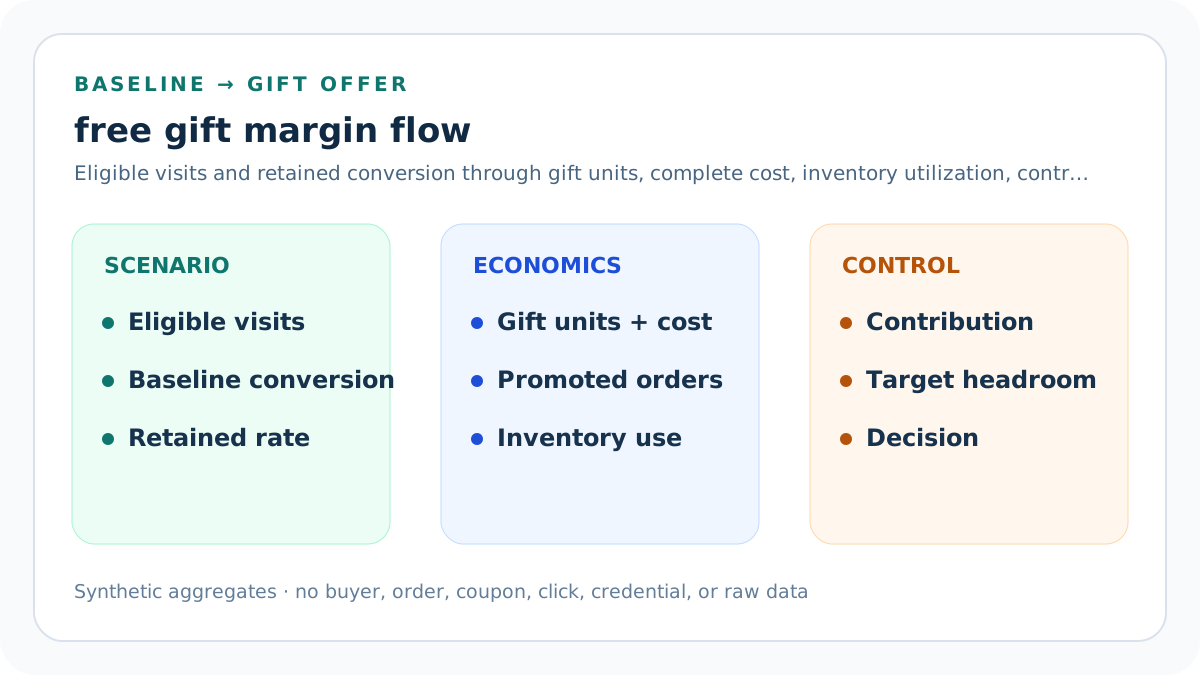
Freeze one gift-with-purchase packet
Record platform, channel, market, currency, qualifying products, purchase threshold, gift SKU, gift quantity, eligibility, limits, start and end dates, warehouse, combinations, return treatment, and disclosure.
A banner saying “free gift” is not a calculation scope.
Use aggregate assumptions only
Prepare synthetic or aggregate visit, conversion, retained-order, revenue, contribution, and gift-cost inputs.
Do not paste buyer names, contacts, addresses, order IDs, coupon records, payments, credentials, tokens, or raw exports.
Separate the qualifying threshold
Enter the checkout threshold or qualifying condition independently from retained revenue.
A threshold is an eligibility rule, not guaranteed collected revenue after adverse outcomes.
Define eligible visits
Use one aggregate audience denominator exposed to the exact gift offer.
Do not substitute total site traffic, product views, sessions from another period, or customers.
Define baseline conversion
Use a comparable period or controlled baseline without the modeled gift.
Do not invent a no-gift counterfactual from the promoted period alone.
Define scenario conversion
Enter one explicit scenario assumption for the light gift and one for the full-size gift.
An assumption is not a forecast or causal estimate.
Use a mature retained rate
Apply one closed cancellation, refund, return, dispute, and reporting window.
Placed gift orders do not automatically become retained contribution.
Record retained revenue
Use aggregate collected revenue per retained qualifying order under the declared tax and shipping convention.
Do not use gross merchandise value when pass-through amounts are excluded.
Record contribution before gift
Use retained order contribution after ordinary product, fulfillment, fees, advertising, and expected adverse loss but before gift-program cost.
This is the funding pool for the gift, not accounting net income.
Record gift units and product cost
Use the exact gift quantity per retained qualifying order and current seller cost per fulfilled gift unit.
A customer price of zero does not make inventory cost zero.
Record added gift weight
Measure packaging-ready incremental grams or ounces for the exact gift set.
Weight is evidence for parcel cost, not a shipping price by itself.
Record added packaging
Include insert, pouch, carton, protection, label, or larger-box cost caused by the gift.
Do not double-count packaging already included in baseline contribution.
Record added pick-pack cost
Include incremental labor or fulfillment charges for selecting, verifying, and packing the gift.
Use the provider's actual per-item or per-order billing rule.
Record added shipping cost
Use supported incremental parcel or separate-shipment cost for the gift's warehouse and service path.
TikTok Shop notes gifts can ship separately when inventory is in another warehouse.
Record expected gift loss
Estimate unrecovered gift, shipping, return, damage, shortage, or disposal loss not already reflected elsewhere.
Classify each loss once.
Include fixed program cost
Add gift listing, approval, setup, creative, merchandising, app, or administration cost that belongs to the scenario.
Separate reusable long-term assets when appropriate.
Calculate promotional retained orders
Multiply eligible visits by scenario conversion and the mature retained rate.
Preserve fractional expected values without predicting a specific order.
Calculate incremental retained orders
Subtract baseline retained orders from scenario retained orders.
Negative or zero incremental orders cannot fund a seller-paid gift.
Calculate gift cost per retained order
Multiply gift unit cost by gift units, then add packaging, pick-pack, shipping, and expected gift loss.
Keep weight visible even when the entered shipping increment is zero.
Calculate required gift inventory
Multiply promoted placed qualifying orders by gift units per order, then compare the result with available units and a seller-owned utilization ceiling.
Placed-order coverage is deliberately more conservative than retained-order coverage and does not reserve platform or warehouse inventory.
Calculate total gift-program cost
Multiply gift cost per retained order by all scenario retained orders, then add fixed setup.
Do not charge gifts only to incremental orders.
Separate eligibility from fulfillment incidence
Track aggregate eligible visits or orders, qualifying retained orders, gifts promised, gifts actually issued, gifts shipped separately, inventory failures, and gifts affected by full or partial returns as distinct evidence counts. Cost every gift actually fulfilled under the documented remedy and return rule.
Do not assume one gift per incremental order or treat an unfulfilled gift as equivalent to a delivered unit. Eligibility measures offer reach, fulfillment incidence measures actual program cost, and incremental retained orders remain a separate modeled counterfactual rather than observed causal proof.
Calculate contribution after gift
Multiply scenario retained orders by contribution before gift and subtract total gift-program cost.
This is conditional scenario contribution, not guaranteed profit.
Calculate target headroom
Subtract retained revenue multiplied by the seller-owned contribution reserve.
Positive contribution can still miss target.
Calculate incremental contribution after gift
Multiply incremental retained orders by pre-gift contribution, then subtract gift cost for every promoted retained order and fixed setup.
This makes the counterfactual burden explicit.
Solve required conversion lift
Solve the conversion increase needed for incremental pre-gift contribution to fund all gift-program cost.
The boundary holds only while cost, retention, contribution, audience, and baseline conversion remain fixed.
Compare light and full-size gifts
Use one audience, baseline, retained rate, revenue, contribution, period, market, and target.
Different assumed conversion does not prove the larger gift caused the difference.
Use Block, Review, and Ready
Block invalid rates, nonpositive audience, incomplete evidence, incompatible scope, or declared conflicts. Review a valid scenario below target or below incremental payback.
Ready means both entered scenarios clear both tests under assumptions.
Respect platform rules
TikTok Shop and Shopify expose different gift or reward configuration, inventory, shipping, return, value, channel, and disclosure mechanics.
Verify current first-party documentation and account settings.
Treat conversion as sensitivity
Run conservative, base, and adverse conversion cases and preserve them.
A calculator cannot establish causality or incrementality.
Preserve an evidence ledger
Store each input, denominator, unit, source, date, maturity state, owner, reviewer, formula version, and assumption.
Never overwrite a failed full-size-gift case.
Define inventory and warehouse controls
Record gift stock, reservation approach, stockout behavior, warehouse placement, separate-shipment risk, and stop criteria.
A positive margin result cannot prove a gift is available.
Define return controls
Document full and partial return treatment, gift recovery, return shipping, damage, inventory disposition, and customer-right boundaries.
The calculator does not decide or enforce remedies.
Define stop and rollback criteria
Name contribution, conversion, gift cost, postage, stock, return, fulfillment, and policy signals that pause or restore the prior offer.
A public tool cannot monitor or change a live promotion.
Release and restore safely
Run calculation, content, similarity, SEO, image, link, browser, mobile, privacy, canonical, schema, strict-404, sitemap, and rollback gates.
Measure Day 0/7/14/28 without claiming same-period causality.
Sources and further reading
- Seller Profit Guard methodology: Evidence versions, formulas, privacy, correction, release, and rollback.
- Seller Profit Guard data privacy: Local-first boundaries for order, buyer, gift, promotion, payment, and cost data.
- TikTok Shop Academy: Gift with Purchase: Reviewed July 31, 2026. Official U.S. guidance covers eligibility segments, thresholds, up to five gifts, active stock deduction, claim limits, separate fulfillment, seller-paid gift shipping, returns, compatibility, and audit history.
- TikTok Shop Academy: Giveaway and Promotions Policy: Reviewed July 31, 2026. Official U.S. policy covers purchase-based incentives, listing and disclosure requirements, Seller Center registration for short-video promotion, stock-limit disclosures, and enforcement boundaries.
- Shopify Help: Buy X get Y discounts: Reviewed July 31, 2026. Official guidance covers purchase-amount qualification, manual cart addition of the reward item, online/POS scope, dates, and store time zone; this differs from TikTok Shop Gift with Purchase.
Related Seller Profit Guard tools
- Etsy CSV profit calculator: Run a local order profit check with editable fee and SKU cost assumptions.
- Payment reconciliation tool: Compare order rows with statement activity and flag unmatched rows.
- SKU cost library: Save or import material, labor, packaging, shipping, and target margin assumptions.
- Variant risk checker: Find missing SKUs and variation cost risks before a listing scales.
- Etsy title checker: Review listing-title clarity, repetition, keyword chains, and mobile scanning.
- Etsy tag checker: Review all 13 tag slots for duplicates, repeated meaning, and truthful coverage.
- Free shipping threshold calculator: Estimate when a shipping subsidy can still meet a target margin.
- Return window loss estimator: Model expected reverse shipping, restock work, recovery, and replacement loss.
- Etsy Ads break-even calculator: Estimate target-safe Etsy Ads spend, ACOS, and ROAS after fees, fulfillment, and expected return loss.
- CSV data privacy: Understand what the local-first workflow needs and what it does not need.
- Free Gift Margin Formula and Inputs: Build gift-with-purchase economics from audience, baseline and scenario conversion, retained orders, gift cost, contribution, and payback.
- Free Gift Margin Example: Lightweight Sample: Follow a synthetic lightweight sample through promoted retained orders, added product and parcel cost, contribution, target, and payback.
- Free Gift Margin for a Full-Size Gift: Model a materially different full-size gift with more assumed conversion, product cost, weight, packaging, pick-pack, shipping, and loss.
- Free Gift Margin Mistakes That Hide Cost: Correct baseline, denominator, all-order gift cost, weight, separate-shipment, returns, inventory, threshold, fee, and causality errors.
- Reliable Data for Free Gift Margin: Map eligibility, threshold, audience, conversion, retention, revenue, pre-gift contribution, gift, parcel, return, and setup inputs to evidence.
- Free Gift Contribution and Payback Thresholds: Separate contribution target, incremental payback, required conversion lift, gift-cost ceiling, evidence maturity, inventory, and rollback thresholds.
- Free Gift Comparison: Sample vs Full-Size Gift: Compare a lightweight sample and full-size gift at equal audience and baseline while exposing gift cost, lift assumption, contribution, and payback.
- A Weekly Free Gift Margin Routine: Operate a repeatable gift review across configuration, audience, baseline, retained outcomes, gift cost, parcel cost, stock, thresholds, and rollback.
- How to Interpret Free Gift Margin: Interpret promoted and incremental retained orders, gift cost, contribution, target headroom, payback, required lift, and uncertainty responsibly.
- Free Gift Margin Audit Checklist: Use a standalone checklist and dated change log for gift mechanics, baseline, formulas, sources, fixtures, thresholds, release, and rollback.
Use the interactive tool
Enable JavaScript to open the calculator and process browser-local inputs. The explanatory content and source links remain available without JavaScript.
Related guide: Define baseline, gift costs, retained contribution, incremental payback, threshold, evidence, and interpretation boundaries.
This tool provides operating estimates, not tax, accounting, legal, financial, or marketplace-policy advice. Verify current official sources and your own records before changing prices or operations.