Seller Profit Guard · How it works · CSV privacy
Marketplace fee anomaly checker
Compare two synthetic marketplace fee packets against dated rule snapshots. Enter the fee family, declared base, expected percentage rate, fixed amount, observed total, expected and observed line counts, currency, period, and evidence context. The browser-local checker flags amount, effective-rate, and duplicate-line differences without connecting to a marketplace or exposing private orders.
Maintained by Seller Profit Guard Editorial Team. Last reviewed: 2026-07-31.
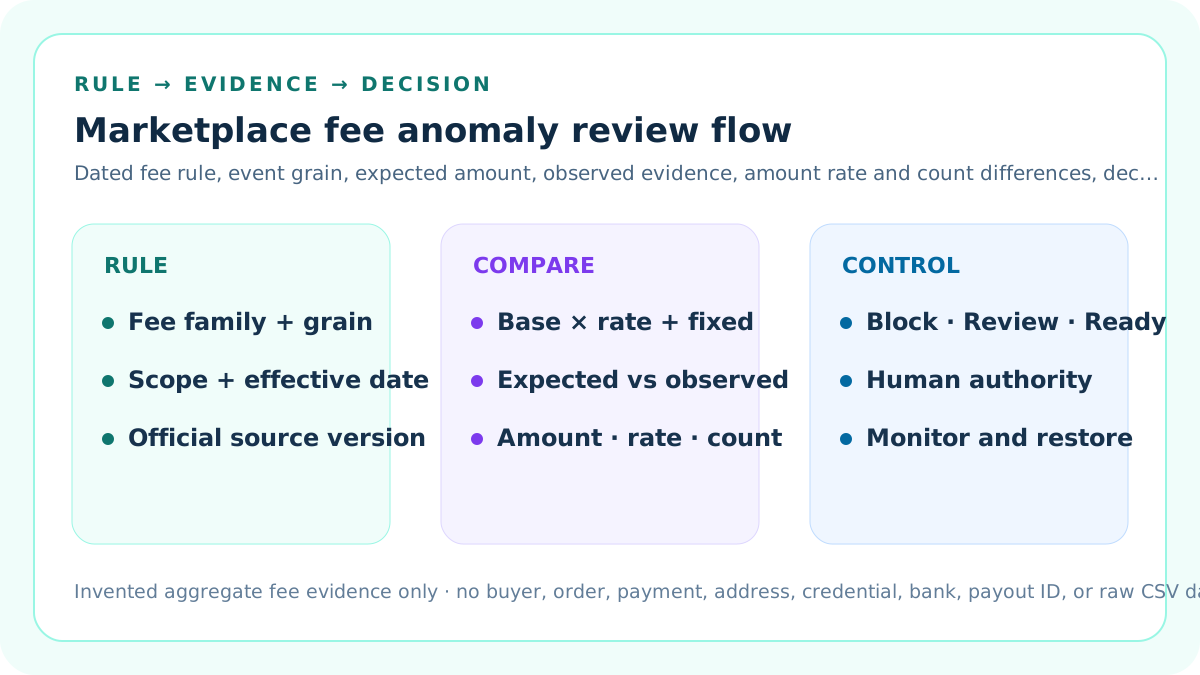
Start with a dated rule snapshot
A fee anomaly is the difference between an observed synthetic fee total and the amount implied by a declared fee family, event grain, base, percentage rate, fixed amount, currency, effective date, and expected line count.
A current fee table is not valid evidence for an older event unless the effective dates match.
Keep this intent distinct
Use fee calculators to plan expected charges before a sale, payout reconciliation to bridge account movements, and this checker to compare observed fee evidence with one preserved rule version.
The checker does not estimate contribution or accounting profit.
Define one fee family
Separate listing, transaction, payment processing, third-party transaction, referral, promotion, logistics, advertising, tax-on-fee, regulatory, conversion, app, and shipping-label charges.
Combining unlike fees destroys the denominator.
Define the event grain
State whether one expected line belongs to a listing publication, auto-renewal, quantity, order, transaction, payment, payout, invoice period, app usage event, or other documented trigger.
Repeated order references do not automatically mean duplicated fee lines.
Record the fee base
Identify whether the base includes merchandise, discounts, shipping, gift wrap, tax, duties, store credit, gift cards, or only a provider-processed portion.
Never infer a base from the fee amount alone.
Record rate and fixed amount separately
Percentage and fixed components can coexist, vary by country or plan, and use different currencies or conversion conventions. Preserve both values and their source.
Do not hide a fixed charge inside an effective rate.
Record effective scope
Capture platform, country, seller location, plan, category, payment provider, program enrollment, promotion, channel, currency, and effective date.
One published rate rarely applies to every seller context.
Calculate expected fee per line
Expected fee per line equals declared base multiplied by the expected rate plus the expected fixed amount.
Rounding should follow the source or observed statement convention.
Calculate expected fee total
Expected total equals expected fee per line multiplied by the expected line count at the declared event grain.
The count is evidence, not a convenient multiplier.
Calculate the amount difference
Fee difference equals observed fee total minus expected fee total. Positive means observed is higher; negative means lower.
The sign does not identify the cause.
Calculate an effective rate
For percentage-bearing fees, remove the expected fixed amount per observed line and divide the remaining observed amount by the declared base.
An effective-rate difference can reveal a changed rate, wrong base, or mixed fee family.
Detect duplicate-line differences
Line-count difference equals observed matching lines minus expected matching lines. Positive values require duplicate or multi-trigger review; negative values require missing-line or scope review.
Do not delete a row until the platform event grain is proven.
Use amount and rate tolerances together
Amount tolerance handles currency precision and documented rounding. Rate tolerance handles small percentage differences. Neither can waive a wrong event grain, missing source, or open conflict.
Version and approve tolerances before an incident.
Version the fee-review contract
Record a real source-review date that covers the evidence month and is not in the future, a policy effective date no later than that review, scenario rule-effective and event dates in correct order, a minimum closed evidence duration, and bounded monetary and fee-line inputs. Confirm the nine synthetic-data, rule, grain, base, evidence, threshold, counterexample, restoration, and authority controls before interpreting a result.
Invalid governance controls mask every derived fee output.
Read Ready
Ready means both synthetic fee packets match their preserved rules within amount, rate, and line-count controls, with complete context and no declared conflict.
It proves the worksheet arithmetic only.
Read Review
Review means the evidence structure is complete but an amount, effective rate, or line count differs. Assign an owner to inspect the source rule and protected fee detail.
Do not call the difference overcharging.
Read Block
Block means a required value, count, context, currency, period, scope, privacy, or conflict control failed.
Repair the evidence packet before interpretation.
Investigate changed rates
Compare effective dates, seller country, plan, category, payment method, promotion, waiver, threshold, onboarding program, and rule version.
A legitimate scope change can look like an error.
Investigate duplicate lines
Compare fee type, event ID in protected storage, role, timestamp, amount, source file, reversal or credit status, and expected trigger count.
A listing renewal and a transaction fee may share context without being duplicates.
Investigate wrong bases
Reperform merchandise, discount, shipping, gift-wrap, tax, duty, store-credit, gift-card, and provider-processed portions using the official rule.
Do not retrofit the denominator to force a match.
Investigate fixed-fee and currency differences
Check fee currency, account currency, listing currency, conversion timing, converted fixed charges, minimums, thresholds, and minor-unit rounding.
A fixed USD fee can appear differently in another account currency.
Preserve first-party evidence
Record source URL, title, access date, effective date, relevant scope, screenshot or export fingerprint in protected storage, and superseded rule version.
A search snippet alone is not durable evidence.
Use synthetic public examples
Public worksheets need no buyer, customer, order, address, payment, bank, payout, credential, or raw CSV data. Use invented bases, amounts, counts, dates, and rule labels.
Keep operational identifiers in authorized systems.
Assign human authority
Name the evidence owner, independent reviewer, dispute or correction approver, monitoring owner, stop authority, and restoration owner.
Ready never authorizes a platform dispute or ledger correction.
Back up before correction
Preserve the source report, rule snapshot, mapping, event-grain definition, fee classifications, prior accepted comparison, exception log, downstream state, and tested restoration instructions.
The public tool creates no backup.
Monitor fee-rule drift
Track new platform notices, category or plan changes, effective dates, recurring residuals, line-count patterns, reversals, credits, and reviewer decisions.
Stop automation when an unreviewed rule changes.
Retest counterexamples
Test exact match, changed rate, duplicate line, missing line, wrong base, fixed-only fee, zero base, threshold boundary, malformed counts, invalid currency, short scope, and open conflict.
Every test must remain synthetic and bounded.
Keep platform claims scoped
Etsy transaction, listing, processing, advertising, regulatory, and conversion fees differ; Shopify plan and provider fees differ; TikTok fee families, categories, programs, and effective dates differ.
Verify current first-party guidance for the exact account.
Do not infer financial loss
An observed difference can come from scope, timing, conversion, tax-on-fee, refunds, credits, mixed sources, rounding, or an incomplete export.
Escalate only with reproducible protected evidence.
Release through ordered gates
Index only after distinct intent, current sources, functioning logic, counterexamples, answer-first content, metadata, schema, diagrams, links, privacy, similarity, mobile, backup, deployment, and live checks pass.
Search signals are measured later, not required for release.
Keep a change log
Record comparison version, rule source, effective scope, input totals, expected and observed result, tolerances, decision, reviewer, correction, monitoring trigger, and restoration reference.
Never overwrite the prior accepted rule without supersession evidence.
Sources and further reading
- Etsy Help: Fees and taxes for selling: Official listing, transaction, payment-processing, advertising, currency-conversion, regulatory, and other fee boundaries.
- Etsy Help: Fee basics: Official listing-event, multi-quantity, transaction-base, and payment-processing distinctions.
- Shopify Help: Third-party transaction fees: Official fee formula, plan dependency, exemptions, refund treatment, and billing-report location.
- Shopify Help: Third-party payment providers: Official provider, payment-method, plan, location, and waiver boundaries.
- TikTok Shop: Check Tax Invoices: Official invoice and order-level fee-detail coverage for referral, promotion, logistics, and CPS Ads fee families.
- TikTok Shop: Referral fees by category: Official category- and effective-date-specific referral-fee examples.
- Seller Profit Guard methodology: Evidence, correction, release, monitoring, and rollback controls.
- Seller Profit Guard data privacy: Synthetic public examples and protected operational-data boundaries.
Related Seller Profit Guard tools
- Etsy CSV profit calculator: Run a local order profit check with editable fee and SKU cost assumptions.
- Payment reconciliation tool: Compare order rows with statement activity and flag unmatched rows.
- SKU cost library: Save or import material, labor, packaging, shipping, and target margin assumptions.
- Variant risk checker: Find missing SKUs and variation cost risks before a listing scales.
- Etsy title checker: Review listing-title clarity, repetition, keyword chains, and mobile scanning.
- Etsy tag checker: Review all 13 tag slots for duplicates, repeated meaning, and truthful coverage.
- Free shipping threshold calculator: Estimate when a shipping subsidy can still meet a target margin.
- Return window loss estimator: Model expected reverse shipping, restock work, recovery, and replacement loss.
- Etsy Ads break-even calculator: Estimate target-safe Etsy Ads spend, ACOS, and ROAS after fees, fulfillment, and expected return loss.
- CSV data privacy: Understand what the local-first workflow needs and what it does not need.
- Fee Anomaly Formula and Input Contract: Define fee family, event grain, base, percentage rate, fixed amount, expected line count, observed evidence, tolerances, and rule scope.
- Fee Anomaly Worked Example: Changed Rate: Reperform a percentage-fee example, change only the observed amount, and trace the resulting effective-rate difference and review decision.
- Fee Anomaly Review for a Duplicate Line: Use a fixed-fee event to distinguish a true duplicate candidate from a legitimate second trigger, credit, renewal, or quantity event.
- Fee Anomaly Mistakes and Corrections: Diagnose mixed fee families, wrong event grain, stale rates, fixed-fee omissions, currency conversion, credits, rounding, and duplicate assumptions.
- Marketplace Fee Evidence Source Map: Map rule snapshots and protected statement evidence to every checker input without exposing private orders or payment data.
- Safe Fee Anomaly Decision Thresholds: Set minor-unit, rounding, rate-point, count, recurrence, age, materiality, and source-confidence controls without hiding a wrong rule.
- Changed Rate vs Duplicate Fee Line: Compare a percentage-rate difference and an extra fixed-fee line at the same evidence grain, then show why their investigation paths diverge.
- Weekly Marketplace Fee Review Routine: Turn rule preservation, fee classification, synthetic regression, exception ownership, approval, monitoring, and restoration into a repeatable control.
- Interpret Fee Anomalies Without False Precision: Explain what zero, positive, negative, rate-only, count-only, recurring, and aged fee differences prove, cannot prove, and require next.
- Fee Anomaly Audit and Change Log: Provide a standalone rule, input, source, exception, correction, monitoring, and restoration record for repeatable marketplace fee review.
- Shopify Payment and Transaction Fee Formula: Define the shared order base, two payment paths, provider processing rates, Shopify transaction rates, source context, thresholds, and limitations.
- Shopify Payments Fee Example Without a Third-Party Fee: Calculate processing and Shopify transaction components for a sole-Shopify-Payments path using one editable same-order fixture.
Use the interactive tool
Enable JavaScript to open the calculator and process browser-local inputs. The explanatory content and source links remain available without JavaScript.
Related guide: Define marketplace fee rules, event grain, expected amount, rate and line-count anomalies, evidence, decisions, monitoring, and restoration.
This tool provides operating estimates, not tax, accounting, legal, financial, or marketplace-policy advice. Verify current official sources and your own records before changing prices or operations.