Seller Profit Guard · How it works · CSV privacy
Dead stock markdown calculator
Compare a moderate markdown with a clearance markdown by estimating sold and unsold units, net recovery after selling and fulfillment costs, storage during the decision window, disposal recovery, and recovery versus inventory cost basis. The result is a probability-weighted operating scenario—not a demand forecast, price authorization, accounting valuation, tax write-down, or guaranteed recovery.
Maintained by Seller Profit Guard Editorial Team. Last reviewed: 2026-07-31.
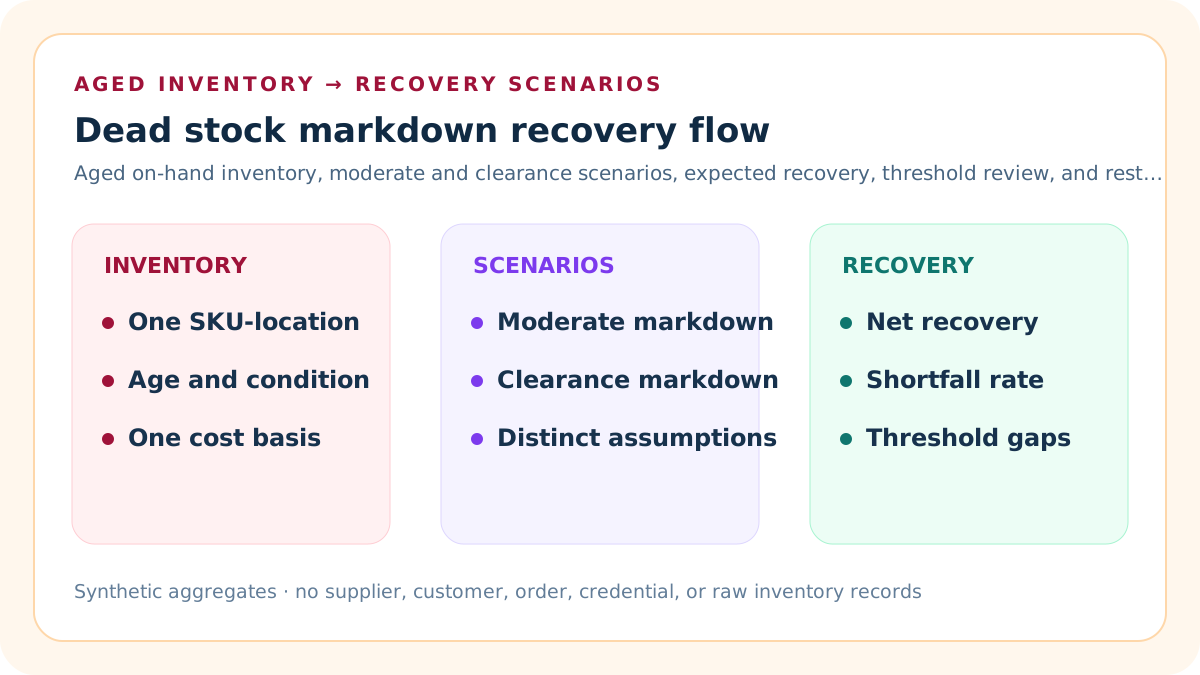
Start with expected net recovery
For each scenario, multiply expected sold units by net recovery per sold unit, add expected disposal recovery from unsold units, and subtract storage cost for the decision window.
Compare scenarios only after every input uses one SKU-location and one currency.
Define the markdown price
Markdown price equals current price multiplied by one minus the markdown rate. A permanent or clearance markdown changes the retail value of on-hand inventory differently from a temporary promotion.
The calculator models a scenario price; it does not publish or authorize it.
Estimate expected sold units
Expected sold units equal on-hand units multiplied by the seller-entered sell-through probability. The probability must come from a named evidence window and comparable price, season, placement, availability, and channel context.
It is an assumption, not a demand forecast.
Calculate net recovery per sold unit
Subtract percentage selling fees and per-sold-unit fulfillment cost from the markdown price. Keep product cost out of this step because the cost basis is compared once at the scenario level.
Do not subtract the same cost twice.
Estimate unsold-unit recovery
Expected unsold units equal on-hand units minus expected sold units. Multiply those units by a conservative liquidation, donation, return-to-vendor, recycling, or disposal recovery value only when that path is documented.
A hoped-for salvage price is not evidence.
Subtract decision-window storage
Storage cost equals on-hand units multiplied by the incremental storage cost assigned to the markdown decision window. Include only the avoidable or decision-relevant amount under a documented allocation.
Annual carrying cost belongs in a different model.
Calculate the recovery rate
Expected recovery rate equals expected net recovery divided by the inventory cost basis. The cost basis is on-hand units multiplied by the entered unit cost.
This operating ratio is not an accounting write-down or tax valuation.
Read Scenario A
The moderate-markdown fixture starts with 100 units at USD 12 cost and USD 30 current price, applies a 30 percent markdown and 55 percent expected sell-through, and produces USD 759.50 expected net recovery.
Its recovery rate is 63.29 percent.
Read Scenario B
The clearance fixture uses the same inventory and cost basis, applies a 50 percent markdown and 90 percent expected sell-through, and produces USD 850 expected net recovery.
Its recovery rate is 70.83 percent.
Compare the fixtures
Scenario B recovers USD 90.50 more in the synthetic example because the higher sell-through assumption and lower decision-window storage outweigh the deeper price cut.
The comparison changes when any assumption changes.
Use inventory age as evidence, not a verdict
Square and Microsoft document age buckets and receipt-date logic for identifying slow or old inventory. Age indicates exposure and review priority but does not prove condition, demand, or the correct markdown.
Inspect the physical and commercial context.
Keep sell-through definitions consistent
Shopify defines product sell-through using sold quantity divided by sold plus remaining quantity over a stated recent period. Other systems can use received inventory, beginning availability, or different windows.
Record the exact definition before importing a percentage.
Separate markdown from promotion
Oracle distinguishes permanent or clearance price changes from promotional price changes in markdown data. A temporary discount may leave inventory retail value treatment unchanged until sale.
Use the correct business event and evidence source.
Separate expected recovery from profit
Expected net recovery is cash-like operating recovery after modeled selling, fulfillment, storage, and disposal effects. It excludes overhead, tax, financing, refund timing, advertising, and opportunity cost unless explicitly modeled elsewhere.
Do not label it accounting profit.
Separate price choice from price execution
A modeled markdown is one scenario for review. Platform rules, minimum advertised price, brand agreements, consumer law, tax, channel parity, and promotion setup may constrain execution.
The calculator cannot approve a price change.
Normalize unit counts
Use sellable on-hand units at one location or documented pooled scope. Exclude quarantined, reserved, damaged, expired, customer-owned, in-transit, or already committed units unless the scenario explicitly includes them.
A mixed numerator corrupts every output.
Normalize unit cost
Use one consistent seller-approved cost basis for both scenarios. Do not mix landed cost, standard cost, replacement cost, retail value, and tax basis.
Accounting and tax owners control their official classifications.
Normalize fee bases
Apply the percentage fee to the markdown selling price only when that matches the platform or payment rule. Add fixed fees or taxes in a separate sensitivity if they apply.
Do not assume every fee uses the same base.
Normalize fulfillment cost
Include pick, pack, packaging, outbound fulfillment, and seller-paid shipping only if they are incremental to a sold markdown unit and not already embedded in another field.
Unsold disposal paths can have different costs.
Document disposal alternatives
Liquidation, return to vendor, donation, recycling, destruction, bundling, transfer, and component recovery have different proceeds, fees, timing, restrictions, and evidence.
One generic salvage value can hide operational constraints.
Avoid false precision
Expected sold units can be fractional because they represent an expected value across a probability-weighted scenario. Preserve decimals in the model but plan physical actions in whole units.
A precise display does not make the probability certain.
Run sensitivity before acting
Change sell-through probability, markdown depth, fee rate, storage, fulfillment, and disposal recovery one at a time. Record the point at which the preferred scenario changes.
A stable recommendation should survive plausible input ranges.
Use a declared review threshold
The minimum recovery-rate threshold is a seller-entered control, not a universal benchmark. The default 70 percent places Scenario A in Review while Scenario B clears that one test.
Threshold clearance does not approve execution.
Use three seller-owned thresholds
Review recovery rate, cost-basis shortfall rate, and minimum sell-through evidence days together. The default fixtures use a 70 percent recovery floor, a 40 percent maximum shortfall, and a 60-day evidence floor.
Passing one threshold does not waive the other two.
Read the shortfall rate
Cost-basis shortfall rate equals inventory cost basis minus expected net recovery, divided by inventory cost basis. Scenario A is 36.71 percent and Scenario B is 29.17 percent.
A negative result would indicate recovery above the entered cost basis, not accounting profit.
Read recovery per on-hand unit
Expected net recovery per on-hand unit divides probability-weighted net recovery by opening on-hand units. The fixtures produce USD 7.60 and USD 8.50 before rounding to two display decimals.
This is not recovery per sold unit.
Read the recovery-rate gap
Subtract the seller recovery floor from each expected recovery rate. Scenario A is 6.71 percentage points below the default floor and Scenario B is 0.83 points above it.
A small positive gap can be fragile under sensitivity.
Confirm nine evidence controls
Confirm one SKU-location grain, on-hand and cost basis, price and fees, sell-through, storage and fulfillment, residual recovery, inventory condition, aggregate privacy, and operating-versus-accounting boundaries.
Any missing confirmation returns Block.
Use real source and policy dates
Record the latest source-review date and the effective date of the seller-owned markdown policy. The policy date cannot be later than the evidence review date.
Dates expose stale or impossible governance records.
Compare materially different scenarios
Scenario B must change at least one markdown, sell-through, fee, fulfillment, storage, residual recovery, age, or evidence-day input.
Duplicating Scenario A does not create a comparison.
Mask invalid calculations
When structural validation fails, the result retains the error list and evidence metadata but masks derived monetary, rate, unit, preference, and threshold-gap outputs as Unavailable.
Do not use partially calculated values from a Block state.
Classify Block, Review, and Ready
Block covers invalid units, costs, prices, percentages, evidence, scope, currency, or open conflicts. Review covers short evidence windows, very old inventory, negative sold-unit recovery, or recovery below threshold.
Ready means only that the entered worksheet clears those controls.
Protect private inventory records
Use aggregate synthetic inputs in the browser. Keep SKU-level exports, supplier names, purchase prices, customer orders, addresses, credentials, and buyer data in authorized systems.
The public page neither needs nor uploads raw rows.
Preserve an assumption ledger
Record source report, field, definition, date range, location, price state, availability state, transformation, owner, reviewer, exception, prior value, and evidence timestamp for every input.
A percentage without lineage is not auditable.
Monitor after a markdown
Track actual sell-through, realized price, fees, fulfillment, storage release, unsold disposition, returns, and recovery against the accepted scenario.
Do not attribute all change to markdown without a comparison design.
Define stop conditions
Pause or reverse a markdown when inventory data changes, price execution differs, fee rules change, stock condition deteriorates, supply constraints emerge, or actual recovery leaves the accepted range.
Keep the prior accepted plan available.
Use adjacent tools without collapsing intents
Inventory carrying cost measures the annual burden of holding stock; reorder point and safety stock address replenishment; contribution margin addresses retained order economics.
The markdown tool answers a separate disposition question.
Use the support guides as evidence artifacts
The formula, worked example, clearance case, mistake register, source map, threshold guide, comparison, weekly routine, interpretation, and audit template each solve a different operational search task.
They are not keyword-swapped duplicates.
Release only after full quality gates
Validate deterministic calculations, direct answers, sources, originality, similarity, schema, metadata, images, internal links, mobile controls, strict routes, backups, build, deployment, and live behavior.
Search signals are measured later and do not replace quality.
Keep the decision reversible
Retain the prior price, quantity, cost basis, evidence window, probability, fees, fulfillment, storage, disposal path, threshold, owner, approval, and restoration rule.
A rollback-ready markdown packet is safer than an overwritten guess.
Sources and further reading
- Shopify Help: Product analytics overview: Official definitions for product sell-through rate, days of inventory remaining, and inventory value context.
- Shopify Help: Inventory reports: Official reporting periods, month-end inventory snapshots, sell-through, ending quantity, and days-remaining boundaries.
- Square Support: Run an aging inventory report: Official weighted age, last-received date, age bands, on-hand quantity, inventory value, and location filters.
- Microsoft Learn: Item Age Composition by Quantity and Value: Current official receipt-date aging report for on-hand quantity and value with item and location filters.
- Oracle Retail: Markdown data requirements: Official distinction between permanent or clearance markdown value changes and temporary promotional markdowns.
- Oracle Retail Markdown Optimization User Guide: Official explanation that markdown timing and depth balance profitability, returns, lifecycle margin, and inventory goals.
- Seller Profit Guard methodology: Evidence, formula, privacy, correction, release, monitoring, and rollback rules.
- Seller Profit Guard data privacy: Local-first boundaries for SKU, supplier, inventory, customer, order, and raw export data.
Related Seller Profit Guard tools
- Etsy CSV profit calculator: Run a local order profit check with editable fee and SKU cost assumptions.
- Payment reconciliation tool: Compare order rows with statement activity and flag unmatched rows.
- SKU cost library: Save or import material, labor, packaging, shipping, and target margin assumptions.
- Variant risk checker: Find missing SKUs and variation cost risks before a listing scales.
- Etsy title checker: Review listing-title clarity, repetition, keyword chains, and mobile scanning.
- Etsy tag checker: Review all 13 tag slots for duplicates, repeated meaning, and truthful coverage.
- Free shipping threshold calculator: Estimate when a shipping subsidy can still meet a target margin.
- Return window loss estimator: Model expected reverse shipping, restock work, recovery, and replacement loss.
- Etsy Ads break-even calculator: Estimate target-safe Etsy Ads spend, ACOS, and ROAS after fees, fulfillment, and expected return loss.
- CSV data privacy: Understand what the local-first workflow needs and what it does not need.
- Dead Stock Markdown Formula and Inputs: Define markdown price, sell-through probability, selling costs, storage, disposal recovery, cost basis, and expected net recovery.
- Dead Stock Markdown Worked Example: Reperform a moderate markdown example from aged inventory through expected units, selling costs, storage, disposal, and recovery rate.
- Clearance Markdown Recovery Scenario: Reperform a clearance markdown example with higher expected sell-through, lower storage, deeper price reduction, and unsold-unit recovery.
- Dead Stock Markdown Modeling Mistakes: Find population, probability, fee, storage, disposal, cost-basis, accounting, privacy, and decision errors in markdown recovery models.
- Dead Stock Markdown Data Sources: Map inventory age, on-hand units, cost, price, sell-through, fees, fulfillment, storage, and disposal recovery to controlled evidence.
- Dead Stock Markdown Decision Threshold: Set a seller-owned recovery threshold, evidence floor, sensitivity range, approval boundary, stop rule, and restoration trigger.
- Moderate vs Clearance Markdown: Compare moderate and clearance markdowns across price, expected units, costs, storage, disposal, recovery, uncertainty, and reversibility.
- Weekly Dead Stock Markdown Routine: Run a weekly age review, source reconciliation, scenario comparison, approval, monitoring, exception, and restoration routine.
- Interpret Markdown Recovery Results: Interpret expected units, recovery, rate, threshold, uncertainty, operating boundaries, and actual-versus-expected results without false precision.
- Dead Stock Markdown Audit Template: Audit inventory scope, price, sell-through, costs, storage, disposal, formula, approvals, execution, monitoring, privacy, and rollback.
Use the interactive tool
Enable JavaScript to open the calculator and process browser-local inputs. The explanatory content and source links remain available without JavaScript.
Related guide: Define markdown price, expected sell-through, net sold-unit recovery, storage, disposal recovery, and cost-basis comparison.
This tool provides operating estimates, not tax, accounting, legal, financial, or marketplace-policy advice. Verify current official sources and your own records before changing prices or operations.