Seller Profit Guard · How it works · CSV privacy
Damaged order loss calculator
Freeze one customer-remedy packet, then compare its seller loss with and without recognized insured recovery. The calculator keeps pending recovery separate, tests absolute loss, lower-loss share, and scenario-difference thresholds, requires dated confirmed evidence, and blocks incompatible numbers, quantities, damage, coverage, claim, currency, or scope.
Maintained by Seller Profit Guard Editorial Team. Last reviewed: 2026-07-31.
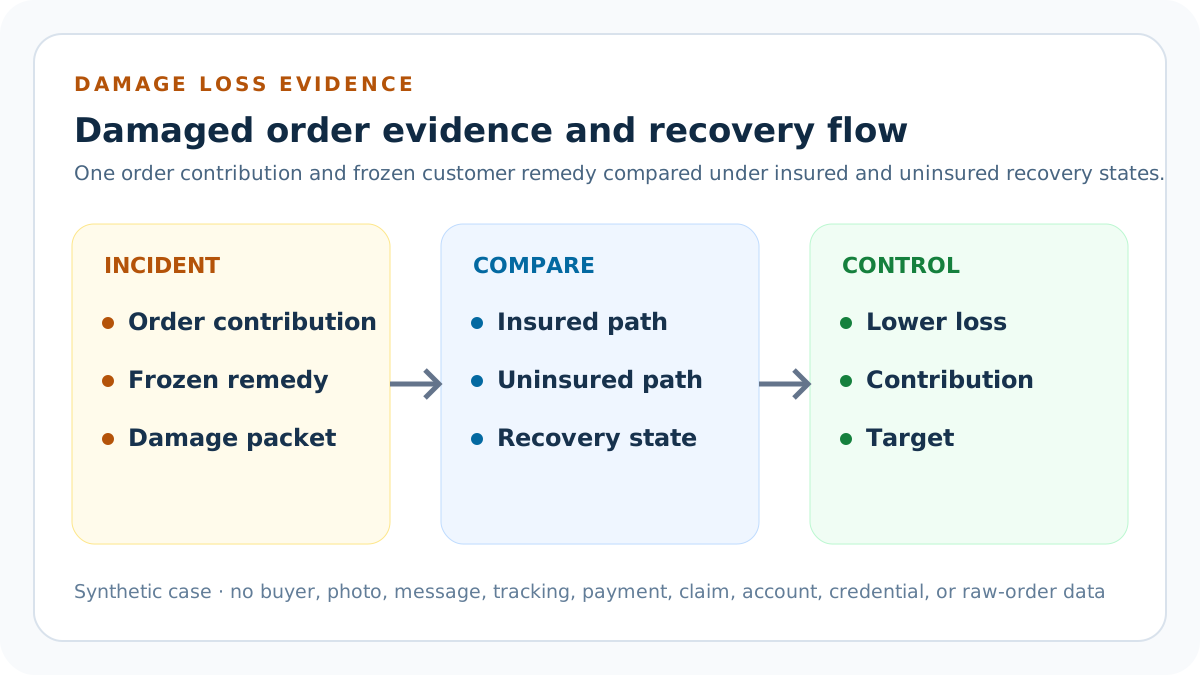
Freeze one damaged physical-order incident
Start with one order alias, one item population, one delivered damage event, one customer-remedy packet, one carrier service, one packaging state, one currency, and one evidence month. These fields define the comparison grain.
Do not combine damage, loss, delay, non-delivery, not-as-described, chargeback, return, and fraud events. A mixed case hides which cost, evidence requirement, recovery path, and authority produced the result.
Keep remedy selection outside this tool
The calculator assumes that the seller has already defined the customer cash returned and any replacement fulfillment. It compares the cost of that frozen packet under insured and uninsured recovery states.
Buyer rights, shop policies, agreements, platform instructions, consumer law, carrier terms, and customer communication decide real obligations. A cheaper scenario cannot cancel, delay, or replace an applicable duty.
Reconstruct original merchandise revenue
Multiply the damaged order item quantity by the original selling price per item. This is the completed merchandise amount before refund, replacement, damage handling, or claim recovery.
Use the transaction currency and completed order version. Do not substitute list price, payout, bank deposit, tax-inclusive reporting totals, claim value, replacement value, or the later refund amount.
Record buyer-paid shipping literally
Add only the shipping amount actually charged to the buyer on the original order. Keep discounts, free-shipping price lifts, tax, duties, tips, and unrelated adjustments outside this field.
A zero buyer shipping charge is valid. Do not invent a shipping allocation merely because the seller paid postage or because a carrier claim later references transportation cost.
Reconstruct original seller cost
Original seller cost equals damaged-item direct product cost plus original outbound shipping plus entered platform and payment fees. This exposes what the order contributed before the damage response.
Keep advertising, overhead, tax, financing, and labor outside unless separately modeled. The tool reports bounded contribution rather than accounting profit or financial-statement loss.
Calculate contribution before damage
Subtract original seller cost from original merchandise revenue plus buyer shipping. This contribution becomes the common starting point for the insured and uninsured damage scenarios.
The comparison does not erase sunk cost. Showing contribution separately prevents refund cash, replacement production, original product cost, and original postage from being counted twice.
Separate customer merchandise refund
Enter the merchandise amount actually or explicitly expected to return to the customer under the frozen remedy packet. The calculator caps it at original merchandise revenue.
A partial refund is not a percentage label; it is a currency amount tied to the transaction version. Keep goodwill credit, shipping refund, tax reversal, and platform-funded refund in separate evidence.
Separate customer shipping refund
Enter original buyer-paid shipping returned to the customer. The amount cannot exceed the shipping charge entered for the original order.
Do not substitute return label cost, replacement postage, carrier refund, or platform fee credit. Each belongs to a different row and has a different owner and evidence state.
Type replacement quantity and current unit cost
If the frozen remedy includes replacement items, multiply replacement quantity by current direct product cost. Use the replacement batch, component, labor, and supplier evidence available at the decision date.
Zero replacement quantity is valid when the remedy contains no replacement. Never reuse original unit cost automatically when materials, labor, supplier pricing, or product configuration has changed.
Type replacement shipping and packaging
Record current replacement outbound postage and packaging as separate amounts. These costs belong to the damage response even if the original shipment used a similar service or box.
Do not net a possible claim recovery against postage. Preserve the gross replacement costs so an auditor can reproduce the response before applying recoveries.
Capture inspection, return, repair, and disposal
Combine only case-specific physical handling that is not recorded elsewhere: return label, inspection, repair attempt, disposal, or damage-assessment work. Preserve the underlying line items privately.
If the damaged item is never returned or inspected, enter zero rather than an invented allowance. If a repaired item becomes sellable, record verified recovered value separately.
Capture seller support and case handling
Enter an explicit seller-owned cost for messages, evidence collection, case log work, claim preparation outside the insured filing row, bookkeeping correction, and exception handling.
Use a documented labor rate and time rule when available. Keep private messages, names, photos, tracking, case records, and credentials outside the public calculator.
Calculate shared response cost
Shared damage-response cost equals customer merchandise refund, customer shipping refund, replacement product, replacement shipping, replacement packaging, physical damage handling, and seller support handling.
The same frozen response packet is used in both coverage scenarios. If the remedy changes, save a new model version rather than disguising a remedy change as an insurance effect.
Recognize only verified platform fee credit
Enter a fee credit only when current platform evidence supports the amount and timing. The field is capped at the original platform and payment fees entered.
A refund preview, policy article, expected reversal, and received ledger credit are different evidence states. Label the state and reopen the model when the actual posting differs.
Value salvage conservatively
Salvage or recovered inventory value must reflect what the damaged item can actually yield after inspection, repair, discount, disposal, fees, and additional handling—not its original selling price.
Unknown value is not zero and not full value. Use a separate scenario or Block when inspection, ownership, return condition, or recovery route remains unresolved.
Separate platform, supplier, and other recovery
Record verified non-carrier recovery such as platform funding, supplier credit, packaging-provider reimbursement, or other evidence-backed cash. Keep each source and date in the protected evidence packet.
Do not merge carrier insurance, fee credits, buyer payments, chargeback reversals, and tax adjustments. Their authority, timing, recoverability, and accounting treatment differ.
Calculate shared verified recovery
Shared verified recovery equals platform fee credit plus salvage or recovered inventory value plus verified platform, supplier, or other recovery. This amount applies to both coverage scenarios.
If a recovery exists only because insurance was purchased, keep it in the insured claim row. Shared recovery must not quietly include the same claim twice.
Enter the insured coverage limit
Use the declared or insured amount supported by the carrier service, label, receipt, certificate, or policy version. The tool blocks a claim recovery above this entered limit.
Coverage limit is not proof of eligibility or payment. Deductibles, exclusions, packaging rules, declared value, proof of value, and filing windows remain external authority questions.
Allocate the insurance premium
Enter only the premium attributable to this shipment or an explicit allocation rule. The insured scenario includes this cost so recovery is not presented as free.
If coverage was included in the service price, document whether zero premium or a postage allocation is the correct seller model. Do not invent a separate premium from a headline coverage amount.
Capture claim preparation and filing cost
Record insured-scenario labor, documentation, photo preparation, packaging preservation, inspection coordination, appeal work, and payment-document handling that exists because the claim is pursued.
Keep this row distinct from general customer support. A claim that appears profitable before filing work may no longer clear the seller target once case-specific effort is included.
Version claim recovery state
Use exactly one state: received, approved, pending, denied, or not filed. Approved and received amounts count as recognized recovery; pending amounts remain visible but are excluded from recognized recovery.
A pending claim triggers Review. Denied and not-filed states count zero claim recovery without pretending the missing recovery is an error in the arithmetic.
Calculate insured damage loss
Insured incremental damage loss equals shared response cost plus allocated insurance premium plus claim filing cost minus shared verified recovery and recognized insured claim recovery.
This is a seller-side model, not a carrier-liability opinion. It does not certify packaging, filing eligibility, proof sufficiency, covered value, claim timing, or reimbursement.
Enter uninsured recovery separately
The uninsured scenario can include a verified recovery that does not depend on the insured claim, but it must not duplicate shared platform, supplier, fee-credit, or salvage rows.
Zero is valid when no uninsured recovery exists. A hypothetical goodwill payment, unfiled carrier request, or expected negotiation is not verified recovery.
Calculate uninsured damage loss
Uninsured incremental damage loss equals shared response cost minus shared verified recovery and verified uninsured recovery. It excludes insured premium, claim filing cost, and insured claim proceeds.
This counterfactual isolates the coverage layer while holding the remedy constant. It does not advise the seller to skip insurance or abandon a valid claim.
Compare remaining contribution
Subtract each scenario loss from original contribution before damage. Remaining contribution shows how much of the order economics survives the incident under the entered evidence.
A negative result is not automatically the accounting loss. Taxes, overhead, ads, inventory accounting, claim receivables, chargebacks, and later recoveries may require separate treatment.
Read the loss difference
The absolute difference between insured and uninsured loss shows the modeled economic effect of premium, filing cost, and recognized scenario-specific recovery for this one incident.
The difference does not estimate future claim frequency, carrier performance, insurance value across a portfolio, or the probability that another claim will be approved.
Set a seller-owned maximum loss
Enter the maximum incremental damage loss the seller is willing to accept for this case or product class. Headroom equals the target minus the lower modeled loss.
A negative headroom produces Review, not an instruction to deny a remedy or manipulate a claim. Escalate product, packaging, carrier, price, reserve, and coverage decisions separately.
Bound loss against the original buyer amount
Divide the lower modeled damage loss by the original gross buyer amount. Compare that percentage with a seller-entered maximum that may exceed 100% because a refund, replacement, support, and claim process can cost more than the original order.
This exposure ratio is a management control, not a carrier or marketplace limit. Record the threshold owner, rationale, effective date, product class, and escalation path instead of borrowing a universal percentage.
Require a material scenario difference
Divide the absolute insured-versus-uninsured loss difference by the larger absolute scenario loss. Review the packet when the difference is below the seller-entered minimum and cost does not clearly distinguish the two recovery states.
A small difference does not invalidate either scenario. It means coverage, customer, evidence, timing, operational burden, and authority considerations deserve more weight than a numerically narrow gap.
Date the source review
Record a real YYYY-MM-DD review date for the order, remedy, damage, shared recovery, coverage, claim, carrier, and platform sources. The date is separate from the monthly evidence cohort used for aggregation.
A valid calendar date does not prove freshness by itself. Store version, owner, effective rule, transaction state, claim state, payment state, and the next required review in the protected packet.
Confirm nine evidence controls
Require yes for original order, customer remedy, damage evidence, shared recovery, coverage terms, insured claim state, uninsured recovery, source lineage, and planning boundary. Any missing confirmation Blocks the result.
A confirmation means the named record and authority were checked; it is not a checkbox substitute for evidence. Preserve redacted pointers, reviewer, timestamp, exception, and correction route.
Reject blank and non-finite numbers
Treat blank, NaN, infinity, fractional order quantity, fractional replacement quantity, negative cost, impossible date, invalid threshold, and incomplete confirmation as structural defects. Do not coerce them to zero.
When structure Blocks, mask losses, contribution, ratios, thresholds, and target outputs. This prevents an invalid packet from presenting plausible money or percentage values that could be copied into a decision.
Use Block, Review, and Ready correctly
Block means structure or evidence is invalid. Review means the math is valid but recovery is pending, scenarios tie, or the lower loss exceeds target. Ready means only that the entered comparison clears those controls.
Ready does not mean claim approved, customer satisfied, platform protected, legally compliant, or financially profitable. It means the bounded calculation is reproducible under current evidence.
Protect damage evidence and buyer privacy
Store names, addresses, emails, messages, photos, tracking, case logs, invoices, payment records, carrier accounts, credentials, and raw order data in authorized systems. Use aliases and redacted pointers in the model.
Public examples and visuals are synthetic. Access, retention, correction, and deletion rules remain part of the protected evidence process rather than the SEO page.
Release and monitor the calculator safely
Before release, preserve local and remote backups, a rollback identifier, and deterministic fixtures. Run typecheck, full tests, integration, build, content, duplicate, SEO, route, image, link, mobile, keyboard, privacy, and restore checks.
After release, verify status, canonical, indexability, schema, answer blocks, images, tool interactions, strict 404, sitemap policy, events, and production scenarios. Record Day 0/7/14/28 evidence and restore on regression.
Sources and further reading
- Seller Profit Guard methodology: Deterministic calculations, evidence versions, privacy, validation, correction, release, and rollback.
- Seller Profit Guard data privacy: Local-first boundaries for buyer, message, tracking, case, payment, claim, account, image, and raw-order data.
- Etsy Help: Purchase Protection for Sellers: Official eligibility, damage-case, primary-coverage, order-value, and seller-responsibility context.
- Etsy Help: Refunds, Returns, and Exchanges for Sellers: Official seller-policy, agreement, replacement-proof, and current Purchase Protection context.
- Etsy Help: Resolve a Case from a Buyer: Official damaged-item case, evidence-request, communication, and resolution context.
- USPS: File a Claim: Official domestic insurance-claim evidence, filing-window, insurance, value, and damage context.
- UPS: File a Claim: Official claim timing, tracking, packaging, contents, invoice, photo, review, and payment-document context.
- UPS: Supporting Documents for Claims: Official supporting-document, merchandise-description, photo, package-dimension, inspection, delay, and denial context.
Related Seller Profit Guard tools
- Etsy CSV profit calculator: Run a local order profit check with editable fee and SKU cost assumptions.
- Payment reconciliation tool: Compare order rows with statement activity and flag unmatched rows.
- SKU cost library: Save or import material, labor, packaging, shipping, and target margin assumptions.
- Variant risk checker: Find missing SKUs and variation cost risks before a listing scales.
- Etsy title checker: Review listing-title clarity, repetition, keyword chains, and mobile scanning.
- Etsy tag checker: Review all 13 tag slots for duplicates, repeated meaning, and truthful coverage.
- Free shipping threshold calculator: Estimate when a shipping subsidy can still meet a target margin.
- Return window loss estimator: Model expected reverse shipping, restock work, recovery, and replacement loss.
- Etsy Ads break-even calculator: Estimate target-safe Etsy Ads spend, ACOS, and ROAS after fees, fulfillment, and expected return loss.
- CSV data privacy: Understand what the local-first workflow needs and what it does not need.
- Damaged Order Loss Formula and Inputs: Define original contribution, one frozen damage remedy, shared recovery, insured claim recovery, uninsured recovery, and target headroom.
- Insured Damaged Order Worked Example: Work a complete insured damage case from original contribution through remedy cost, verified recovery, recognized claim proceeds, and target headroom.
- Uninsured and Denied Damage Scenario: Model an uninsured or denied-claim damage case without inventing carrier recovery, then compare response loss, remaining contribution, and target risk.
- Damaged Order Loss Calculation Mistakes: Diagnose double-counted costs, invented recovery, inflated salvage, mixed incidents, stale claim states, privacy leaks, and false remedy conclusions.
- Damaged Order Loss Data Sources: Map each damage-loss input to protected order, cost, remedy, inspection, carrier, claim, fee-credit, salvage, platform, and payment evidence.
- Damaged Order Loss Decision Thresholds: Set structural, evidence, recovery-state, seller-loss, contribution, recurrence, and escalation thresholds without turning cost into remedy authority.
- Insured vs Uninsured Damage Loss: Compare one frozen damaged-order remedy under insured and uninsured recovery states and isolate premium, filing, recognized recovery, and target effects.
- Weekly Damaged Order Loss Routine: Run a repeatable damage-case control loop for intake, privacy, evidence, remedy freeze, claim state, calculation, triage, correction, and prevention.
- Interpret Damaged Order Loss Results: Read incremental loss, remaining contribution, recovery state, difference, and target headroom without claiming liability, eligibility, or remedy proof.
- Damaged Order Loss Audit Template: Audit damage-case grain, original economics, remedy, recoveries, coverage, claim states, formulas, privacy, sources, tests, release, and rollback.
Use the interactive tool
Enable JavaScript to open the calculator and process browser-local inputs. The explanatory content and source links remain available without JavaScript.
Related guide: Define damaged-order loss, recovery recognition, contribution, and authority boundaries.
This tool provides operating estimates, not tax, accounting, legal, financial, or marketplace-policy advice. Verify current official sources and your own records before changing prices or operations.