Seller Profit Guard · How it works · CSV privacy
Seller CSV import validator
Check two materially distinct synthetic seller CSV fixtures for declared delimiters, quoted fields, required and duplicate headers, row-width consistency, IDs, numeric cells, formula-like values, unsafe columns, byte and line limits, dated evidence, minimum row coverage, and nine explicit control confirmations. Any hard failure masks scenario metrics and blocks the result. It runs locally and never imports, maps, reconciles, uploads, or stores a production file.
Maintained by Seller Profit Guard Editorial Team. Last reviewed: 2026-07-31.
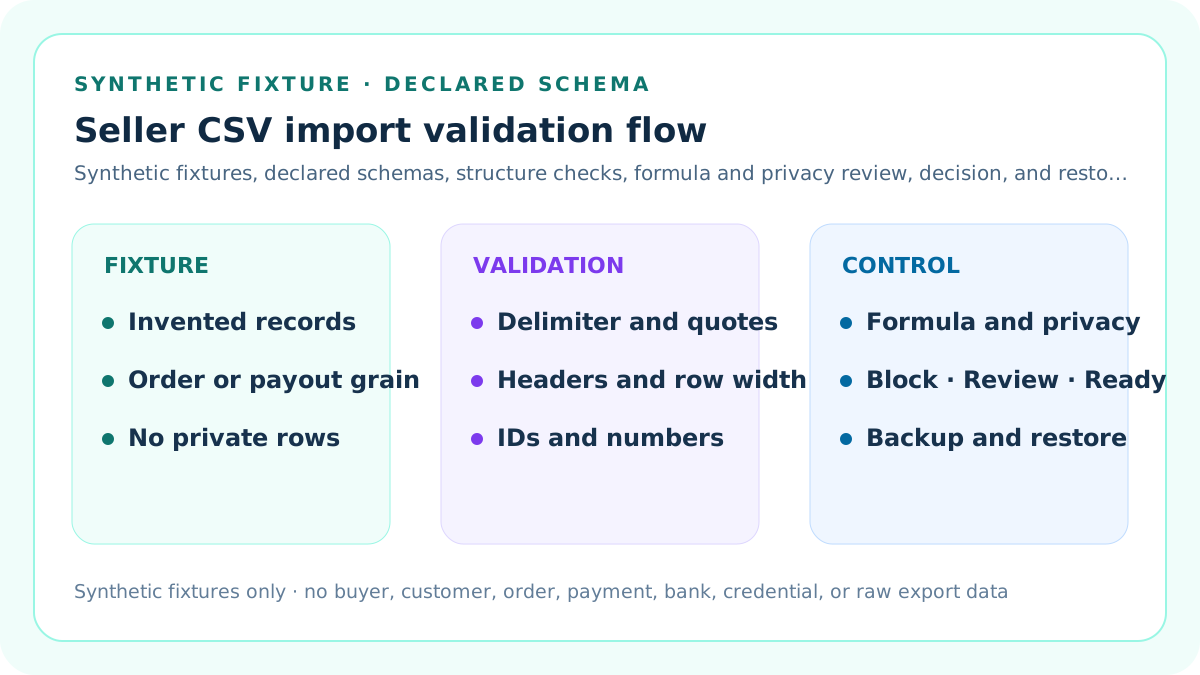
Use synthetic fixtures only
Paste synthetic or irreversibly redacted rows that reproduce the schema problem without exposing a person, order, payment, address, bank account, credential, or source export. The checker runs in the browser, but privacy still begins with data minimization.
The included examples are invented and contain no buyer records.
Declare Scenario A
Scenario A represents an Etsy-like order schema with order reference, SKU, quantity, and item total. It is a structural fixture, not an assertion about Etsy's current export headers or a substitute for the seller's own source dictionary.
Keep platform schemas versioned outside this public calculator.
Declare Scenario B
Scenario B represents a marketplace payout schema with payout reference, transaction type, gross amount, fee amount, and net amount. It tests a second grain so an order export is not silently treated as a payout statement.
Order and payout files require different mappings.
Choose the delimiter explicitly
Select comma, tab, semicolon, or pipe for each fixture. A delimiter is part of the schema; guessing from a single line can split quoted text incorrectly or collapse every record into one field.
The validator rejects undeclared delimiter names.
Preserve quoted delimiters
RFC 4180 describes double-quoted fields for values containing commas, double quotes, or line breaks and doubles an embedded quote. The parser keeps a quoted comma inside one cell instead of manufacturing an extra column.
The default SKU fixture demonstrates a quoted comma.
Check the header row
A header gives names to columns but is not a data record. Compare its field count with every record and treat duplicate or blank schema names as defects that require correction before mapping.
Header presence alone does not prove semantic meaning.
List required headers
Enter the minimum columns needed by the intended local workflow. Missing required names block the fixture because downstream logic cannot safely infer which column represents an identifier, quantity, gross amount, fee, or net amount.
Required lists remain scenario-specific.
Declare one unique ID
Name the column that should uniquely identify the record at its declared grain. Blank or repeated identifiers block the fixture because joins, updates, deduplication, and reconciliation can otherwise overwrite or multiply records.
Uniqueness is checked only inside the pasted fixture.
Declare numeric columns
List fields expected to contain numbers. The checker accepts ordinary negative numeric values in declared numeric columns, which supports refund-like examples, but it does not infer currencies, decimal separators, units, taxes, or accounting sign conventions.
Semantic validation remains a separate control.
Check row width
Every nonblank record should contain the same number of parsed fields as the header. A row-width mismatch often signals an unquoted delimiter, malformed quote, trailing separator, broken line, or wrong delimiter.
The validator reports counts without echoing row content.
Detect unclosed quotes
A quoted field that never closes can absorb later separators and line breaks. The parser blocks the fixture rather than guessing where the record ends, because a seemingly small quote defect can shift many downstream cells.
Repair the source-generation rule, not only one row.
Detect duplicate headers
Two columns with the same normalized name make name-based mapping ambiguous. Rename or version the schema before import and document how the source fields differ instead of allowing the last matching column to win silently.
Do not merge columns merely because labels resemble each other.
Detect blank identifiers
A row without the declared identifier cannot be reliably joined, corrected, or traced. Count and resolve blank identifiers at the source; do not invent production IDs inside this public checker.
A synthetic fixture may use invented stable references.
Detect duplicate identifiers
Repeated values in the declared unique ID field can represent duplicates, line items at a different grain, legitimate revisions, or an incorrect uniqueness assumption. The checker blocks and requires the operator to resolve the grain.
It does not delete or merge records automatically.
Detect invalid numeric cells
A nonempty declared numeric cell must parse as a finite number after common currency, percentage, and grouping marks are removed. Text, mixed units, or malformed values block the fixture for explicit normalization.
This permissive parse is not an accounting-format validator.
Detect formula-like cells
OWASP warns that spreadsheet applications can interpret cells beginning with equals, plus, minus, or at signs as formulas. This checker flags formula-like text while allowing a finite negative number in a declared numeric column.
No sanitization works universally for every spreadsheet and importer.
Screen unsafe headers
Headers that indicate buyers, customers, names, email, phone, addresses, payment, cards, banks, accounts, tokens, passwords, secrets, keys, or credentials block the public fixture. Remove the column rather than masking one example value.
A harmless-looking value does not make a sensitive field public-safe.
Treat BOM as review
A UTF-8 byte-order marker at the start of pasted text is removed from the first header for comparison but still triggers Review. Confirm the receiving application accepts the encoding before a local test import.
Encoding compatibility is outside this browser's proof.
Count blank lines
Blank lines do not become data rows, but their presence triggers Review because different importers may handle them differently. Remove unintended blank records and regenerate the synthetic fixture from the controlled source.
A final line break alone is not a business record.
Set structural tolerance carefully
Zero is the safest default. A positive tolerance can move a nonprivacy structural count into Review, never Ready, but it cannot override unsafe headers, invalid evidence, short scope, or declared conflicts.
Tolerance is an escalation policy, not permission to import defects.
Require dated evidence and nine confirmations
Enter a real source-review date and policy-effective date, keep the policy date no later than the source review, and affirm all nine synthetic-data, parser, schema-grain, identifier, formula/privacy, counterexample, restoration, threshold-ownership, and import-authority controls. A missing confirmation blocks the result rather than converting uncertainty into readiness.
The confirmations document seller responsibility; they do not certify a platform or production file.
Set a minimum synthetic-row threshold
Choose the minimum data-row count each fixture must contain before Ready is possible. A smaller otherwise-valid fixture moves to Review so the operator can expand edge-case coverage without pretending that a header-only or one-row example represents the receiving workflow.
The threshold is bounded to 1–100 rows and still does not prove full-file coverage.
Keep the two schema contracts distinct
The order fixture and payout fixture must differ in delimiter/schema, required headers, unique identifier, or numeric-field contract. Copying one contract into both scenarios blocks the result because it would test one grain twice while claiming cross-workflow coverage.
Distinct fixtures reduce false confidence; they do not establish semantic mapping.
Read Block
Block means at least one structural defect exceeds tolerance, an unsafe header exists, evidence or scope is invalid, or a known conflict remains open. Stop and repair the schema or fixture before any import attempt.
Block does not diagnose the production file automatically.
Read Review
Review means the fixture remains inside the entered tolerance but contains cleanup signals such as BOM, blank lines, or tolerated structural defects. A named reviewer should correct or explicitly accept the bounded issue.
Review is never equivalent to platform acceptance.
Read Ready
Ready means both synthetic fixtures match their declared schema and clear the implemented checks. It proves only this pasted fixture under these inputs; it does not validate all rows, field meaning, platform rules, mappings, reconciliation, or privacy compliance.
Run a small controlled local import separately.
Separate structure from semantics
A column named net_amount can contain a valid number yet follow the wrong sign, currency, fee basis, period, timezone, or transaction grain. Structural validity is necessary but cannot establish accounting or business meaning.
Preserve a source data dictionary and mapping review.
Separate validation from import
The tool never uploads a file, writes a mapping, alters a workbook, connects to a marketplace, or runs an import. Use it to prepare a bounded fixture, then follow the receiving system's documented backup, test, and rollback process.
Human authorization remains outside the calculator.
Reconcile the closed period
Use YYYY-MM to identify the closed evidence period represented by the schema review. A changing live period can mix revisions, late transactions, refunds, and payout adjustments that have not matured.
The date field documents evidence; it does not freeze source systems.
Write a precise scope
Record source family, schema version, delimiter, encoding, record grain, required fields, ID, numeric fields, exclusions, synthetic status, intended receiving workflow, owner, reviewer, and rollback reference.
A short label cannot establish safe comparability.
Preserve a schema ledger
Store the approved header list, field definitions, types, units, signs, null rules, uniqueness assumptions, source version, example fixtures, transformation version, owner, reviewer, and prior accepted mapping in an authorized system.
Do not store private source rows in public content.
Run counterexamples
Test a quoted comma, embedded escaped quote, missing required header, duplicate header, wrong delimiter, row-width mismatch, blank ID, duplicate ID, invalid number, formula-like value, unsafe header, BOM, blank line, and open conflict.
A validator without failing fixtures is not adequately evidenced.
Monitor schema drift
After acceptance, compare new source headers, order, encoding, delimiter, types, enum values, identifiers, signs, and grains with the approved fingerprint. Stop when an unexplained change appears.
Do not silently adapt production mappings to drift.
Define rollback
Before an authorized import, preserve the source pointer, approved fixture, mapping, receiving-system backup, prior accepted state, importer version, operator, reviewer, timestamp, stop condition, and restoration test.
This public checker does not create or verify the backup.
Release through quality gates
Index the tool cluster only after typecheck, unit, integration, build, content, similarity, metadata, schema, image, link, privacy, mobile, backup, deployment, and live checks pass in ordered release batches.
Search signals are measured later, not used as the release gate.
Sources and further reading
- IETF RFC 4180: Common Format and MIME Type for CSV Files: Informational CSV record, header, field-count, quoting, escaped-quote, line-break, charset, and privacy context.
- W3C CSV on the Web Primer: Official schema, column title, datatype, required-value, and uniqueness validation context.
- OWASP: CSV Injection: Formula-injection characters, separator boundaries, spreadsheet behavior, and mitigation limitations.
- Shopify Help: Using CSV files: Official example of platform-specific CSV structure, editing, import, export, and backup risk.
- Seller Profit Guard methodology: Evidence, formula, privacy, correction, release, monitoring, and rollback controls.
- Seller Profit Guard data privacy: Local-first boundaries for customer, buyer, payment, order, credential, bank, and raw export records.
Related Seller Profit Guard tools
- Etsy CSV profit calculator: Run a local order profit check with editable fee and SKU cost assumptions.
- Payment reconciliation tool: Compare order rows with statement activity and flag unmatched rows.
- SKU cost library: Save or import material, labor, packaging, shipping, and target margin assumptions.
- Variant risk checker: Find missing SKUs and variation cost risks before a listing scales.
- Etsy title checker: Review listing-title clarity, repetition, keyword chains, and mobile scanning.
- Etsy tag checker: Review all 13 tag slots for duplicates, repeated meaning, and truthful coverage.
- Free shipping threshold calculator: Estimate when a shipping subsidy can still meet a target margin.
- Return window loss estimator: Model expected reverse shipping, restock work, recovery, and replacement loss.
- Etsy Ads break-even calculator: Estimate target-safe Etsy Ads spend, ACOS, and ROAS after fees, fulfillment, and expected return loss.
- CSV data privacy: Understand what the local-first workflow needs and what it does not need.
- CSV Validator Fields and Checks: Define two synthetic fixtures, delimiters, required headers, unique IDs, numeric columns, tolerance, period, scope, privacy, and decisions.
- Seller Order CSV Worked Example: Validate a synthetic Etsy-like order fixture with quoted commas, required headers, row width, unique IDs, numbers, privacy, and a Ready result.
- Marketplace Payout CSV Scenario: Validate a synthetic payout fixture with transaction types, negative refund values, numeric fields, schema boundaries, privacy, and a Ready result.
- CSV Import Validation Mistakes: Find raw-data exposure, delimiter, quote, header, width, ID, number, formula, semantic, tolerance, authority, and rollback mistakes.
- CSV Schema Data Sources and Evidence: Map source version, delimiter, encoding, grain, headers, types, IDs, signs, units, exclusions, privacy, owners, and rollback evidence.
- CSV Validation Decision Thresholds: Set zero-defect, review-tolerance, privacy, evidence, scope, approval, stop, restoration, and drift controls without weakening import safety.
- Order vs Payout CSV Validation: Compare order and payout fixtures at their correct grains and isolate schema, identifiers, numeric signs, privacy, mapping, and reconciliation differences.
- Weekly CSV Import Validation Routine: Run source, schema, synthetic-fixture, privacy, counterexample, backup, test-import, reconciliation, monitoring, and restoration checks on a schedule.
- How to Interpret CSV Validator Results: Read rows, columns, structural errors, identifiers, numbers, formula flags, unsafe headers, evidence, and decision boundaries without overclaiming.
- CSV Import Validation Audit Template: Audit schema provenance, parsing, privacy, fixtures, counterexamples, mapping, backup, authorization, monitoring, and restoration evidence.
- CSV Privacy Redactor Formula and Input Contract: Define purpose, source, grain, header-only input, required allowlist, keep, remove, review, retention, ownership, and restoration.
- CSV Privacy Redactor Worked Example: Order Export: Reduce an invented Shopify-like order schema to item-level profit fields while removing contact, address, notes, payment-reference, and device columns.
- Date and Currency Normalizer Formula Contract: Define source pattern, calendar validation, UTC offset, decimal convention, currencies, rate direction, observation date, rounding, and evidence.
- Date and Currency Normalizer US Worked Example: Reperform one MM/DD/YYYY event, negative UTC offset, comma-grouped decimal-point amount, USD source, EUR target, and dated rate.
- Export Schema Contract: 9 Inputs Before Automation: Define expected and observed headers, types, required fields, aliases, additions, version dates, row grain, and rollback before automating an export.
- Export Schema Checker Example: One Added Column: Work a complete export schema example where an optional field is added without breaking a name-based parser or exposing seller rows.
Use the interactive tool
Enable JavaScript to open the calculator and process browser-local inputs. The explanatory content and source links remain available without JavaScript.
Related guide: Define synthetic fixtures, delimiter, schema, row, identifier, numeric, formula, privacy, evidence, and rollback controls.
This tool provides operating estimates, not tax, accounting, legal, financial, or marketplace-policy advice. Verify current official sources and your own records before changing prices or operations.