Seller Profit Guard · How it works · CSV privacy
Combined Shipping Margin Calculator
A combined shipping margin calculator adds merchandise revenue and buyer-paid shipping, then subtracts direct item cost, one-parcel postage, packaging, handling, and seller-entered fees. It separately reports order contribution, shipping-side funding, and postage savings versus comparable separate parcels.
Maintained by Seller Profit Guard Editorial Team. Last reviewed: 2026-07-31.
Define one combined-order grain
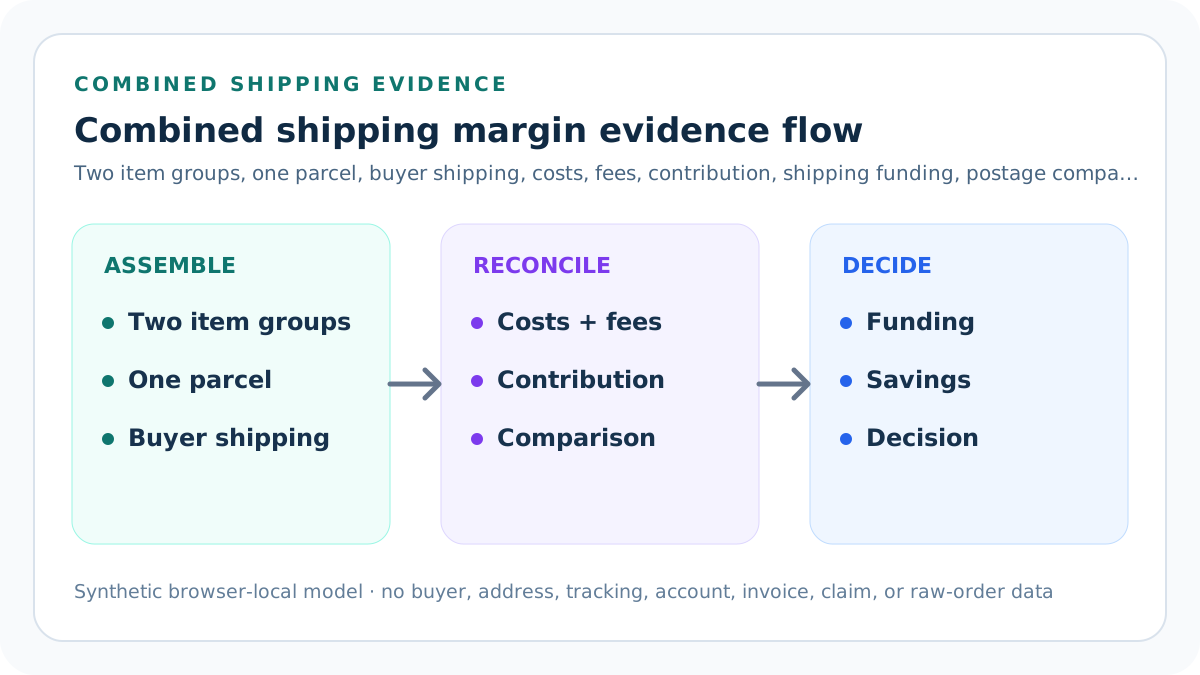
A combined-shipping model begins with one completed order containing two item groups that leave together in one finished parcel. Freeze quantities, unit prices, direct costs, product weights, buyer-paid shipping, package, service pattern, destination class, currency, and evidence month.
Do not combine a listing estimate, a label purchase, an invoice adjustment, and an order from another period. The result becomes reproducible only when every monetary and physical input describes the same modeled shipment.
Separate item groups before combining them
Record quantity, unit selling price, direct product cost, and unit product weight for item group one and item group two. Two groups can represent two SKUs, two sizes, or two products with materially different economics.
Preserving each group prevents a high-margin item from hiding a weak companion and prevents an average unit cost from being applied to unlike products. Add more groups in a protected working ledger before rolling them into the two-group public model.
Calculate merchandise revenue
Merchandise revenue equals item-one quantity multiplied by its unit price plus item-two quantity multiplied by its unit price. Keep discounts, refunds, and tax outside this line unless the seller deliberately creates a new comparable scenario.
Revenue is not cash deposited, profit, or buyer shipping. The formula preserves merchandise and shipping as separate lines so a seller can see whether the parcel is funded by item economics or by the shipping charge.
Calculate direct item cost
Direct item cost equals each group quantity multiplied by its seller-entered unit direct cost, then summed. Use the cost convention already approved for the decision: material and acquisition cost at minimum, with any other direct components named.
Do not silently mix replacement cost, historical cost, retail value, and fully allocated accounting cost. The calculator reports a management contribution scenario, so its direct-cost boundary must be explicit and stable.
Record product weights independently
Multiply each group quantity by its unit product weight and sum the result. This summed item weight is a validation floor for the finished combined package, not a carrier quote or billable-weight result.
The finished parcel normally weighs at least as much as its products because packaging and protection add mass. A parcel weight below summed item weight triggers Block until quantities, units, scale evidence, or product weights are corrected.
Measure the finished combined parcel
Enter actual finished-package weight plus outer length, width, and height after all items, cushioning, closure, labels, and exterior packaging are present. Preserve scale, measurement tool, operator, date, unit, and repeat result.
Package measurements explain the physical scenario but do not directly quote postage. A mixed-size combination can cross dimensional, oversize, service, or package-class boundaries that a simple product-weight sum cannot detect.
Enter buyer-paid shipping once
Use the shipping amount collected for the combined order under the same currency and transaction grain. If shipping was free, enter zero and allow merchandise contribution to fund the parcel visibly.
Do not add item price allocated to shipping unless the business maintains a separate documented pricing analysis. The calculator keeps the buyer shipping line literal so it cannot manufacture shipping recovery.
Use actual combined-parcel postage
Enter the purchased label, current qualified quote, or final invoice postage for the combined parcel and declared service pattern. If the carrier later adjusts the charge, create a new evidence version rather than overwriting history.
Postage excludes packaging and handling in this model because those costs have their own lines. It also excludes taxes, customs, insurance, surcharges, or accessorials unless the seller has deliberately incorporated them into the evidenced postage amount.
Build a valid separate-parcel comparison
The separate-shipment postage total must represent the same items, destination class, service objective, evidence period, and seller eligibility if they were sent in separate parcels. It is a counterfactual benchmark, not an automatically available option.
Using a retail quote for one side and a negotiated invoice for the other creates false savings. Store both package assumptions and every changed service field so the comparison remains attributable.
Calculate postage savings
Postage savings equals comparable separate-shipment postage total minus actual combined-parcel postage. Divide that result by the separate total to calculate the postage-saving rate, then compare it with the seller-entered minimum.
The threshold is a seller planning control, not a carrier promise. Postage savings is not combined-order contribution and excludes item revenue, item cost, packaging, handling, fees, refunds, damage risk, customer promise, and the operational cost of consolidation.
Assign packaging cost
Enter the direct packaging cost used by the combined parcel: box or mailer, insert, label, tape, fill, protection, and any other approved per-order allocation. Use the same quantity and waste convention as the packaging cost ledger.
Do not assume one larger box always costs less than two small packages. A mixed-size order may require stronger protection, void fill, or a different package class even when postage is lower.
Assign handling cost
Handling cost represents the seller-entered value of pick, pack, verify, consolidate, measure, weigh, label, and exception time assigned to this combined order. Keep its time and rate basis outside the public packet but preserve the approved total.
Handling is not automatically recovered by a buyer shipping charge. Keeping it separate reveals when apparent postage savings are consumed by consolidation labor or exception work.
Define the fee convention
The model applies one seller-entered percentage to merchandise revenue plus buyer-paid shipping, then adds one seller-entered fixed fee. This is an editable scenario, not a built-in marketplace fee schedule.
If a platform uses different bases, tiers, taxes, caps, fixed fees, ad fees, currency conversion, or country rules, calculate the applicable fee evidence externally and enter a compatible combined convention or use a more specific fee tool.
Calculate gross buyer amount
Gross buyer amount equals merchandise revenue plus buyer-paid shipping. It is the denominator used for the displayed contribution margin and the base used by the seller-entered percentage fee.
Gross buyer amount is not payout, deposit, taxable revenue, recognized revenue, or profit. Those accounting and tax classifications remain outside the tool.
Calculate combined-order contribution
Combined-order contribution equals gross buyer amount minus direct item cost, combined postage, combined packaging, combined handling, percentage fee, and fixed fee. The calculator retains full precision and displays currency to two decimals.
The result is a bounded management contribution before overhead, advertising, returns, replacements, taxes, financing, owner compensation outside handling, and other excluded costs. It must not be labeled net profit.
Read contribution per unit
Contribution per unit divides combined-order contribution by the total quantity across both item groups. This helps compare order shapes with different unit counts while preserving the order total.
Per-unit contribution can hide which item drives the result. Review the two group inputs and do not allocate the displayed average back to individual SKUs without a documented allocation method.
Read contribution margin
Contribution margin divides combined-order contribution by gross buyer amount. Use it to compare scenarios only when currency, fee convention, cost scope, product mix, service, and evidence timing are comparable.
A percentage can improve while absolute contribution falls, or absolute contribution can rise while percentage falls. Keep both outputs visible before changing a bundle, shipping policy, or promotion.
Isolate shipping-side contribution
Shipping-side contribution equals buyer-paid shipping minus postage, packaging, handling, and the percentage-fee share attributable to the shipping charge. A negative value shows the amount funded by merchandise contribution under this convention.
A negative shipping-side result is not automatically wrong, especially when a seller deliberately offers free or subsidized shipping. It triggers Review so the funding source remains visible rather than being mistaken for carrier savings.
Compare seller-owned thresholds
Target headroom equals combined-order contribution minus the seller-planned minimum contribution. Also compare the postage-saving rate with its minimum and package-minus-item weight as a share of finished weight with its maximum.
These are internal decision boundaries, not carrier limits, marketplace policies, guaranteed margins, accounting break-even, or recommendations. Record owner, purpose, approval, population, effective date, and expiry for every threshold.
Read the two-similar-item fixture
The default synthetic fixture sells two units at USD 25 each, collects USD 10 shipping, assigns USD 16 direct item cost, USD 6 postage, USD 1 packaging, USD 2 handling, and a 10% plus USD 0.30 fee convention.
Gross buyer amount is USD 60, total modeled fees are USD 6.30, and combined contribution is USD 28.70. Separate postage of USD 12 creates USD 6 postage savings, while shipping-side contribution is exactly zero.
Read the mixed-size fixture
A second synthetic fixture combines a USD 25 item with a USD 60 item, uses USD 33 direct item cost, USD 12 postage, USD 2 packaging, USD 3 handling, USD 10 buyer shipping, and the same fee convention.
Combined contribution is USD 35.20 and separate-parcel postage savings are USD 3, but shipping-side contribution is negative USD 8. The Review result shows why positive order contribution and postage savings do not prove that shipping pays for itself.
Apply Block, Review, and Ready precedence
Block blank, non-finite, nonpositive, fractional-quantity, or structurally invalid evidence; invalid thresholds, fee percentage, currency, units, source date, month, scope, incomplete confirmations, package weight below item weight, or declared conflicts.
After structure passes, Review negative contribution headroom, negative shipping-side contribution, postage saving below the seller minimum, or packaging-weight share above its seller maximum. Ready clears only those bounded checks and never certifies broader profitability.
Build a privacy-safe evidence packet
Store seller alias, item-group aliases, aggregate quantities, prices, costs, weights, package measurements, shipping charge, cost allocations, fee convention, three seller thresholds, source-review date, nine evidence confirmations, month, scope, reviewer, and protected source pointers.
Keep buyer names, addresses, tracking numbers, labels, account identifiers, negotiated rate cards, invoices, credentials, claims, raw order exports, and private messages outside public tools, screenshots, guides, analytics, and support drafts.
Test the calculation contract
Reproduce Ready similar items, Review mixed-size shipping funding, below-target Review, configurable savings and packaging-share Review, invalid-number Block, fractional-quantity Block, impossible-date Block, incomplete-confirmation Block, and declared-conflict Block fixtures.
Test price, cost, fee, unit, weight floor, comparison, zero shipping, thresholds, output masking, and rounding boundaries; then run typecheck, unit, integration, build, SEO, duplicate, mobile, live, and rollback checks with synthetic evidence.
Choose the next action from the driver
If Block, repair the evidence structure. If Review is target-driven, adjust economics or reject the combination. If shipping funding is negative, decide explicitly whether merchandise contribution may fund it. If combined postage is higher, compare package and service alternatives.
Use a carrier or authorized rate source to validate availability and price. Preserve the prior scenario so every change in item mix, package, service, buyer charge, cost, or fee remains attributable.
Sources and further reading
- Seller Profit Guard methodology: Comparable-grain evidence, deterministic calculations, validation, correction, release, and rollback.
- Seller Profit Guard data privacy: Local-first boundaries for buyer, address, tracking, account, invoice, credential, claim, and raw order data.
- Etsy: How to Set Up Calculated Shipping: Official Etsy explanation reviewed 2026-07-31 for order weight, item dimensions, package preferences, buyer location, and calculated shipping.
- Etsy Fees & Payments Policy: Official Etsy policy reviewed 2026-07-31 for transaction-fee and payment-processing bases that can include shipping; sellers must enter the applicable current convention.
- UPS: Shipping Dimensions and Weight: Official U.S. UPS context reviewed 2026-07-31 for finished-package dimensions, actual weight, dimensional weight, and billable-weight rules.
- FedEx: What Is Dimensional Weight?: Official U.S. FedEx context reviewed 2026-07-31 for package measurement, dimensional weight, and comparison with actual weight.
Related Seller Profit Guard tools
- Etsy CSV profit calculator: Run a local order profit check with editable fee and SKU cost assumptions.
- Payment reconciliation tool: Compare order rows with statement activity and flag unmatched rows.
- SKU cost library: Save or import material, labor, packaging, shipping, and target margin assumptions.
- Variant risk checker: Find missing SKUs and variation cost risks before a listing scales.
- Etsy title checker: Review listing-title clarity, repetition, keyword chains, and mobile scanning.
- Etsy tag checker: Review all 13 tag slots for duplicates, repeated meaning, and truthful coverage.
- Free shipping threshold calculator: Estimate when a shipping subsidy can still meet a target margin.
- Return window loss estimator: Model expected reverse shipping, restock work, recovery, and replacement loss.
- Etsy Ads break-even calculator: Estimate target-safe Etsy Ads spend, ACOS, and ROAS after fees, fulfillment, and expected return loss.
- CSV data privacy: Understand what the local-first workflow needs and what it does not need.
- Combined Shipping Margin Formula and Inputs: Define item groups, package evidence, buyer shipping, postage, packaging, handling, fees, comparison postage, target, and scope.
- Combined Shipping Margin Worked Example: Reproduce two similar USD 25 items in one parcel with buyer shipping, postage, package, handling, fees, comparison postage, and target.
- Combined Shipping Margin for Mixed-Size Items: Model a small item and a larger item whose one-parcel contribution is positive while the shipping-side subledger remains negative.
- Combined Shipping Margin Calculator Mistakes: Find quantity, item-cost, package-weight, postage, fee-base, comparison, allocation, privacy, and interpretation defects.
- Combined Shipping Margin Data Sources: Build protected lineage for item economics, weights, package, buyer shipping, postage, packaging, handling, fees, targets, and comparisons.
- Combined Shipping Margin Decision Thresholds: Separate structural Block, contribution, shipping funding, minimum postage saving, maximum packaging-weight share, stress, and rollback thresholds.
- Similar vs Mixed-Size Combined Shipping: Compare two similar items with a mixed-size order at the same ledger grain and attribute contribution, funding, package, and postage drivers.
- Combined Shipping Margin Operating Routine: Run an evidence-controlled routine for item groups, parcel records, postage, comparisons, allocations, exceptions, approvals, corrections, and close.
- How to Interpret Combined Shipping Margin: Interpret contribution, margin, per-unit result, shipping funding, savings, headroom, package evidence, uncertainty, and next action.
- Combined Shipping Margin Audit Template: Audit order grain, item economics, physical parcel, postage, fees, comparisons, formula, privacy, accessibility, release, correction, and rollback.
Use the interactive tool
Enable JavaScript to open the calculator and process browser-local inputs. The explanatory content and source links remain available without JavaScript.
Related guide: Define item, parcel, postage, fee, comparison, and contribution boundaries.
This tool provides operating estimates, not tax, accounting, legal, financial, or marketplace-policy advice. Verify current official sources and your own records before changing prices or operations.