Seller Profit Guard · How it works · CSV privacy
Product Bundle Margin Calculator
A product bundle margin calculator extends every component cost by quantity, adds bundle packaging, pick-pack labor, fulfillment, fees, acquisition, and expected return loss, then subtracts that variable-cost stack from discounted bundle revenue. It reports contribution, contribution margin, target gap, and the maximum target-safe discount for one fixed or mix-and-match bundle.
Maintained by Seller Profit Guard Editorial Team. Last reviewed: 2026-07-30.
What does a product bundle margin calculator measure?
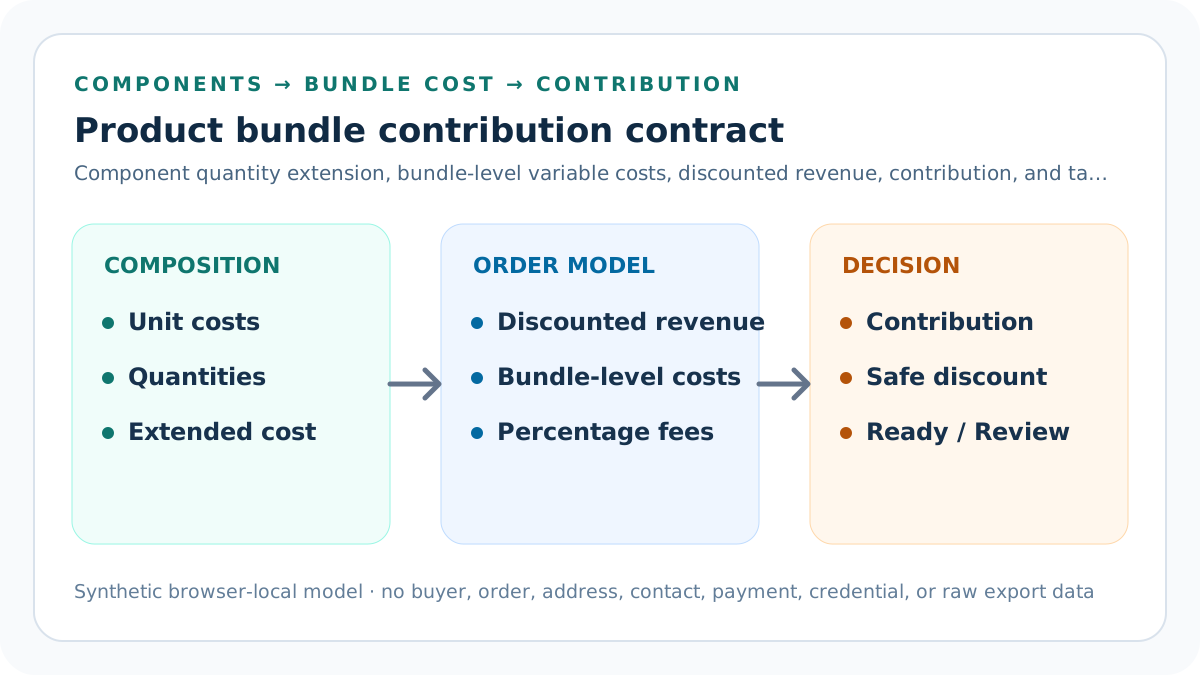
The calculator measures contribution for one declared bundle order after costs that vary with that bundle. It begins with list price, applies the planned percentage discount, adds buyer-paid shipping, extends each component unit cost by quantity, adds bundle-level variable costs and percentage fees, then calculates contribution amount and contribution margin.
It also solves the maximum discount that still preserves the seller-entered contribution target. This is an operating boundary for the entered evidence. It does not prove that bundling increased order value, that customers prefer the bundle, or that the whole business earns accounting profit.
Define one fixed or mix-and-match bundle grain
Choose one fixed bundle with a known bill of materials or one mix-and-match bundle with a defined selected composition. Every component cost, quantity, price, discount, packaging, pick-pack, fulfillment, fee, acquisition, loss, currency, and period value must describe that same bundle order.
Do not combine the average component cost of one bundle with the current price of another, or monthly fulfillment labor with one order. Run separate packets when component eligibility, quantity, shipping weight, packaging, return severity, or discount mechanics differ.
Extend component unit costs by quantity
Enter component unit costs and matching positive whole-number quantities in the same order. Multiply each cost by its quantity, then sum the rows. The default fixed bundle uses USD 12 × 1, USD 8 × 2, and USD 6 × 1 for USD 34 across four component units.
A mismatched row count Blocks because the calculator cannot know which quantity belongs to which cost. Preserve component aliases and source versions in the seller-owned evidence log; public examples should remain synthetic and non-identifying.
Add bundle-level packaging and pick-pack labor
Bundle packaging can differ from the sum of single-item packaging. Record the actual box, insert, wrap, label, protective material, or assembly container caused by the bundle. Avoid double-counting packaging already included in component cost.
Pick-pack labor should reflect incremental work for selecting, checking, assembling, personalizing, or packing the bundle. Use a documented time study and rate at the same evidence period rather than an undocumented round number.
Add outbound fulfillment and fixed variable fees
Use a purchased label, current carrier quote, or fulfillment invoice for the relevant combined weight, dimensions, service, and destination pattern. A bundle can cross a package or dimensional-weight boundary even when individual items do not.
Add fixed per-order fees only once per bundle order. Keep percentage marketplace and payment fees in the separate rate field because they scale with charged revenue. Confirm the actual fee base for the channel before treating a generic estimate as payout evidence.
Add attributable advertising and affiliate cost
Include advertising or affiliate cost only when it is attributable to the modeled bundle order under a documented method. Do not divide a monthly campaign total by one synthetic order without defining the retained attributed-order denominator.
A fixed bundle and a mix-and-match offer may have different acquisition paths, creative, commission bases, or attribution windows. Model them separately when evidence differs rather than forcing one average into both scenarios.
Build expected return, damage, or reship loss
Multiply the affected-bundle rate by unrecovered loss per affected bundle. Severity can include unrecovered component cost, extra shipping, replacement, disposal, damaged packaging, and direct handling after confirmed recoveries.
Use a comparable bundle cohort. A single-item return rate may understate partial bundle returns, missing-component claims, or whole-bundle damage. Keep frequency and severity separate so each can be sourced and stress-tested.
Calculate discounted charged revenue
Discounted product revenue equals bundle list price multiplied by one minus the seller-funded discount rate that reduces retained product revenue. Add buyer-paid shipping revenue after the product discount unless evidence shows shipping is also discounted. Enter 0% for a platform-funded offer that leaves seller-retained product revenue unchanged. Seller-paid outbound shipping remains a cost.
A discount at or above 100% Blocks because product revenue retention is zero or negative. Record whether a platform, seller, or other party funds the benefit; the default model assumes the entered percentage reduces seller product revenue.
Calculate bundle contribution and margin
Percentage fees equal charged revenue multiplied by the entered fee rate. Contribution equals charged revenue minus percentage fees and the fixed variable-cost pool. Contribution margin divides contribution by charged revenue.
The default fixed bundle has USD 77 charged revenue, USD 6.16 percentage fees, and USD 55 fixed variable costs, leaving USD 15.84 contribution and a 20.57% contribution margin. These are before-overhead operating measures, not net income.
Solve target-safe discount headroom
Target-safe charged revenue equals fixed variable costs divided by one minus the fee rate and target contribution rate. Subtract buyer-paid shipping and divide by list price to determine the product-revenue share required; one minus that share is the maximum target-safe discount.
Subtract the planned discount from the maximum to get percentage-point headroom. The default bundle permits about 10.76% while the plan uses 10%, leaving 0.76 percentage points. A negative result means the planned discount exceeds the target boundary.
Separate target-safe from break-even discount
Break-even uses a zero contribution target, so its maximum discount is larger. The default bundle's break-even maximum is about 31.52%, but that reserves nothing for the seller's contribution target or fixed business costs.
Do not promote mathematical break-even as a safe campaign discount. Compare planned discount with the seller-owned target boundary first, and document who owns the target, why it exists, and when it should be reviewed.
Fixed bundle worked example
Use USD 80 list price, 10% discount, USD 5 buyer shipping, four component units costing USD 34, USD 3 packaging, USD 4 pick-pack, USD 7 fulfillment, USD 0.50 fixed fee, USD 4 acquisition, USD 1.50 expected loss, and USD 1 other variable cost.
The fixed variable-cost pool is USD 55. Charged revenue is USD 77, percentage fees are USD 6.16, contribution is USD 15.84, and contribution margin is 20.57%. The packet returns Ready when every evidence and denominator gate passes.
Mix-and-match bundle example
Replace the fixed composition with four one-unit components costing USD 12, USD 12, USD 8, and USD 6. Extended component cost rises to USD 38 while price, discount, shipping, and bundle-level costs remain fixed.
The fixed variable-cost pool becomes USD 59. Contribution falls to USD 11.84 and margin to 15.38%. The target-safe maximum discount drops to about 3.82%, so a planned 10% discount returns Review.
Apply Block, Review, and Ready precedence
Block nonfinite or nonpositive list price, mismatched component rows, nonfinite or negative component cost, non-whole or nonpositive quantity, invalid discount or rate, zero target denominator, invalid source-review date, incomplete evidence confirmation, invalid currency or month, missing scope, or declared conflicts. Favorable revenue cannot compensate for broken structure.
After structure passes, Review negative contribution, contribution below target, or a discount above the target-safe maximum. Ready confirms only that the entered bundle clears its contribution boundary.
Complete the dated bundle evidence contract
Record a real source-review date and answer seven non-compensating confirmations. Confirm the exact component identities, quantities, and cost versions; price, discount funding, and buyer shipping; complete nonduplicated bundle-variable costs; percentage and fixed fee bases; affected-bundle frequency and loss severity; one bundle-order currency and period; and the boundary that excludes fixed overhead, tax, and accounting profit.
Any answer other than yes returns Block. The source-review date must be a real calendar date in the evidence month or later. A favorable list price cannot repair a substituted component, unsupported mix-and-match average, duplicated cost, stale fee, mismatched return cohort, mixed order grain, or accounting claim outside the deterministic calculator.
Avoid bundle-specific calculation mistakes
Do not omit component quantities, double-count packaging, apply a fixed fee per component, ignore increased fulfillment weight, treat list value as retained revenue, hide platform funding assumptions, use a single-item return severity, or compare different bundle compositions as if only discount changed.
Preserve full precision through revenue and target-safe discount equations. Round displayed money and rates only at the end, and never reuse the rounded maximum discount as a new authoritative input.
Separate bundle arithmetic from bundle strategy
A Ready result does not prove incremental order value. Customers might substitute the bundle for purchases they would have made separately, choose only low-cost combinations, create fulfillment complexity, or return partial components. Measure those effects separately.
Bundle strategy also requires inventory availability, compatibility, merchandising, customer clarity, channel rules, tax treatment, demand, and conversion evidence. The calculator supplies one bounded contribution contract, not an automatic publishing decision.
Keep private order evidence out of public content
The calculator uses aggregate cost and rate fields. Do not paste buyer names, addresses, emails, messages, order IDs, payment details, credentials, private export rows, or supplier-confidential documents into public pages, screenshots, community drafts, or feedback forms.
Store source pointers and nonprivate aliases in the evidence log. Validate real bundle orders locally and report only aggregate, non-identifying findings. Public examples remain synthetic.
Use a bundle evidence log and rollback
Record packet ID, bundle composition, component cost versions, quantities, list price, discount, buyer shipping, packaging, labor, fulfillment, fees, acquisition, expected loss, target, outputs, decision, conflicts, reviewer, and next trigger.
Before changing a public bundle or discount, preserve the prior composition, price, eligibility, inventory rule, checkout state, monitoring window, and restoration condition. Restore after a calculation, route, analytics, accessibility, policy, or customer regression.
What should you do after the calculation?
If the packet Blocks, repair the named structural or evidence field. If it Reviews, identify whether component cost, bundle composition, price, discount, fulfillment, acquisition, expected loss, or target drives the shortfall. If Ready, confirm that any test remains reversible and measurable.
Use the listing cost library to version components, the contribution margin calculator for an observed order, and the product price floor calculator when solving a list-price requirement. Recalculate on material evidence triggers rather than content-production frequency.
Sources and further reading
- Seller Profit Guard methodology: Calculation contracts, evidence precedence, deterministic fixtures, release verification, correction, and rollback.
- Seller Profit Guard data privacy: Local-first treatment of seller, buyer, order, payment, contact, credential, and raw export data.
- Shopify product bundles: First-party definitions for fixed, multipack, and mix-and-match bundle structures; platform eligibility remains outside this general calculator.
- Shopify bundle eligibility and considerations: First-party operational boundaries for bundle eligibility, compatibility, inventory, returns, and line-item treatment; these remain outside this arithmetic model.
- SBA break-even point guidance: Primary U.S. small-business source for the selling-price contribution-margin denominator and variable-cost boundary.
- IRS Publication 334 (2025): Primary U.S. context for net receipts, cost of goods sold, gross profit, and later business expenses; this tool does not make a tax determination.
- IRS Schedule C instructions (2025): Primary U.S. context for inventory and cost-of-goods-sold reporting boundaries.
Related Seller Profit Guard tools
- Etsy CSV profit calculator: Run a local order profit check with editable fee and SKU cost assumptions.
- Payment reconciliation tool: Compare order rows with statement activity and flag unmatched rows.
- SKU cost library: Save or import material, labor, packaging, shipping, and target margin assumptions.
- Variant risk checker: Find missing SKUs and variation cost risks before a listing scales.
- Etsy title checker: Review listing-title clarity, repetition, keyword chains, and mobile scanning.
- Etsy tag checker: Review all 13 tag slots for duplicates, repeated meaning, and truthful coverage.
- Free shipping threshold calculator: Estimate when a shipping subsidy can still meet a target margin.
- Return window loss estimator: Model expected reverse shipping, restock work, recovery, and replacement loss.
- Etsy Ads break-even calculator: Estimate target-safe Etsy Ads spend, ACOS, and ROAS after fees, fulfillment, and expected return loss.
- CSV data privacy: Understand what the local-first workflow needs and what it does not need.
- Bundle Margin Formula and Inputs: Define component quantities, bundle-level costs, discounted revenue, contribution, target margin, and target-safe discount headroom.
- Fixed Bundle Margin Worked Example: Trace a four-piece fixed bundle from USD 34 component cost and USD 55 variable-cost pool to USD 15.84 contribution and 10.76% safe discount.
- Mix-and-Match Bundle Margin Example: Replace the fixed composition with a USD 38 mix-and-match component basket and trace the resulting USD 11.84 contribution and Review decision.
- Product Bundle Margin Mistakes: Correct quantity, component, packaging, fulfillment, discount, fee, expected-loss, scenario, rounding, and interpretation errors.
- Reliable Product Bundle Margin Data: Map component costs, quantities, price, discount, packaging, labor, fulfillment, fees, acquisition, expected loss, and target to evidence.
- Safe Bundle Margin Decision Thresholds: Apply component, quantity, rate, denominator, contribution, target, discount-headroom, evidence, and sensitivity gates before acting.
- Fixed vs Mix-and-Match Bundle Margin: Compare fixed and selected component baskets at one commercial grain to isolate component cost, contribution, margin, and discount headroom.
- Weekly Bundle Margin Review Routine: Run a recurring composition, cost, discount, fulfillment, expected-loss, fixture, exception, approval, feedback, and rollback review.
- How to Interpret Bundle Margin Results: Read component cost, fixed pool, charged revenue, contribution, target gap, safe discount, and headroom without false precision.
- Product Bundle Margin Audit Template: Record composition, quantities, cost versions, commercial terms, equations, outputs, decision, changes, verification, feedback, and rollback.
- Shopify Bundle Margin Formula and Inputs: Define fixed-bundle and separate subscription-product price, discount, component, payment, fulfillment, app, return, compatibility, and margin evidence.
- Shopify Fixed Bundle Margin: A Worked Example: Work an invented fixed-bundle packet with component value, discount, selling price, costs, inventory, payment, result, target, and decision.
Use the interactive tool
Enable JavaScript to open the calculator and process browser-local inputs. The explanatory content and source links remain available without JavaScript.
Related guide: Define component extension, bundle-level costs, contribution, and discount headroom.
This tool provides operating estimates, not tax, accounting, legal, financial, or marketplace-policy advice. Verify current official sources and your own records before changing prices or operations.