Seller Profit Guard · How it works · CSV privacy
Custom Order Quote Calculator
A custom-order quote calculator adds materials, production labor, design time, included revision labor, packaging, shipping, rush direct cost, and an uncertainty reserve, then solves the minimum quote that preserves a seller contribution target and compares it with the proposed customer quote.
Maintained by Seller Profit Guard Editorial Team. Last reviewed: 2026-07-31.
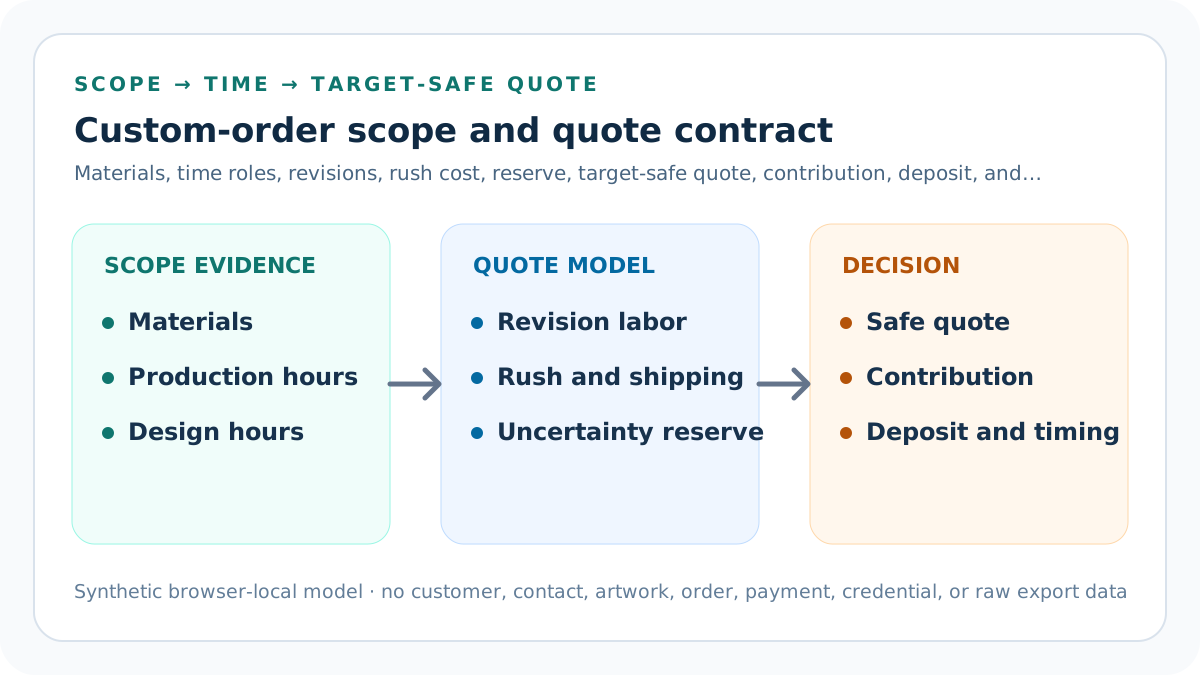
Start with one agreed custom-order scope
Freeze one privacy-safe packet before calculating: deliverable, quantity, dimensions, material, finish, personalization, proofing path, included revision rounds, due-date basis, shipping responsibility, currency, evidence period, and acceptance checkpoint. The quote is meaningful only when every cost and hour refers to that same specification.
Do not average a standard commission with a rush remake or copy hours from a different product simply because the customer request sounds similar. When size, material, complexity, artwork cleanup, proofing, revision rights, production method, or delivery promise changes, preserve a named scenario rather than hiding the difference in one rounded amount.
Source materials and purchased components
Materials should include the items consumed or purchased specifically for the custom request: substrate, blank, fabric, wood, metal, findings, ink, coating, outsourced part, licensed component, sample, test piece, spoilage allowance, and inbound freight when applicable. Preserve quantity, unit, supplier version, currency, quote date, and replacement trigger.
Separate reusable tools and general overhead from order-caused materials. A one-off fixture or setup component can be included when the request causes it and the evidence packet identifies that role. Do not paste supplier invoices or private customer files into public calculators; use aggregate amounts and protected source pointers.
Calculate production labor
Production labor equals the hours caused by making, finishing, inspecting, packing, or otherwise completing the custom deliverable multiplied by the seller-entered production rate. Use an observed time study or a documented estimate that explains setup, active work, batch handling, drying or machine time, and quality control.
Do not omit owner labor or treat all elapsed time as active labor without evidence. The calculator keeps hours and rate separate so a reviewer can see whether the quote changed because the job takes longer or because the labor policy changed. It does not decide payroll, owner compensation, employment law, or tax treatment.
Calculate design and setup time separately
Design and setup hours cover work before repeatable production: requirement clarification, layout, artwork preparation, digitizing, pattern adjustment, template creation, machine setup, color proof, sample configuration, or customer-specific documentation. Multiply those hours by the declared design/setup rate.
Separating design from production prevents a complex first order from appearing as cheap as a repeat run. The U.S. Copyright Office explains that commissioned-work ownership and work-made-for-hire treatment depend on specific legal requirements and written agreements. Quote arithmetic never transfers artwork, source-file, reuse, license, or exclusivity rights.
Estimate included revision labor
Expected revision labor equals the included revision hours multiplied by the revision rate. Tie that allowance to a stated number of rounds and an agreed proofing sequence. Revision hours can cover one consolidated feedback pass, artwork adjustment, specification correction, or production-proof change when the scope says so.
Do not confuse seller-caused correction with customer-requested scope change. Rework from a production defect, a late material substitution, an added concept, and a second customer feedback round can have different responsibility. The calculator prices the entered allowance but cannot determine fault, approval, or enforceable change-order terms.
Add packaging, shipping, and other variable cost
Add custom packaging, inserts, protective materials, labels, certificates, special handling, seller-paid shipping, insurance, signature service, and other cost caused by this request. Use the package, origin, destination class, service, dimensions, weight, and quote validity that match the promised delivery path.
Buyer-paid shipping can still affect payment fees or customer acceptance, but this model expects seller-paid shipping inside the quoted amount. For applicable U.S. merchandise orders, FTC guidance requires a reasonable basis for a stated shipment time and defines delay, consent, cancellation, and refund duties. The seller must review the actual jurisdiction and order separately.
Model rush or expedite direct cost
Rush direct cost represents resources caused by a compressed schedule: expedited inbound material, priority machine time, overtime premium, special courier, extra setup, split shipment, weekend pickup, or displaced capacity. Enter actual incremental cost, not a vague percentage added because the customer requested urgency.
A rush fee charged to the customer can exceed direct rush cost when the seller chooses a policy, but the target-safe quote already protects the entered contribution target. Capacity, queue displacement, employee availability, carrier cutoff, proof approval, and delivery risk still require a separate operational decision. A calculated quote cannot promise an impossible date.
Build the direct custom-order cost
Add materials, production labor, design/setup labor, expected revision labor, packaging, seller-paid shipping, rush direct cost, and other variable cost. The default standard fixture produces USD 206 of direct cost: USD 42 materials, USD 72 production labor, USD 45 design, USD 24 revision labor, USD 6 packaging, USD 12 shipping, and USD 5 other cost.
Preserve the arithmetic at full precision and keep each role visible. A single 'cost' number makes it impossible to tell whether a new material, longer production time, added design work, extra revision, or rush requirement moved the quote. The tool does not automatically allocate rent, software, equipment depreciation, financing, income tax, or unrelated overhead.
Add an evidence-based uncertainty reserve
Multiply direct custom-order cost by the seller-entered uncertainty percentage. The reserve is a transparent allowance for plausible material variance, design discovery, revision effort, remake risk, shipping change, or other uncertainty still inside the agreed scope. The default 10% reserve adds USD 20.60 to USD 206 direct cost.
A reserve is not a substitute for resolving a known conflict. If material availability, artwork approval, dimensions, rights, quantity, delivery address class, or deadline is unresolved, declare the issue and Block. Use named low, expected, and high scenarios when uncertainty is wide rather than presenting a padded quote as exact.
Calculate payment fees and the quote cost pool
The quote cost pool equals direct custom-order cost plus the uncertainty reserve and fixed payment fee. Percentage payment fee is applied to the proposed quote. The standard fixture combines USD 206 direct cost, USD 20.60 reserve, and USD 0.30 fixed fee into a USD 226.90 cost pool.
Keep payment paths separate. Card, invoice, bank transfer, deposit platform, marketplace, currency conversion, installment, chargeback, refund, or financing arrangements can use different bases and timing. The calculator uses one entered percentage and fixed fee; it does not reproduce a processor statement, tax invoice, deposit escrow, or payout record.
Solve the target-safe custom-order quote
Divide the quote cost pool by one minus the payment fee rate and target contribution margin. The denominator must remain positive. With a USD 226.90 cost pool, 3% payment fee, and 25% target, the minimum target-safe quote is USD 315.14 before display rounding.
Substitute the solved quote into the forward equation and reproduce the target at full precision. A mismatch indicates changed cost roles, reserve basis, fee base, target, or rounding. Treat the result as the minimum modeled seller contribution boundary for this packet, not as a market price, contract offer, customer willingness-to-pay estimate, or accounting profit.
Calculate proposed-quote contribution and headroom
Subtract percentage payment fees and the quote cost pool from the proposed customer quote. Divide contribution by the proposed quote for the contribution margin. Subtract the target-safe quote from the proposal for headroom. At USD 330, the standard fixture has USD 9.90 percentage fee, USD 93.20 contribution, 28.24% margin, and USD 14.86 headroom.
Positive headroom means the proposal clears the modeled target under current evidence. It does not prove that the customer will accept, that the seller can deliver, or that the scope is legally complete. Negative headroom identifies the gap that must be addressed through scope, cost, reserve, fee, target, or quote—not through an unrelated favorable assumption.
Read the break-even quote carefully
The break-even quote uses the same cost pool and payment fee but a zero contribution target. The standard fixture produces USD 233.92. It is a diagnostic boundary showing where modeled order contribution reaches zero before fixed overhead and tax; it is not a recommended quote.
A quote at modeled break-even has no contribution buffer for source error, omitted work, extra revision, remake, late approval, delivery change, support, warranty, or overhead. Keep break-even, target-safe, and proposed amounts separate in the quote packet so a reviewer can explain the decision without calling any one of them profit.
Standard custom-request worked example
Use USD 42 materials, three production hours at USD 24, 1.5 design hours at USD 30, one expected revision hour at USD 24, USD 6 packaging, USD 12 shipping, no rush direct cost, USD 5 other variable cost, 10% reserve, 3% payment fee, USD 0.30 fixed fee, 25% target, and a USD 330 proposal.
The direct cost is USD 206, reserve USD 20.60, and quote cost pool USD 226.90. The target-safe quote is USD 315.14. The proposal yields USD 93.20 contribution and 28.24% margin, leaving USD 14.86 headroom. A 50% requested deposit equals USD 165, while the fourteen-day lead time and one included revision round remain documented operating terms.
Rush custom-request worked example
Use USD 50 materials, four production hours at USD 26, two design hours at USD 32, 1.5 revision hours at USD 26, USD 8 packaging, USD 25 shipping, USD 30 rush direct cost, USD 8 other cost, 15% reserve, 4% payment fee, 22% target, USD 540 proposal, and five-day lead time.
Direct cost is USD 328, reserve USD 49.20, and quote cost pool USD 377.50. The target-safe quote is USD 510.14. The proposal yields USD 140.90 contribution and 26.09% margin with USD 29.86 headroom. Reducing the proposal to USD 480 leaves USD 83.30 contribution but only 17.35% margin and USD -30.14 headroom, so the packet Reviews.
Document deposit, lead time, and revision rounds
The requested deposit equals proposed quote multiplied by the entered deposit percentage. Display it as arithmetic, not proof of enforceability, refund treatment, payment security, or cash availability. Record when the deposit is due, what activates production, which costs are nonrecoverable, and how cancellation or nonpayment is handled in qualified terms outside this tool.
Promised lead time and included revision rounds are structural fields because a quote without time and change boundaries is incomplete. Shopify draft orders are one platform-specific way to record custom prices and send invoices, but a platform record does not establish cancellation, refund, shipment, rights, or production terms. Those remain separately reviewed commitments.
Apply Block, Review, and Ready precedence
Block blank, nonfinite, or negative time and cost; nonpositive quote; invalid reserve, fee, target, denominator, deposit, or seller threshold; fractional lead days or revision rounds; invalid currency, period, or source-review date; missing scope; incomplete evidence confirmations; or declared conflicts. Favorable arithmetic cannot compensate for broken evidence.
After structure passes, Review negative or below-target contribution, a proposal below the target-safe quote, a reserve below the seller-entered minimum, or rush direct cost paired with lead time above the seller-entered maximum. Ready confirms only the entered contribution packet and never authorizes a contract or shipment promise.
Complete the dated custom-order evidence contract
Confirm ten assertions before interpreting money: specification identity, materials and availability, time roles and rates, revision versus change-order responsibility, fulfillment terms, payment and cancellation terms, artwork and usage rights, capacity and lead-time support, one quote grain, and the accounting boundary. The calculator cannot inspect the protected evidence behind these confirmations.
Record one real source-review date, a seller-owned minimum uncertainty reserve, and a seller-owned maximum rush lead time. Blank, nonfinite, negative, fractional-day, impossible-date, or unconfirmed inputs Block before monetary outputs are usable. This non-compensating contract prevents a plausible quote from hiding missing approval, expired material, unsupported rights, or impossible delivery.
Avoid custom-order quoting mistakes
Do not omit design time, assume revisions are free, mix active labor with elapsed drying time, apply fees to the wrong base, double-count shipping, hide rush cost, use a reserve to cover known scope conflict, round the inverse equation early, forget deposit and lead time, or treat a customer message as an approved specification.
Do not reuse a generic product margin or wholesale calculator by renaming fields. Custom orders need separate production, design, and revision hours; an uncertainty reserve; rush direct cost; included revision rounds; deposit arithmetic; lead-time visibility; scope identity; and a privacy boundary for customer content.
Protect customer and creative privacy
Do not paste names, emails, addresses, phone numbers, order IDs, private messages, artwork, photographs, recordings, measurements tied to a person, payment details, tax documents, contracts, credentials, source files, or raw exports into public pages, screenshots, analytics, community drafts, or support examples.
Use synthetic examples and privacy-safe scope aliases in the browser-local calculator. Keep protected evidence in the appropriate private system and store only a pointer, version, owner, and review date in the audit packet. Public examples cannot establish another customer's identity, rights, acceptance, payment, or actual quote.
Maintain a reproducible quote packet
Record packet ID, scope alias, deliverable, quantity, material, production hours and rate, design hours and rate, revision hours and rate, packaging, shipping, rush, other cost, reserve, fees, target, proposal, deposit, lead time, revision rounds, currency, period, evidence scope, equations, outputs, status, issues, reviewer, action, and next trigger.
Attach source versions, full-precision arithmetic, displayed rounding, supported and broken fixtures, tests, build, content and browser audits, quote version, aggregate outcome, exception, closure, withdrawal, and restoration evidence. Never silently overwrite an old custom-order packet when specification, material, time, fee, delivery, or approval changes.
Choose the next action after calculation
If the packet Blocks, resolve the named structural or evidence field. If it Reviews, identify whether scope, material, production, design, revision, rush, fulfillment, reserve, fee, target, proposal, deposit, or delivery drives the issue. If it is Ready, independently review capacity, rights, tax, payment, acceptance, cancellation, and delivery before issuing a quote.
Use the listing cost library to version material and labor evidence, the contribution calculator to review an observed completed order, and the product price floor calculator for a repeatable catalog item. Recalculate whenever the scope, approved proof, source cost, expected hours, revision allowance, rush condition, carrier quote, payment path, target, or lead time changes.
Sources and further reading
- Seller Profit Guard methodology: Evidence precedence, calculation contracts, deterministic fixtures, validation, correction, release, and rollback.
- Seller Profit Guard data privacy: Local-first boundaries for customer, order, payment, contact, credential, artwork, and raw export data.
- FTC Mail, Internet, or Telephone Order Merchandise Rule business guide: Primary U.S. business guidance for having a reasonable basis for shipment promises, delay notices, consent, cancellation, and prompt refunds.
- Etsy Help: How to offer custom items: Primary marketplace context for agreeing the requested item and price before creating a private custom listing from the request thread.
- Shopify draft orders and invoices: Primary platform context for custom items, custom prices, price locks, invoices, payment terms, shipping, and recorded payment paths.
- U.S. Small Business Administration break-even analysis: Primary small-business context for contribution margin and break-even relationships; this calculator uses one custom-order cost boundary.
- U.S. Copyright Office work-made-for-hire guidance: Primary U.S. copyright context showing that commissioned-work ownership depends on specific legal requirements and written agreements, not quote arithmetic.
- IRS Publication 334 (2025): Primary U.S. context for business income, cost of goods sold, inventory, and gross profit; this tool does not make a tax determination.
- IRS Schedule C instructions (2025): Primary U.S. context for cost-of-goods-sold and expense-reporting boundaries.
Related Seller Profit Guard tools
- Etsy CSV profit calculator: Run a local order profit check with editable fee and SKU cost assumptions.
- Payment reconciliation tool: Compare order rows with statement activity and flag unmatched rows.
- SKU cost library: Save or import material, labor, packaging, shipping, and target margin assumptions.
- Variant risk checker: Find missing SKUs and variation cost risks before a listing scales.
- Etsy title checker: Review listing-title clarity, repetition, keyword chains, and mobile scanning.
- Etsy tag checker: Review all 13 tag slots for duplicates, repeated meaning, and truthful coverage.
- Free shipping threshold calculator: Estimate when a shipping subsidy can still meet a target margin.
- Return window loss estimator: Model expected reverse shipping, restock work, recovery, and replacement loss.
- Etsy Ads break-even calculator: Estimate target-safe Etsy Ads spend, ACOS, and ROAS after fees, fulfillment, and expected return loss.
- CSV data privacy: Understand what the local-first workflow needs and what it does not need.
- Custom Order Quote Formula and Inputs: Define custom scope, materials, production and design time, revisions, rush cost, fulfillment, reserve, fees, target margin, deposit, and quote equations.
- Standard Custom Order Quote Example: Trace a standard request from USD 206 direct cost and USD 20.60 reserve to a USD 315.14 target-safe quote and USD 93.20 contribution.
- Rush Custom Order Quote Scenario: Model a five-day rush request with different material, production, design, revision, shipping, expedite, reserve, fee, and target evidence.
- Custom Order Quote Calculation Mistakes: Correct scope, material, active-time, design, revision, rush, fulfillment, reserve, fee, target, deposit, delivery, rounding, and interpretation defects.
- Reliable Custom Order Quote Data: Map specification, materials, production and design time, revisions, rush cost, fulfillment, reserve, fees, target, deposit, and lead time to evidence.
- Safe Custom Order Quote Thresholds: Apply scope, cost, time, reserve, fee, denominator, deposit, delivery, evidence, contribution, rush, approval, capacity, and reversibility gates.
- Standard vs Rush Custom Order Quotes: Compare standard and rush commission packets without mixing scope, materials, production, design, revisions, fulfillment, reserve, fees, target, or delivery.
- Weekly Custom Order Quote Routine: Run a recurring intake, specification, source, time, reserve, fixture, exception, capacity, approval, quote, feedback, closure, and rollback process.
- How to Interpret Custom Order Quote Results: Read direct cost, labor roles, reserve, cost pool, contribution, margin, target-safe and break-even quotes, headroom, deposit, lead time, and status.
- Custom Order Quote Audit Template: Record scope, materials, production, design, revisions, rush, fulfillment, reserve, fees, target, quote, deposit, delivery, equations, approval, and rollback.
Use the interactive tool
Enable JavaScript to open the calculator and process browser-local inputs. The explanatory content and source links remain available without JavaScript.
Related guide: Define custom scope, time, revisions, rush cost, reserve, quote, deposit, and decision boundaries.
This tool provides operating estimates, not tax, accounting, legal, financial, or marketplace-policy advice. Verify current official sources and your own records before changing prices or operations.