Seller Profit Guard · How it works · CSV privacy
TikTok Shop return reserve calculator
Estimate expected TikTok Shop return loss per delivered order and total cohort reserve from a matured return rate, refund responsibility, shipping, handling, product recovery, commission effects, other costs, stress rate, and evidence controls.
Maintained by Seller Profit Guard Editorial Team. Last reviewed: 2026-07-29.
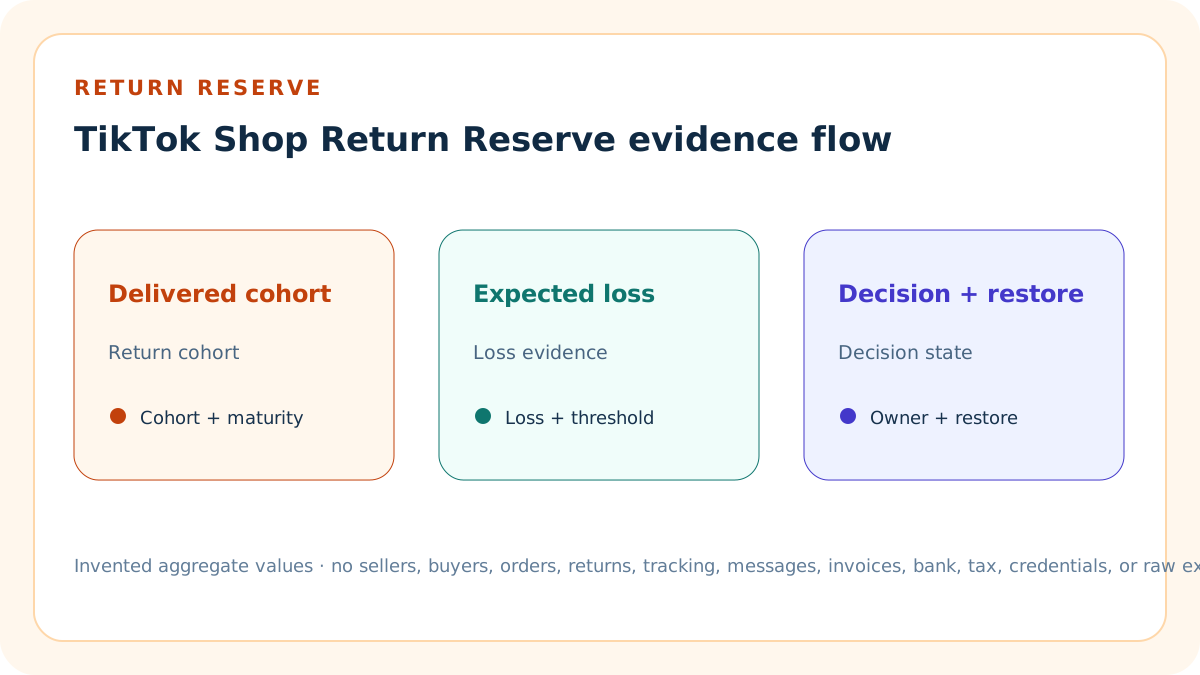
Estimate a reserve, not a guaranteed loss
A return reserve is an expected contribution allowance built from a declared matured return rate and a declared loss packet. It is not a prediction that every future cohort will behave identically.
Record market, category, product type, fulfillment method, period, currency, delivered-order denominator, return maturation, source dates, and exclusions before interpreting the estimate.
Choose the delivered-order denominator
Use delivered orders when the return-rate source uses delivered orders, and keep order, item, shipment, and return-request grains separate. The default fixtures use one retained delivered order as the reserve denominator.
Do not divide returned items by orders while multiplying loss by shipments. Mixed grains can overstate or understate the reserve even when every input appears reasonable.
Use a matured return rate
Return rate equals matured returned or refunded orders divided by the declared delivered-order cohort. Use a cohort old enough to include the applicable request, shipping, inspection, appeal, and refund timing.
An immature current week can be monitored but should not replace a settled historical basis. Preserve both dates and record the seller's maturation rule.
Separate all-return and NBFR rates
TikTok Shop's NBFR is a specific non-buyer-fault performance measure with a defined delivered-order denominator and rolling window. It is not automatically the seller's total economic return rate.
A reserve may use all economically relevant returns. Label NBFR, buyer-fault, seller-fault, logistics, refund-only, exchange, and cancellation evidence separately.
Model refund responsibility explicitly
Expected refunded merchandise loss uses average customer payment per returned order multiplied by the seller-entered refund-responsibility percentage. The responsibility may differ by reason, program, subsidy, or seller-configured rule.
Do not hard-code one policy percentage across every category and return reason. Use a weighted, dated aggregate or separate cohorts when responsibility differs materially.
Keep forward shipping separate
Enter the amount of original delivery or outbound shipping refunded or otherwise lost per return when the seller bears it. Record whether the buyer paid it and which logistics method applies.
Do not assume the same forward-shipping result for seller-preferred logistics, platform-preferred logistics, FBT, refund-only, exchange, and every return reason.
Model return shipping at seller share
Return-shipping loss equals the entered return-shipping cost multiplied by the seller-responsibility percentage. Platform support, buyer responsibility, insurance, logistics method, and fault reason can change this line.
Use observed settled charges when available. If a subsidy or reimbursement is uncertain, model it separately rather than netting it into an unexplained cost.
Include inspection and handling
Inspection, restocking, customer-service, repackaging, disposal, and warehouse processing can create seller cost even when the product is recovered. Enter a documented average handling amount per return.
Do not treat staff time as zero merely because no separate invoice exists. Use a conservative, reviewable assumption when a material process consumes labor.
Credit only recoverable product value
Product write-down equals product cost multiplied by one minus the entered recovery percentage. Recovery should reflect resale, refurbish, salvage, exchange reuse, or reimbursement evidence at the same category and condition mix.
A returned unit is not automatically recovered at full cost. Wrong-item, damaged, missing, hazardous, non-returnable, late, or lost-return cases can produce different recovery.
Separate creator commission effects
Enter the portion of creator commission that remains an economic loss after the return or refund is settled. Verify actual order, refund, protected-rate, and settlement evidence.
Do not assume all commission reverses or all commission remains. The calculator keeps this line editable because platform and contract treatment can vary.
Include nonrefunded platform and ad cost
Additional nonrecoverable costs can include documented platform fee, payment fee, refunded ad cost differences, insurance deductible, exchange fulfillment, or another return-specific line.
Name each included amount in the scenario evidence. Never use one opaque adjustment to force the reserve toward a desired result.
Calculate expected loss per delivered order
Expected return loss per delivered order equals matured return rate multiplied by loss per return. Loss per return is seller refund share plus forward shipping, seller return-shipping share, handling, product write-down, commission effect, and other nonrecoverable cost.
This produces the reserve applied to every delivered order in the declared cohort, not a claim about the loss of one specific buyer or order.
Calculate total cohort reserve
Total reserve equals expected loss per delivered order multiplied by delivered orders. The value supports contribution planning and period reconciliation.
It is not cash already paid, a platform liability, or accounting guidance. Compare the modeled reserve with matured realized loss and release or increase it under a documented policy.
Model a low-return category
The invented low-return packet uses 100 delivered orders, a 5% return rate, USD 60 average customer payment, 100% seller refund share, USD 2 forward-shipping loss, USD 8 return shipping at 50% seller share, USD 3 handling, USD 20 product cost at 80% recovery, USD 1 commission effect, and USD 1 other loss.
Loss per return is USD 75. Expected reserve is USD 3.75 per delivered order and USD 375 for the cohort.
Model a high-return category
The invented high-return packet uses the same order count and payment but a 20% return rate, USD 4 forward-shipping loss, full responsibility for USD 9 return shipping, USD 5 handling, 30% product recovery, USD 2 commission effect, and USD 2 other loss.
Loss per return is USD 96. Expected reserve is USD 19.20 per delivered order and USD 1,920 for the cohort.
Set a seller-owned reserve limit
The default fixture uses a maximum reserve of USD 5 per delivered order. Ready requires both packets to be structurally complete and at or below that seller-owned limit.
The limit is not a TikTok rule. Set it from price, contribution target, cash needs, category variance, seasonality, and escalation authority.
Use a stress return rate
Stress reserve recalculates the packet at the entered stress return rate while holding the loss-per-return inputs constant. It shows sensitivity to return frequency.
A stress packet does not replace separate stress tests for shipping, product recovery, refund share, commission, or cost inflation. Change one variable at a time and preserve the prior result.
Block incomplete evidence first
Block missing market, currency, category, denominator, maturity, positive delivered orders, valid percentages, context, configuration confirmation, owner, reviewer, backup, stop rule, restoration, or declared conflicts.
A small calculated reserve cannot repair an unresolved policy or data conflict. Correct the packet before repricing or changing return settings.
Use Review for an economic limit miss
Review means a structurally valid packet exceeds the seller's maximum reserve per delivered order at the base or stress return rate.
Review is not an automatic instruction to reject returns, restrict buyers, change policy, or raise prices. Investigate product quality, description, sizing, logistics, damage, packaging, product mix, return reason, handling, and recovery.
Interpret Ready narrowly
Ready means both entered scenarios reconcile within the seller's declared reserve limit and evidence controls. It proves internal calculation consistency only.
It does not prove future return rate, eligibility, refund responsibility, platform reimbursement, appeal success, Shop Performance Score, settlement, accounting reserve treatment, or that a seller should change policy.
Protect private return data
Use invented examples or approved aggregates. The browser-local calculator does not connect to TikTok Shop or upload seller, buyer, order, address, tracking, message, image, invoice, bank, tax, credential, or raw return-export data.
Never publish individual return reasons tied to buyers, order IDs, tracking numbers, addresses, messages, dispute evidence, creator contracts, invoices, or screenshots containing private identifiers.
Version the complete reserve packet
Record prior value, new value, reason, source, period, maturity, category, logistics, owner, reviewer, expected effect, actual effect, backup, stop rule, and restoration result.
A material policy, return-rate, subsidy, logistics, product-mix, recovery, commission, fee, cost, threshold, or formula change opens a new packet.
Reconcile estimate with realized loss
After the cohort matures, compare modeled return count, modeled loss per return, modeled total reserve, realized return count, realized return-specific loss, recoveries, reimbursements, and released reserve.
The variance should change the next evidence packet only after its cause and grain are understood. Do not mechanically chase one small cohort.
Release the complete cluster
Index the working calculator and ten dedicated guides together only after source, functionality, content, originality, image, accessibility, test, backup, release-mode, deployment, purge, and live-verification gates pass.
Search signals are measurements after release, not a publication prerequisite. Ordered release and rollback safety still control the production mutation.
Use strict numeric and date contracts
Every count, amount, percentage, duration, source date, and seller-policy date must parse under the displayed contract. Scientific notation, suffixed strings, fractional order counts, impossible dates, future policy dates, and out-of-bound amounts create Block.
This protects calculations from silent JavaScript coercion. Correct the source packet rather than editing a displayed result.
Require nine evidence confirmations
The calculator separately confirms synthetic aggregate use, cohort maturity and date basis, all-return versus NBFR definitions, reason and logistics responsibility, refund and shipping funding, fees and advertising, commission, handling and recovery, independent review, restoration, and human authority.
All nine must be yes. A missing confirmation is structural, even when the displayed reserve would otherwise sit below the seller threshold.
Treat 60-day NBFR as a separate metric
TikTok Shop defines NBFR as seller- or logistics-fault return or refund requests divided by delivered non-canceled orders over the past 60 days. The seller's economic reserve may cover a broader all-return cohort.
Record both when relevant, but never substitute NBFR for all economic returns or imply that the seller reserve predicts Shop Performance Score.
Map responsibility by reason and logistics path
Current TikTok Shop responsibility tables vary across seller-preferred logistics, platform-preferred logistics, Fulfilled by TikTok, category, reason, and fault. Store a weighted aggregate only after the underlying mix is documented.
A single permanent seller-responsibility percentage is not a platform rule. Open a new packet when the reason or logistics mix changes materially.
Separate refund, fee, commission, and ad effects
A refund can affect customer payment, referral-fee reversal and administration effects, creator commission, advertising cost, settlement, and net-sales reporting on different evidence timelines.
Record only the nonrecoverable amount in each reserve line. Do not subtract a gross refund and then repeat the same economic loss in an opaque adjustment.
Close the full maturity path
Age a cohort through the applicable request window, return shipment, carrier receipt, warehouse receipt, inspection, replacement, dispute, appeal, refund, fee, commission, advertising-cost, and settlement states.
The default 60-day evidence duration is a seller control aligned with the current NBFR observation window, not a guarantee that every case is fully settled by day 60.
Quarantine nineteen derived outputs
When structure or evidence fails, the calculator hides nine numeric outputs for each scenario plus the cross-scenario reserve difference. It keeps category labels, formulas, confirmation coverage, evidence dates, threshold, and repair diagnostics visible.
This prevents malformed or incomplete packets from presenting precise-looking reserve values while preserving enough context to repair them.
Keep action authority outside the calculator
No Ready, Review, or Block state can approve or deny a customer request, assign fault, change a return rule, contact a buyer, alter a listing or price, choose logistics, submit an appeal, book an accounting reserve, or mutate Seller Center.
Preserve the authorized reviewer, protected backup, stop condition, tested restoration, and approved platform workflow for every external action.
Sources and further reading
- TikTok Shop: Customer Order Cancellation, Return, and Refund Policy: Current official returnability, request, refund-only, forward-shipping, return-shipping, logistics-path, reimbursement, appeal, and responsibility boundaries.
- TikTok Shop: Requirements for Managing Returns, Refunds, and Replacements: Current official handling, response, return receipt, refund, replacement, logistics, and maturity guidance.
- TikTok Shop: Non-Buyer Fault Return and Refund Rate: Current official NBFR seller-or-logistics-fault numerator, delivered-order denominator, exclusions, 60-day window, and Shop Performance Score context.
- TikTok Business Help: Maximize Net Sales: Current official net sales, gross revenue, refunds, and refund-aware advertising-cost boundary.
- TikTok Business Help: Maximize Net Sales Best Practices: Current official Refund GMV, Refunded Ad Cost, Shop ads Commission fee, and Finance evidence guidance.
- TikTok Shop Academy: Referral Fee Updates: Official refund, referral-fee reversal, refund-administration-fee, settlement, and fee evidence boundaries.
- TikTok Shop Academy: Affiliate Commission: Official actual-paid-price, partial-refund, full-refund, settlement, protected-rate, and creator-commission guidance.
- Seller Profit Guard methodology: Evidence, privacy, deterministic calculation, release, monitoring, and restoration controls.
Related Seller Profit Guard tools
- TikTok Shop GMV vs Profit Calculator: Carry the reserve into a broader contribution bridge.
- TikTok Shop Fee Reference Calculator: Reconcile fee and commission effects separately.
- Return Window Loss Calculator: Compare a platform-neutral matured return cohort.
- Profit Guard: Apply the accepted reserve to retained order contribution.
- Methodology: Review evidence, privacy, validation, release, monitoring, and restoration.
- Data Privacy: Protect seller, buyer, order, return, tracking, message, and raw export data.
- How do you calculate a TikTok Shop return reserve?: Calculate loss per return from seller refund responsibility, forward-shipping loss, seller-paid return shipping, handling, product write-down after recovery, commission effects, and other nonrecoverable cost. Multiply that loss by a matured return rate to estimate reserve per delivered order, then multiply by delivered orders for the cohort.
- What is a TikTok Shop return reserve for a low-return category?: In the invented low-return packet, a 5% matured rate and USD 75 loss per return produce USD 3.75 expected loss per delivered order. Across 100 delivered orders, the modeled reserve is USD 375. A separate 8% stress rate raises reserve to USD 6 per order.
- How does a high-return category change the TikTok Shop reserve?: In the invented high-return packet, a 20% matured rate and USD 96 loss per return produce USD 19.20 reserve per delivered order and USD 1,920 for 100 delivered orders. Lower product recovery, full return-shipping responsibility, and higher handling make this scenario economically distinct.
- What makes a TikTok Shop return reserve estimate wrong?: Common errors include using an immature cohort, mixing delivered orders with returned items, substituting NBFR for total economic returns, hard-coding one responsibility rate, assuming subsidy receipt, duplicating refund loss, ignoring product recovery, omitting handling or commission, and reading a reserve as guaranteed future cash loss.
- Where do TikTok Shop return reserve inputs come from?: Use matured delivered-order and return records for frequency; return-reason, responsibility, and subsidy evidence for refund and shipping shares; Finance and Ads reporting for nonrefunded costs; Affiliate Center for commission; warehouse records for handling and recovery; and seller policy for target, stress, ownership, and restoration.
- What is a safe TikTok Shop return reserve threshold?: Block incomplete denominator, maturity, responsibility, recovery, cost, ownership, or restoration evidence. Review a structurally valid packet when base or stress reserve exceeds the seller's maximum per delivered order. Ready means both declared scenarios remain within that limit; it does not certify future returns or policy responsibility.
- How should low-return and high-return reserves be compared?: Align market, currency, period, maturation, delivered-order grain, return definition, product-cost scope, and evidence quality. Then compare return rate, refund responsibility, shipping shares, handling, recovery, commission, other cost, and stress rate separately. Do not attribute the entire reserve difference to category name.
- How often should a TikTok Shop return reserve be reviewed?: Review the monitoring packet weekly, but update the accepted reserve only when the declared cohort matures or a material policy, category, logistics, return-reason, subsidy, recovery, commission, cost, product-mix, or threshold change is verified. Preserve prior values, owner approval, stop criteria, and restoration evidence.
- What does a TikTok Shop return reserve result prove?: It proves only that seller-entered aggregate return frequency and loss assumptions reconcile under the displayed formula and evidence controls. It does not prove future return rate, customer eligibility, seller responsibility, platform subsidy, reimbursement, appeal outcome, Shop Performance Score, settlement, accounting treatment, or a policy recommendation.
- What belongs in a TikTok Shop return reserve audit?: Record market, category, currency, period, delivered orders, matured returns, return definition, maturation rule, fault mix, refund share, shipping responsibility, handling, product cost, recovery, commission, other loss, base and stress rates, reserve threshold, sources, owner, reviewer, conflicts, prior result, backup, stop rule, realized variance, and restoration.
- How do you calculate TikTok Shop seller-funded shipping?: Reconcile listed shipping with buyer payment, platform checkout support, and seller checkout discount. Then calculate net retained platform funding from verified shipping credits minus offsets. Seller-funded shipping equals actual shipping plus packaging minus retained buyer shipping and net platform funding. Keep checkout and settlement evidence separate.
- How does a platform-supported TikTok Shop shipment affect margin?: In the invented supported packet, USD 6 platform checkout support and USD 2 seller checkout support explain an USD 8 free-shipping display. A separately verified USD 4 retained platform credit reduces USD 8 of shipping and packaging cost to USD 4 seller-funded shipping, producing USD 25 contribution.
Use the interactive tool
Enable JavaScript to open the calculator and process browser-local inputs. The explanatory content and source links remain available without JavaScript.
Related guide: Define the matured return rate, loss-per-return packet, reserve, stress threshold, evidence, and restoration controls.
This tool provides operating estimates, not tax, accounting, legal, financial, or marketplace-policy advice. Verify current official sources and your own records before changing prices or operations.