Seller Profit Guard · How it works · CSV privacy
TikTok Shop GMV vs profit calculator
Reconcile Seller Center GMV or Ads Manager gross revenue with retained seller contribution by separating discounts, tax, refunds, fees, creator commission, ads, product cost, fulfillment, other variable cost, return reserve, and evidence controls.
Maintained by Seller Profit Guard Editorial Team. Last reviewed: 2026-07-29.
Start with a named GMV definition
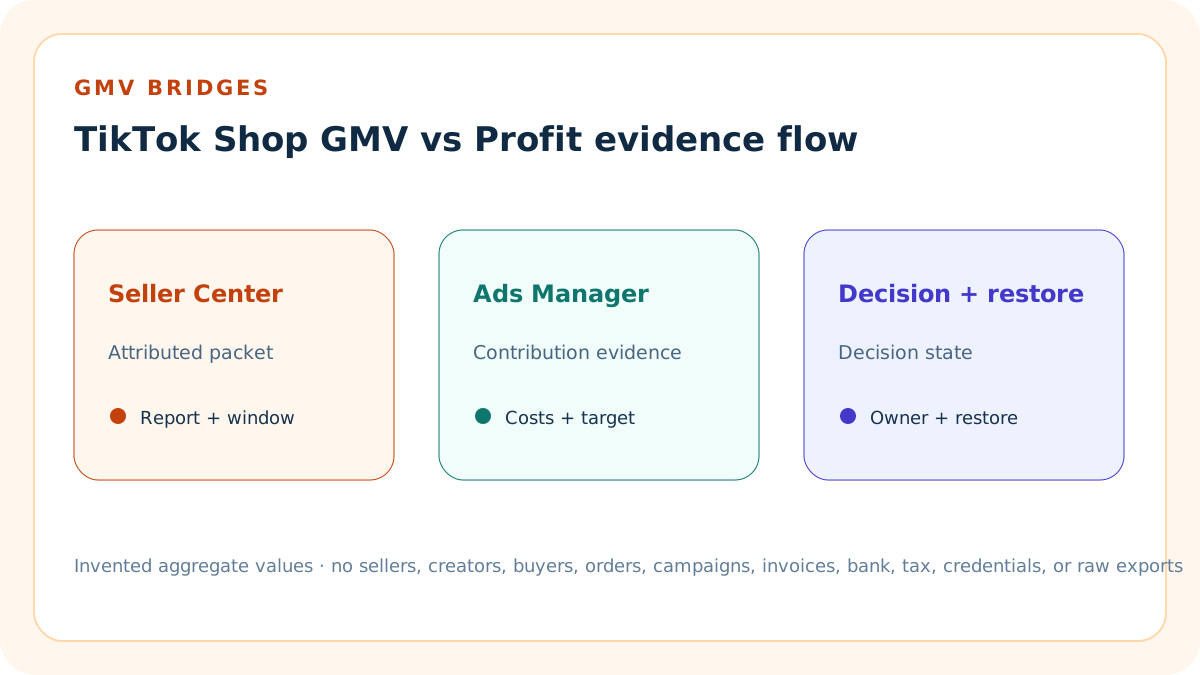
GMV is not one universal accounting field. Record the exact report, market, currency, date range, attribution setting, tax treatment, platform-discount treatment, order state, and data-through date before entering a value.
This calculator compares two explicitly named reporting packets. It does not silently convert an Ads Manager gross-revenue number, Seller Center GMV, payout, net sales, or booked revenue into another measure.
Bridge reporting to seller economics
The bridge begins with entered customer payment and platform-funded discounts, then separates tax and refunds before subtracting fees, creator commission, ads, product cost, fulfillment, other variable cost, and return reserve.
Each line remains visible because a single headline GMV figure cannot show which party funded a discount, whether tax belongs in the numerator, or whether a later refund has matured.
Keep customer payment literal
Customer payment should reflect the declared reporting grain and period, not a blended catalog price. Preserve the report name and whether shipping, tax, discount, or other amounts are included.
If an order cohort contains several products, use a documented allocation or keep it at cohort level. Do not force shop-level revenue onto one SKU and call the result product profit.
Separate platform-funded discounts
Platform-funded product discounts can appear in platform gross-revenue definitions even though the buyer did not pay that portion. Record them separately so the bridge can reproduce the named platform numerator.
Seller-funded discounts affect seller economics differently and should already be reflected in the entered customer-payment or retained-revenue evidence. Do not classify a discount by guess.
Remove tax consistently
Tax is recorded as its own line because platform, finance, and accounting views may handle it differently. The fixture treats tax as excluded from seller operating revenue.
Verify the market and transaction evidence. This educational model does not decide legal tax treatment, collect tax records, or replace professional accounting advice.
Mature refunds before interpretation
Refunds and cancellations can arrive after an attributed sale. Use a declared maturation window and preserve both the original report and the later retained-order packet.
An immature cohort can be calculated, but it should not be treated as final profit. The decision controls require the seller to disclose timing uncertainty instead of hiding it inside a reserve.
Calculate platform-reported revenue
Entered platform-reported revenue equals customer payment plus platform-funded discount minus tax for this declared fixture. The calculation exposes the bridge rather than asserting that every TikTok report uses the same formula.
Compare the calculated value with the named Seller Center or Ads Manager field. A mismatch is a reconciliation issue that must be resolved or explicitly declared.
Calculate retained seller revenue
Retained seller revenue equals customer payment plus platform-funded discount minus tax and matured refunds in this model. It is the starting point for contribution, not a payout forecast.
Settlement deductions, reserve releases, tax adjustments, and other finance lines can occur later. Preserve them as separate evidence instead of compressing them into an unexplained net number.
Subtract verified platform fees
Enter referral and other marketplace fees from dated transaction or invoice evidence. Do not infer a current category rate from a prior order or treat an unavailable line as a universal zero.
The model accepts aggregate seller-entered values and never accesses Seller Center. Verify current category, transaction state, promotion, market, and invoice scope before acting.
Keep creator commission separate
Creator commission is deducted independently because affiliate evidence, protected rates, refunds, and actual-paid-price bases can differ from ad attribution. A creative identity alone does not prove commission entitlement.
Use Affiliate Center and order evidence at the same grain. Do not apply one public rate to every attributed order or publish private creator economics.
Subtract advertising once
Ad spend is its own bridge line. It should match the chosen report, currency, period, Shop ID attribution scope, and data-through date.
Do not subtract advertising in both the fee packet and the ads line. Duplicating spend understates contribution, while omitting it turns a pre-ad margin into a misleading profit claim.
Use seller-owned product cost
Product cost should come from the accepted SKU or cohort cost record at the same retained-order grain. It may include landed components only when that scope is documented.
Do not copy a catalog average into a high-variance cohort without noting the allocation. Product mix can explain why two equal GMV packets produce different contribution.
Include fulfillment and variable costs
Fulfillment and other variable costs include the seller-selected operational lines that change with the order or cohort. Keep packaging, pick-and-pack, logistics, apps, and handling visible when material.
Avoid adding overhead to some packets but not others. The evidence scope must state exclusions so comparisons remain reproducible.
Add a separate return reserve
A return reserve represents expected unresolved loss beyond matured refunds. It is a seller assumption, not a TikTok rule, and it must have an owner, basis, effective date, and review cadence.
Stress the reserve rather than presenting one precise profit number. Once refunds mature, replace the assumption with evidence and version the packet.
Calculate contribution dollars
Contribution equals retained seller revenue minus platform fees, creator commission, advertising, product cost, fulfillment, other variable cost, and return reserve.
The result is before overhead, income tax, owner compensation, financing, and other excluded items unless the evidence scope explicitly includes them. It is not accounting net income.
Calculate contribution margin
Contribution margin equals contribution divided by retained seller revenue. The denominator must be positive and use the same period, currency, order state, and cohort as every cost line.
A high margin on a small or immature cohort may not be operationally meaningful. Review volume, refund maturity, allocation, and data completeness before changing price or spend.
Measure the GMV-to-contribution conversion
GMV-to-contribution conversion equals contribution divided by the named platform-reported revenue. It explains how much of a reporting numerator survives the entered economic bridge.
This ratio does not measure incrementality or settlement accuracy. It only reconciles the seller-entered packet under the displayed assumptions.
Compare Seller Center and Ads Manager packets
Scenario A and Scenario B can represent Seller Center GMV and Ads Manager gross revenue, but both must be normalized to a compatible market, currency, date range, attribution window, order grain, and maturity.
Do not compare different reporting dates or attribute every difference to ads. The output isolates entered bridge lines and names remaining reconciliation gaps.
Use Block for structural defects
Block applies when market, currency, definitions, source period, context, confirmation, positive revenue, non-negative values, ownership, backup, stop rule, restoration, or declared conflicts are incomplete.
A favorable contribution result cannot repair a missing denominator. Resolve the evidence packet before treating the output as an operating signal.
Use Review for economic or reconciliation gaps
Review applies when a structurally complete packet misses the seller's contribution-margin target or its calculated platform-reported revenue differs materially from the declared report value.
Review is not an automatic recommendation to pause ads or reprice. Investigate definitions, discount funding, refunds, fees, commission, costs, allocation, product mix, and timing.
Interpret Ready narrowly
Ready means both invented packets reconcile within the entered tolerance and meet the seller-owned contribution target with complete declared controls.
It does not prove platform settlement, accounting revenue, tax treatment, incrementality, future conversion, scalable spend, creator quality, or that any campaign or price should change.
Protect private commerce data
Use invented values or approved aggregates. The calculator runs in the browser and does not upload reports or read seller, creator, buyer, order, campaign, invoice, bank, tax, message, or credential data.
Never publish shop IDs, order IDs, campaign IDs, customer details, creator contracts, invoices, bank records, tax numbers, access tokens, or raw exports in a support page or evidence screenshot.
Version every accepted bridge
Record prior value, new value, reason, source, effective date, owner, reviewer, expected effect, actual effect, backup, stop rule, and restoration result.
A material report-definition, attribution, refund, fee, commission, advertising, cost, target, or formula change creates a new packet. Do not overwrite the accepted evidence.
Select the exact revenue definition
Choose seller-center-gmv for a Seller Center GMV packet or ads-manager-gross-revenue for an Ads Manager packet. The calculator rejects any other value and requires the two comparison scenarios to use distinct definitions.
TikTok's current official bridge states Seller Center GMV equals Customer Payment, while Ads Manager Gross Revenue equals Customer Payment minus Sales Tax plus Platform Price Discount. A shared label is not a shared formula.
Normalize seller economics separately
After reconciling each named platform numerator, calculate a normalized seller bridge as customer payment plus platform price discount minus sales tax minus matured refund. Subtract fees, commission, ads, seller variable costs, and reserve from that normalized value.
The normalized bridge is an explicit planning convention. It is not Seller Center GMV, Ads Manager gross revenue, net sales, payout, or accounting revenue, and every included or excluded line remains visible.
Reconcile order date and day of touch
Seller Center can report a sale on the order date while Ads Manager assigns Shop Ads performance to the day of the advertising touch. Record account scope, shop scope, attribution window, report date basis, and data-through date for both packets.
Do not force daily totals to match when event assignment differs. Preserve the discrepancy and compare an aligned closed period before attributing the variance to ads, products, or creators.
Declare Product GMV Max attribution
Product GMV Max can attribute all paid and organic orders for selected products while the campaign is active, including orders without an ad view or click. Record whether either packet includes this scope.
A Product GMV Max total cannot be treated as paid-only incrementality. Keep the selected-product set, campaign-active period, paid-plus-organic boundary, and allocation evidence with the packet.
Keep gross revenue and net sales separate
Gross revenue, GMV, and net sales use different numerators. Maximize Net Sales subtracts refunds and exposes refunded ad cost and Refund GMV, while gross-revenue reporting follows its own discount and tax definition.
Do not compare Net Sales ROI directly with a gross-revenue ROAS or call either ratio contribution. Reconcile refunds and Finance charges before building the seller economics layer.
Enforce strict numbers and real dates
Only plain finite decimal amounts, a whole evidence duration from one to 366 days, and real YYYY-MM-DD source and policy dates pass structural validation. Scientific notation, unit-suffixed values, impossible dates, or out-of-bound amounts create Block.
The seller contribution-policy date cannot be later than the official-source review date. This prevents an unsupported policy version from appearing to rest on evidence that had not yet been reviewed.
Require nine reconciliation confirmations
Both scenarios require nine yes confirmations covering synthetic-only data, report definitions and dates, GMV and gross-revenue equations, refunds and net sales, full cost scope, GMV Max attribution, comparable grain and allocation, independent review, and restoration authority.
Any no creates Block. Packet labels and evidence diagnostics remain visible, but 17 derived revenue, gap, contribution, margin, conversion, and cross-scenario outputs are masked as Unavailable.
Quarantine structural failures
A malformed amount, invalid date, unsupported revenue definition, duplicate scenario definition, incomplete 150-word evidence scope, missing required concept, unresolved conflict, or failed confirmation is a structural defect rather than an economic miss.
Repair and version the evidence before reading contribution. A favorable entered GMV, gross revenue, or margin cannot override a failed definition, privacy, review, backup, restoration, or authority control.
Release only a complete useful cluster
The working calculator and ten dedicated guides become indexable together only after content, functionality, originality, image, accessibility, schema, backup, test, release-mode, deployment, purge, and live-verification gates pass.
Search signals are not a publication prerequisite for this program. Ordered release, bounded batches, standalone value, and rollback safety remain mandatory controls.
Sources and further reading
- TikTok Business Help: Ads Metrics in Seller Center: Official cost, purchase, gross-revenue, ROAS, reporting-source, product-card, video, and affiliate-overlap definitions.
- TikTok Business Help: Gross Revenue for Shop Ads: Official Seller Center GMV and Ads Manager gross-revenue equations, discount and tax treatment, and ROAS boundary.
- TikTok Business Help: Seller Center and Ads Manager Metric Differences: Official account, shop, content, order-date, and day-of-touch reporting differences.
- TikTok Business Help: Product GMV Max: Official paid-plus-organic optimization and all-selected-product order attribution boundary.
- TikTok Business Help: GMV Max Attribution: Official attribution of paid and organic selected-product orders while Product GMV Max is active.
- TikTok Business Help: Maximize Net Sales: Official distinction between gross-revenue and net-sales optimization, refunds, and refunded ad cost.
- TikTok Shop Academy: Referral Fee Updates: Official completed-order referral-base and fee guidance used in the seller contribution bridge.
- TikTok Shop Academy: Affiliate Commission: Official actual-paid-price, refund, protected-rate, and creator-commission guidance.
- Seller Profit Guard methodology: Evidence, privacy, deterministic calculation, release, monitoring, and restoration controls.
Related Seller Profit Guard tools
- TikTok Shop Fee Reference Calculator: Reconcile fee and creator-commission lines before completing the bridge.
- TikTok Shop Ads CPA Calculator: Translate retained contribution into advertising limits.
- Profit Guard: Model platform-neutral retained order contribution.
- Methodology: Review evidence, privacy, validation, release, monitoring, and restoration.
- Data Privacy: Protect seller, creator, buyer, order, campaign, invoice, bank, tax, and raw export data.
- How do you calculate TikTok Shop GMV versus profit?: Start with one named platform revenue definition, then separate customer payment, platform-funded discounts, tax, matured refunds, fees, creator commission, ads, product cost, fulfillment, other variable cost, and return reserve. The remainder is contribution, not accounting net profit, payout, tax income, or proof of incremental sales.
- What does a TikTok Shop GMV-to-profit example look like?: In the invented Seller Center packet, USD 100 customer payment plus USD 8 platform discount minus USD 6 tax produces USD 102 calculated platform revenue. After a USD 5 refund and USD 68 of fees, ads, and seller costs, retained contribution is USD 29.
- How should Ads Manager gross revenue be reconciled to profit?: Treat Ads Manager gross revenue as a named attribution report, not payout or profit. Align market, currency, attribution window, reporting date, order grain, discount and tax scope, then bridge matured refunds, fees, commission, ads, and seller costs to contribution under a dated evidence packet.
- What makes a TikTok Shop GMV-to-profit bridge wrong?: Frequent errors include calling GMV profit, comparing different periods, hiding discount funding, mixing tax treatments, ignoring refund maturity, forcing shop attribution onto one SKU, omitting commission, subtracting ads twice, blending order and item grains, and treating payout as contribution without reconciling the underlying evidence.
- Where do TikTok Shop GMV-to-profit inputs come from?: Use a named Seller Center or Ads Manager report for the reporting numerator and attribution settings; order and Finance evidence for payment, discounts, tax, refunds, and fees; Affiliate Center for commission; and seller ledgers for ads, product, fulfillment, reserve, and targets.
- What is a safe TikTok Shop GMV reconciliation threshold?: Block incomplete definitions or evidence. Review a complete packet when calculated platform revenue differs beyond the entered tolerance or contribution misses the seller target. Ready means both declared packets reconcile and meet the target; it does not certify settlement, tax, incrementality, or future profit.
- Can Seller Center GMV and Ads Manager revenue be compared directly?: Only after normalization. Align market, currency, date range, report data-through date, attribution window, tax and discount scope, refund maturity, order grain, and product allocation. Then compare bridge lines and retain unexplained differences as reconciliation gaps rather than inventing a cause.
- How often should TikTok Shop GMV versus profit be reviewed?: Review a matured bridge weekly and after a report-definition, attribution, discount, tax, refund, fee, creator, ad-spend, product-mix, cost, or target change. Preserve prior packets, assign an owner and reviewer, log exceptions, and test stop and restoration paths before accepting the revised result.
- What does a TikTok Shop GMV-to-profit result prove?: It proves only that seller-entered aggregate report and cost values reconcile under the displayed definitions, tolerance, and controls. It does not prove platform settlement, accounting net income, tax treatment, incrementality, future conversion, scalable ads, creator performance, or a pricing recommendation.
- What belongs in a TikTok Shop GMV reconciliation audit?: Record market, currency, report name, definition, date range, data-through date, attribution, order grain, customer payment, discounts, tax, refunds, fees, commission, ads, seller costs, reserve, declared report value, tolerance, target, owner, reviewer, conflicts, backup, stop rule, and documented tested restoration result.
- How do you calculate a TikTok Shop return reserve?: Calculate loss per return from seller refund responsibility, forward-shipping loss, seller-paid return shipping, handling, product write-down after recovery, commission effects, and other nonrecoverable cost. Multiply that loss by a matured return rate to estimate reserve per delivered order, then multiply by delivered orders for the cohort.
- What is a TikTok Shop return reserve for a low-return category?: In the invented low-return packet, a 5% matured rate and USD 75 loss per return produce USD 3.75 expected loss per delivered order. Across 100 delivered orders, the modeled reserve is USD 375. A separate 8% stress rate raises reserve to USD 6 per order.
Use the interactive tool
Enable JavaScript to open the calculator and process browser-local inputs. The explanatory content and source links remain available without JavaScript.
Related guide: Define GMV, retained revenue, contribution, evidence, reconciliation tolerance, threshold, and restoration controls.
This tool provides operating estimates, not tax, accounting, legal, financial, or marketplace-policy advice. Verify current official sources and your own records before changing prices or operations.