Seller Profit Guard · How it works · CSV privacy
Shopify refund loss calculator
Estimate Shopify full- and partial-refund loss from the customer refund, unrecovered payment cost, consumed outbound shipping, return shipping, handling, attributable app cost, recovered inventory, and verified recoveries. Ready, Review, or Block also requires one recorded refund packet, current provider evidence, ownership, privacy controls, and a tested restoration path.
Maintained by Seller Profit Guard Editorial Team. Last reviewed: 2026-07-29.
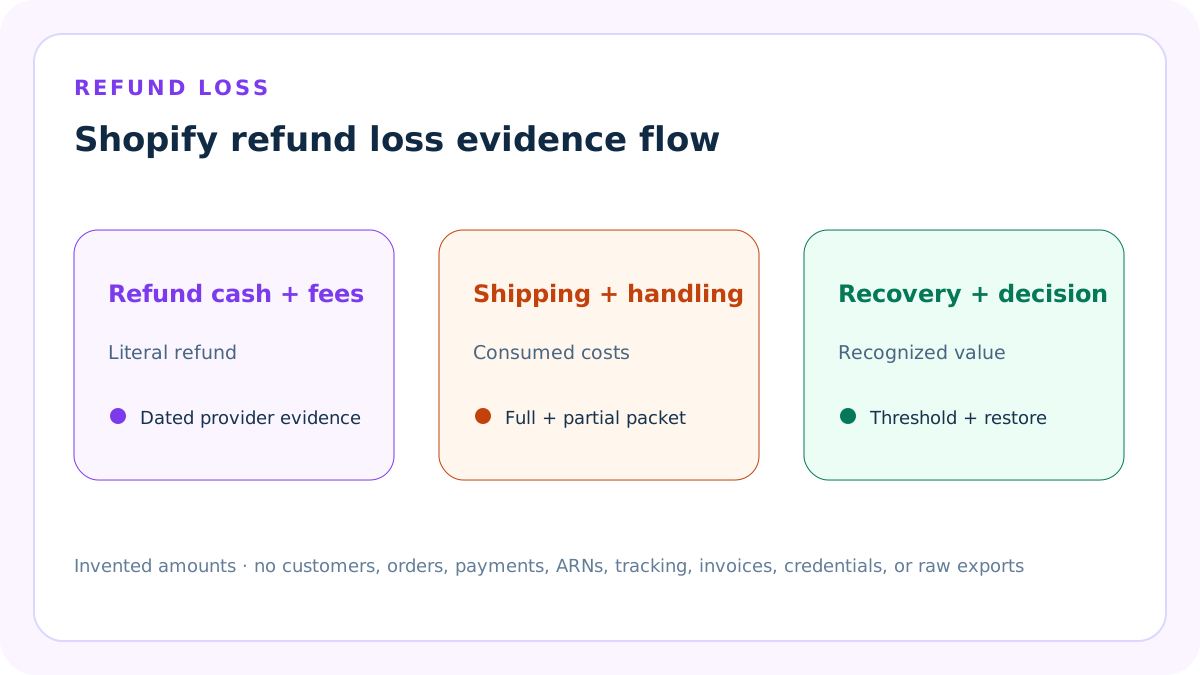
Measure one frozen refund packet
A Shopify refund-loss packet contains one order alias, refund method, payment provider, fulfillment state, return state, currency, evidence period, and explicitly entered cost convention.
Do not blend cancellations, returns, exchanges, chargebacks, store credit, damaged-order claims, and replacement orders. They can share money movements but have different authorities and recovery states.
Use the bounded refund-loss equation
Estimated net refund loss equals customer merchandise and shipping cash refunded, retained payment cost, outbound shipping, return shipping, handling, and attributable app cost, minus recovered inventory and other verified recovery.
The equation is an operational scenario, not an accounting journal entry or complete profit statement. Taxes, duties, chargebacks, overhead, advertising, replacement orders, and unentered costs remain outside scope.
Keep the refund amount literal
Enter the merchandise and buyer-paid shipping amounts actually refunded or approved for the declared scenario. The calculator blocks negative values and requires a recorded refund state.
A full refund and a partial refund are separate packets. Do not infer the refund from list price, gross sales, payout, store credit face value, or a return request.
Separate original processing fee from recovery
Enter the original payment or transaction cost and a separate verified fee credit. Retained payment cost is the original fee minus the accepted credit, never below zero.
Shopify documents that Shopify Payments original credit-card processing fees are not reimbursed. Third-party transaction-fee credits depend on provider path, Shopify Payments availability, refund share, and use of Shopify admin.
Do not hard-code a universal Shopify fee rule
Payment-provider, plan, market, card, currency, payment method, charged base, refund path, and current terms can change the fee and credit evidence.
The calculator therefore accepts the observed original fee and verified credit. A copied percentage from another store is not evidence for this order packet.
Record outbound shipping already consumed
Outbound shipping remains a seller cost when the parcel was fulfilled and the carrier service was consumed. Enter the qualified label or final carrier cost for the frozen packet.
An unfulfilled cancellation can legitimately use zero outbound shipping. Do not carry a fulfilled-order default into a cancellation or double-count the same postage inside product cost.
Record return shipping separately
Use the seller-funded return label, reimbursement, or approved reverse-logistics cost only when the declared return path creates it.
Shopify return rules and processes can display return-shipping charges or labels, but responsibility and actual cost still require store policy, customer agreement, configuration, carrier, and invoice evidence.
Capture handling without padding
Handling can include documented customer support, inspection, cleaning, relabeling, restocking, disposal, and refund administration that is not already recorded elsewhere.
Use an explicit activity, time, rate, and owner. Do not add arbitrary labor, count the same work in product cost, or call a customer-facing restocking fee seller recovery without evidence.
Allocate only attributable app cost
Some return portals, label services, or workflow apps can create usage or transaction charges. Enter only the amount attributable to this refund packet under a documented allocation rule.
Shopify-billed and externally billed apps can have different cycles and credits. A pending charge, future application credit, paid refund, and external developer adjustment are distinct states.
Value recovered inventory conservatively
Recovered inventory value is the expected usable value after receipt, inspection, condition grading, repair, cleaning, repackaging, resale discount, and incremental selling cost.
It is not automatically original cost or retail price. Use zero when no item returns; use Block or a separate sensitivity when condition and ownership are unresolved.
Recognize other recovery once
Other recovery can include a received carrier reimbursement, platform funding, supplier credit, insurance payment, or another verified amount not represented by fee credit or inventory value.
Pending, disputed, requested, denied, and received recoveries must not be merged. Never subtract the same credit from both fee recovery and other recovery.
Calculate the full-refund fixture
The invented full-refund packet returns USD 60 merchandise and USD 8 shipping, retains a USD 2.27 processing fee, and adds USD 7 outbound shipping, USD 6 return shipping, USD 3 handling, and USD 1 app cost.
Subtracting USD 14 recovered inventory produces USD 73.27 estimated net refund loss. Every amount is editable and does not claim a current Shopify rate.
Calculate the partial-refund fixture
The invented partial-refund packet returns USD 20 merchandise, retains the same USD 2.27 processing fee, and includes USD 7 consumed outbound shipping, USD 1.50 handling, and USD 0.50 attributable app cost.
With no return shipping or inventory recovery, the result is USD 31.27. This scenario does not imply that a partial refund is allowed, adequate, or preferable.
Compare full and partial results carefully
The default full-refund packet exceeds the partial-refund packet by USD 42.00 because cash refunded, return logistics, handling, app cost, and inventory recovery differ.
The comparison does not choose the customer remedy. Policy, agreement, law, payment rules, item condition, return authorization, chargeback risk, and customer evidence still control real action.
Use one maximum-loss review threshold
The seller-entered maximum net refund loss is an internal review boundary applied to both scenarios. A valid packet above the threshold returns Review.
This amount is not a refund cap, customer right, policy rule, legal limit, authorization to deny a claim, or evidence that the underlying offer is profitable.
Use Block for missing structure
Block applies to invalid amounts, fee credits above original fees, identical scenarios, missing refund confirmation, thin provider and fulfillment context, missing period or scope, declared conflicts, or absent restoration evidence.
A favorable result cannot repair missing authority, source, payment, fulfillment, return, privacy, ownership, or rollback evidence.
Use Review for bounded uncertainty
Review applies when the arithmetic is structurally valid but one scenario exceeds the seller threshold or a recovery remains too uncertain to recognize.
Keep unrecognized recovery visible in the protected evidence log, not silently inside the result. Recalculate when the actual inventory grade, fee credit, label adjustment, app credit, or reimbursement arrives.
Use Ready narrowly
Ready means both invented packets reconcile under the entered cost, recovery, context, review-threshold, owner, reviewer, and restoration controls.
It does not issue a refund, modify an order, restock inventory, create a return, credit an app, predict a payout, approve a policy, or provide accounting, tax, legal, or consumer-rights advice.
Keep refund action outside the calculator
Shopify states that a refund initiated in admin cannot be canceled or reversed. Authorized staff must verify the order, payment method, available amount, permissions, notification, return, restock, shipping, duties, and import-tax choices before action.
The public tool never connects to Shopify and cannot validate an irreversible production action. Use invented fixtures here and an authorized two-person review in the live store.
Protect customer and order data
Public examples need only invented aggregate amounts and redacted evidence statements. The browser-local calculator does not upload or transmit a Shopify export.
Keep names, emails, addresses, messages, order identifiers, payment details, ARNs, tracking, labels, returns, photos, invoices, app bills, credentials, and raw exports in approved systems.
Version every recovery state
Preserve the original order, refund, payment fee, fee credit, label, return, inspection, inventory recovery, app charge, external recovery, and result versions with effective dates and owners.
Do not overwrite the estimate when a pending fee credit posts or returned inventory is graded. The difference between estimated and actual loss is operational evidence.
Require nine independent confirmations
A usable packet confirms invented aggregate data, refund permission and method, provider fee and credit evidence, fulfillment and return state, shipping and handling sources, inventory and recovery maturity, market-policy boundaries, two-person review, and tested restoration.
The two scenario-level refund confirmations do not replace these shared controls. One missing confirmation Blocks both packets and quarantines every derived amount.
Record source and policy dates separately
The Shopify guidance review date identifies when the official refund and return sources were checked. The seller policy date identifies the internal formula, threshold, evidence, and authority version actually applied.
The seller policy date cannot postdate the source review. Reopen the packet after provider, refund path, return rule, final-sale, market, fee, app, carrier, inventory, reviewer, or authority changes.
Distinguish refund from return creation
Shopify permits a refund without first creating a return, but a return cannot be created after that refund is issued. The packet must therefore freeze whether a fulfilled-item return exists before any irreversible action.
A fulfilled return can include return shipping, restocking, inspection, exchange, and inventory evidence. An unfulfilled refund removes the item from fulfillment and must not inherit a fulfilled-return cost template.
Apply fee-credit evidence by payment path
For Shopify Payments, Shopify documents that the original credit-card processing fee is not returned. Third-party transaction-fee credit depends on Shopify Payments availability, refunded share, and whether the refund is issued through Shopify admin.
Keep the observed original cost and posted credit editable. Never assume a universal percentage, copy another store's terms, or recognize a requested credit as received.
Keep configured return fees out of recovery until deducted
Shopify return rules can display a return-shipping fee or percentage restocking fee, including market-specific rules, but return fees are not automatically deducted from refunds.
Recognize a seller recovery only when the authorized refund record shows the actual deduction or receipt. Do not subtract a configured fee merely because it appears in policy settings.
Separate future-order rules from historical orders
Shopify states that return-rule changes apply to future orders rather than rewriting previous orders. Each refund-loss packet therefore records the rule version and market attached to the order being measured.
Do not apply today's return window, final-sale exception, shipping rule, or restocking fee retrospectively without order-specific evidence and a separate legal or policy review.
Quarantine nineteen derived outputs on Block
When currency, amount, date, confirmation, scenario, source, recovery, conflict, or restoration structure fails, the two scenarios' eighteen derived amounts plus their signed difference display Unavailable.
The tool may still show the entered threshold and control metadata so the operator can repair the packet, but it does not reveal apparently precise loss arithmetic from invalid evidence.
Keep two-person review before store action
The calculator is browser-local and cannot inspect permissions, available refundable amount, payment method, notification, restock, return, shipping, duty, tax, market, or legal state in Shopify.
An independent reviewer must compare the protected packet with current authorized records before any refund, return, exchange, restock, notification, fee deduction, or customer communication.
Test full, partial, and failure states
Run full refund, partial refund, no-return, zero-recovery, recovered-inventory, fee-credit, app-charge, threshold, malformed currency, missing context, unconfirmed refund, and declared-conflict fixtures.
Verify Ready, Review, Block, reset behavior, mobile layout, keyboard flow, metadata, images, links, source dates, privacy language, and strict route behavior.
Release the whole cluster or none
Index this tool and its ten support pages only after functionality, sources, worked examples, visuals, uniqueness, metadata, links, privacy, accessibility, backups, deployment, and live verification pass.
Search impressions, clicks, citations, AdSense status, and revenue are later measurements. They do not replace quality, production ordering, or rollback gates.
Sources and further reading
- Shopify Help: Refunding orders: Official full and partial refund, shipping refund, restock, permission, irreversible-action, Shopify Payments fee, and third-party transaction-credit context.
- Shopify Help: Shopify Payments refunds: Official payout timing, negative-balance, ARN, and original credit-card processing-fee treatment for Shopify Payments refunds.
- Shopify Help: Returns and exchanges: Official separation of refund, return, exchange, self-serve request, inspection, and return-label workflows.
- Shopify Help: Creating and processing returns: Official return shipping, restocking fee, inspection, partial processing, refund-later, and exchange workflow context.
- Shopify Help: Return and cancellation rules: Official fulfilled-item return rules, market-specific settings, return windows, shipping costs, restocking fees, final-sale exceptions, and manual fee-deduction boundaries.
- Shopify Help: App charges on Shopify bills: Official app billing-cycle, usage-charge, application-credit, external developer-charge, pending-charge, and refund boundaries.
- Seller Profit Guard methodology: Deterministic evidence, scope, privacy, validation, correction, release, monitoring, and restoration.
Related Seller Profit Guard tools
- Refund vs Replacement Calculator: Compare two customer-remedy cost paths before freezing the refund packet.
- Return Shipping Cost Calculator: Build the reverse-logistics component separately when carrier evidence needs more detail.
- Shopify Payment vs Transaction Fee Calculator: Separate provider processing fees from Shopify third-party transaction fees before estimating recovery.
- Shopify App Cost per Order Calculator: Verify the attributable return-app charge instead of inserting a full monthly bill.
- Methodology: Review evidence, formula, privacy, correction, release, monitoring, and restoration.
- Data Privacy: Keep customers, orders, payments, returns, invoices, app bills, credentials, and raw exports protected.
- Shopify Refund Loss Formula and Inputs: Define the bounded refund-loss equation, payment-cost recovery, fulfillment and return costs, recovered inventory, evidence states, and exclusions.
- Shopify Full Refund Loss: A Worked Example: Work a complete invented full-refund packet with cash, retained fee, shipping, handling, app cost, inventory recovery, result, and decision.
- Shopify Partial Refund Loss Example: Model a partial refund without disguising it as a scaled full refund, including retained fees, consumed fulfillment, handling, and no-return evidence.
- 9 Shopify Refund Loss Mistakes to Correct: Diagnose cash, fee-credit, fulfillment, return, inventory, app, scope, authority, and interpretation errors with corrected fixtures.
- Shopify Refund Data: A Source Map: Map every input to protected Shopify admin, provider, carrier, billing, inventory, labor, and recovery evidence without publishing customer data.
- Set a Shopify Refund Loss Review Threshold: Separate structural Block rules, seller-owned Review thresholds, recovery uncertainty, policy authority, and narrow Ready status.
- Shopify Full vs Partial Refund Loss: Compare full and partial packets at one evidence grain while explaining which cash, shipping, handling, app, and recovery variables drive the gap.
- A Weekly Shopify Refund Loss Routine: Turn refund-loss measurement into a repeatable exception log, source refresh, actual-versus-estimate review, owner sign-off, and restoration cycle.
- Read Shopify Refund Loss Without False Precision: Explain net refund loss, scenario difference, threshold headroom, recognized versus pending recovery, exclusions, and the next bounded action.
- Shopify Refund Loss Audit Checklist: Provide a standalone checklist and dated change log for refund, provider, fulfillment, return, fees, costs, recoveries, decisions, monitoring, and restoration.
Use the interactive tool
Enable JavaScript to open the calculator and process browser-local inputs. The explanatory content and source links remain available without JavaScript.
Related guide: Define the refund-loss equation, payment-provider recovery, fulfillment and return costs, inventory value, decision states, and restoration.
This tool provides operating estimates, not tax, accounting, legal, financial, or marketplace-policy advice. Verify current official sources and your own records before changing prices or operations.