Seller Profit Guard · How it works · CSV privacy
Shopify app cost per order calculator
Normalize recurring, usage, one-time, credit, and externally billed Shopify app costs to one closed period, then divide the reconciled net amount by retained orders. Compare two invented app stacks locally and receive Ready, Review, or Block without uploading bills, orders, app usage, customers, contracts, or credentials.
Maintained by Seller Profit Guard Editorial Team. Last reviewed: 2026-07-29.
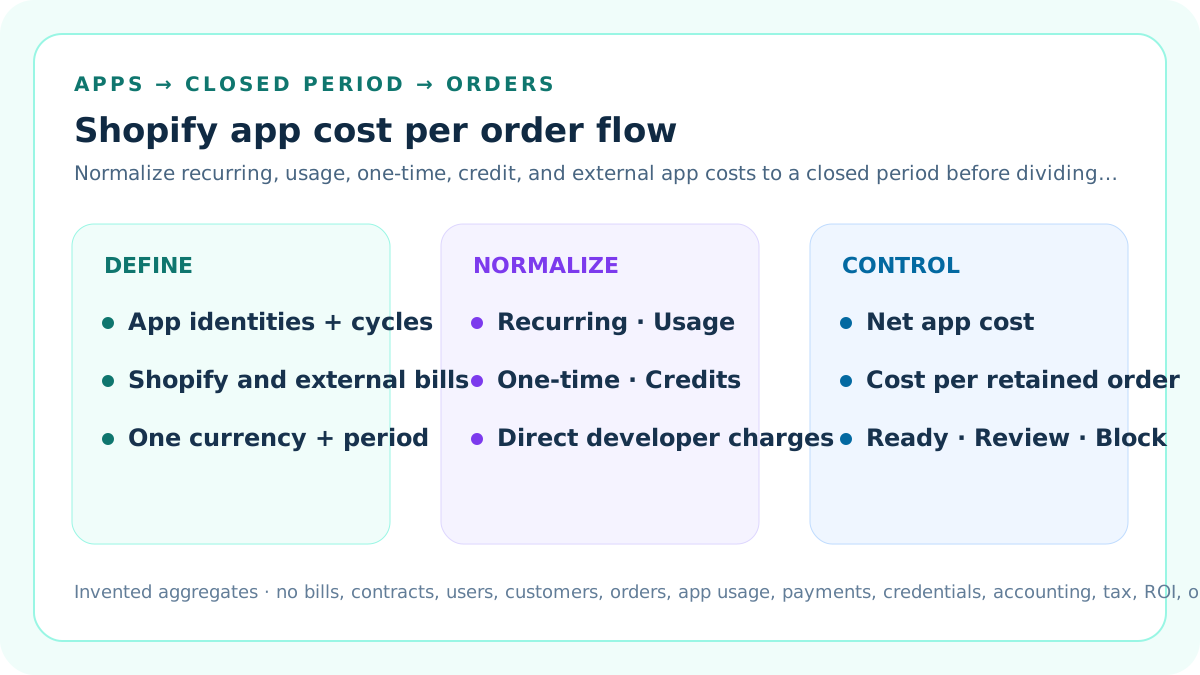
Start with the narrow question
This calculator asks how much one declared Shopify app stack costs per retained order in one closed period.
It does not score whether an app is useful, recommend an app, cancel a subscription, request a credit, inspect private usage, or calculate complete profit.
Separate this tool from the subscription audit
The broader Seller Tool Subscription Audit lists recurring tools and produces a planning screen. This Shopify-specific calculator reconciles recurring, usage, one-time, application-credit, and externally billed app components under independent app cycles.
Use the broader audit for inventory discovery; use this page after the Shopify-specific charge packet and denominator are defined.
Separate app cost from Shopify plan cost
Shopify plan subscription cost belongs in the Plan Fee Allocator. App charges belong here.
Do not copy plan, payment, transaction, shipping-label, tax, domain, theme, Shopify Messaging, financing, or unrelated service charges into an app-cost numerator.
Use one closed period
Choose a completed month or another documented closed analysis period. Record start and end dates, currency, report time zone, source versions, and reversals.
A bill date alone is not a comparable operating period because each app can use its own 30-day cycle.
Identify every app before adding money
Record an app identity, plan or subscription status, active dates, billing path, charge type, cycle, and owner.
Do not combine unidentified bill lines into an unexplained Apps total and call the result auditable.
Record recurring charges
Recurring app charges represent continuous fixed-rate plans. Normalize the portion attributable to the closed period under the documented app cycle.
Do not assume that the app cycle starts on the Shopify plan invoice date.
Record usage charges
Usage charges vary with app use and can fall across two Shopify subscription invoices when cycles differ.
Tie each protected aggregate usage total to the app, usage cycle, spending limit, event scope, bill evidence, and period-normalization rule.
Record one-time charges
One-time app purchases can appear on separate invoices. Enter the verified amount and a seller-approved benefit period.
The calculator divides the one-time charge by the entered whole number of months. That is a planning allocation, not an accounting capitalization rule.
Record application credits
Application credits can arise from an app downgrade or other developer action and can offset future app-related charges.
Enter only a verified credit applicable to the modeled packet. Do not invent a refund or assume a pending dispute will create a credit.
Record externally billed app charges
Some third-party app developers bill outside Shopify, so those charges do not appear on the Shopify bill.
Use a protected developer invoice or contract aggregate. Do not expose contracts, bank data, card details, credentials, or transaction rows.
Calculate gross period app cost
Gross period app cost equals recurring charges plus usage charges plus the normalized one-time component plus externally billed app charges.
Keep each component visible so a low Shopify Apps total cannot hide an external developer bill.
Calculate net period app cost
Net period app cost equals gross period app cost minus verified application credits.
A credit cannot exceed the modeled gross packet. Unresolved refunds, disputes, promotional promises, and expected future credits remain outside the calculation.
Define retained orders
Use a positive whole-number denominator representing the seller's declared closed-period retained orders.
Document tests, cancellations, fully reversed orders, edits, returns, exchanges, split orders, POS orders, wholesale orders, and imported orders rather than switching definitions between scenarios.
Calculate app cost per retained order
Divide net period app cost by retained orders for the same closed period and currency.
This number is a fixed-and-semi-variable operating allocation. It does not prove that every order caused the same app cost.
Work the small-stack fixture
The invented small stack uses USD 29 recurring, USD 10 usage, USD 120 spread over 12 months, USD 5 credit, zero external charges, and 100 retained orders.
The normalized one-time component is USD 10, net period cost is USD 44, and app cost per retained order is USD 0.44.
Work the expanded-stack fixture
The invented expanded stack uses USD 149 recurring, USD 80 usage, USD 600 spread over 12 months, USD 10 credit, USD 50 external charges, and 500 retained orders.
The normalized one-time component is USD 50, net period cost is USD 319, and displayed app cost per retained order is USD 0.64.
Interpret the per-order difference
Scenario B minus Scenario A is approximately USD 0.20 per retained order under the entered fixtures.
The expanded stack costs more in total but spreads across more orders. Neither result proves incremental revenue, app ROI, retention, attribution, conversion, or necessity.
Set a seller-planned threshold
Enter a maximum app cost per retained order from a documented downstream margin or operating policy.
The default threshold is an invented control, not a Shopify rule, industry benchmark, app-store recommendation, or universal acceptable cost.
Declare hard input bounds
Set the maximum accepted app-charge component, retained-order count, one-time benefit months, and minimum closed evidence days before evaluating either stack.
These are seller controls, not Shopify limits. A value outside the declared contract Blocks instead of being silently clipped or coerced.
Use strict numeric evidence
Enter plain finite decimals for money and safe whole numbers for months, days, and retained orders.
Currency symbols, percentages, words, exponential overflow, fractional counts, and empty values are invalid; the tool does not repair them into zero.
Date the source and allocation policy
Record a real Shopify source-review date and the effective date of the seller's allocation policy.
The policy date cannot be later than the source review. A calendar-shaped but impossible date Blocks the packet.
Confirm nine control statements
Explicitly confirm invented aggregates, app identities and cycles, charge coverage, credits and external bills, retained orders, bounds, counterexamples, restoration, and human authority.
A missing confirmation Blocks the packet; a long narrative cannot substitute for an explicit control attestation.
Quarantine derived outputs on Block
When structure fails, the tool masks both scenarios' normalized one-time, gross, credit, net, retained-order, per-order, and signed-difference outputs.
This prevents a plausible number from escaping a broken evidence packet while still showing which input or control needs repair.
Preserve an app-charge lineage ledger
For every app, link identity, developer, active dates, billing path, cycle, charge type, protected source fingerprint, acquisition time, filter version, reviewer, and expiry.
The public page describes the ledger contract but never publishes invoice numbers, app users, contracts, order rows, payment data, or credentials.
Use Ready narrowly
Ready means both app packets are structurally valid, normalized to a comparable period and currency, reconciled by charge type, free of declared conflicts, and within the seller threshold.
Ready does not authorize an install, upgrade, downgrade, uninstall, cancellation, refund request, spending-limit change, or accounting entry.
Use Review for threshold breaches
Review means both packets calculate, but at least one app cost per retained order exceeds the seller-planned maximum.
Refresh app identities, cycles, usage, external bills, credits, retained orders, and downstream contribution before making an operational decision.
Use Block for broken evidence
Block covers invalid amounts, months, orders, currency, period, app labels, contexts, scope, credits, or open conflicts.
Repair the protected source packet instead of entering zero, copying another store's app price, or hiding an external bill.
Account for independent app cycles
Shopify documents that app subscriptions use independent 30-day cycles and usage charges from one cycle can be distributed across different Shopify invoices.
Preserve a period-normalization bridge for each app instead of adding invoice totals from mismatched dates.
Account for upgrades and downgrades
A new app plan can replace an existing recurring charge; upgrades can be prorated and downgrades can create application credits.
Record effective dates and the replaced charge. Do not count the old full plan, new full plan, proration, and credit as four independent costs.
Account for free trials and free plans
Settings > Apps can show remaining free-trial days, plan status, billing cycle, upcoming changes, usage charges, and reset dates.
A zero current bill is not proof of zero future cost. Keep trial expiry and scheduled pricing changes in monitoring.
Account for uninstall timing
Uninstalling can stop future billing cycles but might not remove a pending charge already generated for an upcoming invoice.
This calculator records the accepted charge packet; it does not promise a refund or advise the seller to dispute a bill.
Account for direct developer billing
Canceling or uninstalling inside Shopify might not cancel a subscription charged directly by the developer.
Preserve separate termination and billing evidence without publishing private contracts or contacting a developer automatically.
Account for billing thresholds
Outstanding recurring app and other charges can contribute to a Shopify billing-threshold invoice before the regular bill date.
Invoice timing does not change which closed operating period receives the normalized app cost.
Keep app spending limits separate
A usage spending limit controls whether additional app usage charges can be accepted during a cycle.
It is not the same as the seller's app-cost-per-order decision threshold and does not prove the app will deliver value.
Keep taxes separate
Taxes applied to app or Shopify bills can vary by jurisdiction and seller status.
This educational calculator excludes tax treatment. Use an authorized accountant and the actual bill when tax-inclusive allocation is required.
Keep currency consistent
Both app charge packets, credits, external bills, and order denominator must use one declared three-letter currency.
Normalize other currencies through a separate dated exchange-rate policy before entering an amount.
Protect private data
The calculator needs invented aggregates and seller-entered evidence summaries only.
Keep app contracts, staff identities, customer records, order rows, messages, usage events, payment identifiers, credentials, bank details, invoices, and raw exports in authorized systems.
Assign human authority
Name the app owner, bill owner, data owner, finance reviewer, stop authority, downstream model owner, and restoration owner.
A browser-local Ready result cannot change an app, bill, usage limit, subscription, plan, price, report, or accounting record.
Preserve source fingerprints
Record protected source paths or URLs, versions, acquisition dates, filters, cycle boundaries, bill identifiers, app names, and hashes.
Public pages should contain only invented fixtures and source descriptions, never operational identifiers.
Reconcile protected observations
Compare modeled recurring, usage, one-time, credit, and external components with protected aggregate statements for the same period.
Age unexplained differences and Block downstream use when the numerator or denominator cannot be reconciled.
Run sensitivity tests
Change one charge, credit, benefit period, or retained-order denominator at a time and record the new per-order result.
Sensitivity identifies the driver; it cannot validate a stale bill or establish an app's incremental benefit.
Avoid false precision
Cents make the fixture reproducible, but bill timing, tax, proration, credits, currency, and usage rules can change the real packet.
An exact division does not make weak evidence current or complete.
Stage downstream use
Insert an accepted app-cost-per-order result into a contribution or price-floor model only after preserving the prior value and affected consumers.
Do not overwrite historical decisions or silently combine app cost with Shopify plan cost.
Monitor material changes
Rerun when an app is installed, upgraded, downgraded, paused, uninstalled, externally billed, credited, or moved to a new pricing or usage cycle.
Also monitor retained-order definition, report filters, currency, threshold, source expiry, exceptions, and restoration readiness.
Release only after quality gates
Index the cluster only after functionality, official sources, independent support pages, original diagrams, metadata, links, privacy, uniqueness, mobile behavior, backups, deployment, and live checks pass.
Search impressions, clicks, AEO citations, CTR, position, traffic, and revenue are measured later and are not release prerequisites.
Sources and further reading
- Shopify Help: App charges on Shopify bills: Official recurring, usage, one-time, credit, external-charge, independent-cycle, upgrade, downgrade, and uninstall billing guidance.
- Shopify Help: Managing apps: Official admin paths for subscription status, billing cycle, usage spending, limits, next bill date, privacy, permissions, and app history.
- Shopify Help: Types of charges: Official separation of Shopify subscription, app, shipping, transaction, recurring, per-use, and one-time charge categories.
- Shopify Help: Order reports: Official order-count definitions and caveats for edits, returns, fulfillment, and report grain.
- Seller Profit Guard methodology: Deterministic fixtures, evidence precedence, privacy, correction, release, monitoring, and rollback.
Related Seller Profit Guard tools
- Seller Tool Subscription Audit: Inventory broader recurring seller tools before building the Shopify-specific charge packet.
- Shopify Plan Fee Allocator: Allocate the fixed Shopify subscription-plan charge separately.
- Marketplace Fee Anomaly Checker: Reconcile observed aggregate fee lines against dated rules in a separate gate.
- Contribution Margin Calculator: Use an accepted app cost per order as one downstream operating-cost assumption.
- Methodology: Review evidence, calculation, correction, release, monitoring, and rollback controls.
- Data Privacy: Keep bills, apps, usage events, orders, customers, contracts, and credentials outside public fixtures.
- Shopify App Cost per Order Formula: Define app identities, independent cycles, recurring, usage, one-time, credit, external-charge, retained-order, threshold, and evidence inputs.
- Shopify App Cost per Order Worked Example: Calculate a small app stack from recurring, usage, normalized one-time, credit, external, retained-order, and review inputs.
- Expanded Shopify App Stack Cost Example: Model a larger stack with separate recurring, usage, one-time, credit, external, and retained-order evidence under the same period.
- Shopify App Cost per Order Mistakes: Diagnose missing external bills, mixed cycles, duplicate charges, wrong credits, denominator drift, private data, and unsupported ROI conclusions.
- Reliable Sources for Shopify App Costs: Map app identity, plan, cycle, recurring, usage, one-time, credit, external bill, and retained-order inputs to protected primary records.
- Decision Thresholds for Shopify App Cost per Order: Separate structural validity, seller threshold review, downstream contribution, unsupported ROI, and operational authority.
- Small vs Expanded Shopify App Stack Costs: Compare two app stacks at the same closed period, currency, charge taxonomy, one-time policy, retained-order definition, and evidence standard.
- A Shopify App Cost Review Routine: Turn app-cost allocation into a dated review of cycles, charges, credits, external bills, orders, exceptions, consumers, monitoring, and restoration.
- How to Interpret Shopify App Cost per Order: Explain component totals, credits, denominator sensitivity, threshold state, and limitations without making app-value or cancellation claims.
- Shopify App Cost Audit Checklist and Change Log: Provide a standalone app, cycle, bill, charge, credit, external, order, result, approval, monitoring, and restoration record.
Use the interactive tool
Enable JavaScript to open the calculator and process browser-local inputs. The explanatory content and source links remain available without JavaScript.
Related guide: Define app identities, cycles, charge components, credits, external bills, retained orders, thresholds, monitoring, and restoration.
This tool provides operating estimates, not tax, accounting, legal, financial, or marketplace-policy advice. Verify current official sources and your own records before changing prices or operations.