Seller Profit Guard · How it works · CSV privacy
Multi-channel currency margin converter
Normalize two closed channel cohorts into one base currency by subtracting source-currency deductions and an explicit conversion fee, applying a timestamped exchange rate, subtracting costs already in the base currency, and comparing contribution, margin, and contribution per retained order without fetching or forecasting foreign-exchange rates.
Maintained by Seller Profit Guard Editorial Team. Last reviewed: 2026-07-29.
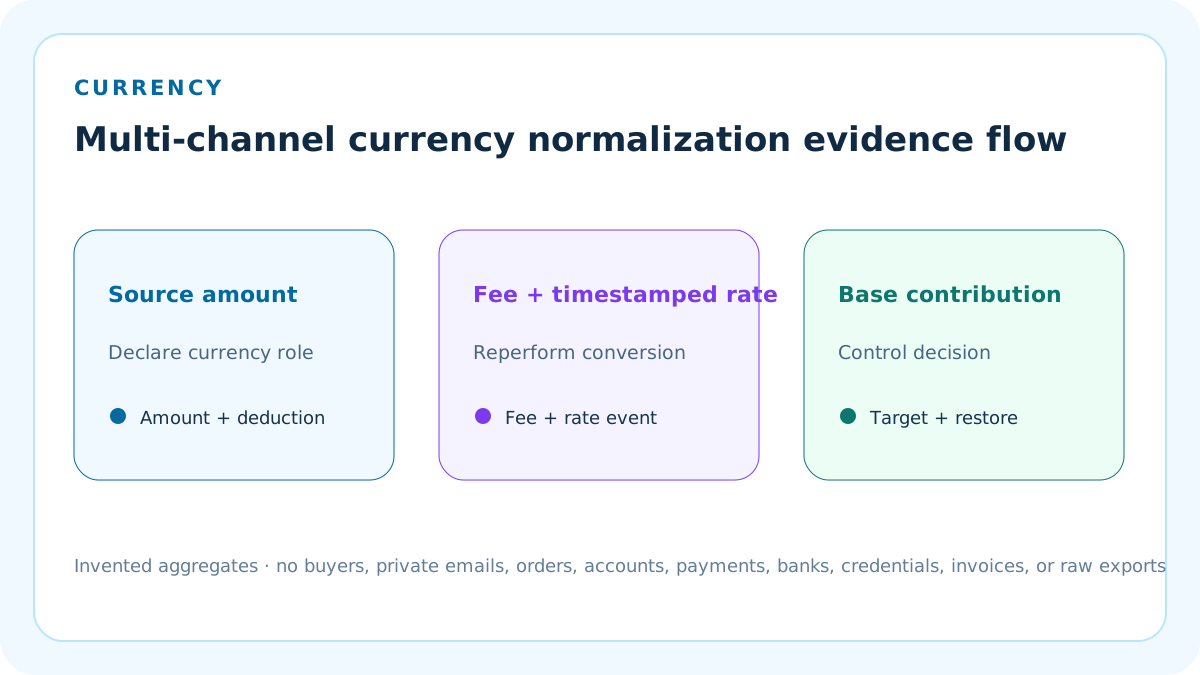
Name every currency
Record source, customer-presentment, store, platform-report, payout, bank, and comparison-base currencies separately.
A three-letter code without its operational role cannot explain which amount was converted or retained.
Choose one comparison base
Normalize both cohorts into one declared base currency for economic comparison.
Do not silently switch the base between revenue, cost, contribution, and per-order outputs.
Close the cohort
Wait until reporting, payout, refund, chargeback, and retained-order boundaries are declared.
A live dashboard amount can change before payout or refund maturity.
Define gross retained revenue
Start from aggregate seller revenue inside the chosen source-currency cohort after declared cancellations and exclusions.
Do not substitute list value, gross merchandise value, tax, platform-funded discounts, or unverified payout estimates.
Carry source deductions
Record non-conversion refunds, seller fees, reversals, and other deductions already denominated in the source currency.
Keep conversion fee separate so the same charge is not included in deductions and modeled again.
Declare the fee base
Enter the evidenced source-currency amount to which the conversion-fee percentage applies.
Etsy documents a sale-amount base; Shopify documents a gross-order base from April 6, 2026, so the tool does not infer one universal base.
Verify the effective date
Record which platform fee formula was active for the cohort and when the seller policy accepted it.
A current formula must not be back-applied to an older settlement without evidence.
Declare rate direction
Enter base-currency units received for one source-currency unit.
Reversing EUR per USD and USD per EUR can produce a plausible-looking but materially wrong result.
Record the timestamp
Tie each rate to capture, transaction, refund, payout, bank conversion, or another named event.
A market quote from a different timestamp does not reproduce a platform or bank settlement.
Separate conversion fee from rate
Keep the explicit percentage fee distinct from the entered exchange rate.
Do not add a fee twice when the reported rate or payout already embeds it.
Calculate net source amount
Subtract declared source-currency deductions from gross retained revenue.
Block when deductions equal or exceed gross retained revenue because the packet no longer supports positive normalization.
Calculate conversion fee
Multiply the separate evidenced conversion-fee base by the entered conversion-fee percentage.
Do not reuse net source amount unless the applicable official formula and cohort evidence support it.
Calculate normalized revenue
Subtract the conversion fee from net source amount, then multiply by base-currency units per source unit.
Preserve full precision for the calculation and round only displayed outputs.
Carry base-currency costs
Subtract product, fulfillment, advertising, software, or other declared costs already measured in the base currency.
Do not convert the same cost twice or omit it because revenue crossed a currency boundary.
Calculate normalized contribution
Normalized contribution equals normalized revenue minus additional base-currency costs.
It is a bounded operating measure, not cash balance, accounting income, taxable profit, or investable return.
Calculate contribution per order
Divide normalized contribution by mature retained orders in the same cohort.
The denominator must not mix placed, authorized, fulfilled, delivered, refunded, and retained orders.
Use the same-day fixture
The invented Etsy EUR cohort uses a recorded capture rate, explicit net-source fee base, and USD costs.
Its rate and fee are educational inputs, not a current quote or universal Etsy outcome.
Use the delayed-payout fixture
The invented Shopify EUR cohort uses a later payout rate and a separately editable fee.
The difference illustrates timing exposure without predicting whether a currency will rise or fall.
Compare rate difference
Measure the absolute rate gap against the average of the two positive entered rates.
A threshold breach triggers Review, not an automatic channel, payout, or hedging recommendation.
Read contribution difference
Compare normalized contribution after consistent deductions, fees, rates, costs, and retained-order definitions.
Do not interpret a currency-only gap when product mix, volume, refund severity, or cost scope also differs.
Run one-variable sensitivity
Preserve the accepted packet, then vary one rate, fee, refund, or base-cost input.
Sensitivity identifies decision drivers but does not replace observed settlement evidence with optimistic assumptions.
Block structural defects
Block missing currencies, invalid rates, impossible deductions, incomplete timestamps, short context, unconfirmed evidence, or declared conflicts.
A favorable normalized contribution cannot repair a broken packet.
Review economic thresholds
Review a cohort below the seller-entered normalized-contribution floor or above the declared rate-difference threshold.
Investigate source definitions and evidence before changing prices, capture timing, payout settings, or banks.
Interpret Ready narrowly
Ready means both entered packets reconcile and pass their declared thresholds.
It does not forecast FX, approve a transfer, recommend hedging, rank a channel, or authorize a live change.
Separate platform and bank conversion
A platform can convert before payout, while a bank can convert again after receipt.
Record each event, fee, direction, timestamp, and amount separately to prevent double counting.
Separate refunds and chargebacks
Refund or chargeback conversions can use a different event-time rate from the original sale.
Do not assume a later reversal exactly cancels the original normalized amount.
Separate reporting currency
Analytics can display an account currency that differs from the shop or payout currency.
Use the seller statement and platform definition appropriate to the decision rather than combining dashboard totals.
Version official rules
Record source URL, access date, data-through date, market, plan, region, payment path, and applicable effective date.
A current platform rule can change, and one region's fee is not a universal input.
Protect private data
Use invented examples or approved aggregate totals only.
Never publish private emails, buyer names, addresses, order rows, account IDs, payment details, bank records, credentials, invoices, or raw exports.
Reject coercive input
Require plain decimal amounts, whole retained-order and evidence-day counts, and real ISO dates.
Values such as 10000eur, fractional order counts, or impossible calendar dates must Block rather than parse partially.
Require nine shared controls
Confirm aggregate privacy, currency roles, cohort grain, rate timing, fee-base source, reversal maturity, cost comparability, independent review, and restoration authority.
A missing structural confirmation blocks every derived economic output.
Quarantine structural output
Mask 26 amount, rate, contribution, margin, and comparison values when the packet is structurally invalid.
Unavailable is safer than displaying arithmetic derived from an unsupported currency or fee-base contract.
Assign owner and reviewer
Name who assembled currencies, deductions, fee bases, rates, timestamps, costs, and retained orders and who independently reperformed them.
A self-approved packet is weaker evidence for a consequential payout or pricing decision.
Preserve the prior packet
Save accepted inputs, outputs, sources, screenshots or aggregate statements, and calculation version before a material change.
The prior packet is the rollback baseline.
Define the stop rule
Specify the observed normalized-contribution, refund, cost, settlement, or rate-variance condition that stops a live experiment.
Do not invent a stop threshold after results are known.
Test restoration
Document how to restore prior prices, capture settings, payout currency, bank path, or channel configuration when authorized.
The browser-local calculator does not execute external changes.
Keep tax and accounting separate
Currency normalization for this tool is an operating comparison.
It does not determine functional currency, tax reporting rate, realized gain or loss, bookkeeping treatment, or legal obligation.
Keep financial advice separate
The calculator does not recommend buying, selling, holding, timing, or hedging currency.
Consult qualified professionals for regulated financial, tax, legal, or accounting decisions.
Release the complete cluster
Index this working tool with ten dedicated guides only after source, function, originality, privacy, accessibility, backup, release-mode, deployment, purge, and live-verification gates pass.
Search signals are measurement outputs, not a release prerequisite.
Sources and further reading
- Etsy Help: Currency Conversion Fees: Official listing currency, Payment account currency, sale-amount fee base, conversion fee, and applied market-rate evidence.
- Etsy Help: Currencies Supported for Etsy Payments: Official buyer, listing, deposit-currency, bank-location, and possible bank foreign-exchange context.
- Shopify Help: Currency conversions and exchange rates: Official store, presentment, payout, transaction-time, refund, chargeback, and timing-risk definitions.
- Shopify Help: Supported payout currencies: Official payout-currency, exchange-rate, fee, historical-rate, and multi-currency payout context.
- Shopify Help: Currency conversion fee calculation: Official old and post-April 6, 2026 fee-base formulas; record the applicable effective date and current gross-order base.
- TikTok Ads: Product-level reporting: Official warning that reporting currency and shop currency can differ and converted figures can vary with exchange rates.
- TikTok Ads: Shop Ads reporting time: Official attributed-event versus real-time conversion reporting dates for comparable cohort cutoffs.
- Seller Profit Guard methodology: Evidence precedence, deterministic calculation, privacy, review, correction, release, and restoration.
Related Seller Profit Guard tools
- Sales Channel Contribution Calculator: Compare complete contribution packets after currency normalization.
- Etsy Currency Conversion Fee Calculator: Reconstruct one Etsy-specific conversion fee packet.
- Marketplace Fee Comparison Calculator: Compare channel fee packets at a common retained-order grain.
- Marketplace Price Parity Calculator: Solve channel prices for a common contribution target.
- Methodology: Review evidence, privacy, validation, correction, release, and restoration.
- Data Privacy: Protect seller, buyer, order, payment, bank, and raw-export data.
- How do you normalize channel contribution across currencies?: For each closed cohort, subtract source-currency refunds, fees, and deductions from gross retained revenue; subtract the explicitly modeled conversion fee; multiply by base-currency units per source unit; then subtract costs already in the base currency. Compare normalized contribution, margin, and contribution per mature retained order.
- What is a same-day channel currency conversion example?: An invented EUR 10,000 Etsy cohort has EUR 500 of non-conversion deductions and a 2.5% editable fee on the EUR 10,000 sale amount. At 1.08 USD per EUR, normalized revenue is USD 9,990; after USD 1,000 of base-currency costs, normalized contribution is USD 8,990.
- How does delayed payout conversion change normalized contribution?: An invented EUR 10,000 Shopify cohort has EUR 500 of non-conversion deductions and a 2% editable fee on the post-April 6, 2026 gross-order base. At 1.03 USD per EUR, normalized revenue is USD 9,579; after USD 1,000 of base costs, contribution is USD 8,579.
- What makes a multi-channel currency comparison wrong?: Common errors include reversing rate direction, mixing presentment with payout currency, applying a fee to the wrong base, double-counting embedded conversion, using a later market quote instead of the settlement rate, ignoring refund timing, converting costs twice, rounding early, mixing order denominators, and treating normalization as an FX forecast.
- Where should multi-channel currency data come from?: Use platform transaction or payout records for source and payout amounts, order timelines for applied rates, official help for definitions and fee bases, aggregate refund records for reversals, bank statements for any second conversion, seller ledgers for base-currency costs, and dated owner-review records for accepted assumptions and restoration.
- When should a currency normalization packet be blocked?: Block invalid currency codes, nonpositive rates, impossible deductions, missing timestamps, incomplete context, unconfirmed evidence, or open conflicts. Review reconciled cohorts below the normalized-contribution floor or above the entered rate-gap threshold. Ready only describes the entered packet; it does not recommend conversion, payout timing, hedging, or a channel.
- How should same-day and delayed conversions be compared?: Align cohort scope, source and base currencies, gross retained revenue, source deductions, conversion-fee base, retained orders, base-currency costs, rounding, and evidence rules. Then isolate the entered fee and timestamped exchange-rate differences without claiming that timing caused every contribution difference or predicts a future rate.
- How often should multi-channel currency packets be reviewed?: Review after transaction, payout, refund, and chargeback windows close and whenever a platform, bank, payout currency, fee base, conversion path, or material rate changes. Preserve the prior packet, assign an owner and reviewer, document exceptions, monitor a declared threshold, and test restoration before any authorized live setting change.
- What does normalized currency contribution mean?: It restates one declared closed cohort in the selected base currency under entered deductions, fee base, rate, timestamp, and costs. It does not determine cash timing, accounting functional currency, realized gain or loss, tax treatment, future exchange rates, hedging value, channel superiority, demand, conversion, or lifetime value.
- What belongs in a multi-channel currency audit?: Record channel and cohort identity, every currency role, gross retained revenue, source deductions, conversion-fee rate and base, exchange-rate direction and timestamp, normalized revenue, base-currency costs, contribution, retained orders, rounding policy, source versions, conflicts, owner, reviewer, prior packet, decision, monitoring trigger, stop rule, and restoration test.
Use the interactive tool
Enable JavaScript to open the calculator and process browser-local inputs. The explanatory content and source links remain available without JavaScript.
Related guide: Define currencies, deductions, fee base, rate direction, timing, normalized contribution, evidence, and restoration.
This tool provides operating estimates, not tax, accounting, legal, financial, or marketplace-policy advice. Verify current official sources and your own records before changing prices or operations.