Seller Profit Guard · How it works · CSV privacy
Sales channel contribution calculator
Compare two closed sales-channel cohorts by retained net revenue, total contribution, contribution margin, and contribution per retained order after product cost, platform and payment fees, acquisition, commission, fulfillment, mature returns, software, support labor, and other declared channel costs.
Maintained by Seller Profit Guard Editorial Team. Last reviewed: 2026-07-29.
Start with closed cohorts
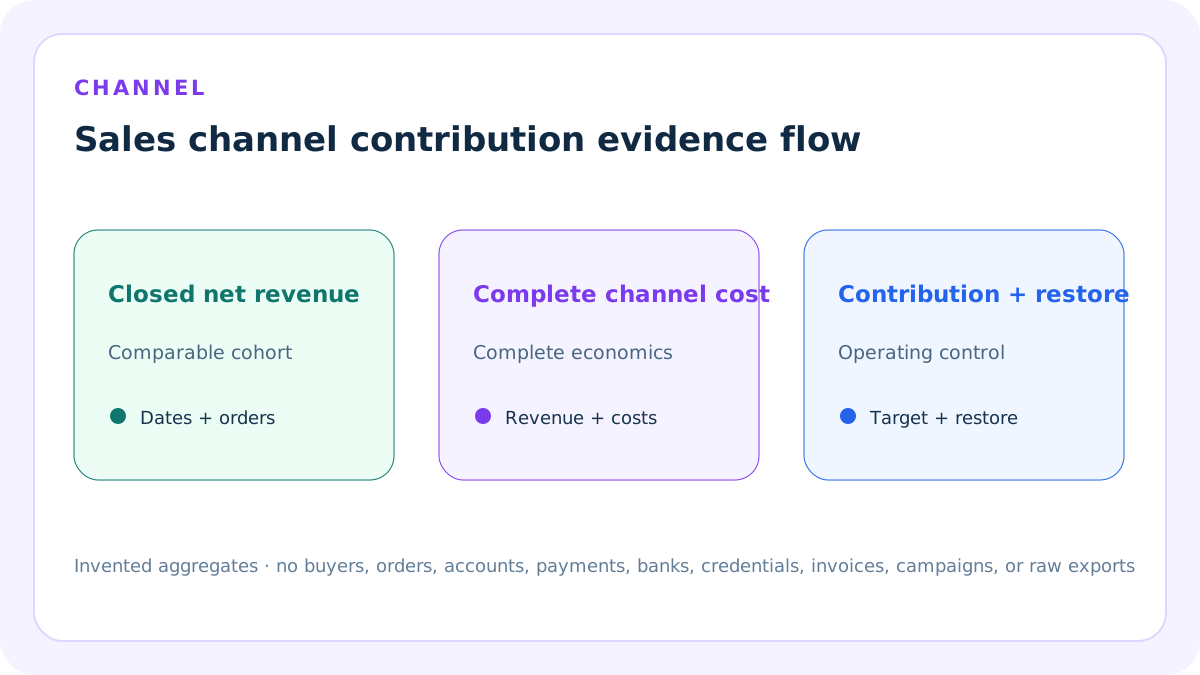
Compare channels only after their reporting, settlement, refund, return, and retained-order windows are sufficiently closed.
A live dashboard snapshot can omit reversals, mature returns, late fees, software allocation, and support labor.
Define retained net revenue
Use seller-retained revenue after seller discounts, refunds, cancellations, and reversals, with tax and unverified platform funding excluded or separately declared.
Do not substitute GMV, Gross Revenue, list value, checkout total, payout, or accounting income.
Define retained orders
Count orders that remain inside the same mature revenue and cost cohort after exclusions and reversals.
A placed-order, paid-order, fulfilled-order, delivered-order, and retained-order denominator can differ.
Align currency and dates
Use the same reporting currency, closed start and end dates, settlement cutoff, and return-maturity rule.
Convert currency through a documented separate method rather than blending unlike nominal totals.
Carry product cost
Use extended product cost for the retained units in each channel cohort.
Record inventory-cost version, component changes, discounts, recoveries, and whether returned inventory was reusable.
Carry marketplace and payment fees
Aggregate applicable marketplace, payment, gateway, transaction, regulatory, listing, and related retained-order fees without double counting.
Reconcile official category definitions with actual current statements.
Carry acquisition and commission
Include attributable advertising, affiliate, creator, referral, and other acquisition cost at the same cohort grain.
Do not call organic exposure zero-cost if content, samples, commission, or production resources are material and attributable.
Carry fulfillment and shipping
Include packaging, pick-pack, label, fulfillment-provider, seller shipping, and other outbound burden attributable to the cohort.
Buyer-paid shipping belongs in retained net revenue only when the seller retains it under the chosen definition.
Carry mature return loss
Use unrecovered seller loss from a sufficiently mature comparable cohort, including refunds, damaged inventory, extra shipping, reships, and handling where evidenced.
Return count alone does not measure economic severity.
Allocate software and channel fixed costs
Allocate subscriptions, apps, listing programs, storefront software, and other channel-specific fixed costs using a documented denominator.
Preserve the source charge and allocation period.
Carry support and operations labor
Include attributable customer service, dispute, moderation, listing, order-management, or channel-operations labor when the comparison intends to capture it.
Use a documented time and rate method rather than an unexplained estimate.
Name other channel costs
Use the other-cost field only for a named cost that does not fit the declared categories.
Do not use it to hide a balancing difference or unreconciled payout gap.
Calculate total channel cost
Add product, platform and payment, acquisition, fulfillment, return, software, support, and other declared costs.
Keep each component visible so a reviewer can identify the dominant driver.
Calculate contribution
Contribution equals retained net revenue minus total declared channel cost.
It is a bounded before-overhead operating measure, not net income or taxable profit.
Calculate contribution margin
Divide contribution by retained net revenue.
Do not use GMV, cost, payout, ad spend, or list value as the denominator.
Calculate contribution per retained order
Divide contribution by mature retained orders.
This enables a comparable unit view when cohort sizes differ, but it does not replace total contribution.
Read total and per-order together
One channel can produce lower contribution per order but greater total contribution through higher verified volume.
Another can produce better unit economics but insufficient total contribution or operational capacity.
Normalize different cohort sizes
Use total contribution to understand the actual closed-period contribution pool and per-retained-order contribution to compare unit economics when order counts differ.
Do not rescale one observed cohort to the other channel's volume unless a separate capacity and demand scenario documents the assumption.
Run bounded cost sensitivity
After accepting the base packet, vary one evidenced cost driver such as acquisition, mature return loss, fulfillment, software allocation, or support labor while preserving the original result.
Sensitivity shows which input can change the decision; it does not authorize replacing observed costs with optimistic targets.
Use the organic marketplace fixture
The invented Etsy cohort includes 100 retained orders, USD 6,000 retained net revenue, product cost, fees, fulfillment, mature returns, software, support, and other cost.
Zero paid acquisition is a declared fixture value, not a claim that marketplace demand is free.
Use the paid owned-store fixture
The invented Shopify cohort includes 80 retained paid orders, USD 6,400 retained net revenue, payment fees, attributable acquisition, fulfillment, returns, plan and apps, support, and product cost.
It keeps store software and paid acquisition visible instead of calling the owned channel fee-free.
Apply Block first
Block invalid currency, non-whole or nonpositive retained orders, missing revenue, negative costs, incomplete context, unconfirmed configuration, or declared conflicts.
A favorable margin cannot repair a broken cohort.
Use Review for target misses
Review when a reconciled cohort falls below the seller-entered contribution margin or contribution-per-retained-order threshold.
Diagnose revenue, cost, volume, attribution, allocation, or return maturity before changing a channel.
Interpret Ready narrowly
Ready means both entered cohorts pass the declared structure and target gates.
It does not prove channel superiority, causality, future demand, migration value, customer lifetime value, or incremental advertising return.
Separate contribution from payout
Payout can exclude unsettled amounts or include prior-period adjustments, while contribution matches revenue and costs to the declared cohort.
Reconcile cash timing separately.
Separate contribution from accounting
Overhead, payroll, owner compensation, financing, depreciation, tax, inventory accounting, and other business-level items may remain outside the channel packet.
Name exclusions before presenting contribution as complete.
Avoid attribution mismatch
Use acquisition and commission cost from the same attribution and order cohort.
Do not divide a broad campaign total by a narrower retained-order subset without a documented bridge.
Avoid allocation distortion
A fixed plan, app, software, or support cost can look artificially low when divided by all placed orders instead of mature retained orders.
Preserve both the raw charge and denominator.
Protect private data
Use invented examples or approved aggregates only. Never publish buyer emails, names, addresses, order IDs, payment details, account IDs, bank records, credentials, private invoices, or raw exports.
The browser-local tool does not connect to marketplace, storefront, advertising, bank, or accounting systems.
Reject coercive numeric evidence
Accept only plain decimal values for revenue, costs, thresholds, and retained-order counts; reject units, exponent notation, booleans, arrays, and partial parses.
A field such as 250usd must Block rather than silently becoming 250.
Validate source and policy dates
Require real YYYY-MM-DD values for the official-source review and seller contribution policy, and do not allow the seller policy to postdate the reviewed source packet.
Require a positive whole-number closed evidence duration to prevent an incomplete return or settlement window from being presented as mature.
Require nine shared controls
Confirm synthetic aggregate use, matched cohort windows, retained definitions, official sources, acquisition scope, fulfillment and returns, fixed and labor allocations, independent review, and tested restoration.
These controls make Ready a reviewed internal comparison rather than a channel recommendation.
Quarantine structural Block outputs
When any structural control fails, mask all 32 cohort quantities and comparison differences as Unavailable.
Do not leave attractive contribution figures visible beside a Block decision because they can be copied without the failed evidence context.
Version the channel packet
Record source, access date, data-through date, cohort dates, exclusions, currency, definitions, allocations, owner, reviewer, and prior accepted result.
A material definition or cost change opens a new version.
Preserve rollback
Before changing a channel, campaign, price, staffing, plan, provider, or fulfillment setting, save the prior configuration, monitoring window, stop condition, and restoration steps.
The calculator does not authorize or perform external mutations.
Release the complete cluster
Index this working calculator with ten dedicated guides only after function, source, originality, accessibility, backup, test, release-mode, deployment, purge, and live-verification gates pass.
Search signals are measurement inputs after release, not a publication prerequisite.
Sources and further reading
- Etsy Help: Payment Account: Official Etsy sales, fee, tax, credit, seller-service, and shipping-label balance context.
- Etsy Help: seller fees and taxes: Official Etsy fee-category, base, payment-processing, advertising, conversion, and regulatory context.
- Shopify Help: types of charges: Official Shopify subscription, app, shipping, and transaction-charge context.
- Shopify Help: profit reports: Official cost-per-item, net-sales, discount, refund, gross-profit, and report-timing boundaries.
- Shopify Help: analytics fields: Official sales, discounts, returns, shipping, tax, and cohort-field definitions.
- TikTok Ads: Shop Ads reporting: Official Shop Ads reporting and attribution context for channel acquisition evidence.
- TikTok Ads: Gross Revenue for Shop Ads: Official warning that platform Gross Revenue and seller-retained revenue are different concepts.
- TikTok Ads: affiliate creatives: Official Ads x Affiliate, creator authorization, and commission context.
- Seller Profit Guard methodology: Evidence precedence, deterministic calculation, privacy, review, release, correction, and restoration.
Related Seller Profit Guard tools
- Marketplace Fee Comparison Calculator: Compare fee packets for one retained order.
- Marketplace Price Parity Calculator: Reverse-solve channel prices for a common contribution target.
- Contribution Margin Calculator: Model one retained-order contribution packet.
- Ad Attribution Reconciliation Calculator: Reconcile paid and seller order evidence before allocating acquisition cost.
- Methodology: Review evidence, privacy, validation, release, correction, and restoration.
- Data Privacy: Protect seller, buyer, order, payment, account, bank, and raw export data.
- How do you calculate sales channel contribution?: For one closed, mature cohort, subtract product cost, platform and payment fees, acquisition and commission, fulfillment, return loss, software, support labor, and other declared channel costs from retained net revenue. Divide contribution by retained revenue for margin and by retained orders for a comparable unit result.
- What is an organic marketplace contribution example?: An invented closed Etsy cohort retains USD 6,000 across 100 orders. After USD 4,100 of product, fee, fulfillment, mature return, software, support, and other costs, contribution is USD 1,900, margin is 31.67%, and contribution per retained order is USD 19.00.
- How do you calculate paid owned-store contribution?: An invented closed Shopify cohort retains USD 6,400 across 80 paid orders. After USD 5,000 of product, payment, attributable acquisition, fulfillment, mature return, plan and app, support, and other costs, contribution is USD 1,400, margin is 21.88%, and contribution per retained order is USD 17.50.
- What makes a channel contribution comparison wrong?: Common errors include comparing different date or maturity windows, using GMV instead of retained net revenue, dividing by placed orders, omitting acquisition or commission, ignoring return severity, calling an owned store fee-free, allocating software arbitrarily, excluding support labor, mixing payout with contribution, and inferring causality from two cohorts.
- Where should channel contribution data come from?: Use closed marketplace or storefront reports for aggregate revenue and retained orders, settlement and payment statements for fees, ad and affiliate reports for acquisition, fulfillment invoices and seller ledgers for delivery and product cost, mature cohorts for return loss, bills for software, and time records for attributable support labor.
- When should a channel contribution packet be blocked?: Block when dates, currency, retained revenue, retained orders, costs, allocations, context, ownership, or restoration fail. Review when a reconciled channel misses the seller's margin or per-order contribution target. Ready only means the entered cohorts pass those controls; it does not recommend a channel or prove future performance.
- How should organic marketplace and paid-store cohorts be compared?: Align currency, closed dates, retained revenue, retained-order definition, settlement cutoff, return maturity, product scope, cost rules, and allocations. Then compare total contribution, margin, contribution per retained order, cohort volume, and every cost component without calling observed differences causal or permanent.
- How often should channel contribution be reviewed?: Review after the reporting, settlement, and return windows close, and whenever a material fee, acquisition, fulfillment, product-cost, software, support, or definition change occurs. Preserve the prior packet, assign an owner and reviewer, document exceptions, and restore a controlled channel change after a verified regression.
- What does a channel contribution result mean?: It describes one declared closed cohort. Total contribution reflects both unit economics and retained volume; contribution per order normalizes cohort size; margin normalizes retained revenue. None proves incremental demand, customer lifetime value, future volume, payout timing, accounting income, tax, or that one channel should replace another.
- What belongs in a channel contribution audit?: Record channel and product scope, currency, cohort and settlement dates, return maturity, retained net revenue and order definitions, product cost, fees, acquisition, commission, fulfillment, return loss, software allocation, support labor, other costs, formulas, outputs, targets, conflicts, owner, reviewer, prior packet, stop rule, monitoring, and restoration test.
- How do you normalize channel contribution across currencies?: For each closed cohort, subtract source-currency refunds, fees, and deductions from gross retained revenue; subtract the explicitly modeled conversion fee; multiply by base-currency units per source unit; then subtract costs already in the base currency. Compare normalized contribution, margin, and contribution per mature retained order.
- What is a same-day channel currency conversion example?: An invented EUR 10,000 Etsy cohort has EUR 500 of non-conversion deductions and a 2.5% editable fee on the EUR 10,000 sale amount. At 1.08 USD per EUR, normalized revenue is USD 9,990; after USD 1,000 of base-currency costs, normalized contribution is USD 8,990.
- How do you compare self-fulfillment with third-party fulfillment?: Use the same mature retained orders, retained revenue, product mix, zones, package profile, service level, currency, and return window. For each option, add pick-pack, packaging, shipping, storage, software, minimums, receiving, returns, and other documented costs; subtract product and fulfillment cost from retained revenue; then review contribution and practical capacity.
- What is a complete self-fulfillment cost example?: An invented 100-retained-order cohort has USD 12,000 retained revenue, USD 4,000 product cost, and USD 3,000 fulfillment cost after valued seller labor, packaging, shipping, space, software, receiving, returns, and other costs. Contribution is USD 5,000, or USD 50 per retained order, at 83.3% capacity utilization.
Use the interactive tool
Enable JavaScript to open the calculator and process browser-local inputs. The explanatory content and source links remain available without JavaScript.
Related guide: Define closed cohorts, retained net revenue, all channel costs, contribution, evidence, and restoration.
This tool provides operating estimates, not tax, accounting, legal, financial, or marketplace-policy advice. Verify current official sources and your own records before changing prices or operations.