Seller Profit Guard · How it works · CSV privacy
Fulfillment Channel Comparison Calculator
Compare self-fulfillment and third-party fulfillment on the same mature retained-order cohort. Include seller labor or provider pick-pack charges, packaging, carrier shipping, storage, software, minimum commitments, inbound receiving, returns, other documented costs, product cost, retained revenue, and practical capacity before interpreting contribution.
Maintained by Seller Profit Guard Editorial Team. Last reviewed: 2026-07-29.
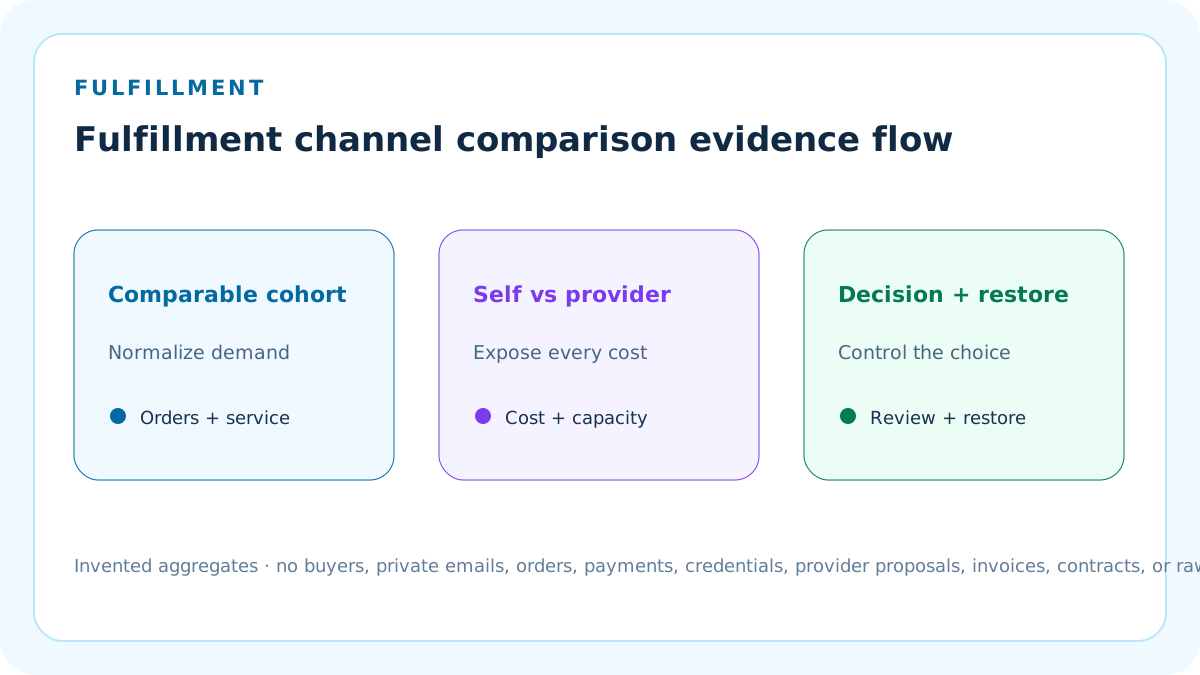
Start with one comparable cohort
Compare the same product mix, destination zones, package profile, carrier service, currency, return window, and mature retained orders.
A self-fulfilled month and a provider quote with different assumptions are not comparable.
Define retained orders
Use orders remaining after the declared cancellation and return-maturity window.
Do not divide one option by placed orders and the other by shipped units.
Define retained revenue
Use merchandise and seller-retained shipping after mature refunds, discounts, and credits.
Keep tax and marketplace-reported gross figures outside the fulfillment numerator unless the same definition is used in both options.
Record product cost
Keep product cost visible even though the decision focuses on fulfillment.
Contribution must not make an inexpensive fulfillment option look attractive when the underlying order is unprofitable.
Value self-fulfillment labor
Multiply observed pick, pack, label, exception, and handoff time by a declared loaded labor rate.
Owner time is not free merely because no payroll invoice exists.
Record provider pick-pack charges
Map base order fees, per-item tiers, inserts, kitting, special handling, and oversized-item charges.
A headline pick-and-pack rate rarely represents the complete provider invoice.
Record packaging
Include mailers, boxes, tape, labels, dunnage, inserts, custom packaging, and provider material markups.
Hold the package profile constant where the service comparison requires it.
Record carrier shipping
Use the same zone mix, billable weights, service levels, fuel or logistics surcharges, residential charges, and delivery-area effects.
Customer-facing shipping price is not the same as carrier cost.
Record storage
Self-fulfillment needs allocated space, utilities, equipment, insurance, and handling; provider storage needs volume, season, age, and utilization terms.
A zero storage entry requires a documented reason.
Record software and integrations
Include warehouse tools, label software, order-routing apps, connector charges, implementation, and recurring support.
Do not hide a required integration inside general overhead for one option only.
Record minimum commitments
Show monthly minimums, unused minimum spend, account fees, and volume commitments.
Allocate the actual shortfall for the declared forecast rather than assuming the minimum is always consumed.
Record inbound receiving
Include appointment, unloading, pallet, carton, unit, labeling, placement, inspection, and discrepancy work.
Inbound cost belongs to the option that creates it.
Record returns
Include return labels when seller-funded, receiving, inspection, restocking, repackaging, disposal, forwarding, and lost recovery.
Use a mature return rate and identical recovery definition.
Record other documented costs
Use a named line for insurance, account management, inventory counts, projects, removals, long-term storage, or exception handling.
Never use other costs as an unexplained balancing plug.
Calculate total fulfillment cost
Add pick-pack, packaging, carrier shipping, storage, software, minimums, returns, receiving, and other documented fulfillment costs.
Keep product cost separate so both operational and total contribution views remain auditable.
Calculate fulfillment cost per retained order
Divide total fulfillment cost by mature retained orders.
This denominator exposes the effect of returns, minimums, and unused capacity.
Calculate contribution
Subtract product cost and every declared fulfillment cost from retained revenue.
Contribution is not cash, accounting profit, taxable income, or a provider service-level score.
Calculate contribution per retained order
Divide contribution by the same retained-order denominator used for both options.
Compare the amount against the seller-entered floor rather than choosing the higher option automatically.
Measure practical capacity
Estimate forecast orders against capacity that can be delivered at the declared service level after downtime, peaks, staffing, and provider limits.
The theoretical maximum is not practical capacity.
Use the self-fulfillment fixture
The invented 100-order packet records USD 3,000 of fulfillment cost and USD 5,000 contribution.
Contribution is USD 50 per retained order at 83.3% capacity utilization.
Use the provider fixture
The invented 100-order provider packet records USD 3,200 of fulfillment cost and USD 4,800 contribution.
Contribution is USD 48 per retained order at 50% capacity utilization.
Read the tradeoff
Self-fulfillment leads the invented packet by USD 200 contribution, while the provider retains more modeled capacity headroom.
The calculator does not declare either option universally better.
Block incomparable revenue
Block when retained orders or retained revenue differ between options.
A seller can model a different demand case separately, but should not call it a pure fulfillment comparison.
Block unsupported costs
Block negative entries, missing evidence, impossible capacity, or unresolved rate and scope conflicts.
A missing provider quote or unvalued seller labor is not zero.
Review contribution thresholds
Review when either option falls below the entered contribution-per-retained-order target.
A relative winner can still be economically unacceptable.
Review capacity thresholds
Review when forecast utilization exceeds the seller-entered capacity limit.
Capacity headroom protects peak periods, exceptions, staffing gaps, and provider constraints.
Interpret Ready narrowly
Ready means the entered aggregate options are structurally comparable and pass the chosen economic and capacity thresholds.
It is not a provider recommendation, contract approval, service guarantee, or migration authorization.
Separate price from service
Model cost and capacity here, then review accuracy, damage, delivery, support, inventory control, brand experience, and contract remedies separately.
Do not convert qualitative claims into invented dollar savings.
Run sensitivity cases
Vary volume, zone mix, weight, return rate, storage age, wage, minimum shortfall, peak surcharge, and service level one at a time.
Preserve the base packet so the driver is visible.
Protect private data
Use invented examples or approved aggregates only.
Never publish private emails, buyer names, addresses, order rows, payment details, bank records, credentials, provider proposals, invoices, or raw exports.
Version the evidence
Record source URL, access date, data-through date, rate card, quote version, contract exclusions, report version, owner, and reviewer.
Fulfillment charges and operational constraints can change.
Require a closed evidence duration
Enter a positive whole-number minimum evidence duration and keep the retained-order cohort closed for at least that many days before comparison.
A quote date alone does not establish mature shipping, return, receiving, exception, or capacity evidence.
Record two real control dates
Use a real ISO review date for current official sources and a real ISO effective date for the seller's fulfillment policy; the seller policy date cannot be later than the source review.
These dates make stale rules and future-dated assumptions visible without pretending that either date guarantees provider performance.
Complete all nine confirmations
Confirm synthetic aggregates, cohort comparability, seller labor, provider rates and minimums, return maturity, capacity and service, current sources, independent review, and restoration authority.
A single missing confirmation blocks the derived economics because an apparently precise contribution difference would otherwise rest on an unresolved control.
Mask blocked economics
When structural evidence fails, the calculator shows Unavailable for contribution, per-order cost, capacity utilization, and other derived fulfillment outputs.
Masking prevents an invalid packet from leaking a persuasive dollar comparison while issues, control dates, and confirmation coverage remain available for correction.
Separate hybrid fulfillment
If a seller uses its own location and a fulfillment app for the same product, model each operational packet separately or create an explicitly weighted hybrid scenario.
Shopify tracks inventory separately by location and routes orders according to configuration, so pooled cost and capacity assumptions can conceal operational differences.
Preserve rollback
Before an authorized routing or provider change, save the prior location, shipping, inventory, integration, packaging, staffing, and return configuration.
Define stop conditions and test restoration before migration.
Release the complete cluster
Index the working calculator with ten dedicated guides only after functionality, source, originality, privacy, accessibility, backup, release-mode, deployment, purge, and live-verification gates pass.
Search signals are measurement outputs, not a release prerequisite.
Sources and further reading
- Shopify Help: inventory across locations and fulfillment apps: Official location, capacity, routing, inventory-separation, and fulfillment-service context.
- Shopify Help: order fulfillment and shipping features: Official self-fulfillment, location, shipping-profile, shipping-rate, return, and fulfillment-service boundaries.
- Amazon Multi-Channel Fulfillment pricing: Official pick-pack-ship, product-size, weight, units-per-order, speed, storage, surcharge, and rate-card context.
- Amazon MCF service terms: Official storage-limit, return, disposal, payment, suspension, and service-term boundaries.
- Seller Profit Guard methodology: Evidence, privacy, deterministic calculation, independent review, correction, release, and restoration.
Related Seller Profit Guard tools
- Sales Channel Contribution Calculator: Compare channel economics after fulfillment normalization.
- Shipping Zone Margin Calculator: Inspect destination-zone shipping pressure.
- Packaging Cost per Order Calculator: Build an auditable packaging packet.
- Return Shipping Cost Calculator: Model return-logistics burden separately.
- Methodology: Review evidence, privacy, calculation, correction, release, and restoration.
- Data Privacy: Protect seller, buyer, order, payment, provider, contract, and raw-export data.
- How do you compare self-fulfillment with third-party fulfillment?: Use the same mature retained orders, retained revenue, product mix, zones, package profile, service level, currency, and return window. For each option, add pick-pack, packaging, shipping, storage, software, minimums, receiving, returns, and other documented costs; subtract product and fulfillment cost from retained revenue; then review contribution and practical capacity.
- What is a complete self-fulfillment cost example?: An invented 100-retained-order cohort has USD 12,000 retained revenue, USD 4,000 product cost, and USD 3,000 fulfillment cost after valued seller labor, packaging, shipping, space, software, receiving, returns, and other costs. Contribution is USD 5,000, or USD 50 per retained order, at 83.3% capacity utilization.
- What is a complete third-party fulfillment cost example?: An invented provider packet uses the same 100 retained orders and USD 12,000 retained revenue. USD 4,000 product cost plus USD 3,200 fulfillment cost leaves USD 4,800 contribution, or USD 48 per retained order. Forecast utilization is 50% of declared practical provider capacity, preserving more headroom than the self-fulfilled fixture.
- What makes a fulfillment comparison unreliable?: Common errors include comparing different order mixes, treating owner time as free, substituting customer shipping charges for carrier cost, hiding storage or inbound work, assuming minimums are consumed, ignoring returns and surcharges, mismatching denominators, accepting a headline provider rate, overstating capacity, and treating the result as contract approval.
- Where should fulfillment comparison inputs come from?: Use mature order and refund aggregates, time studies and loaded labor rates, packaging purchases, carrier invoices, allocated facility records, software bills, provider rate cards and quotes, receiving and return reports, contract terms, capacity observations, source versions, and independent review. Keep private rows and confidential provider documents out of public pages.
- When should a fulfillment comparison be blocked?: Block when options use different retained-order or revenue scope, cost layers are negative or unsupported, forecast exceeds capacity, provider or labor evidence is unconfirmed, or material conflicts remain. Review comparable options that miss contribution or capacity thresholds. Ready only means the entered packet is comparable; it does not recommend outsourcing or approve a provider contract.
- How should self-fulfillment and a 3PL be compared?: Hold product mix, retained orders, destination zones, package profile, service level, currency, and return maturity constant. Value self labor and space; expand the provider quote into pick-pack, receiving, storage, minimums, packaging, shipping, surcharges, software, returns, and exclusions. Compare contribution and capacity, then vary one driver at a time.
- How often should fulfillment economics be reviewed?: Review after a mature order and return window closes and whenever volume, zone mix, weight, packaging, carrier rates, wages, space, provider pricing, minimums, storage age, service level, return policy, integration, or contract terms change. Preserve the prior packet, assign an owner and reviewer, log exceptions, define stop conditions, and test restoration.
- What does a fulfillment comparison result mean?: It estimates retained-order contribution and capacity under the entered aggregate packet. A higher contribution does not prove better delivery, accuracy, damage performance, customer support, inventory control, brand experience, scalability, or contract protection. Ready does not quote a provider, guarantee performance, approve migration, or replace operational, legal, tax, accounting, insurance, and contract review.
- What belongs in a fulfillment comparison audit?: Record currency, cohort dates, product and zone mix, package and service level, retained orders and revenue, product cost, every fulfillment cost, denominator, practical capacity, forecast, formulas, rate and quote versions, contract exclusions, owner, reviewer, conflicts, sensitivity cases, prior packet, authorized change, expected result, realized variance, stop rule, and restoration test.
Use the interactive tool
Enable JavaScript to open the calculator and process browser-local inputs. The explanatory content and source links remain available without JavaScript.
Related guide: Define comparable fulfillment cohorts, costs, contribution, capacity, evidence, and restoration.
This tool provides operating estimates, not tax, accounting, legal, financial, or marketplace-policy advice. Verify current official sources and your own records before changing prices or operations.