Seller Profit Guard · How it works · CSV privacy
TikTok Shop payout reconciliation checker
Rebuild weekly and month-end settlement amounts from sales, refunds, discounts, shipping, fees, adjustments, and reserve movements, then reconcile initiated payouts to bank receipts without exposing order, buyer, statement, payment, or bank data.
Maintained by Seller Profit Guard Editorial Team. Last reviewed: 2026-07-29.
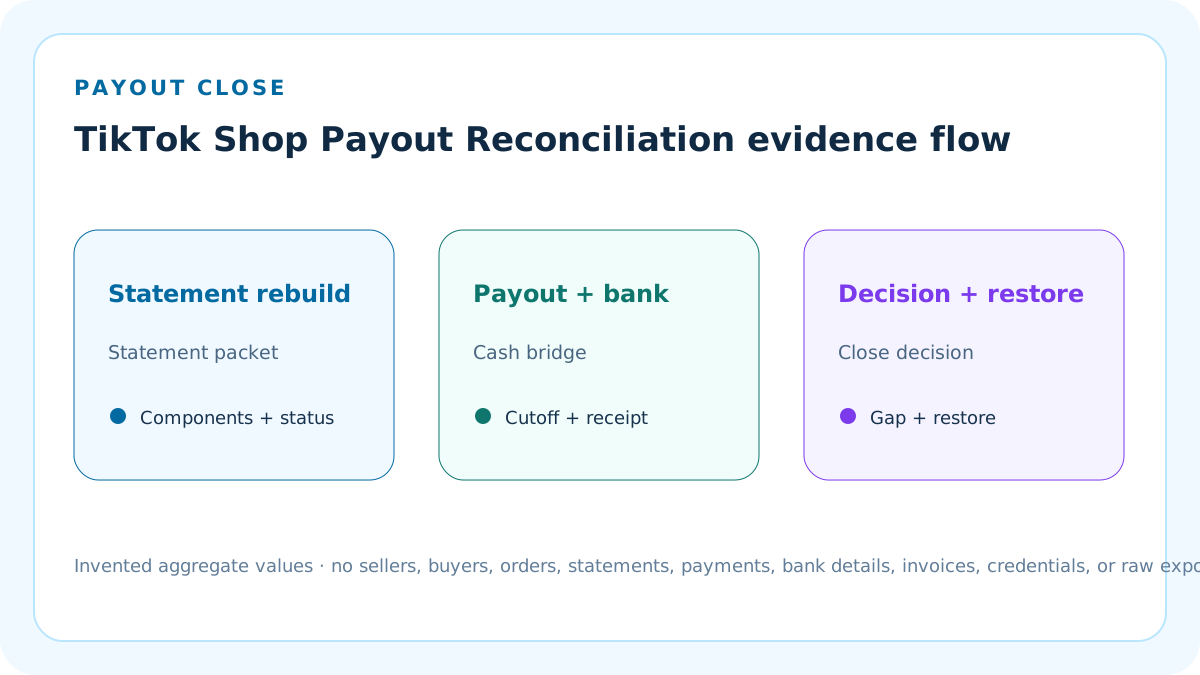
Choose one reconciliation grain
Use one currency, shop, settlement timezone, statement window, payout window, and bank cutoff. Weekly and month-end packets can coexist only as separate scenarios.
Do not compare an order-created report directly with a delivery-based statement or a bank date without declaring the timing bridge.
Start with the settlement statement
A statement provides the platform calculation for settled orders and adjustments. Preserve its statement ID, payment ID, status, currency, report version, and export cutoff in a private evidence packet.
The calculator uses invented aggregates and never requests a real identifier or raw export.
Rebuild net sales
Modeled net sales begin with gross sales, subtract gross-sales refunds and seller discounts, and add seller-discount refunds.
Keep every input non-negative and let the displayed equation control direction so a negative CSV convention is not subtracted twice.
Rebuild retained shipping
Modeled retained shipping equals shipping revenue minus shipping refunds and shipping-related seller charges.
Customer shipping, platform support, logistics cost, and statement shipping can represent different grains. Use only the lines included in the declared statement packet.
Rebuild fees
Referral fees, affiliate commission, refund administration fees, shipping charges, Shop Ads commission fees, and other verified statement fees remain separate.
Do not infer a current rate from a total debit. Reconcile the settled amount first and preserve rate analysis as a separate audit.
Rebuild adjustments
Add verified adjustment credits and subtract verified adjustment debits. Record the reason, effective date, order or account grain, and statement allocation outside the public calculator.
Do not net unrelated compensation, penalty, correction, promotion, tax, reserve, or prior-period lines into one unexplained adjustment.
Keep reserves separate
Subtract newly held reserve and add released reserve only when those movements belong to the statement calculation being modeled.
On-hold balance is not automatically a payout discrepancy. A reserve release can settle in a later statement or payment window.
Calculate expected statement amount
Expected statement amount equals modeled net sales plus retained shipping minus fees plus net adjustments minus reserve held plus reserve released.
This is a reconstruction from entered aggregates, not an accounting opinion or a substitute for the official statement.
Compare expected and observed statement
Statement gap equals expected statement amount minus the observed statement amount.
A gap inside the seller-entered tolerance is matched for this packet. A larger gap remains Review until the missing or duplicated line is identified.
Bridge statements to payouts
TikTok Shop can aggregate eligible settlement amounts into payouts, while negative settlement, reserve, minimum payout, processing, or failed status can affect timing.
Use the exact payout cutoff and status. Do not call a processing or on-hold amount missing cash before its declared maturity point.
Bridge payouts to bank receipts
Expected bank receipt equals payout initiated minus failed or reversed payout amounts. Payout gap equals that expectation minus observed bank receipt.
Bank fees, conversion, split receipts, weekends, account changes, or returned funds require separately documented adjustment lines.
Classify matched and unresolved movement
The checker returns Matched when both gaps are within tolerance and Unresolved when a statement or payout gap exceeds it.
It does not automatically match individual order rows; preserve order-level investigation in a private, access-controlled workflow.
Use a weekly settlement example
The invented weekly packet rebuilds USD 83 from sales, one refund, seller discount, shipping, fees, one adjustment credit, and no reserve movement.
Its observed statement, initiated payout, and bank receipt are all USD 83, so both gaps are zero.
Use a month-end example
The invented month-end packet rebuilds USD 358 from a larger statement aggregate with refunds, seller discounts, shipping, fees, affiliate commission, credits, debits, reserve held, and reserve released.
Its USD 358 initiated payout and bank receipt also reconcile at the declared cutoff.
Use tolerance only for documented rounding
The default tolerance is one cent for the statement and payout comparisons.
Do not widen tolerance to hide a missing refund, duplicate fee, reserve timing error, currency conversion, payout reversal, or bank mismatch.
Treat status as evidence
Pending, processing, paid, and failed statuses answer different questions. Preserve the status observed at the cutoff and the next expected transition.
A payment ID associated with a pending statement is not proof of a completed bank receipt.
Treat negative settlement correctly
A negative settlement can be carried against later positive amounts, delaying payout until platform rules and thresholds are met.
Model the statement itself, then bridge the carry separately. Never invent a zero payout merely to force bank reconciliation.
Treat refunds at the right period
A refund can affect the order, statement, payout, ad cost, reserve, or bank period at different times.
Record which refund event is included in each source and avoid deducting the same refund in both net sales and a separate adjustment.
Treat Shop Ads cost separately
A Shop Ads commission fee can appear in Finance order detail, and refunded ad cost can have its own timing.
Reconcile the settled fee line. Do not use Ads Manager attribution or Refund GMV as a substitute for the Finance amount.
Preserve currency and timezone
Statement and payout reports can use UTC dates while the bank posts in another timezone. Currency conversion can create a separate bank-side difference.
This checker assumes one declared currency per scenario and does not fetch exchange rates or calculate tax.
Block incomplete evidence
Block missing currency, labels, positive tolerance, configuration confirmation, dated period, source grain, owner, reviewer, backup, stop rule, or restoration evidence.
A zero gap cannot rescue an undocumented or internally inconsistent packet.
Use Review for monetary mismatches
Review means the structure is complete but at least one statement or payout gap exceeds tolerance.
Investigate the exact component, status, timing, currency, reserve, adjustment, or bank bridge before marking the period closed.
Interpret Ready narrowly
Ready means two entered aggregate packets reconcile within tolerance under the declared source and cutoff controls.
It does not prove order-level completeness, payout finality after the cutoff, accounting profit, tax treatment, fraud absence, or authority to edit platform records.
Protect financial and buyer data
Use invented examples or approved aggregates. Never publish statement IDs, payment IDs, bank details, buyer data, order rows, invoice images, credentials, or raw exports.
The browser-local calculator does not upload files or connect to TikTok Shop, a bank, an accounting system, or an ad account.
Version every close packet
Record prior result, new result, source versions, export cutoffs, formula version, gap explanation, owner, reviewer, expected resolution, actual resolution, backup, stop rule, and restoration result.
A source-schema, status, fee, refund, reserve, adjustment, currency, cutoff, tolerance, or formula change opens a new version.
Reject coercive numeric inputs
Every money field and tolerance must be a plain decimal within the supported range. Strings with units, scientific notation, infinity, and partially parsed values are structurally blocked.
This prevents a display that looks numeric from silently changing the reconstructed statement or payout bridge.
Require real evidence dates
Record a real Finance source-review date and a seller close-policy effective date. The close policy cannot postdate the source evidence it claims to use.
Dates version the interpretation contract; they do not prove that a report, payout, reserve release, or bank posting is complete.
Require nine shared confirmations
Ready requires invented or approved aggregates, current settlement schema, mature payout status, reserve ledger, Finance components, bank cutoff, one-currency grain, independent review, and restoration authority.
A zero gap with eight confirmations is Block because missing governance can make the arithmetic misleading.
Use the current report equation
The current settlement report separates Net Sales, Shipping, Fees, and Adjustments. Reserve then explains the bridge from statement amount to final payout.
Do not combine reserve with seller contribution or assume the bank receipt equals the statement before payout grouping and reserve movement are reconciled.
Separate statement and payment IDs
A statement groups settled activity; a payment ID represents an initiated payout grouping with a status such as pending, processing, paid, or failed.
Preserve identifiers only in the private evidence system. The public browser input uses aggregate amounts and never requests them.
Model reserve as a dated ledger
New reserve held and reserve released are opposite movements. On-hold reserve and expected release belong to a separate dated ledger.
Dynamic settlement or security review can alter timing. Do not call a still-on-hold amount a missing payout.
Mature the bank bridge
Compare initiated payout less failed or reversed amounts with a dated aggregate bank receipt only after the seller-defined maturity cutoff.
Processing, weekends, bank posting time, currency conversion, returned transfers, and account changes require explicit exceptions instead of a wider tolerance.
Quarantine structural Block outputs
When currency, dates, numbers, confirmations, scenario evidence, privacy, ownership, or restoration controls fail, 24 scenario values display Unavailable.
Equations, dates, confirmation coverage, issues, and repair steps remain visible so the reviewer can fix evidence without trusting incomplete calculations.
Separate reconciliation from accounting
A matched statement and bank bridge does not establish revenue recognition, tax treatment, profit, fraud absence, reserve accounting, or bank correctness.
Use the checker as a deterministic close control and route accounting, tax, banking, dispute, or fraud decisions to authorized professionals.
Keep action authority human-only
The calculator does not initiate, retry, cancel, redirect, or edit a payout; alter bank details; resolve after-sales cases; or change Seller Center records.
Any corrective action requires an authorized human, preserved evidence, an approved change record, an independent reviewer, a stop condition, and a tested restoration path.
Release the complete cluster
Index the working checker and ten dedicated guides together only after source, functionality, content, originality, image, accessibility, test, backup, release-mode, deployment, purge, and live-verification gates pass.
Search signals are measurements after release, not a publication prerequisite. Ordered release and rollback safety still control production mutation.
Sources and further reading
- TikTok Shop: Finances Page FAQ: Official statement, settlement amount, payout, on-hold, processing, paid, reserve, minimum-payout, and timing context.
- TikTok Shop: How to Access Your Settlement Report: Official report access, statement and payment identifiers, status, net sales, shipping, fee, adjustment, and settlement-field definitions.
- TikTok Shop: Dynamic Settlement and Reserve Policy: Official 2026 settlement-tier, performance-review, deferred-settlement, reserve-level, 30-day hold, release, and security-check context.
- TikTok Shop: How to View Your Reserve Record: Official reserve collection, rolling hold, release, on-hold, daily change, and final-payout bridge.
- TikTok Shop: Earnings Analytics: Official paid-order, settled-adjustment, revenue, fee, expense, SKU, account, and time-filter analysis context.
- TikTok Shop: Customer Order Cancellation, Return, and Refund Policy: Official cancellation, return, refund, partial-refund, replacement, shipping-responsibility, and dispute context.
- TikTok Business Help: Troubleshoot Net Sales Campaigns: Official refunded ad-cost, Refund GMV, Finance transaction, and order-detail settlement context.
- Seller Profit Guard methodology: Evidence, privacy, deterministic calculation, release, monitoring, and restoration controls.
Related Seller Profit Guard tools
- TikTok Shop Promotion Stack Calculator: Trace promotion credits and offsets before statement close.
- TikTok Shop Fee Reference Calculator: Reconcile platform, affiliate, promotion, logistics, and refund fee lines.
- TikTok Shop Return Reserve Calculator: Keep modeled return loss separate from statement reserve movement.
- Payment Reconciliation: Use a marketplace-neutral settlement and deposit workflow.
- Methodology: Review evidence, privacy, validation, release, monitoring, and restoration.
- Data Privacy: Protect seller, buyer, order, statement, payment, bank, invoice, and raw export data.
- How do you reconcile a TikTok Shop payout?: Rebuild the statement from gross sales less refunds and seller discounts, plus discount refunds and retained shipping, less verified fees, plus net adjustments and reserve releases, less new reserves. Compare that result with the observed statement, then compare initiated payout less failed amounts with the bank receipt.
- How does a weekly TikTok Shop payout reconcile?: In the invented weekly packet, USD 100 gross sales less USD 10 refund and USD 5 seller discount, plus USD 5 shipping, less USD 9 total fees, plus USD 2 adjustment credit, produces USD 83 expected settlement. The observed statement, initiated payout, and bank receipt are each USD 83.
- How does a month-end TikTok Shop payout reconcile?: In the invented month-end packet, gross sales, refunds, discounts, shipping, platform and affiliate fees, adjustment credits and debits, and reserve held and released produce USD 358 expected settlement. The observed statement and mature payout both equal USD 358, and the bank receipt matches at the declared cutoff.
- What makes a TikTok Shop payout reconciliation wrong?: Common errors include subtracting negative export values twice, mixing order and settlement dates, deducting a refund in two places, hiding unrelated fees or adjustments in one net line, treating on-hold reserve as missing cash, calling a processing payout paid, ignoring failed transfers, and equating bank receipt with profit.
- Which sources should a TikTok Shop payout reconciliation use?: Use Finance Statements for settled components; Payments for initiated payout, status, and payment grouping; transaction and order detail for disputed fees or refunds; reserve exports for held and released amounts; Earnings Analytics for investigation; and a dated bank aggregate for receipt. Preserve source grain, timezone, currency, owner, and cutoff.
- When should a TikTok Shop payout reconciliation be blocked or reviewed?: Block when currency, source grain, cutoff, configuration, ownership, or restoration evidence is missing. Review a complete packet when the expected statement differs from the observed statement or expected mature payout differs from the bank beyond tolerance. Ready only means both entered aggregate bridges pass those declared controls.
- How should weekly and month-end TikTok Shop payouts be compared?: Keep the formula, currency, sign convention, source definitions, tolerance, and evidence rules constant. Let statement windows, volume, fees, adjustments, reserve movements, payment groupings, and bank cutoffs differ explicitly. Compare absolute and relative gaps, unresolved movements, aging, and ownership rather than assuming the larger close is less accurate.
- How often should TikTok Shop payouts be reconciled?: Reconcile each mature payout and run a period close after refund, reserve, adjustment, and bank cutoffs are declared. Export statement and payment aggregates, normalize signs and timezones, rebuild settlement, bridge mature payouts to bank receipts, investigate gaps, assign owners, preserve evidence, and retest after corrections.
- What does a TikTok Shop payout reconciliation result prove?: It proves only that entered aggregate statement components and mature payout-to-bank amounts reconcile within the displayed tolerance under the declared cutoff and evidence controls. It does not prove order-level completeness, future payout finality, accounting income, tax treatment, fraud absence, bank correctness, or authority to edit platform records.
- What belongs in a TikTok Shop payout reconciliation audit?: Record shop scope, currency, timezone, statement and payout windows, source versions, sales, refunds, discounts, shipping, every fee class, adjustment credits and debits, reserve held and released, observed statement, payout status, failed amounts, bank cutoff and receipt, tolerance, gaps, owner, reviewer, conflicts, backup, stop rule, correction, and restoration.
- How do you calculate TikTok LIVE shopping margin?: Reconcile customer payment to original item amount less seller LIVE deal, seller coupon, and platform incentive. Add buyer shipping and only verified platform settlement funding. Then subtract platform fees, creator commission, ads, samples, giveaways, host and production allocation, fulfillment, product cost, return reserve, and other variable cost per retained order.
- What is the margin on an owned TikTok LIVE stream?: In the invented owned stream, USD 65 original item amount becomes USD 55 customer payment after seller and platform promotions. A USD 2 verified platform credit produces USD 57 retained revenue. Allocating USD 220 of ads, samples, giveaway, and production across 50 retained orders leaves USD 27.60 contribution per retained order.
Use the interactive tool
Enable JavaScript to open the calculator and process browser-local inputs. The explanatory content and source links remain available without JavaScript.
Related guide: Define statement components, payout and bank bridges, tolerances, cutoffs, evidence, and restoration.
This tool provides operating estimates, not tax, accounting, legal, financial, or marketplace-policy advice. Verify current official sources and your own records before changing prices or operations.