Seller Profit Guard · How it works · CSV privacy
TikTok GMV Max break-even calculator
Turn TikTok-reported Gross Revenue into seller-owned break-even and target ROAS by reconciling customer payment, verified platform credit, fees, commission, fulfillment, product cost, returns, observed ad cost, and a retained-revenue contribution target.
Maintained by Seller Profit Guard Editorial Team. Last reviewed: 2026-07-29.
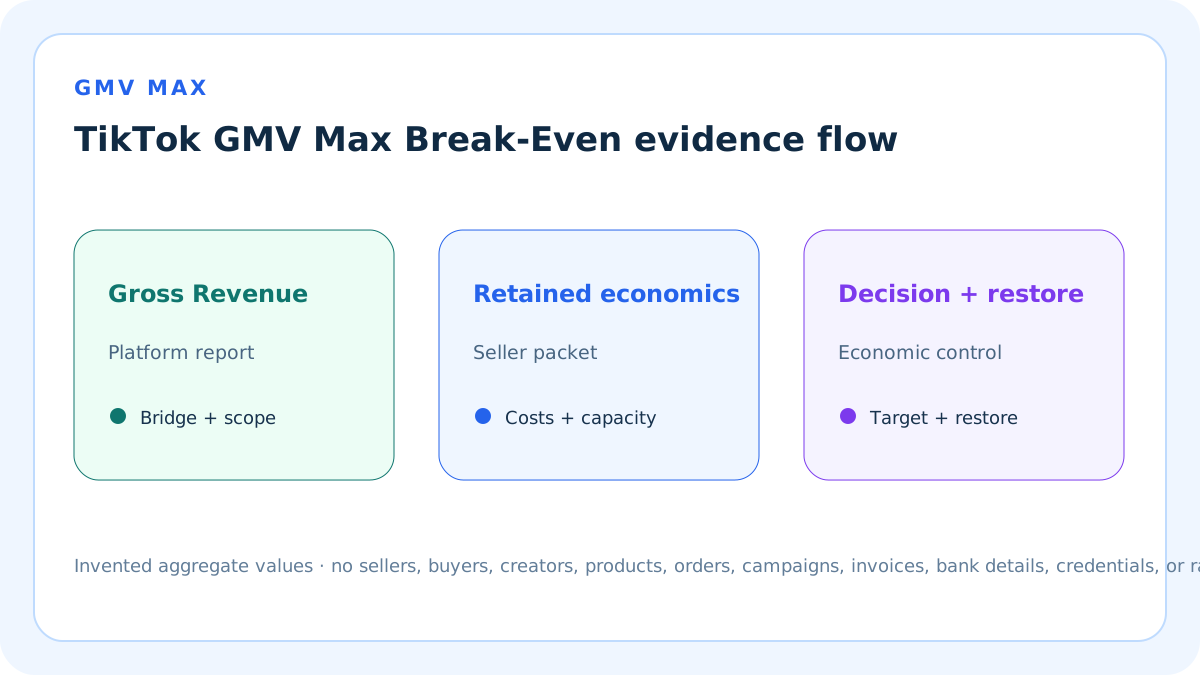
Start with the seller decision
Use the calculator to decide whether one observed GMV Max packet can fund its non-ad costs, advertising, and a seller-entered contribution target.
It does not choose a TikTok target ROI, forecast delivery, or prove that attributed orders were caused by advertising.
Reject coercive numeric evidence
Every money, percentage, tolerance, and evidence-duration input must be a plain decimal within the documented bounds.
Values such as 1.6e2, USD 160, negative amounts, fractional evidence days, infinity, or a value above the bounded review range structurally Block the packet instead of being silently coerced.
Use real evidence dates
Record a real YYYY-MM-DD official-source review date and a seller GMV Max economics policy effective date that does not postdate that review.
The date fields make stale definitions and premature seller-policy changes visible; they do not imply that TikTok or Seller Center approved the seller's policy.
Require nine shared controls
Ready requires synthetic aggregates, the current Gross Revenue bridge, paid-organic-affiliate scope, campaign mode and window, Finance costs, mature returns, separate seller target, independent review, and tested restoration with human-only authority.
A scenario confirmation cannot substitute for a missing shared control, and a dashboard ratio cannot repair an incomplete evidence or authority chain.
Keep platform and seller targets separate
TikTok may recommend an ROI using market and historical campaign signals. The seller target here is derived from retained economics.
A more competitive platform target can support delivery, while a seller-owned target protects the contribution required by the business.
Use the official Gross Revenue bridge
TikTok Ads Manager Gross Revenue equals customer payment minus sales taxes plus platform price discount.
Enter customer payment after sales tax and platform price discount separately, then reconcile their sum to reported Gross Revenue.
Do not call Gross Revenue retained revenue
Gross Revenue can include a customer-facing platform price discount that is not automatically the same as a seller-retained settlement credit.
Retained revenue adds only the platform credit verified in Finance to customer payment after sales tax.
Keep GMV Max attribution visible
Product GMV Max can attribute orders from paid, organic, and affiliate sources for promoted products.
Therefore reported Gross Revenue ROAS is a platform performance ratio, not an incremental paid-ad ROAS or a profit margin.
Build one mature packet
Use one market, currency, campaign scope, reporting window, attribution definition, settlement cutoff, and matured return cutoff.
Do not combine a current ad-cost window with older sales, unsettled fees, or immature returns.
Reconcile platform fees
Subtract referral and other verified platform charges that belong to the same retained cohort.
A planning rate may be entered only when it is labeled as an assumption and preserved separately from an observed invoice.
Reconcile creator commission
Subtract creator or affiliate commission at the same product, order, and settlement grain.
Do not assume that attributed affiliate orders have zero commission or that commission is already inside ad cost.
Carry fulfillment and product cost
Subtract packaging, fulfillment, shipping burden, and product cost for the same retained cohort.
Keep fixed overhead outside the tool unless the seller deliberately allocates it into other variable cost.
Carry a matured return reserve
Subtract a return-loss reserve from a mature cohort or a clearly labeled scenario assumption.
Refund GMV, return rate, refundable ad cost, seller economic loss, and accounting reserve are different measures.
Calculate contribution before ads
Contribution before ads equals retained revenue minus platform fees, commission, fulfillment, product cost, return reserve, and other variable cost.
This is the maximum break-even advertising spend only for the declared scope and assumptions.
Calculate seller target contribution
Target contribution equals retained revenue multiplied by the seller-entered contribution-margin target.
The default 15% is an invented planning control, not a TikTok requirement or universal business standard.
Calculate target ad spend
Target ad spend equals contribution before ads minus seller target contribution.
A non-positive result blocks the packet because there is no advertising capacity after seller costs and the chosen margin floor.
Calculate break-even Gross Revenue ROAS
Break-even Gross Revenue ROAS equals reported Gross Revenue divided by break-even ad spend.
It marks zero contribution after ads, so the seller target ROAS will normally be higher and safer.
Calculate target Gross Revenue ROAS
Target Gross Revenue ROAS equals reported Gross Revenue divided by target ad spend.
This converts seller-retained economics into a platform-reporting ratio without claiming the two revenue definitions are identical.
Read observed Gross Revenue ROAS
Observed Gross Revenue ROAS equals reported Gross Revenue divided by observed GMV Max ad cost.
Compare it with the seller target only after the Gross Revenue bridge, cost period, and attribution scope reconcile.
Use the catalog example
The invented catalog packet reports USD 1,100 Gross Revenue, retains USD 1,080, and has USD 450 contribution before ads.
A 15% target leaves USD 288 target ad spend, a 3.82× target Gross Revenue ROAS, and USD 38 headroom over USD 250 observed ad cost.
Use the product example
The invented product packet reports USD 660 Gross Revenue, retains USD 650, and has USD 200 contribution before ads.
A 15% target leaves USD 102.50 target ad spend, a 6.44× target Gross Revenue ROAS, and USD 12.50 headroom over USD 90 observed ad cost.
Use Review for overspend
Review means the evidence reconciles but observed ad cost exceeds target capacity or observed retained contribution misses the seller margin.
Diagnose price, verified platform credit, fees, commission, product cost, fulfillment, returns, or ad cost before changing a campaign.
Use Block for structural failure
Block missing currency, source period, Gross Revenue bridge, positive advertising capacity, confirmed configuration, ownership, backup, stop rule, or restoration.
A strong dashboard ROI cannot repair a broken retained-economics packet.
Quarantine blocked economics
When a structural control fails, the calculator preserves scenario labels, formulas, evidence dates, confirmation coverage, issues, and repair guidance but masks 23 derived money, margin, and ROAS values as Unavailable.
This prevents a reviewer from copying a mathematically computed number out of an evidentially invalid packet while retaining enough diagnostics to repair it.
Interpret Ready narrowly
Ready means both entered packets reconcile under the official reporting bridge and seller-owned contribution controls.
It does not certify TikTok recommendations, ROI Protection, campaign eligibility, delivery, incrementality, payout, accounting profit, or future results.
Avoid rapid target changes
TikTok's current Product GMV Max guidance says frequent ROI changes interrupt learning and recommends holding a setting for at least three full days.
This tool records economic capacity; it does not authorize or automate target changes.
Separate Max delivery
Max delivery can use an independent seller-set budget and has different optimization behavior from Target ROI mode.
Do not merge its spend into a Target ROI packet without a clearly bounded combined reporting window and mode record.
Protect private data
Use invented examples or approved aggregates only. Never publish sellers, buyers, creators, products, orders, campaign IDs, invoices, bank details, credentials, or raw exports.
The browser-local tool does not connect to TikTok Ads Manager, Seller Center, Finance, a bank, or accounting software.
Version and restore the packet
Record prior values, new values, reason, source versions, owner, reviewer, expected effect, actual variance, backup, stop rule, and restored result.
Every target, attribution, fee, commission, cost, return, or formula change opens a new version.
Release the complete cluster
Index this working tool with its ten dedicated guides only after source, function, content, originality, accessibility, test, backup, release-mode, deployment, purge, and live-verification gates pass.
Search signals are measurement inputs after release, not a publication prerequisite.
Sources and further reading
- TikTok Ads: Gross Revenue for Shop Ads: Official customer-payment, sales-tax, platform-discount, GMV, Gross Revenue, and Shop Ads ROAS definitions.
- TikTok Ads: Product GMV Max: Official Product GMV Max paid-and-organic optimization, attribution, product scope, and reporting context.
- TikTok Ads: Product GMV Max best practices: Official historical non-LIVE GMV, ad-cost, recommended ROI, budget, and change-cadence guidance.
- TikTok Ads: GMV Max ROI recommendation: Official recommendation, competitiveness, market-data, historical-setting, seller-margin, and final-decision context.
- TikTok Ads: GMV Max migration: Official current Shop Ads migration, supported-campaign, legacy-campaign, and historical-ROI transition context.
- TikTok Ads: Maximize Net Sales: Official Net Sales, Gross Revenue, refunds, billing, and Net Sales ROI definitions for a distinct optimization goal.
- TikTok Ads: Product and video quality measurement: Official caution that GMV Max ROI and cost per order combine paid and organic traffic.
- TikTok Ads: ROI protection: Official campaign-level eligibility, target, cost, Gross Revenue, ad-credit, timing, and exclusion context.
- Seller Profit Guard methodology: Evidence, privacy, deterministic calculation, review, release, monitoring, and restoration controls.
Related Seller Profit Guard tools
- TikTok Shop Ads CPA Calculator: Convert retained contribution into a per-order acquisition limit.
- TikTok Shop GMV vs Profit Calculator: Reconcile GMV, Gross Revenue, settlement, and contribution.
- TikTok Shop Return Reserve Calculator: Build a mature seller-loss reserve.
- TikTok Shop Fee Reference Calculator: Reconcile platform and creator fee lines.
- Methodology: Review evidence, privacy, validation, release, monitoring, and restoration.
- Data Privacy: Protect seller, buyer, creator, product, order, campaign, invoice, bank, and raw export data.
- How do you calculate break-even ROAS for TikTok GMV Max?: Reconcile reported Gross Revenue to customer payment after sales tax plus platform price discount. Build retained revenue from customer payment and verified settlement credit, subtract seller costs to get contribution before ads, then divide Gross Revenue by break-even or target ad capacity. Keep platform attribution and seller economics separate.
- What is a TikTok GMV Max catalog break-even example?: An invented catalog packet reports USD 1,100 Gross Revenue and retains USD 1,080. After USD 630 non-ad costs, contribution before ads is USD 450. A 15% target leaves USD 288 target ad spend and a 3.82× target Gross Revenue ROAS; USD 250 observed cost remains Ready.
- What is a TikTok GMV Max product break-even example?: An invented product packet reports USD 660 Gross Revenue and retains USD 650. After USD 450 non-ad costs, contribution before ads is USD 200. A 15% target leaves USD 102.50 target ad spend and a 6.44× target Gross Revenue ROAS; USD 90 observed cost remains Ready.
- What makes a TikTok GMV Max break-even calculation wrong?: Common errors include treating Gross Revenue as retained cash, counting a platform discount as seller funding, calling blended paid-and-organic ROI incremental ROAS, mixing time windows, omitting commission or returns, dividing by the wrong ad cost, copying TikTok's recommendation into a profit target, and acting on an unreconciled packet.
- Where should TikTok GMV Max break-even inputs come from?: Use Ads Manager for Gross Revenue and ad cost, the official metric definition for its bridge, Seller Center and Finance for customer payment and retained credits, invoices for fees and commission, seller ledgers for fulfillment and product cost, mature cohorts for returns, and an approved planning record for the contribution target.
- When should a TikTok GMV Max break-even packet be blocked?: Block when Gross Revenue, attribution, settlement, costs, target capacity, source, owner, or restoration evidence fails. Review when the packet reconciles but observed ad cost exceeds seller target capacity. Ready only means the entered packet passes those controls; it does not approve a TikTok target or predict delivery.
- How should catalog and product GMV Max economics be compared?: Align market, currency, reporting dates, attribution window, settlement cutoff, Gross Revenue definition, return maturity, and seller target. Then isolate product mix, platform credit, fees, creator commission, fulfillment, product cost, returns, and observed ad cost. Compare target spend, target ROAS, headroom, and the variable that drives the decision.
- How often should TikTok GMV Max break-even be reviewed?: Review one accepted packet after the reporting, settlement, and return windows are sufficiently mature, and whenever a material product, target, fee, commission, cost, attribution, or optimization-mode change occurs. Preserve the prior result, record the owner and reviewer, and use a stop rule rather than changing targets from intraday noise.
- What does TikTok GMV Max break-even ROAS actually mean?: It is the platform-reported Gross Revenue divided by the seller's calculated advertising capacity for one declared packet. It translates retained economics into a reporting ratio, but it does not prove incremental ad return, payout, accounting profit, target eligibility, future delivery, or that TikTok's recommended ROI should equal the seller target.
- What belongs in a TikTok GMV Max break-even audit?: Record market, currency, campaign and product scope, reporting and attribution dates, customer payment, sales tax treatment, platform discount, Gross Revenue, retained credit, fees, commission, fulfillment, product cost, returns, ad cost, seller target, formulas, outputs, conflicts, owner, reviewer, prior result, backup, stop rule, and restoration test.
- How do you compare marketplace fees correctly?: Align one product, currency, customer-revenue definition, evidence period, product cost, fulfillment, and mature returns. Then calculate each channel's marketplace, payment, creator, advertising, and allocated fixed costs from explicit bases and rates. Compare retained contribution and margin—not one headline fee percentage.
- What is an Etsy versus Shopify fee comparison example?: An invented USD 65 order carries USD 30 of common seller costs. Editable Etsy transaction and payment charges leave about USD 27.88 contribution, while editable Shopify payment and allocated fixed costs leave about USD 31.32. The USD 3.44 difference is conditional on the entered packet.
Use the interactive tool
Enable JavaScript to open the calculator and process browser-local inputs. The explanatory content and source links remain available without JavaScript.
Related guide: Define Gross Revenue, retained economics, ad capacity, target ROAS, evidence, and restoration.
This tool provides operating estimates, not tax, accounting, legal, financial, or marketplace-policy advice. Verify current official sources and your own records before changing prices or operations.