Seller Profit Guard · How it works · CSV privacy
TikTok Shop Ads CPA calculator
Convert retained TikTok Shop order contribution into break-even and target CPA limits, minimum gross-revenue ROAS, observed performance headroom, and narrow Ready, Review, or Block decisions for product-card and affiliate-creative packets.
Maintained by Seller Profit Guard Editorial Team. Last reviewed: 2026-07-29.
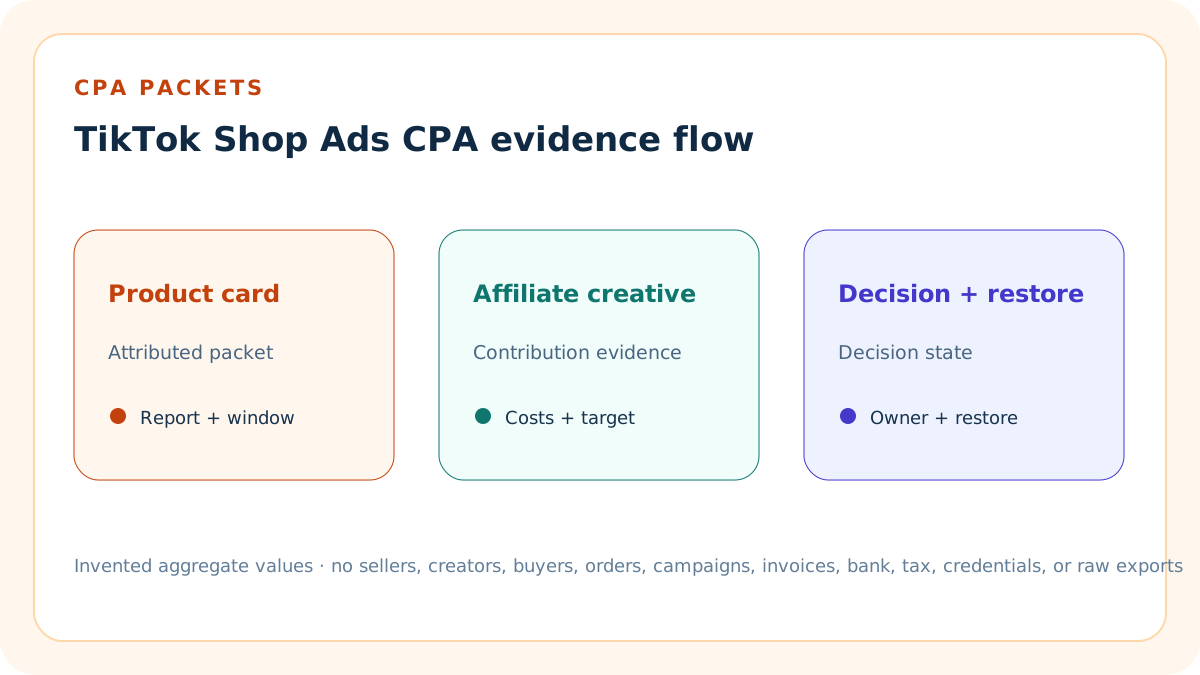
Use contribution to set an ads ceiling
This calculator starts with retained order revenue and subtracts referral fees, creator commission, product cost, fulfillment, other variable cost, and return reserve before advertising. The remaining pre-ad contribution is the economic ceiling available for ad spend.
Platform cost per purchase and ROAS are reporting metrics. They do not establish profit until the seller aligns attribution, refunds, fee scope, commission, cost grain, and target contribution.
Choose one attributable order grain
Record whether each packet represents one purchase, one retained order, one item, or a closed aggregate cohort. Use the same grain for gross revenue, refunds, costs, commissions, attributed purchases, and ad spend.
Do not divide campaign spend by item quantity while comparing it with order-level contribution. A mixed denominator can make CPA appear safe when the underlying order loses money.
Record TikTok gross revenue literally
TikTok defines Shop Ads gross revenue as buyer payment less sales tax plus platform product discounts. Capture the report, period, market, currency, attribution window, and whether the value comes from Ads Dashboard, Data Compass, or another named report.
Do not silently replace platform gross revenue with payout, net sales, booked accounting revenue, or seller-defined merchandise revenue. Keep each measure named and reconcile differences.
Separate attributed and retained revenue
Attributed gross revenue belongs to the platform reporting packet. Retained revenue subtracts declared refunds or cancellations at the same order grain and is the calculator's contribution denominator.
A later refund can change economics after the ad click was recorded. Preserve report dates and maturation windows instead of treating today's attributed ROAS as final profit.
Keep attribution windows visible
The default Shop Ads attribution explanation uses seven days after click and one day after view, with shop-level attribution and clicks taking precedence. Record the actual report setting and data-through date.
Seller Center and Ads Manager can place the same sale on different reporting dates. Do not compare mismatched windows or claim incrementality from an attribution report alone.
Respect Shop ID attribution
TikTok Shop Ads can attribute orders across products, formats, placements, product cards, search, livestreams, and affiliate creative under the same Shop ID. The advertised product is not necessarily the purchased product.
A product-level CPA packet therefore needs an explicit allocation method or product report. Block a claim that creative-level spend proves SKU-level contribution when the evidence is shop-level.
Calculate pre-ad contribution
Pre-ad contribution equals retained revenue minus marketplace and payment fees, creator commission, product cost, fulfillment cost, other variable cost, and return reserve. The fixture keeps every component editable and source-dated.
Do not subtract ad spend twice. The pre-ad value deliberately excludes advertising so it can become the maximum CPA input.
Derive break-even CPA
Break-even CPA equals pre-ad contribution per attributed retained purchase. Spending above that ceiling produces negative modeled contribution before overhead and tax.
Break-even is not a recommended target. It leaves no contribution buffer for uncertainty, delayed refunds, measurement drift, overhead, or cash requirements.
Derive target CPA
Target CPA equals retained revenue minus non-ad variable costs minus the seller's required contribution dollars. Required contribution is retained revenue multiplied by the target margin percentage.
A valid target CPA cannot exceed break-even CPA. If it is zero or negative, the offer cannot support paid acquisition at the entered target without changing price, fees, commission, costs, or margin policy.
Derive minimum platform ROAS
Minimum gross-revenue ROAS equals attributed gross revenue divided by target CPA. The result is a translation into the platform's gross-revenue reporting language, not a profit measure.
If target CPA is USD 15 and platform gross revenue is USD 60, the gross-revenue ROAS floor is 4.00. That floor changes when refunds, product mix, fees, commission, or cost scope changes.
Model a product-card packet
The invented product-card packet uses USD 65 platform gross revenue, USD 61 retained revenue, USD 3.66 referral fee, USD 20 product cost, USD 6 fulfillment, USD 2 other variable cost, zero creator commission, and USD 3 return reserve.
Its pre-ad contribution is USD 26.34. At a 20% target contribution margin, target CPA is USD 14.14 and the corresponding gross-revenue ROAS floor is about 4.60.
Model an affiliate-creative packet
The invented affiliate-creative packet holds the same revenue and operating costs but adds USD 5.60 protected creator commission. Its pre-ad contribution falls to USD 20.74.
At the same 20% target margin, target CPA falls to USD 8.54 and minimum gross-revenue ROAS rises to about 7.61. The difference isolates the entered creator commission.
Keep creator economics separate
Affiliate creative can be used in Shop Ads, but platform attribution does not distinguish affiliate from non-affiliate creative when assigning an order. Use Affiliate Center and order evidence to confirm creator commission separately.
Do not infer commission from the ad's identity or subtract an assumed rate from every attributed order. Record actual-paid-price basis, refund, protected rate, effective date, and settlement state.
Use observed ad spend and purchases
Observed CPA equals ad spend divided by attributed purchases at the declared report grain. Observed ROAS equals attributed platform gross revenue divided by ad spend.
A zero-purchase or zero-spend packet is structurally incomplete for observed CPA or ROAS. Use a planning-only target packet instead of manufacturing a performance ratio.
Compare observed CPA with target CPA
Headroom equals target CPA minus observed CPA. Positive headroom means the entered observed CPA is below the modeled target; negative headroom identifies a target-margin miss.
Headroom is not proof that a campaign is incremental, scalable, or correctly attributed. It is only a reconciliation between declared reporting and contribution packets.
Distinguish gross and net-sales optimization
Gross-revenue optimization and Maximize Net Sales use different outcome definitions. Net-sales reporting incorporates refunds and can expose refunded ad cost; gross-revenue reporting does not become net profit simply because the campaign meets ROI.
Record the optimization goal and report metric. Do not mix a Net Sales ROI target with a gross-revenue numerator or compare two modes without labeling the difference.
Treat GMV Max recommendations as delivery inputs
Platform-recommended ROI and budget can help establish a delivery starting point. Seller-owned contribution economics still determine whether the recommendation is affordable.
Do not repeatedly change ROI targets to chase short windows. Preserve the prior setting, learning period, actual spend, product set, creative set, and observed result before changing the packet.
Set a seller-owned margin target
The default fixture requires 20% contribution after ads. Ready requires both packets to retain that margin at or below target CPA with complete source and control evidence.
The target is a business policy, not a TikTok rule. Record owner, reviewer, effective date, exception authority, and the reason for any change.
Block structural conflicts first
Block missing market, currency, report definition, attribution window, order grain, refund maturity, fee scope, commission, cost, purchase, spend, owner, backup, stop rule, restoration, or conflicting evidence before reading the ratio.
A high platform ROAS cannot repair an unverified denominator. Resolve the evidence and rerun the packet before adjusting budget or bid targets.
Use Review for economic misses
Review means the packet is structurally valid but observed CPA exceeds target CPA, observed gross-revenue ROAS is below the modeled floor, or the retained contribution after ads misses the seller's target.
Review is not an instruction to pause advertising. Inspect product mix, attribution maturity, refund lag, creator commission, price, fees, costs, inventory, creative, and strategic objectives.
Interpret Ready narrowly
Ready means both entered packets reconcile under the declared formulas, report definitions, target, ownership, and restoration controls. It proves internal consistency only.
It does not prove attribution incrementality, future conversion, platform recommendation quality, creator performance, settlement, payout, tax treatment, or that spend should scale.
Protect private advertising data
Use invented examples or approved aggregates. This browser-local calculator does not connect to TikTok, upload reports, or read seller, creator, buyer, order, invoice, bank, tax, campaign, audience, message, or credential data.
Never publish Shop IDs, campaign IDs, creator handles tied to private economics, buyer information, order identifiers, invoices, bank data, tax numbers, access tokens, or raw exports.
Version the complete packet
Record market, currency, report name, attribution window, data-through date, order grain, gross and retained revenue, purchases, spend, fees, commission, costs, reserve, target, owner, reviewer, prior result, backup, stop rule, and restoration test.
A material report, attribution, refund, fee, commission, cost, product-mix, creative, campaign, target, or formula change opens a new packet instead of overwriting the accepted result.
Require a closed evidence duration
Use a seller-entered whole-number duration from one to 366 days and declare the actual closed report period. The default fixture uses 30 days so CPA is not presented as mature evidence from an unspecified fragment.
Duration is a control, not a guarantee of statistical stability. Preserve the dates, data-through timestamp, purchase count, refund maturity, and exclusions needed to interpret the period.
Separate source review and policy dates
Record the date the official TikTok Shop Ads definitions were reviewed and the effective date of the seller's ads-economics policy. The seller policy date cannot be later than its reviewed source date.
A source date does not prove every account uses the same feature, optimization mode, market rule, or reporting interface. Record account-specific evidence separately without exposing identifiers.
Reconcile report and date basis
Name the report, Shop ID scope, attribution window, data-through date, and whether the interface assigns a purchase by order date or by the day of the advertising touch. Compare only aligned reporting packets.
Seller Center and Ads Manager can differ because their reporting scopes and date bases differ. Preserve the discrepancy rather than forcing one total to equal another.
Keep gross revenue and net sales distinct
Gross revenue and net sales answer different questions. Gross revenue follows the platform reporting definition; net sales subtracts refunds, and the calculator uses a declared matured refund to build retained seller revenue.
If Maximize Net Sales is active, record refunded ad cost and Finance evidence separately. Do not relabel gross-revenue ROAS as a net-sales, payout, contribution, or accounting-profit metric.
Document Product GMV Max paid-plus-organic scope
Product GMV Max reporting can combine paid and organic delivery. Record whether its product ROI or cost-per-order metric is the source and state that it does not isolate one video's effectiveness or prove paid incrementality.
A paid-plus-organic numerator cannot be compared with an isolated paid-only packet without a documented bridge. Block the comparison when the allocation method is absent.
Record optimization mode and learning
Name Max delivery, Target ROI, Product GMV Max, Maximize Net Sales, or another actual mode; preserve target, budget, product set, learning period, and prior accepted result. Product GMV Max guidance recommends holding an ROI target for at least three full days before changing it.
Max delivery prioritizes budget use and GMV, so ROI can fluctuate. A seller contribution ceiling still governs affordability regardless of the platform delivery objective.
Quarantine malformed and incomplete inputs
Accept only plain finite decimal amounts, positive whole-number purchases, real YYYY-MM-DD dates, and explicit evidence. Scientific notation, unit-suffixed strings, invalid calendar dates, fractional purchases, missing concepts, or unresolved conflicts create Block.
On Block, every derived retained-revenue, cost, contribution, CPA, ROAS, headroom, margin, and cross-scenario economic output is masked as Unavailable while packet labels and control diagnostics remain visible.
Require nine independent confirmations
Ready and Review require nine yes confirmations covering synthetic-only packets, metric definitions, attribution and dates, refund and net-sales boundaries, fees and costs, paid-plus-organic scope, optimization and learning, two-person review, and restoration authority.
One missing confirmation creates Block. This prevents a plausible ratio from outranking missing report, privacy, evidence, review, or human-authority controls.
Release the complete cluster
Index the working calculator and ten dedicated guides together only after official-source, functionality, content, originality, image, accessibility, test, backup, release-mode, deployment, purge, and live-verification gates pass.
Search signals are measurements after release, not a publication prerequisite. Ordered release and rollback safety still control the production mutation.
Sources and further reading
- TikTok Business Help: Ads Metrics in Seller Center: Official cost, purchase, CPA, ROAS, gross-revenue, product-card, video, LIVE, SKU, and attribution reporting definitions.
- TikTok Business Help: Gross Revenue for Shop Ads: Official gross-revenue equation and gross-revenue ROAS definition.
- TikTok Business Help: Shop Ads Attribution: Official Shop ID attribution, 7-day click and 1-day view windows, affiliate-creative scope, and reporting-date differences.
- TikTok Business Help: Product GMV Max Best Practices: Official ROI-target, budget, learning, product, and creative operating guidance.
- TikTok Business Help: Maximize Net Sales: Official distinction between gross-revenue and net-sales optimization, refunds, refunded ad cost, and Finance evidence.
- TikTok Shop Academy: Referral Fee Updates: Official completed-order referral-base and fee guidance used before advertising capacity is derived.
- TikTok Shop Academy: Affiliate Commission: Official actual-paid-price, refund, protected-rate, and commission guidance for affiliate-creative packets.
- Seller Profit Guard methodology: Evidence, privacy, deterministic calculation, release, monitoring, and restoration controls.
Related Seller Profit Guard tools
- TikTok Shop Fee Reference Calculator: Reconcile order fees and creator commission before deriving an advertising ceiling.
- Creator Commission Calculator: Model creator, sample, advertising, and return economics separately.
- Break-Even ROAS Calculator: Compare the same contribution logic in a platform-neutral model.
- Profit Guard: Model retained order contribution before channel-specific advertising interpretation.
- Methodology: Review evidence, privacy, validation, release, monitoring, and restoration.
- Data Privacy: Protect seller, creator, buyer, order, campaign, invoice, bank, tax, and raw export data.
- How do you calculate a TikTok Shop Ads CPA limit?: Calculate pre-ad contribution from retained revenue minus verified non-ad variable costs. Break-even CPA equals pre-ad contribution per attributed retained purchase. Target CPA subtracts required contribution dollars, while minimum platform gross-revenue ROAS equals attributed gross revenue divided by total allowable advertising spend.
- What is a safe TikTok Shop Ads CPA for a product-card order?: In the invented product-card packet, USD 61 retained revenue minus USD 34.66 of non-ad variable cost leaves USD 26.34 pre-ad contribution. A 20% target margin leaves USD 14.14 target CPA and requires about 4.60 gross-revenue ROAS on USD 65 attributed revenue.
- How does affiliate creative change TikTok Shop Ads CPA?: The invented affiliate-creative packet adds USD 5.60 creator commission while holding attributed revenue, refund, purchases, fees, and seller costs constant. Pre-ad contribution falls to USD 20.74, target CPA falls to USD 8.54, and the minimum platform gross-revenue ROAS rises to approximately 7.61.
- What makes a TikTok Shop Ads CPA estimate wrong?: Common errors include mixing purchases with orders or items, treating attributed gross revenue as payout, ignoring refund lag, forcing shop-level attribution onto one SKU, subtracting ad spend twice, omitting creator commission, comparing different windows, and reading platform ROAS as profit.
- Where do TikTok Shop Ads CPA inputs come from?: Use the named Seller Center or Ads Manager report for spend, purchases, gross revenue, attribution setting, and data-through date; Finance and order evidence for fees and refunds; Affiliate Center for commission; and seller records for product, fulfillment, reserve, target, ownership, and restoration.
- What is a safe TikTok Shop Ads CPA threshold?: Block unresolved report, attribution, grain, refund, fee, commission, cost, purchase, spend, ownership, or restoration evidence. Review a valid packet when observed CPA exceeds target CPA or platform ROAS misses the modeled floor. Ready requires both declared packets to clear seller-owned targets.
- How should product-card and affiliate-creative CPA be compared?: Hold market, currency, report, attribution window, retained revenue, purchases, fees, seller costs, reserve, and target margin constant. Then add only the documented creator commission and related attribution evidence. Label every other packet difference before interpreting target CPA or platform ROAS.
- How often should TikTok Shop Ads CPA be reviewed?: Review matured CPA and ROAS weekly and after a report, attribution, optimization, product mix, price, refund, fee, creator, cost, or target change. Preserve prior packets, assign an owner and reviewer, respect learning periods, and test the stop and restoration path.
- What does a TikTok Shop Ads CPA result prove?: It proves only that seller-entered aggregate advertising reports and retained-order contribution values reconcile under the declared formula, attribution, and evidence controls. It does not prove incrementality, future conversion, scalable spend, creator quality, platform settlement, payout, tax treatment, or a campaign recommendation.
- What belongs in a TikTok Shop Ads CPA audit?: Record market, currency, named report, optimization goal, attribution window, data-through date, retained-order grain, attributed gross and retained revenue, purchases, observed spend, fees, creator commission, seller costs, reserve, target, owner, independent reviewer, prior result, exception, protected backup, stop rule, and tested restoration.
- How do you calculate TikTok Shop GMV versus profit?: Start with one named platform revenue definition, then separate customer payment, platform-funded discounts, tax, matured refunds, fees, creator commission, ads, product cost, fulfillment, other variable cost, and return reserve. The remainder is contribution, not accounting net profit, payout, tax income, or proof of incremental sales.
- What does a TikTok Shop GMV-to-profit example look like?: In the invented Seller Center packet, USD 100 customer payment plus USD 8 platform discount minus USD 6 tax produces USD 102 calculated platform revenue. After a USD 5 refund and USD 68 of fees, ads, and seller costs, retained contribution is USD 29.
Use the interactive tool
Enable JavaScript to open the calculator and process browser-local inputs. The explanatory content and source links remain available without JavaScript.
Related guide: Define retained contribution, target CPA, minimum gross-revenue ROAS, attribution, evidence, threshold, and restoration controls.
This tool provides operating estimates, not tax, accounting, legal, financial, or marketplace-policy advice. Verify current official sources and your own records before changing prices or operations.