Seller Profit Guard · How it works · CSV privacy
Shopify free shipping threshold calculator
Solve separate domestic and international Shopify free-shipping thresholds from seller-entered shipping, packaging, handling, merchandise cost, payment fee, and target-margin evidence. Ready, Review, or Block also requires the correct profile, origin, zone, active market, currency treatment, package, price condition, checkout tests, ownership, and restoration controls.
Maintained by Seller Profit Guard Editorial Team. Last reviewed: 2026-07-29.
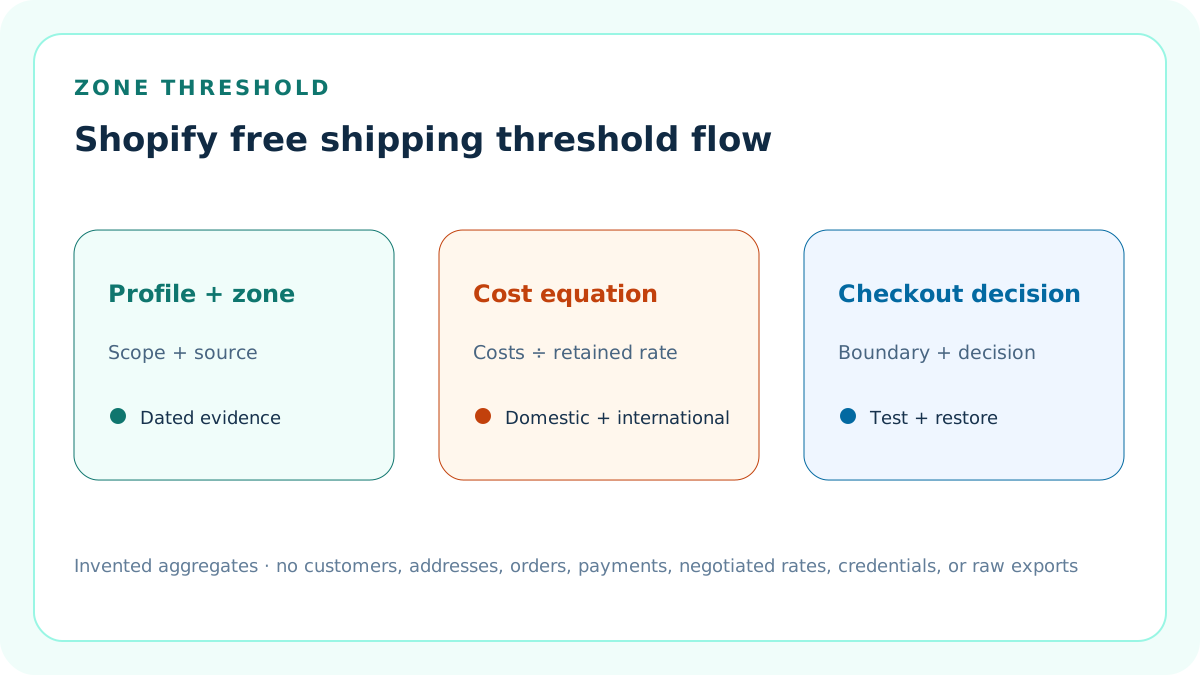
Solve a zone threshold, not a sitewide slogan
A defensible Shopify free-shipping threshold belongs to one declared profile, fulfillment origin, zone, market, currency treatment, package, service level, and cost period.
The tool compares one domestic and one international packet. It does not assume every product, address, location, carrier, or market shares the same economics.
Use the target-margin equation
The modeled threshold equals shipping cost plus packaging and handling plus the fixed payment fee, divided by the rate left after merchandise variable cost, payment percentage fee, and target contribution margin.
If the retained rate is zero or negative, no finite threshold can satisfy the entered target. Reduce costs, change the target, or redesign the offer instead of forcing a number.
Separate variable and fixed costs
Enter merchandise cost as a percentage of merchandise revenue. Enter shipping, packaging, handling, and the fixed payment fee as per-order amounts for the declared packet.
Do not mix monthly plan fees, advertising, returns, tax, duties, discounts, or overhead into an undocumented rate. Model them separately or state their exclusion.
Keep payment fees editable
Payment processing can vary by plan, country, card, provider, currency, and charged amount. The calculator accepts a seller-verified percentage and fixed amount rather than claiming a universal Shopify rate.
Verify the actual fee source and base for the store. A free-shipping threshold is incomplete when its fee assumption is copied from an unrelated plan or market.
Round upward deliberately
The raw algebraic result can contain impractical cents. Round upward to the seller-entered increment so the displayed threshold does not fall below the solved target.
A USD 27.76 result becomes USD 28.00 at a USD 1 increment, or USD 30.00 at a USD 5 increment. Merchandising preference must not round the safety result down.
Calculate the domestic fixture
The invented domestic packet uses USD 8 shipping, USD 2 packaging and handling, a USD 0.30 fixed payment fee, 40% merchandise variable cost, 2.9% payment fee, and a 20% target margin.
The retained rate is 37.1%. Dividing USD 10.30 by 0.371 gives USD 27.76, rounded to a USD 28 modeled threshold. The entered USD 35 proposal clears the arithmetic target.
Calculate the international fixture
The invented international packet uses USD 22 shipping, USD 3 packaging and handling, the same fixed fee and rates, plus a separately documented active market, currency treatment, and duties boundary.
USD 25.30 divided by 0.371 gives USD 68.19, rounded to USD 69. The entered USD 75 proposal clears the modeled target but still requires protected destination and checkout tests.
Read the B-minus-A difference
The default international modeled threshold is USD 41 above the domestic threshold because the fixed shipping packet is higher while the retained rate is held constant.
This difference is not a carrier quote, demand forecast, or recommendation to show the same customer-facing number in different currencies.
Compare with current cart behavior
The tool shows proposed threshold minus current average merchandise subtotal for each zone. A large positive gap can create a merchandising or conversion question even when the margin equation passes.
Current average subtotal must use the same retained-order definition, currency, zone, profile, exclusions, and period. It does not alter the solved cost floor.
Assign products to the correct profile
Shopify profiles group products with particular shipping rules. Products outside a custom profile use the general profile, and carts spanning profiles or locations can produce combined rates.
Record which products, variants, origins, and locations the packet covers. A safe number in the wrong profile is a configuration failure.
Verify the zone and active market
A zone controls where its rates apply, while the destination country must also be in an active market. Customers outside configured zones or inactive markets cannot use the modeled offer as assumed.
International packets need explicit destination scope. Do not generalize one country test to a continent-sized zone without representative evidence.
Choose a price-based condition intentionally
Shopify permits flat rates with conditions based on order amount or weight and lets sellers add a minimum order amount for free shipping.
This calculator solves a merchandise-price threshold. Weight-based or carrier-calculated strategies need a different model and representative package evidence.
Protect currency semantics
Local-currency display and fixed local-currency rates can differ by market and Shopify Payments availability. A USD model is not automatically the exact amount a buyer sees in EUR, GBP, CAD, or another currency.
Record whether the setting is converted or fixed by zone. Test below, at, and above the displayed local threshold.
Keep tax and duties outside the merchandise denominator
The threshold model uses merchandise revenue before tax and treats duties and import taxes as separately verified international settings.
HS codes, country of origin, destination, de minimis rules, tax-inclusive display, duty collection, and customs differences can change checkout and landed-cost experience without changing this simple equation.
Test package and weight assumptions
Accurate product and package weights matter for weight-based and carrier-calculated rates and for the real shipping cost the seller absorbs.
Use a representative packed-weight distribution, not an unpacked product estimate. Recalculate when product mix, packaging, carrier, service, origin, or dimensional weight changes.
Test threshold boundaries in checkout
Use protected invented carts just below, exactly at, and just above the configured amount, with eligible and excluded products and representative addresses.
Also test mixed profiles, multiple origins, unavailable regions, discount interactions, and recent saved changes. Stop before payment when appropriate and retain only redacted evidence.
Use Block before arithmetic review
Invalid rates, a non-positive denominator, missing profile or market scope, unresolved currency treatment, failed checkout evidence, open conflicts, or absent restoration controls create Block.
A proposed threshold above the formula cannot repair a rate that does not display or applies to the wrong cart.
Use Review for a low proposal
When the evidence packet is structurally complete but a proposed threshold is below the rounded modeled threshold, the tool returns Review.
Review means change the proposed amount, target, costs, or offer design and rerun. It is not a conversion recommendation.
Use Ready narrowly
Ready means both entered proposals meet or exceed their modeled thresholds and the declared evidence packet is structurally complete.
It is not Shopify approval, a live carrier quote, a tax or duties result, a conversion guarantee, complete profit, or authority to publish a shipping rate.
Distinguish rates from discounts
A price-conditioned free shipping rate belongs in shipping settings. A free-shipping discount has separate country, rate-cap, purchase, eligibility, date, and combination controls.
Choose and document the actual implementation. Do not validate a discount code by testing only a shipping-rate condition.
Declare the custom-profile boundary
Record the current custom-profile count and the reviewed Shopify boundary of up to 99 custom shipping profiles separately from the general profile.
The count is a configuration control, not evidence that products, locations, zones, or rates are assigned correctly.
Reject coercive cost formats
Enter plain decimals only. Currency symbols, percent signs, words, exponent notation, invalid dates, fractional profile counts, and silent blanks Block instead of being converted.
When the contract Blocks, the retained rate, twelve scenario calculations, and B-minus-A threshold are all quarantined as Unavailable.
Require nine evidence confirmations
Confirm invented public scope, shared economics and currency, profile assignments, origins/zones/markets, package/condition/method, currency/duties, checkout boundaries, cost sources, and restoration plus human authority.
All nine confirmations must be yes. A long free-text narrative cannot substitute for a missing attestation.
Version source and policy dates
Use real YYYY-MM-DD values for Shopify guidance review and seller threshold-policy effect, plus a positive closed evidence duration.
The seller policy cannot postdate the source review. Impossible calendar dates fail before any threshold is shown.
Audit combined profile behavior
Products from different profiles or locations can produce combined checkout rates, and price-based and weight-based rates combine differently.
Test mixed-profile and multi-origin carts explicitly; one single-profile threshold cannot be generalized to a combined rate.
Keep the price-condition grain exact
Price-based shipping conditions use the cart value after discounts and before taxes. The threshold model must use the same merchandise grain.
Do not mix buyer-paid shipping, tax, duties, gift cards, or an unverified pre-discount subtotal into the denominator.
Quarantine all calculations on Block
Structural failure hides fourteen calculations: the retained rate, six outputs for each zone, and the signed threshold difference.
Decision, equation, confirmation count, profile boundary, dates, and known-conflict count remain visible only to repair evidence.
Separate local-currency implementations
Fixed local-currency shipping rates have Shopify Payments and zone-currency conditions, while automatic conversion follows different behavior and existing rates do not update automatically.
Record whether the reviewed threshold is stored in base currency, fixed local currency, or converted display currency, then test the actual market checkout.
Protect private commerce data
The public calculator needs invented aggregate costs, rate summaries, and redacted evidence statements only.
Keep customer addresses, order rows, payment details, unpublished promotions, negotiated carrier rates, contracts, staff identities, credentials, app settings, and raw exports in authorized systems.
Monitor material changes
Rerun after profile, product assignment, origin, zone, market, currency, package, weight, carrier, service, rate condition, payment fees, costs, average cart, target, tax, duty, checkout, owner, or source changes.
Preserve the prior accepted rate packet and a tested restoration path so configuration drift is reversible.
Release through the complete gate
Index this cluster only after functionality, sources, examples, diagrams, metadata, links, privacy, uniqueness, mobile behavior, backups, deployment, and live checks pass.
Search impressions, clicks, citations, AdSense, and revenue are later measurements, not substitutes for quality or rollback evidence.
Sources and further reading
- Shopify Help: Setting up shipping zones and rates: Official profile, zone, market, flat-rate, price-condition, local-currency, free-shipping, and checkout behavior guidance.
- Shopify Help: Shipping profiles: Official general and custom profile rules for products, fulfillment locations, zones, and rates.
- Shopify Help: Combined shipping rates: Official different-profile, location-group, price-based, weight-based, naming, and combined-rate behavior.
- Shopify Help: Creating a shipping strategy: Official free, flat, and carrier-calculated shipping strategy boundaries.
- Shopify Help: Troubleshooting and testing shipping rates: Official product, location, market, profile, package, price, weight, carrier, and checkout test checks.
- Shopify Help: Free shipping discounts: Official discount-code and automatic free-shipping eligibility, country, rate-cap, minimum-purchase, date, and combination context.
- Shopify Help: Shipping rates in local currencies: Official fixed local-currency rate, single-currency zone, Shopify Payments, conversion, and pre-existing-rate boundaries.
- Shopify Help: Duties and taxes for markets: Official international market tax-display, duty-collection, HS-code, origin, destination, and estimate boundaries.
- Seller Profit Guard methodology: Deterministic fixtures, evidence precedence, privacy, correction, release, monitoring, and rollback.
Related Seller Profit Guard tools
- Free Shipping Threshold Calculator: Use the platform-neutral Etsy-oriented threshold workflow when Shopify configuration evidence is outside scope.
- Shopify Discount Stack Calculator: Model a separate product, order, and shipping discount combination.
- Shipping Zone Margin Calculator: Compare observed contribution for existing zones instead of solving a threshold.
- Shopify Payment vs Transaction Fee Calculator: Verify the payment-fee component before using it in the threshold equation.
- Methodology: Review evidence, formulas, correction, release, monitoring, and restoration.
- Data Privacy: Keep customers, orders, addresses, rates, contracts, credentials, and private exports protected.
- Shopify Free Shipping Threshold Formula: Derive a zone-specific threshold from retained contribution, shipping, handling, payment fees, target margin, and documented Shopify scope.
- Shopify Domestic Free Shipping Example: Work the domestic USD 28 threshold from a documented zone packet, then test an entered USD 35 proposal.
- Shopify International Shipping Threshold: Solve the international USD 69 threshold while separating market, currency, duties, package, and destination evidence.
- Shopify Free Shipping Threshold Mistakes: Diagnose denominator, profile, zone, market, currency, package, rate-method, checkout, and interpretation failures.
- Shopify Threshold Data Source Map: Map every cost, rate, profile, origin, zone, market, package, currency, checkout, and average-cart input to protected evidence.
- Shopify Shipping Threshold Decisions: Separate structural Block rules, algebraic Review, merchandising gap, operational approval, and rollback authority.
- Domestic vs International Thresholds: Compare domestic and international packets at the same cost, fee, margin, currency, period, and evidence grain.
- Shopify Shipping Threshold Routine: Turn threshold maintenance into a profile inventory, cost refresh, boundary test, approval, monitoring, and restoration cycle.
- How to Read Shopify Threshold Results: Explain solved amount, proposal, retained rate, contribution, average-cart gap, zone difference, evidence, and limitations.
- Shopify Free Shipping Audit Template: Provide a standalone packet for formula, costs, profile, origin, zone, market, currency, package, tests, decisions, changes, and restoration.
Use the interactive tool
Enable JavaScript to open the calculator and process browser-local inputs. The explanatory content and source links remain available without JavaScript.
Related guide: Define the retained-rate equation, zone packets, cost evidence, price condition, checkout boundaries, decision states, and restoration.
This tool provides operating estimates, not tax, accounting, legal, financial, or marketplace-policy advice. Verify current official sources and your own records before changing prices or operations.