Seller Profit Guard · How it works · CSV privacy
Shopify bundle margin calculator
Compare a fixed Shopify bundle with a separately configured subscription product by subtracting offer discount, component cost, payment cost, fulfillment, app cost, return reserve, and other variable cost from component retail value. The tool blocks native Shopify bundle plus subscription combinations because Shopify documents purchase-option incompatibility.
Maintained by Seller Profit Guard Editorial Team. Last reviewed: 2026-07-29.
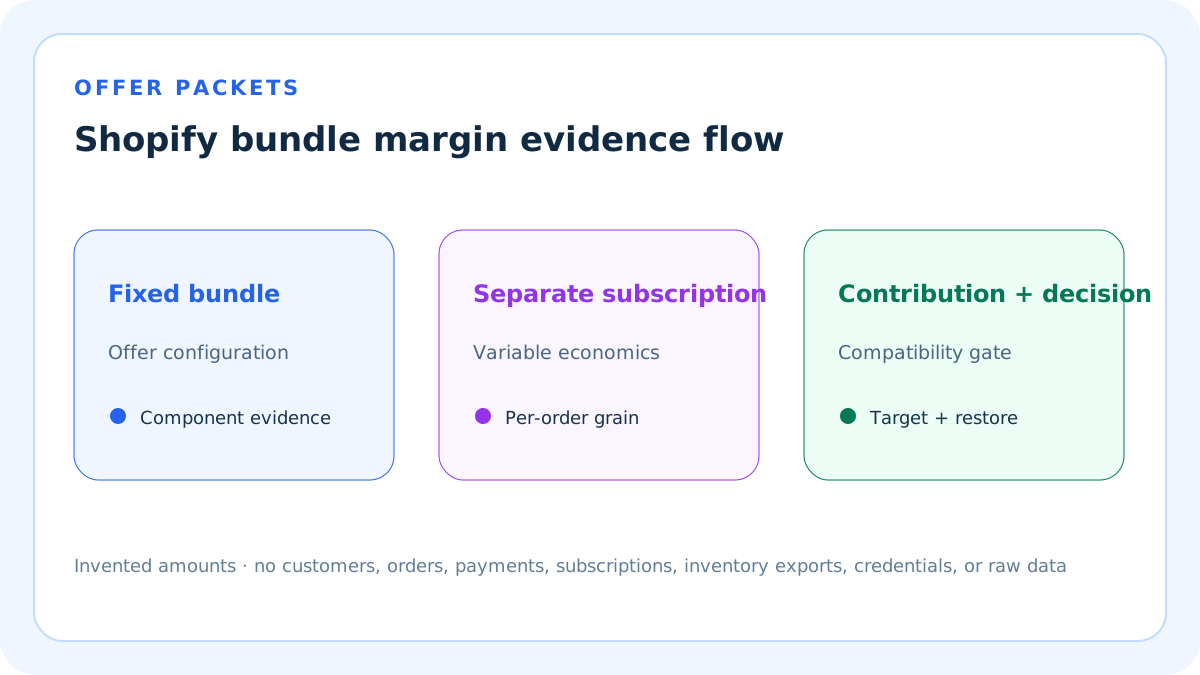
Separate two Shopify offer packets
Scenario A is a fixed Shopify bundle with documented components, quantities, bundle SKU, component SKUs, component inventory, eligible channel, discount treatment, and checkout evidence. Scenario B is a separately configured subscription product and selling-plan packet.
Shopify documents that bundles are incompatible with purchase options, including subscriptions, preorders, and try-before-you-buy. The model blocks any claim that one native bundle can also carry a purchase option.
Use the bounded contribution equation
Contribution equals component retail value minus the offer discount, component cost, payment cost, packaging and fulfillment, attributable app cost, expected return loss, and other entered variable cost.
This is an operational offer model, not complete profit. It excludes tax, duties, fixed overhead, advertising, customer acquisition, churn, refunds outside the entered reserve, financing, and unentered costs.
Freeze component retail value
Component retail value is the seller-entered sum of the exact component variants and quantities in one offer packet before the bundle or subscription discount.
Do not use compare-at price, a different channel's price, a stale catalog total, or a hypothetical maximum. Preserve the dated component price snapshot.
Enter the offer discount once
For the fixed bundle, enter the reduction from the frozen component retail value to its bundle selling price. For the subscription product, enter the reduction for one recurring order.
Do not subtract a catalog bundle price and then subtract the same discount again. Separately verify any checkout discount that could stack with the offer price.
Build component cost at variant grain
Component cost includes the actual variants and quantities consumed by one fixed or recurring offer packet. Use the same currency, period, cost convention, and retained-unit definition.
Bundle inventory can depend on component inventory. Missing one component cost or silently substituting a cheaper variant understates contribution and can hide fulfillment risk.
Keep inventory evidence outside arithmetic
The calculator requires configuration and inventory evidence but does not turn stock counts into revenue or margin. Confirm component quantities, available inventory, bundle status, bundle SKU, component SKUs, and synchronization.
Shopify documents that bundle availability is determined by component availability. Inventory evidence can block an offer even when the arithmetic is favorable.
Record packaging and fulfillment
Enter pick, pack, packaging, inserts, fulfillment service, label, and other per-offer fulfillment cost that is not already inside component cost.
Fixed bundles and recurring boxes can use different package sizes, pick complexity, weights, zones, and service levels. Reuse a cost only when the evidence truly matches.
Apply payment fees to selling price
The browser-local model applies the seller-entered percentage and fixed payment fee to component retail value minus the entered offer discount.
Verify the actual charged base, provider, plan, market, card, currency, and payment method. The public default is invented and is not a current Shopify rate promise.
Allocate app cost by offer packet
A fixed bundle may use Shopify Bundles or another bundle app; a subscription product uses a checkout-integrated subscription app or custom solution. Enter only the attributable per-order app cost.
Shopify's first-party Bundles app can be free, but third-party bundle, subscription, fulfillment, or analytics apps can create recurring or usage charges. Do not insert the whole monthly bill into one order.
Reserve expected return loss carefully
Expected return loss is the seller's bounded per-order reserve for non-recovered fulfillment, reverse logistics, handling, damage, write-down, and other expected loss not counted elsewhere.
Shopify bundle returns can be handled by individual eligible components. A recurring product's return and cancellation terms require separate current evidence.
Model other variable cost explicitly
Other variable cost is a disclosed per-offer amount that does not fit component, payment, fulfillment, app, or return categories.
Name the cost and its source. Do not use it as a plug that forces the desired margin or hides advertising, tax, overhead, or duplicate costs.
Calculate the fixed-bundle fixture
The invented fixed bundle has USD 90 component retail value and a USD 15 bundle discount, producing a USD 75 selling price. Component cost is USD 32; fulfillment is USD 8; app cost is USD 1; expected return loss is USD 3.
At 2.9% plus USD 0.30 payment cost, contribution is USD 28.52 when displayed to cents and contribution margin is about 38.03%. Every input is editable.
Calculate the separate subscription fixture
The invented recurring packet has USD 84 component retail value and a USD 19 offer discount, producing USD 65 per recurring order. Component cost is USD 28; fulfillment is USD 9; app cost is USD 2; expected return loss is USD 4.
At the same entered payment assumptions, contribution is USD 19.81 when displayed to cents and margin is about 30.48%. This is a separate subscription product packet, not a native Shopify bundle.
Compare contribution at one grain
Scenario A exceeds Scenario B contribution by about USD 8.71 because price, component cost, fulfillment, app cost, and return reserve differ.
The comparison does not prove lifetime value or subscription superiority. One recurring order is not a customer cohort, renewal forecast, retention model, or churn analysis.
Use one target contribution margin
The seller-entered target applies to both offer packets. A structurally valid packet below the target returns Review.
The target is an internal operating boundary, not Shopify approval, an accounting standard, a legal minimum, a customer promise, or proof that marketing spend is affordable.
Block incompatible configurations
Block applies when Scenario B claims a native Shopify bundle also has a purchase option, or when configuration, inventory, discount, checkout, currency, period, ownership, conflict, backup, stop-rule, or restoration evidence is missing.
A favorable contribution cannot repair a platform incompatibility or missing operational proof.
Use Review for target misses
Review means the calculator can reconcile the entered packet but at least one contribution margin misses the seller's target.
Review also belongs in the evidence workflow when component cost, app allocation, return reserve, discount stacking, or inventory behavior requires a new protected checkout or actual-order test.
Use Ready narrowly
Ready means both invented packets reconcile under the entered evidence, compatibility, cost, target, owner, reviewer, and restoration controls.
It does not create a bundle, selling plan, app configuration, product, SKU, discount, inventory adjustment, checkout, subscription contract, or publication.
Protect checkout and customer evidence
Use invented amounts and aggregate evidence summaries on public pages. The calculator runs in the browser and does not upload data or connect to Shopify.
Keep customer, payment, order, contract, address, subscription, cancellation, inventory, SKU, app bill, checkout, and raw export records in approved systems.
Version every configuration
Preserve bundle component, quantity, SKU, inventory, price, discount, app, subscription, selling plan, billing cadence, fulfillment, return reserve, source, owner, reviewer, result, and restoration versions.
Do not overwrite a fixed bundle when component SKUs change or reuse a subscription result after cadence, app, price, product, or fulfillment changes.
Enforce current fixed-bundle limits
The reviewed Shopify Bundles boundary accepts up to 30 fixed-bundle components, 2,000 units per component, three options, and 100 total variants. Record both the observed configuration and the accepted source boundary.
A component, unit, option, or variant count above the reviewed boundary Blocks. Do not raise a seller-entered accepted maximum beyond Shopify's current documentation to make an invalid packet pass.
Require nine shared confirmations
A valid packet confirms invented aggregate data, shared economic grain, bundle eligibility and upgraded checkout, component SKU and inventory evidence, channel, shipping and return boundaries, discount and cost sources, purchase-option separation, two-person review, and tested restoration.
Scenario confirmations do not replace the shared register. Any missing confirmation Blocks both offers and quarantines all nineteen derived comparison values.
Record source and seller-policy dates
The source review date records when official Shopify bundle limits and compatibility guidance were checked. The seller policy date versions the internal formula, bounds, target, evidence, review, and authority contract.
The seller policy cannot postdate its source review. Reopen after Shopify, app, checkout, component, SKU, inventory, channel, discount, shipping, return, subscription, reviewer, or restoration changes.
Reperform bundle inventory arithmetic
Shopify estimates bundle availability by dividing each tracked component's available inventory by the units required, rounding down, and using the lowest result. Components not tracked or set to continue selling can be ignored by the availability calculation.
The margin tool records this evidence but does not calculate stock availability. Use the dedicated inventory calculator and protected store state before publication or fulfillment.
Keep component shipping profiles visible
Shopify bundles do not have their own shipping profile; shipping rates derive from the individual component products' profiles. A bundle-margin packet must therefore record component assignment, weight, origin, zone, market, and checkout behavior.
Do not use one invented bundle-level shipping profile to justify fulfillment cost or customer rate. Model any combined-profile or multi-origin behavior separately.
Apply bundle discounts to the parent product
Shopify documents that product or collection discounts must include the parent bundle product. A bundle discount calculates on the parent price and allocates to components by weighted price before component tax calculation.
Keep this platform allocation separate from the seller-entered built-in offer discount. Test checkout stacking rather than subtracting the same reduction twice.
Treat SKU changes as configuration changes
Shopify assigns the bundle a separate SKU from its component SKUs and documents that a component SKU change requires deleting and recreating the bundle.
A changed component SKU invalidates the earlier packet even when price and cost are unchanged. Preserve the old bundle identity, open a new version, retest inventory and checkout, and refresh restoration evidence.
Quarantine nineteen outputs on Block
The tool has nine calculated values for each offer plus one signed contribution difference. When amount, date, count, confirmation, compatibility, context, conflict, or restoration structure fails, all nineteen display Unavailable.
Control metadata remains visible to diagnose the packet, but the interface does not expose apparently precise contribution or margin from invalid evidence.
Test eligible and ineligible states
Test fixed bundle, separate subscription product, component cost change, inventory shortage, discount change, payment fee change, app allocation, return reserve, target miss, native-bundle incompatibility, missing checkout, conflict, and restore fixtures.
Verify Ready, Review, Block, reset, mobile layout, keyboard flow, images, sources, internal links, metadata, privacy, noindex staging, and strict route behavior.
Keep complete profit outside scope
Contribution before fixed costs is useful for comparing the two entered offer packets, but it does not include every cost or future renewal outcome.
Use separate overhead, advertising, cohort retention, tax, inventory planning, and accounting workflows before treating the result as a business forecast.
Release the whole cluster or none
Index the working tool and ten support pages only after functionality, official sources, examples, originality, images, metadata, links, privacy, accessibility, backups, deployment, and live verification pass.
Search impressions, clicks, citations, AdSense status, and revenue are later measurements. They do not replace compatibility, quality, production ordering, or rollback gates.
Sources and further reading
- Shopify Help: Product bundles: Official bundle definition, sales-channel context, bundle-app requirement, and fixed, multipack, and mix-and-match scope.
- Shopify Help: Bundle eligibility and considerations: Official eligibility, upgraded-checkout, component inventory, returns, SKU, channel, and purchase-option incompatibility boundaries.
- Shopify Help: Shopify Bundles: Official first-party fixed-bundle and multipack workflow, component limits, options, publishing, inventory synchronization, performance, and troubleshooting context.
- Shopify Help: Purchase options: Official subscription, preorder, and try-before-you-buy definitions and checkout-integrated app boundary.
- Shopify Help: Combining discounts: Official discount-class, eligibility, combination, checkout, plan, channel, and limit context.
- Seller Profit Guard methodology: Deterministic evidence, scope, privacy, testing, correction, release, monitoring, and restoration.
Related Seller Profit Guard tools
- Bundle Margin Calculator: Use the platform-neutral contribution model when Shopify configuration evidence is outside scope.
- Shopify Discount Stack Calculator: Test eligible checkout discounts separately from the built-in offer discount.
- Bundle Component Inventory Calculator: Model the component-level stock constraint separately from contribution.
- Shopify App Cost per Order Calculator: Verify per-order bundle and subscription app allocations.
- Methodology: Review evidence, formula, privacy, correction, release, monitoring, and restoration.
- Data Privacy: Keep customers, orders, payments, subscriptions, inventory, app bills, credentials, and raw exports protected.
- Shopify Bundle Margin Formula and Inputs: Define fixed-bundle and separate subscription-product price, discount, component, payment, fulfillment, app, return, compatibility, and margin evidence.
- Shopify Fixed Bundle Margin: A Worked Example: Work an invented fixed-bundle packet with component value, discount, selling price, costs, inventory, payment, result, target, and decision.
- Shopify Subscription Product Margin Without Bundle Conflict: Model one recurring order as a separate subscription product and selling-plan packet rather than claiming a native Shopify bundle supports subscriptions.
- 10 Shopify Bundle Margin Mistakes to Correct: Diagnose price, discount, component, inventory, payment, fulfillment, app, return, compatibility, scope, and interpretation errors.
- Shopify Bundle Data: A Protected Source Map: Map each input to product, bundle, component, inventory, discount, payment, app, fulfillment, return, subscription, checkout, and cost evidence.
- Set a Shopify Bundle Contribution Threshold: Separate structural Block rules, seller-owned target Review, configuration compatibility, inventory evidence, and narrow Ready status.
- Shopify Fixed Bundle vs Subscription Product Margin: Compare a fixed bundle and separate recurring product at one order grain while keeping platform compatibility and lifetime value outside the result.
- A Weekly Shopify Bundle Margin Routine: Turn offer measurement into a repeatable component, inventory, price, discount, checkout, cost, exception, owner, and restoration cycle.
- Read Shopify Bundle Margin Without False Precision: Explain contribution, margin, target headroom, scenario difference, compatibility, inventory, exclusions, and the next bounded action.
- Shopify Bundle Margin Audit Checklist: Use a standalone change log for bundle type, subscription product, components, inventory, price, discount, costs, checkout, decision, and restoration.
- Shopify Subscription Margin Formula and Inputs: Define monthly and prepaid price, fulfillment, product, payment, app, reserve, churn, CAC, policy, and evidence inputs safely.
- Monthly Shopify Subscription Margin: Worked Example: Calculate one invented pay-as-you-go packet from recurring charge through churn-based expected shipments and CAC payback.
Use the interactive tool
Enable JavaScript to open the calculator and process browser-local inputs. The explanatory content and source links remain available without JavaScript.
Related guide: Define fixed-bundle and separate subscription-product contribution, compatibility, component inventory, cost, decision, and restoration evidence.
This tool provides operating estimates, not tax, accounting, legal, financial, or marketplace-policy advice. Verify current official sources and your own records before changing prices or operations.