Seller Profit Guard · How it works · CSV privacy
Product Launch Break-Even Calculator
Estimate how many mature retained units must sell to recover one-time product launch investment. Separate development, samples, creative, setup, initial advertising, inventory write-off, and other launch costs from recurring unit contribution; then adjust for mature returns, round break-even volume up, compare two launch scopes, and preserve evidence and restoration.
Maintained by Seller Profit Guard Editorial Team. Last reviewed: 2026-07-29.
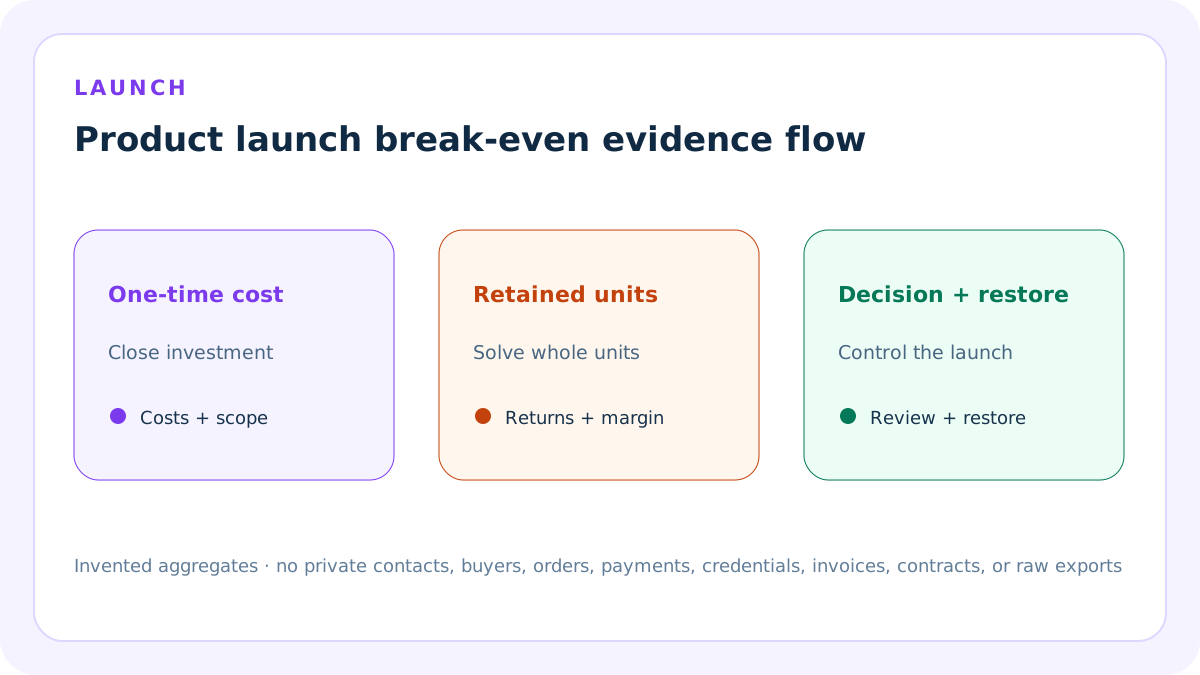
Start with one launch decision
Define one product, market, launch window, channel scope, currency, and decision owner.
Do not combine unrelated products or channel rollouts into one denominator.
Separate one-time and recurring cost
One-time launch investment is recovered once; recurring costs belong inside unit contribution.
Do not count the same setup, app, advertising, fulfillment, or return cost on both sides.
Record development cost
Include approved design, engineering, formulation, pattern, prototype, testing, or documentation work attributable to the launch.
Separate reusable business overhead when it is not specific to this product launch.
Record samples and prototypes
Include produced samples, revisions, freight, duties, packaging, and documented disposal or write-off.
Do not replace invoices or approved internal cost records with public estimates.
Record photography and creative
Include product photography, editing, video, graphics, copy, and launch-specific usage rights.
Separate later recurring content production from the initial launch packet.
Record setup and integration
Include marketplace setup, catalog work, theme or landing-page work, apps, domains, data cleanup, feeds, and approved technical services.
Current platform bills and contracts override generic examples.
Record initial advertising
Use the approved initial campaign budget or billed spend that belongs to the launch window.
Gross revenue, GMV, attributed revenue, clicks, and ROAS are not contribution.
Record inventory write-off allowance
Include only the launch-specific amount expected not to recover through retained sales or other documented disposition.
Do not count full salable inventory cost here when product cost is already inside unit contribution.
Record other one-time launch cost
Name each legal, compliance, packaging setup, tooling, translation, training, creator, or operational cost.
A blank miscellaneous total prevents useful review.
Build contribution before return loss
Start with retained seller revenue and subtract recurring product, marketplace, payment, advertising or creator, fulfillment, shipping, packaging, support, and other variable cost.
Use one consistent placed-unit denominator.
Use mature return evidence
Estimate the return rate only after the declared cohort has enough time to cancel, return, refund, exchange, charge back, or otherwise reverse.
An open launch-week order count is not mature evidence.
Estimate loss per returned unit
Include unrecovered product, outbound and return shipping, fees, handling, refurbishment, disposal, and recovery credit.
Use the seller's actual fee-recovery and inventory-recovery rules.
Calculate net placed-unit contribution
Subtract mature return rate multiplied by loss per returned unit from contribution before return loss.
Keep the return rate as a decimal inside the formula.
Convert to retained-unit contribution
Divide net placed-unit contribution by the retained rate so the payback denominator is a mature retained unit.
Block a return rate of 100% or nonpositive effective contribution.
Calculate break-even retained units
Divide total one-time launch cost by contribution per mature retained unit and round up to the next whole unit.
Rounding down understates the required retained sales.
Calculate forecast recovery
Multiply forecast retained units by retained-unit contribution and subtract total launch cost.
Positive recovery is modeled headroom, not cash, profit, or guaranteed payback.
Use the marketplace fixture
The invented marketplace launch costs USD 3,300 and produces USD 19.11 contribution per retained unit after a 10% return rate.
The exact quotient rounds up to 173 retained units; 220 forecast retained units leave about USD 904.44 modeled recovery.
Use the multi-channel fixture
The invented multi-channel launch costs USD 6,300 and produces USD 25.91 contribution per retained unit after a 12% return rate.
The exact quotient rounds up to 244 retained units; 300 forecast retained units leave about USD 1,472.73 modeled recovery.
Compare scenarios without hiding scope
Hold product economics comparable while naming different creative, integration, channel, and initial advertising requirements.
A lower break-even count can still have weaker channel coverage or operational readiness.
Block incomplete evidence
Block missing cost lines, invalid rates, nonpositive contribution, unconfirmed evidence, ambiguous scope, duplicate labels, or unresolved conflicts.
Favorable forecast volume cannot repair broken structure.
Review contribution threshold
Review a structurally valid scenario whose retained-unit contribution is below the seller-entered minimum.
The threshold is an operating choice, not a platform rule.
Review break-even threshold
Review a valid scenario whose whole retained-unit break-even exceeds the seller's capacity or risk limit.
Do not silently raise the threshold to obtain Ready.
Review forecast shortfall
Review when forecast mature retained units do not recover the declared one-time launch cost.
A review result identifies the gap; it does not reject the product automatically.
Interpret Ready narrowly
Ready means the entered launch packet passes its structural and seller-entered thresholds.
It does not prove demand, authorize spend, approve a product, or guarantee timing.
Separate launch payback from ROAS
ROAS compares attributed revenue with ad cost; this calculator compares all declared one-time launch investment with retained-unit contribution.
Never substitute platform gross revenue or GMV for seller contribution.
Separate launch payback from price floor
Price-floor tools solve a selling price under recurring economics.
This tool holds recurring contribution as an input and recovers one-time investment through volume.
Run one-variable sensitivity
Change one supported cost, return rate, return severity, contribution, forecast, or threshold while preserving the accepted base packet.
Document which assumption changes the decision.
Monitor after authorization
Track actual launch invoices, spend, mature returns, retained units, contribution, stock, capacity, and restoration triggers.
Recalculate when evidence changes materially.
Protect private data
Use invented examples or approved non-identifying aggregates.
Never publish private contacts, buyers, addresses, order rows, payments, credentials, invoices, contracts, or raw exports.
Version every source
Record URL or internal pointer, access date, data-through date, currency, launch version, owner, reviewer, and accepted formula.
Platform fees, billing categories, attribution definitions, and seller economics can change.
Preserve rollback
Before an authorized launch change, save the prior product, listing, price, creative, app, campaign, inventory, and channel configuration.
Define stop conditions and test restoration.
Require a closed evidence duration
Record a positive whole-number evidence duration that is long enough for the declared cancellation, return, refund, exchange, chargeback, and recovery windows.
An open launch-week order count cannot validate mature retained-unit contribution.
Validate source and policy dates
Use real ISO dates for the current official-source review and seller launch-economics policy.
The seller policy cannot postdate the source review used to support it.
Require nine shared confirmations
Confirm privacy, comparable scope, one-time versus recurring boundaries, mature returns, forecast and capacity, cost ownership, current sources, independent review, and restoration authority.
Missing shared evidence produces Block before favorable economics are shown.
Mask invalid launch economics
When structure is blocked, hide all scenario total-cost, retained-rate, contribution, break-even, and forecast-recovery outputs.
Invalid or coercive input must not produce a decision-ready number.
Keep platform revenue separate
Etsy and Shopify fee or billing categories identify possible cost evidence, while TikTok Shop Ads Gross Revenue and ROAS are platform reporting definitions.
Neither gross revenue nor a billing label is seller retained-unit contribution without a documented bridge.
Keep accounting classification outside the tool
Record approved cost amounts and duplicate checks, but escalate capitalization, expense, tax, legal, product-safety, and contract treatment to qualified review.
The calculator models recovery arithmetic and does not decide reporting treatment.
Release the complete cluster
Index the working calculator with ten dedicated guides only after functionality, source, originality, privacy, accessibility, backup, release-mode, deployment, purge, and live-verification gates pass.
Search signals are measurement outputs, not a release prerequisite.
Sources and further reading
- Etsy Help: Fees and taxes for selling: Official setup, listing, transaction, advertising, payment, and other seller-fee categories; current amounts remain seller-entered.
- Shopify Help: Types of billing charges: Official recurring, usage, app, theme, domain, transaction, shipping-label, and other billing categories.
- TikTok Business Help: Gross revenue for Shop Ads: Official gross-revenue and ROAS definitions; gross revenue is not seller profit or retained contribution.
- Seller Profit Guard methodology: Evidence, privacy, deterministic calculation, independent review, correction, release, and restoration controls.
Related Seller Profit Guard tools
- Product Price Floor Calculator: Solve the recurring-economics price boundary separately.
- Break-Even ROAS Calculator: Translate retained contribution into an advertising revenue boundary.
- Paid CPA Limit Calculator: Set a per-acquisition limit separately from full launch recovery.
- Contribution Margin Calculator: Build the recurring contribution input.
- Methodology: Review evidence, privacy, calculation, correction, release, and restoration.
- Data Privacy: Protect seller, buyer, order, payment, invoice, contract, and raw-export data.
- How do you calculate product launch break-even units?: Add only documented one-time development, sample, creative, setup, initial advertising, inventory write-off, and other launch costs. Estimate contribution before return loss per placed unit, subtract mature return-rate loss, divide by retained rate, then divide launch cost by contribution per retained unit and round up. Keep forecast, evidence, thresholds, monitoring, and restoration explicit.
- What is a complete marketplace launch break-even example?: An invented marketplace launch totals USD 3,300. Contribution before return loss is USD 18 per placed unit; a 10% mature return rate and USD 8 returned-unit loss produce USD 17.20 net placed-unit contribution and USD 19.11 per retained unit. The quotient rounds up to 173 retained units; 220 forecast retained units leave about USD 904.44.
- What is a multi-channel launch break-even example?: An invented multi-channel rollout totals USD 6,300. Contribution before return loss is USD 24 per placed unit; a 12% mature return rate and USD 10 returned-unit loss produce USD 22.80 net placed-unit contribution and USD 25.91 per retained unit. The quotient rounds up to 244 retained units; 300 forecast retained units leave about USD 1,472.73.
- What makes a product launch break-even estimate unreliable?: Common errors include mixing one-time and recurring costs, counting inventory twice, omitting prototypes or setup, treating platform gross revenue as contribution, using open orders, ignoring return severity, dividing by placed rather than mature retained units, rounding down, treating forecast as evidence, comparing different products, hiding unresolved costs, and interpreting Ready as permission to launch.
- Where should product launch break-even inputs come from?: Use approved project ledgers for development; sample and freight records; creative scopes; platform bills and setup records; billed or approved launch advertising; inventory disposition evidence; mature retained-order contribution packets; return and recovery records; documented forecasts and capacity; official platform definitions; and owner-reviewed prior, monitoring, stop, and restoration packets.
- When should a product launch break-even packet be blocked?: Block invalid currency, negative or duplicate costs, a return rate at or above 100%, nonpositive effective contribution, incomplete evidence, ambiguous scope, duplicate scenario labels, or open conflicts. Review valid scenarios below the retained-unit contribution floor, above the break-even-volume limit, or below forecast recovery. Ready confirms only the entered planning packet.
- How should two launch break-even scenarios be compared?: Use one currency, product definition, contribution convention, return maturity rule, retained-unit denominator, forecast horizon, evidence standard, and rounding method. Let one-time development, samples, creative, setup, initial advertising, inventory write-off, and channel scope differ transparently. Compare total investment, contribution per retained unit, whole-unit break-even, forecast recovery, capacity, uncertainty, monitoring, and rollback.
- How often should product launch break-even be reviewed?: Review when launch cost, platform billing, creative scope, ad spend, product or fulfillment cost, fee treatment, mature returns, forecast, capacity, or a stop trigger changes. Preserve the prior packet, recalculate one variable at a time, assign an owner and reviewer, authorize outside the calculator, and test restoration.
- What does a product launch break-even result mean?: It reports how many mature retained units recover the entered one-time investment under the entered recurring contribution and return assumptions. It cannot prove demand, conversion, capacity, cash timing, attribution, incrementality, product safety, tax treatment, inventory recovery, or launch success. A Ready packet still requires current source checks, authorization, monitoring, stop conditions, and rollback.
- What belongs in a product launch break-even audit?: Record product and market, channel scope, currency, launch dates, development, sample, creative, setup, initial advertising, inventory write-off, other cost lines, recurring contribution definition, mature return rate, returned-unit loss, retained rate, contribution per retained unit, whole-unit break-even, forecast recovery, thresholds, sources, owner, reviewer, authorization, actual variance, stop rule, prior configuration, and restoration test.
- How do you calculate marketplace migration cost?: Add loaded labor cost, one-time tools and setup, creative adaptation, old-and-new platform overlap, and modeled lost contribution. Divide labor hours by approved weekly capacity for implementation time. Divide total migration cost by post-migration contribution per mature retained order and round up for payback volume.
- What is a complete add-an-owned-store migration cost example?: An invented plan has 160 labor hours at USD 40, USD 1,600 of one-time nonlabor cost, USD 200 of overlap, and USD 500 of lost contribution. Total migration cost is USD 8,700. At 20 hours per week it takes 8.00 weeks; at USD 30 contribution it requires 290 retained orders.
Use the interactive tool
Enable JavaScript to open the calculator and process browser-local inputs. The explanatory content and source links remain available without JavaScript.
Related guide: Define one-time launch cost, mature retained-unit contribution, break-even volume, evidence, and restoration.
This tool provides operating estimates, not tax, accounting, legal, financial, or marketplace-policy advice. Verify current official sources and your own records before changing prices or operations.