Seller Profit Guard · How it works · CSV privacy
Marketplace Migration Cost Calculator
Estimate the total operating cost of adding or moving a sales channel. Combine catalog, cleanup, storefront, integration, URL, training, and test labor with setup, creative, overlap, and lost contribution; then calculate implementation weeks, retained-order payback, and forecast headroom for two migration scenarios.
Maintained by Seller Profit Guard Editorial Team. Last reviewed: 2026-07-29.
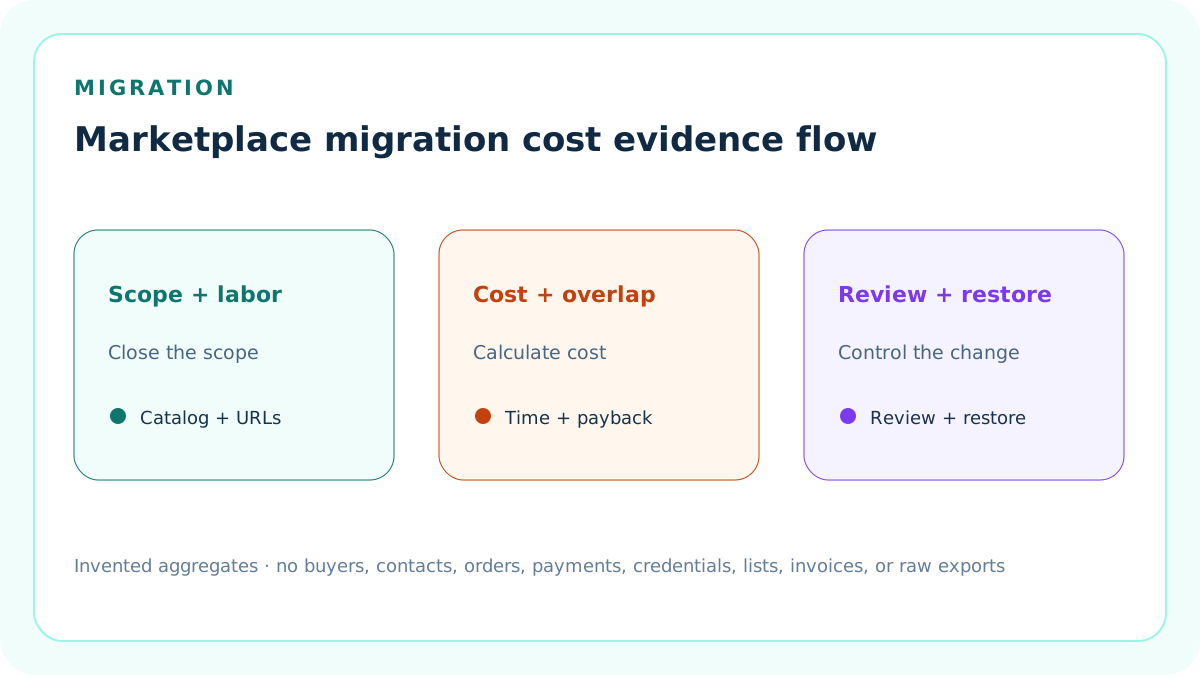
Define the migration boundary
Name the source channel, target channel, products, variants, markets, languages, currencies, domains, integrations, permitted data, and explicit exclusions.
Do not treat adding an owned store as equivalent to closing and replacing a marketplace.
Inventory catalog labor
Estimate product, variant, collection, category, attribute, SKU, inventory, media, and metadata mapping hours.
A row count alone does not measure variant, media, taxonomy, or exception work.
Estimate data cleanup labor
Include normalization, duplicate review, missing-field repair, unsupported-field handling, consent boundaries, and import-error correction.
Never place private buyer, contact, order, payment, credential, or raw export data in a public planning artifact.
Estimate storefront work
Include theme, navigation, policy, content, localization, accessibility, structured data, and responsive QA.
Separate reusable content from target-specific design and template work.
Estimate integration work
Include approved apps, feeds, payment, shipping, tax, fulfillment, analytics, consent, email, support, and reporting connections.
Availability and configuration differ by platform, market, plan, provider, and product.
Estimate URL and SEO work
Inventory old URLs, choose destinations, prepare server-side redirects where supported, update internal links and canonicals, and plan sitemap and monitoring.
A redirect plan can reduce avoidable loss but cannot guarantee traffic, ranking, or indexing.
Estimate training and procedure work
Include new operating procedures, permissions, exception handling, support, refunds, fulfillment, reconciliation, and rollback practice.
Do not hide owner time because no outside invoice is issued.
Estimate test work
Budget catalog, variant, pricing, inventory, checkout, payment, tax, shipping, discount, refund, fulfillment, notification, analytics, consent, accessibility, redirect, and restoration tests.
A successful import is not a successful migration.
Separate technical completion from operating acceptance
Record import completion separately from accepted catalog accuracy, checkout, payment, tax, shipping, refund, fulfillment, analytics, consent, redirect, accessibility, search recrawl, and retained-contribution evidence. Assign an owner, acceptance rule, and restoration trigger to every operating boundary.
A technically completed transfer can still require remediation, parallel-platform overlap, or rollback. Cost those exceptions explicitly instead of marking the migration finished when files import, DNS changes, or a storefront first becomes reachable.
Use a loaded hourly cost
Multiply total approved labor hours by a rate that represents the declared internal or external resource boundary.
Document whether the rate includes payroll burden, contractor markup, management, or opportunity cost.
Add one-time tools and apps
Include migration utilities, temporary connectors, import tooling, data transformation, and one-time app charges.
Separate one-time migration charges from continuing subscription cost.
Add setup fees
Include target-platform setup, domain, payment, provider, consulting, and other documented one-time fees.
Verify current provider terms rather than copying an old quote.
Add creative adaptation
Include photography, video, copy, templates, localization, accessibility assets, and format conversion that cannot be reused unchanged.
Do not count routine future content production as migration cost.
Add other one-time cost
Use a named evidence field for documented costs not represented elsewhere.
Do not use a large miscellaneous bucket to conceal uncertainty.
Calculate parallel-platform overlap
Multiply the old-and-new platform overlap cost per month by planned overlap months.
Overlap can support testing and rollback, but an unlimited overlap period can distort the plan.
Model lost contribution
Estimate contribution not retained because of downtime, catalog gaps, paused promotion, processing delay, redirect loss, or operational errors.
Keep modeled loss separate from paid invoices and labor.
Calculate total migration cost
Add loaded labor, one-time tools, setup fees, creative, other one-time cost, overlap, and modeled lost contribution.
Do not substitute gross revenue, GMV, or total payroll for incremental migration cost.
Calculate implementation weeks
Divide total migration labor hours by approved weekly implementation capacity.
Capacity is a scheduling input, not a promise that every dependency finishes on time.
Calculate retained-order payback
Divide total migration cost by post-migration contribution per mature retained order and round up to a whole order.
Use seller contribution after recurring costs and mature loss, not order value.
Calculate forecast headroom
Multiply forecast retained orders by post-migration contribution per retained order, then subtract migration cost.
Positive modeled headroom is not accounting profit or guaranteed cash.
Use the add-owned-store fixture
The invented packet uses 160 labor hours at USD 40, USD 1,600 of one-time nonlabor cost, USD 200 overlap, and USD 500 lost contribution.
Total migration cost is USD 8,700; at 20 hours per week it takes 8.00 weeks, and USD 30 contribution requires 290 retained orders.
Use the move-marketplaces fixture
The invented packet uses 210 labor hours at USD 45, USD 1,950 one-time nonlabor cost, USD 750 overlap, and USD 1,200 lost contribution.
Total migration cost is USD 13,350; at 25 hours per week it takes 8.40 weeks, and USD 35 contribution requires 382 retained orders.
Block structural defects
Block invalid currency, negative amounts, nonpositive capacity or contribution, fractional forecast orders, missing evidence, incomplete context, duplicate labels, or unresolved conflicts.
Favorable payback does not repair a privacy, data, URL, integration, ownership, or rollback defect.
Review excessive payback volume
Review a valid scenario whose required retained orders exceed the seller-entered maximum.
The maximum should reflect demand evidence, cash tolerance, and operating risk.
Review excessive implementation time
Review a valid scenario whose labor divided by capacity exceeds the entered week limit.
Do not inflate weekly capacity merely to force Ready.
Review negative forecast headroom
Review a valid scenario when forecast retained contribution does not recover total migration cost.
A longer forecast horizon needs independent evidence rather than a convenient extension.
Interpret Ready narrowly
Ready means the entered planning packet is structurally complete and passes its own thresholds.
It does not authorize data transfer, account changes, DNS, redirects, cutover, marketplace closure, spending, or publication.
Compare scenarios on one boundary
Use one currency, product set, contribution convention, evidence standard, privacy boundary, and forecast horizon where a clean comparison requires them.
Keep source and target platform differences visible.
Run one-variable sensitivity
Vary one labor category, hourly rate, fee, creative cost, overlap month, lost-contribution estimate, capacity, contribution, forecast, or threshold at a time.
Preserve the accepted baseline and identify the decision driver.
Monitor after authorized cutover
Compare planned and actual hours, import errors, checkout defects, redirect coverage, indexation, retained orders, contribution, overlap cost, and restoration triggers.
Stop or restore under the separately approved operating plan.
Protect data and accounts
Use invented examples or approved non-identifying aggregates in public artifacts.
Keep buyer data, customer contacts, order rows, payment details, credentials, exports, and account access inside authorized protected systems.
Version sources and assumptions
Record source URLs, access date, data-through date, platform versions, estimates, quotes, owner, reviewer, prior state, stop rule, and restoration test.
Platform capabilities, prices, limits, and policies can change.
Release the complete cluster
Index the working calculator with ten dedicated guides only after functionality, source, originality, privacy, accessibility, backup, release-mode, deployment, purge, and live-verification gates pass.
Search signals are measurement outputs, not a release prerequisite.
Sources and further reading
- Shopify Help: Migrate to Shopify: Official migration paths, store-data scope, manual and app-assisted transfer, testing, and post-migration context.
- Shopify Help: Migration checklist: Official catalog, customer, domain, shipping, tax, payment, order, and test checklist context.
- Google Search Central: Site moves with URL changes: Official URL mapping, server-side redirect, canonical, sitemap, monitoring, and timing guidance.
- Etsy Help: Download your Etsy data: Official export scope and privacy boundary; an export is not permission to republish buyer data.
- Seller Profit Guard methodology: Evidence, privacy, deterministic calculation, review, correction, release, and restoration.
Related Seller Profit Guard tools
- Product Launch Break-Even Calculator: Separate new-product launch cost from platform migration cost.
- Contribution Margin Calculator: Build retained-order contribution inputs.
- Multi-Channel Inventory Allocation Calculator: Plan inventory across channels after migration scope is stable.
- Sales Channel Contribution Calculator: Compare mature channel economics separately.
- Methodology: Review evidence, privacy, calculation, correction, release, and restoration.
- Data Privacy: Protect buyer, customer, order, payment, credential, list, and raw-export data.
- How do you calculate marketplace migration cost?: Add loaded labor cost, one-time tools and setup, creative adaptation, old-and-new platform overlap, and modeled lost contribution. Divide labor hours by approved weekly capacity for implementation time. Divide total migration cost by post-migration contribution per mature retained order and round up for payback volume.
- What is a complete add-an-owned-store migration cost example?: An invented plan has 160 labor hours at USD 40, USD 1,600 of one-time nonlabor cost, USD 200 of overlap, and USD 500 of lost contribution. Total migration cost is USD 8,700. At 20 hours per week it takes 8.00 weeks; at USD 30 contribution it requires 290 retained orders.
- What is a move-between-marketplaces migration cost example?: An invented move uses 210 labor hours at USD 45, USD 1,950 of one-time nonlabor cost, USD 750 of overlap, and USD 1,200 of lost contribution. Total migration cost is USD 13,350. At 25 hours per week it takes 8.40 weeks; at USD 35 contribution it requires 382 retained orders.
- What makes a marketplace migration cost estimate unreliable?: Common errors include counting only software fees, omitting owner labor, mixing ongoing subscriptions with one-time work, ignoring catalog exceptions, skipping URL mapping and test orders, assuming exports are complete, publishing private data, using gross order value as contribution, understating overlap, excluding lost contribution, inflating weekly capacity, and treating Ready as cutover authority.
- Where should marketplace migration cost inputs come from?: Use an approved catalog and variant inventory, permitted-field map, source and target requirements, URL inventory, integration register, current provider quotes, internal time estimates, loaded rates, platform bills, overlap plan, mature retained-order contribution, demand forecast, test matrix, owner review, protected prior state, stop conditions, and restoration evidence.
- When should marketplace migration planning be blocked?: Block invalid currency, negative costs, nonpositive capacity or contribution, fractional forecast orders, missing evidence, incomplete privacy or URL scope, duplicate scenarios, or open conflicts. Review valid packets that exceed retained-order or implementation limits or have negative forecast headroom. Ready is planning arithmetic, not migration authority.
- How should two marketplace migration scenarios be compared?: Use one declared currency, product set, retained-order contribution convention, forecast horizon, evidence standard, and privacy boundary where comparison requires them. Expose differences in catalog, cleanup, storefront, integration, URL, training, test, rate, fee, creative, overlap, lost contribution, capacity, payback, uncertainty, and restoration.
- How often should a marketplace migration estimate be reviewed?: Review when catalog size, variant complexity, data permissions, target requirements, domain plan, integrations, provider pricing, team capacity, contribution, forecast, overlap, or cutover scope changes. Preserve the prior packet, recalculate one variable at a time, authorize outside the tool, test privately, monitor after cutover, and retain restoration.
- What does a marketplace migration cost result mean?: It reports deterministic planning arithmetic for the entered scope. It cannot prove export completeness, transfer eligibility, privacy compliance, provider compatibility, redirect availability, indexation, traffic preservation, demand, cash timing, accounting profit, or implementation success. Ready still requires current sources, authorization, private testing, monitoring, stop conditions, and restoration.
- What belongs in a marketplace migration audit?: Record source and target channels, products, variants, markets, permitted fields, exclusions, export and import methods, URL mapping, redirects, integrations, labor categories, loaded rate, tools, setup, creative, overlap, lost contribution, capacity, retained-order contribution, forecast, thresholds, sources, owner, reviewer, authorization, tests, actual variance, stop rule, prior state, and restoration result.
Use the interactive tool
Enable JavaScript to open the calculator and process browser-local inputs. The explanatory content and source links remain available without JavaScript.
Related guide: Define migration scope, labor, nonlabor cost, overlap, lost contribution, implementation capacity, payback, evidence, and restoration.
This tool provides operating estimates, not tax, accounting, legal, financial, or marketplace-policy advice. Verify current official sources and your own records before changing prices or operations.