Seller Profit Guard · How it works · CSV privacy
Marketplace-collected tax separator
Separate aggregate marketplace-remitted tax and seller-collected tax liabilities from merchandise and shipping revenue, apply corresponding refund lines, and reconcile retained revenue plus seller-tax cash liability to the payout record without determining taxability, nexus, registration, filing, remittance, or accounting treatment.
Maintained by Seller Profit Guard Editorial Team. Last reviewed: 2026-07-29.
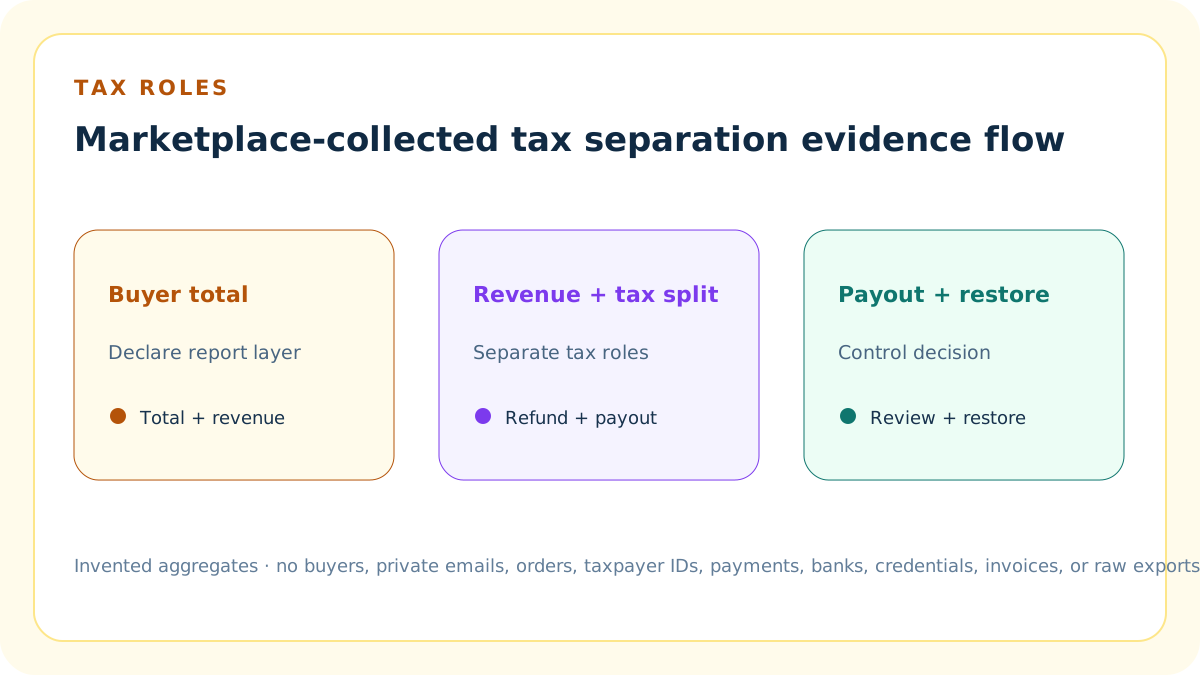
Start with tax roles
Classify marketplace-remitted buyer tax, seller-collected tax liability, tax on seller fees, withholding, import tax, and income tax separately.
This tool models only the first two roles in an aggregate payout bridge.
Declare the cohort
Use a closed channel, currency, reporting period, payout cutoff, refund window, and export version.
A live order dashboard is not a settled reconciliation.
Read the export layout
Identify whether reported buyer total includes tax or presents tax in a separate column.
The same economic order can appear differently under tax-inclusive and separate-tax exports.
Record buyer order total
Use the aggregate amount buyers were shown or charged under the report's documented definition.
Do not call it retained revenue before separating tax and refunds.
Record merchandise and shipping
Isolate item, seller-retained shipping, gift wrap, and other seller revenue before merchandise refunds.
Exclude marketplace-remitted tax and seller tax liabilities from this revenue layer.
Record marketplace-collected tax
Use the aggregate buyer-tax line the marketplace identifies as collected and remitted or filed by the channel.
A visible tax line is not automatically seller revenue or seller cash.
Record seller-collected tax
Keep tax collected for the seller as a separate liability until qualified tax and accounting treatment.
It can enter cash or payout without becoming operating revenue.
Confirm the remittance flag
Record channel, market, order type, reporting marker, collection certificate or platform evidence that supports marketplace remittance.
Block a positive marketplace-tax amount when its role remains unconfirmed.
Bridge the order total
Reported buyer total should reconcile to merchandise and shipping plus marketplace-collected and seller-collected tax under the declared export layout.
An unexplained difference is a structural defect, not other revenue.
Record merchandise refunds
Subtract refunded merchandise and shipping from seller revenue.
Use the same cohort and avoid mixing full-order and item-level refund definitions.
Record marketplace-tax refunds
Reduce the marketplace-tax informational balance when the platform reverses tax on a qualifying refund.
Do not add the reversal to seller revenue unless the platform's payout evidence shows a distinct seller amount.
Record seller-tax refunds
Reduce the modeled seller-collected tax liability when the seller-side tax amount is refunded.
Preserve jurisdiction and professional treatment outside this tool.
Calculate retained revenue
Seller-retained revenue equals merchandise and shipping gross minus merchandise and shipping refunds.
It excludes both marketplace-remitted and seller-collected tax roles.
Calculate net marketplace tax
Subtract marketplace-tax refunds from marketplace-collected tax.
Show it for reconciliation while keeping it outside retained revenue and the modeled seller payout bridge.
Calculate seller-tax liability
Subtract seller-tax refunds from seller-collected tax.
Include this net amount in the cash bridge only because it can be received cash, not because it is revenue.
Record non-tax fees
Aggregate platform, payment, transaction, advertising, label, and other fees that are not the modeled buyer-tax roles.
Tax charged on seller fees needs a separate visible classification rather than being hidden inside buyer tax.
Record signed adjustments
Use positive or negative payout adjustments only when their source and sign are documented.
Do not use adjustments as a plug for an unexplained tax or payout gap.
Calculate expected payout
Expected payout equals retained revenue plus net seller-tax liability minus non-tax fees plus signed adjustments.
Marketplace-remitted tax is excluded because the seller does not retain it under this packet.
Compare actual payout
Match the aggregate expected payout to a payout record with the same cutoff and included transaction statuses.
A bank deposit can combine payouts or timing layers and needs a separate bridge.
Use the tax-inclusive fixture
The invented Etsy export reports USD 10,800 including USD 800 marketplace tax against USD 10,000 merchandise and shipping.
After merchandise and marketplace-tax refunds, retained revenue is USD 9,500 and net marketplace tax is USD 760.
Use the separate-tax fixture
The invented Shopify export separates USD 10,000 merchandise from USD 1,000 seller-collected tax.
After refunds, retained revenue is USD 9,600 and USD 960 remains a modeled liability inside cash, not revenue.
Block impossible refunds
Block merchandise or tax refunds that exceed their corresponding gross layer.
A negative net tax or revenue result requires a more explicit credit or prior-period bridge.
Block order-total gaps
Block when buyer total does not reconcile to merchandise, shipping, marketplace tax, and seller tax.
Do not alter tax classification merely to force the gap to zero.
Review payout gaps
Review when the absolute expected-versus-actual payout difference exceeds the entered tolerance.
Investigate statuses, cutoffs, fees, reserves, adjustments, and tax roles before changing books or settings.
Review retained revenue
Review when a structurally valid cohort falls below the seller-entered retained-revenue floor.
The target is operational, not a tax or legal threshold.
Interpret Ready narrowly
Ready means the entered aggregate roles and payout bridge reconcile within declared thresholds.
It does not decide taxability, nexus, registration, filing, remittance, exemption, or accounting treatment.
Separate payout from revenue
Payout can include seller-collected tax liabilities and prior-period adjustments while excluding marketplace-remitted tax.
Retained revenue is therefore not necessarily equal to payout.
Separate tax on seller fees
VAT, GST, or sales tax charged on marketplace services is a seller-cost or recoverability question.
It is not the same as tax a buyer paid on an order.
Separate withholding tax
Platform withholding from seller proceeds can represent another jurisdiction-specific tax layer.
Do not classify it as buyer marketplace tax without official and professional evidence.
Separate tax reporting totals
Government-reporting definitions of gross sales or consideration can include items excluded from operating retained revenue.
Preserve each report's definition rather than forcing one universal revenue number.
Protect private data
Use invented examples or approved aggregates only.
Never publish private emails, buyer names, addresses, order rows, taxpayer IDs, payment details, bank records, credentials, invoices, or raw exports.
Version sources
Record source URL, access date, data-through date, market, channel, order type, export setting, and report version.
Marketplace tax roles can change by jurisdiction and product.
Assign owner and reviewer
Name who classified the tax and payout lines and who independently reperformed the bridge.
Material tax ambiguity requires qualified professional review outside the tool.
Reject coercive inputs
Enter plain decimal amounts without currency symbols, grouping commas, percentages, exponents, booleans, or whitespace-only values.
A structurally invalid amount blocks the packet instead of being silently converted.
Date the evidence contract
Record a real official-source review date, a seller tax-mapping effective date that does not postdate it, and a positive whole-number closed evidence duration.
A narrative month label does not replace verifiable source and mapping dates.
Require nine confirmations
Confirm aggregate-only privacy, tax-role separation, comparable windows, export mapping, remittance evidence, refund maturity, payout completeness, independent review, and restoration authority.
One missing confirmation blocks the packet even when arithmetic happens to balance.
Quarantine blocked outputs
When any structural gate fails, hide all twenty-eight cohort-derived amounts rather than displaying calculations from invalid evidence.
Formula labels, entered thresholds, dates, and the reason for Block remain visible for correction.
Preserve rollback
Save prior export settings, mappings, accounting rules, accepted packets, stop conditions, and restoration steps before an authorized change.
The calculator does not change platform or bookkeeping systems.
Release the complete cluster
Index the working separator with ten dedicated guides only after source, function, originality, privacy, accessibility, backup, release-mode, deployment, purge, and live-verification gates pass.
Search signals are measurement outputs, not a release prerequisite.
Sources and further reading
- Etsy Help: US State Sales Tax: Official marketplace-facilitator collection, remittance, Payment account, and buyer-paid-tax reporting context.
- Etsy Help: Tax Laws Around the World: Official distinctions among buyer tax, seller withholding, seller-fee tax, and government reporting.
- Shopify Help: Sales tax in Shop: Official marketplace-tax payout, refund, finance-report, filing, and professional-review context.
- Shopify Help: Marketplace Connect order imports: Official Withhold tax versus Send tax import behavior and reporting visibility.
- TikTok Ads: Gross Revenue: Official Gross Revenue bridge that subtracts sales taxes from customer payment.
- Seller Profit Guard methodology: Evidence, privacy, deterministic calculation, review, correction, release, and restoration.
Related Seller Profit Guard tools
- Payment Account Reconciliation: Rebuild a complete aggregate settlement bridge.
- Marketplace Fee Comparison Calculator: Keep fee packets separate from buyer-tax roles.
- TikTok GMV vs Profit Calculator: Separate platform-reported sales from seller-retained economics.
- Sales Channel Contribution Calculator: Compare contribution after revenue and tax normalization.
- Methodology: Review evidence, privacy, calculation, correction, release, and restoration.
- Data Privacy: Protect seller, buyer, order, payment, tax, bank, and raw-export data.
- How do you separate marketplace-collected tax from seller-retained revenue?: Reconcile buyer total to merchandise and shipping plus separately identified marketplace-remitted and seller-collected tax. Subtract merchandise refunds to calculate retained revenue. Keep net marketplace tax outside revenue and payout; show net seller-collected tax as a cash liability; then reconcile retained revenue, liability, fees, and adjustments to payout.
- How do you read a tax-inclusive marketplace export?: An invented USD 10,800 buyer total contains USD 10,000 of merchandise and shipping plus USD 800 of marketplace tax. After USD 500 of merchandise refunds and USD 40 of tax refunds, retained revenue is USD 9,500 and net marketplace tax is USD 760, which remains outside seller payout.
- How do you read a separate-tax marketplace export?: An invented export shows USD 10,000 merchandise and shipping plus USD 1,000 seller-collected tax. After USD 400 merchandise refunds and USD 40 seller-tax refunds, retained revenue is USD 9,600 and USD 960 remains liability cash. After USD 900 of non-tax fees, expected payout is USD 9,660.
- What makes marketplace tax separation wrong?: Common errors include treating buyer tax as revenue, excluding seller-tax liability from a cash bridge, mixing marketplace and seller collection, ignoring tax refunds, combining tax on seller fees with buyer tax, hiding withholding, using mismatched payout cutoffs, forcing a report definition into accounting revenue, publishing order rows, and treating reconciliation as tax advice.
- Where should marketplace tax reconciliation data come from?: Use marketplace order and tax reports for buyer totals and tax lines, platform guidance and reporting markers for collection roles, refund records for merchandise and tax reversals, settlement details for fees and adjustments, payout records for cash, qualified tax and accounting review for treatment, and dated owner-review records for accepted mappings.
- When should a marketplace tax packet be blocked?: Block when totals, tax roles, remittance flags, refunds, fee classes, payout cutoffs, context, or evidence do not reconcile. Review structurally valid packets that miss retained-revenue or payout-gap thresholds. Ready only describes the entered aggregate bridge; it does not decide taxability, nexus, registration, filing, remittance, exemption, or accounting.
- How should tax-inclusive and separate-tax exports be compared?: Map each export to the same conceptual layers: buyer total, merchandise and shipping, marketplace tax, seller tax, corresponding refunds, non-tax fees, adjustments, retained revenue, and payout. Compare after the mapping, not by raw column totals, and do not infer tax obligations from presentation differences.
- How often should marketplace tax separation be reviewed?: Review after order, refund, settlement, and payout windows close and whenever a channel, jurisdiction, product classification, tax flag, export layout, import setting, or accounting mapping changes. Preserve the prior packet, assign an owner and reviewer, document exceptions, obtain qualified advice where needed, and test restoration.
- What does a marketplace tax separator result mean?: It explains one aggregate payout bridge under entered tax roles. Marketplace-remitted tax is informational and outside seller revenue; seller-collected tax can be cash and liability without being revenue. The result does not determine taxability, nexus, registration, remittance, filing, taxable income, accounting presentation, legal compliance, or future obligation.
- What belongs in a marketplace-collected tax audit?: Record market, channel, currency, cohort dates, export version, buyer total, merchandise and shipping, marketplace and seller tax, remittance evidence, each refund layer, fee classes, signed adjustments, expected and actual payout, gap tolerance, source versions, conflicts, owner, reviewer, qualified-advice boundary, prior mapping, stop rule, and restoration test.
Use the interactive tool
Enable JavaScript to open the calculator and process browser-local inputs. The explanatory content and source links remain available without JavaScript.
Related guide: Define buyer totals, revenue, tax roles, refunds, payout bridge, evidence, and restoration.
This tool provides operating estimates, not tax, accounting, legal, financial, or marketplace-policy advice. Verify current official sources and your own records before changing prices or operations.