Seller Profit Guard · How it works · CSV privacy
Customer Acquisition Payback Calculator
Estimate whether one acquired customer's cost is recovered on the first mature retained order or through probability-weighted repeat contribution over a finite cohort horizon. Separate new-customer classification, attribution, refund-adjusted contribution, repeat probability, decay, cycle timing, thresholds, uncertainty, monitoring, and restoration before interpreting payback.
Maintained by Seller Profit Guard Editorial Team. Last reviewed: 2026-07-29.
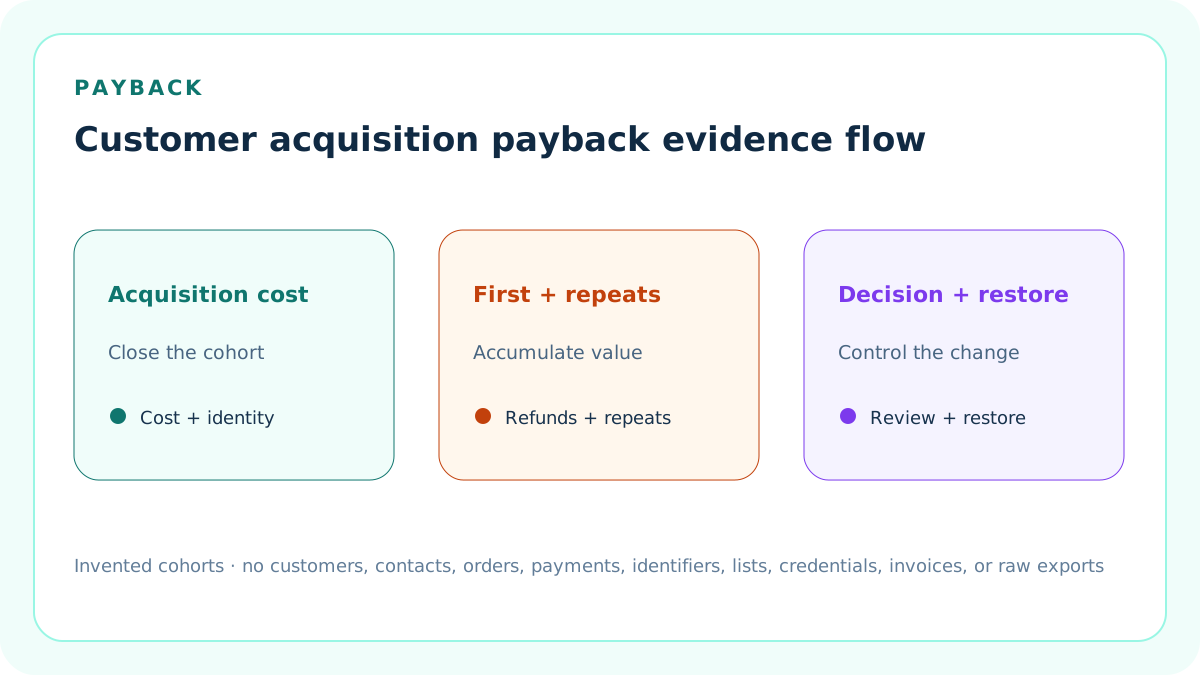
Start with a closed acquisition cohort
Define one acquisition source, date range, market, product mix, new-customer rule, attribution boundary, and maturity cutoff.
Do not compare an open campaign with a fully matured cohort.
Calculate acquisition cost per confirmed new customer
Divide attributable acquisition spend and declared acquisition-specific cost by confirmed new customers under one rule.
Clicks, leads, attributed orders, platform conversions, and all customers are not interchangeable denominators.
Define a new customer consistently
Use one first-purchase or approved identity rule across spend, orders, refunds, and cohort reports.
Platform detection can include unknown or misclassified customers; preserve that limitation.
Separate attribution from incrementality
Attribution assigns reporting credit under a declared window and model.
It does not prove that the customer or repeat order would not have occurred without the campaign.
Build first-order contribution
Start with seller-retained revenue and subtract product, channel, payment, advertising, creator, fulfillment, shipping, packaging, support, and other recurring costs.
Do not use gross revenue, GMV, conversion value, or order value as contribution.
Mature the first-order refund window
Use a cohort old enough for cancellations, refunds, returns, exchanges, disputes, and fee recovery to stabilize.
A same-day purchase report is not mature contribution evidence.
Calculate first-order refund loss
Multiply the mature first-order refund rate by loss per refunded first order.
Returned-unit loss should reflect fee recovery, product recovery, shipping, handling, refurbishment, disposal, and credits.
Calculate first-order net contribution
Subtract expected first-order refund loss from contribution before refund loss.
Block nonpositive contribution rather than relying on future repeats to conceal broken first-order economics.
Define repeat-order probability
Estimate the probability that one acquired customer makes a repeat order in the first declared cycle.
Use a comparable first-purchase cohort and a finite observation window.
Define repeat contribution separately
Repeat orders can have different product mix, discounts, fulfillment, service, and refund economics.
Do not reuse first-order contribution without evidence.
Mature repeat refunds
Calculate repeat-order contribution after its own mature refund frequency and loss.
Do not assume repeat customers have zero refund or service cost.
Define cycle length
Choose days, weeks, months, or quarters that match the cohort report and product repurchase behavior, then convert to whole days.
A 30-day model does not claim every customer buys on day 30.
Define probability retention
Reduce the next-cycle repeat probability by a declared retention factor.
This is a transparent deterministic simplification, not a fitted survival model.
Use a finite horizon
Limit repeat cycles to a declared evidence and decision horizon.
An infinite lifetime-value tail can manufacture payback from unsupported future orders.
Accumulate expected contribution
Add first-order net contribution and each cycle's repeat probability multiplied by repeat-order net contribution.
Keep probability-weighted expected contribution separate from realized orders and cash.
Find the first payback cycle
The payback cycle is the first cycle where cumulative expected contribution equals or exceeds acquisition cost.
If the first order covers cost, payback days are zero in this model.
Calculate modeled payback days
Multiply the first payback cycle by declared cycle days.
This produces a cohort-planning interval, not a customer-level promise or exact cash date.
Calculate horizon headroom
Subtract acquisition cost from cumulative expected contribution at the full modeled horizon.
Positive headroom is not accounting profit, customer lifetime value, or guaranteed surplus.
Use the first-order fixture
The invented first-order packet has USD 45 acquisition cost and USD 50 net first-order contribution after mature refund loss.
It reaches modeled payback on the first order, day zero, with USD 5 horizon headroom.
Use the repeat-supported fixture
The invented repeat packet has USD 80 acquisition cost and USD 30 first-order contribution.
A 60% first repeat probability, 80% probability retention, USD 25 repeat contribution, and 30-day cycles first cross payback in cycle five, day 150.
Block structural defects
Block invalid currency, negative costs, invalid rates, nonpositive net contribution, invalid cycles, incomplete scope, missing evidence, duplicate labels, or unresolved conflicts.
Favorable platform conversion value cannot repair broken cohort structure.
Review slow or missing payback
Review a valid packet that does not pay back in the finite horizon or exceeds the seller-entered day limit.
Do not extend the horizon only to force Ready.
Review insufficient headroom
Review a valid packet whose horizon contribution minus acquisition cost is below the entered minimum.
The threshold is seller-defined and should reflect risk, capacity, and cash constraints.
Interpret Ready narrowly
Ready means the entered cohort packet passes its structural and threshold checks.
It does not authorize bids, prove incrementality, identify a customer, or guarantee repeats.
Separate payback from CPA limit
A CPA-limit tool asks how much can be spent given a contribution target.
This tool asks how the entered acquisition cost is recovered through first and probability-weighted repeat contribution over time.
Separate payback from ROAS
ROAS compares reported revenue or conversion value with ad spend.
Customer acquisition payback uses seller contribution and a cohort time axis.
Run one-variable sensitivity
Change acquisition cost, contribution, refund frequency, refund severity, repeat probability, decay, cycle length, horizon, or thresholds one at a time.
Preserve the accepted base packet and name the decision driver.
Monitor mature cohorts
Compare modeled and realized aggregate new-customer counts, refunds, contribution, repeat timing, and cumulative recovery after each cohort matures.
Stop or restore when the approved trigger is crossed.
Protect customer privacy
Use invented examples or approved non-identifying cohort aggregates.
Never publish names, emails, addresses, order rows, payment data, identifiers, credentials, invoices, customer lists, or raw exports.
Version sources and definitions
Record source URL or internal pointer, access date, data-through date, new-customer rule, attribution setting, cohort version, owner, reviewer, and accepted formula.
Platform reporting and seller economics can change.
Preserve rollback
Before an authorized acquisition change, save the prior campaign, budget, bid, audience, attribution, product, offer, landing, and measurement configuration.
Define stop conditions and test restoration.
Require a closed cohort duration
Record a positive whole-number evidence duration that covers first-order refunds and the declared finite repeat horizon.
An open acquisition cohort cannot validate mature payback.
Validate source and policy dates
Use real ISO dates for current official-source review and seller acquisition-payback policy.
The seller policy cannot postdate the sources used to support it.
Require nine shared confirmations
Confirm aggregate privacy, comparable scope, attribution boundaries, mature contribution, finite repeats, cohort ownership, current sources, independent review, and restoration authority.
Missing shared evidence produces Block before favorable economics are shown.
Mask blocked cohort economics
When structure is blocked, hide all 18 scenario acquisition, contribution, expected-order, payback, and headroom outputs.
Invalid or coercive input must not produce a decision-ready customer result.
Respect report-time semantics
Shopify cohort reports can use entire order history, while TikTok Seller Center and Ads Manager can report under different event and attribution dates.
Record time basis before comparing cohorts.
Keep value and contribution separate
Google Ads conversion value and value per cost depend on configured conversion values; TikTok attribution assigns reporting credit.
Neither proves incrementality or equals seller retained contribution without a documented bridge.
Release the complete cluster
Index the working calculator with ten dedicated guides only after functionality, source, originality, privacy, accessibility, backup, release-mode, deployment, purge, and live-verification gates pass.
Search signals are measurement outputs, not a release prerequisite.
Sources and further reading
- Shopify Help: Customer reports and cohort analysis: Official first-purchase cohort, repeat-purchase interval, full order-history, average order, and reporting-latency context.
- Google Ads Help: Conversion values: Official conversion-value and value-per-cost context; platform conversion value is not automatically seller contribution.
- TikTok Business Help: Shop Ads attribution: Official attribution-window, Shop ID, click/view, reporting-date, and cross-product order boundaries.
- Seller Profit Guard methodology: Evidence, privacy, deterministic calculation, review, correction, release, and restoration.
Related Seller Profit Guard tools
- Paid CPA Limit Calculator: Solve the maximum acquisition spend boundary separately.
- Break-Even ROAS Calculator: Translate contribution into a revenue-to-spend boundary.
- Contribution Margin Calculator: Build first and repeat contribution inputs.
- Ad Attribution Reconciliation Checker: Reconcile attributed outcomes before assigning acquisition cost.
- Methodology: Review evidence, privacy, calculation, correction, release, and restoration.
- Data Privacy: Protect customer, contact, order, payment, identifier, list, and raw-export data.
- How do you calculate customer acquisition payback?: Divide attributable acquisition cost by confirmed new customers under one rule, then compare that cost with mature refund-adjusted first-order contribution. If the first order does not recover cost, add probability-weighted repeat-order contribution by declared cycle, reduce probability with an explicit retention factor, stop at a finite horizon, and report the first payback cycle and day.
- What is a complete first-order acquisition payback example?: An invented cohort assigns USD 45 acquisition cost per confirmed new customer. First-order contribution is USD 55 before refund loss; a 10% mature refund rate and USD 50 loss reduce it to USD 50. The first retained order covers acquisition cost, so modeled payback is cycle zero, day zero, with USD 5 headroom.
- What is a repeat-supported acquisition payback example?: An invented cohort starts with USD 80 acquisition cost and USD 30 net first-order contribution. Repeat contribution is USD 25 after mature refunds. A 60% first repeat probability retains 80% each 30-day cycle. Cumulative expected contribution first exceeds acquisition cost in cycle five, day 150, and reaches about USD 85.34 after six cycles.
- What makes customer acquisition payback unreliable?: Common errors include dividing spend by all orders, changing the new-customer rule, treating attribution as incrementality, using gross revenue or conversion value, ignoring mature refunds, reusing first-order economics for repeats, applying repeat rate forever, counting subscriptions twice, mixing cohort dates, using customer-level predictions, extending the horizon to force payback, and interpreting Ready as bidding authority.
- Where should acquisition payback inputs come from?: Use billed acquisition spend; a documented first-purchase or approved new-customer rule; platform attribution settings and reconciliation; mature first-order revenue, cost, and refund aggregates; first-purchase cohort reports for repeat intervals and orders; separate repeat-order contribution packets; source dates; and owner-reviewed prior, monitoring, stop, correction, and restoration records.
- When should customer acquisition payback be blocked?: Block invalid currency, negative costs, rates outside 0–100%, nonpositive net contribution, invalid cycle or horizon, missing cohort evidence, ambiguous new-customer or attribution definitions, duplicate scenario labels, or open conflicts. Review valid packets that miss payback within the horizon, exceed the day limit, or fall below minimum headroom. Ready is not bidding authority.
- How should first-order and repeat-supported payback be compared?: Use one currency, acquisition-cost rule, new-customer definition, attribution boundary, product-mix scope, refund maturity, contribution convention, and evidence standard. Expose different first-order contribution, repeat economics, probability, decay, cycle length, and horizon. Compare payback cycle, days, expected orders, horizon contribution, headroom, sensitivity, uncertainty, monitoring, and rollback.
- How often should acquisition payback be reviewed?: Review after acquisition spend closes and when new-customer classification, attribution settings, conversion reporting, product mix, fees, discounts, fulfillment, refunds, repeat behavior, subscription treatment, cycle timing, or capacity changes. Preserve the prior packet, mature the cohort, recalculate one variable at a time, authorize outside the tool, monitor actual recovery, and test restoration.
- What does a customer acquisition payback result mean?: It reports when cumulative expected contribution crosses the entered acquisition cost under a finite aggregate cohort model. It cannot prove attribution or incrementality, predict an individual customer, value an infinite lifetime, guarantee repeats, determine cash timing, authorize advertising, or establish accounting profit. Ready still requires current sources, ownership, monitoring, stop conditions, and restoration.
- What belongs in an acquisition payback audit?: Record campaign and channel, dates, spend, confirmed new customers, acquisition-cost denominator, attribution window and model, product mix, first contribution, first refunds, repeat contribution, repeat refunds, initial probability, probability retention, cycle days, finite horizon, payback cycle and day, expected orders, horizon headroom, thresholds, sources, owner, reviewer, authorization, actual variance, stop rule, prior configuration, and restoration test.
Use the interactive tool
Enable JavaScript to open the calculator and process browser-local inputs. The explanatory content and source links remain available without JavaScript.
Related guide: Define acquisition cost, mature contribution, repeat probability, finite horizon, payback timing, evidence, and restoration.
This tool provides operating estimates, not tax, accounting, legal, financial, or marketplace-policy advice. Verify current official sources and your own records before changing prices or operations.