Seller Profit Guard · How it works · CSV privacy
Seller CSV privacy redactor
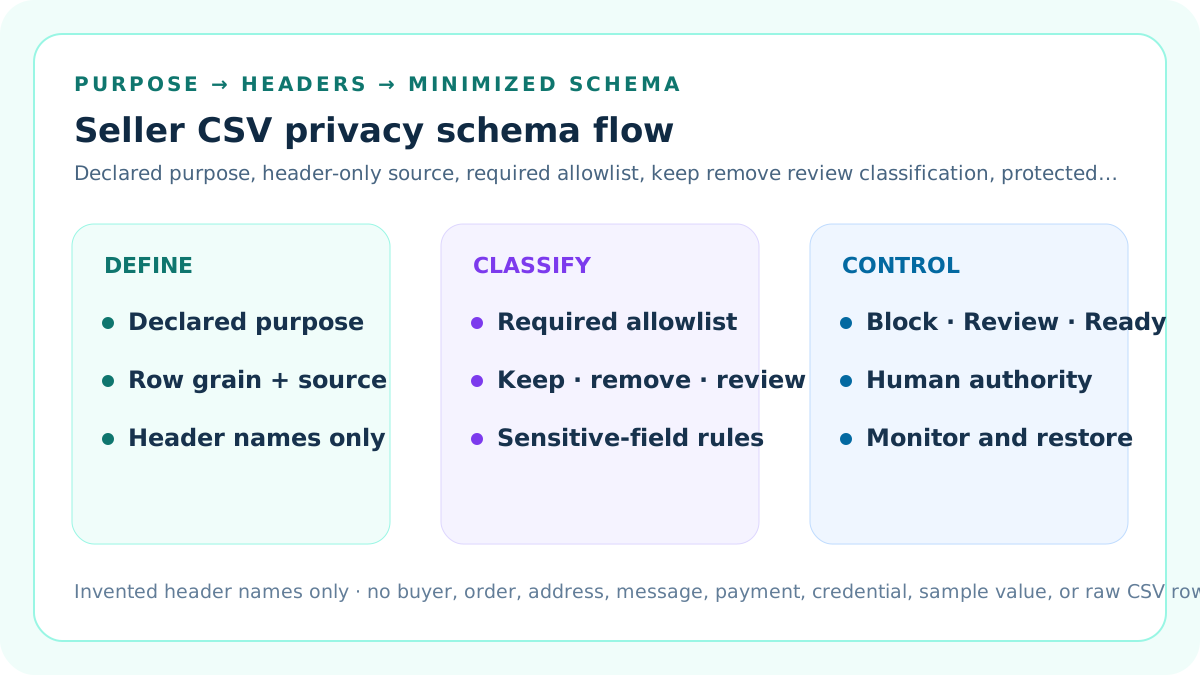
Plan a minimized local-analysis schema from synthetic CSV header names only. Enter an order-export packet and a support-ticket packet, list the fields required for each declared purpose, and set review and retention controls. The browser-local checker classifies fields as keep, remove, or human review without reading or rewriting a real file.
Maintained by Seller Profit Guard Editorial Team. Last reviewed: 2026-07-29.
Use header names only
Paste invented or documentation-derived column names, never example values or real rows. The checker classifies a schema contract; it does not inspect cell contents or rewrite a file.
An email address, URL, date value, payment token, or long numeric sequence in the input Blocks the public worksheet.
Start with a declared purpose
Name the exact local analysis, its row grain, output, owner, reviewer, and retention decision before selecting fields.
'We might need it later' is not a sufficiently bounded purpose.
Keep this intent distinct
Use the CSV validator for syntax and formula-injection checks, the column mapper for canonical field mapping, and this privacy redactor for field minimization before protected analysis.
It is not an anonymizer, pseudonymizer, deletion engine, legal assessment, or compliance certificate.
Define the source schema
Record platform, export type, version, filters, date basis, row grain, and protected source fingerprint.
Shopify order exports and transaction exports are not interchangeable, and Etsy exposes multiple export types.
Define required analysis fields
List only columns that directly support the declared calculation or QA task, such as sold date, currency, SKU, quantity, price, discount, shipping, tax, refund, or fee.
A required field must exist in the header packet.
Remove direct contact fields
Names, email addresses, phone numbers, and similar contact columns are normally unnecessary for aggregate profit analysis.
If a separate support or legal workflow requires them, keep that workflow outside the minimized profit schema.
Remove street-level address fields
Billing and shipping names, street lines, postal codes, phones, and free-form delivery details increase exposure without improving most item-level margin calculations.
Country or region may be evaluated separately when a documented rule genuinely needs it.
Remove free-text fields
Notes, messages, comments, personalization, attachment links, and custom attributes can contain unpredictable personal or sensitive information.
Do not attempt public keyword redaction of free text.
Remove secrets and credentials
Passwords, API keys, access tokens, session values, cookies, bank identifiers, card data, and payment references never belong in a public analysis worksheet.
Rotate an exposed secret; deleting one copied file is not enough.
Review operational identifiers
Order, customer, buyer, ticket, device, employee, tracking, and transaction identifiers may support deduplication or reconciliation but are not automatically required for profit analysis.
Prefer a protected pseudonymous key in an authorized workflow when identity continuity is necessary.
Remove unused financial fields
A financial column that is not required by the declared calculation should also be removed. Data minimization is not limited to personal data labels.
Preserve the calculation contract so a reviewer can challenge every retained amount.
Classify unfamiliar headers
Unknown column names go to human Review rather than automatic keep or remove.
Check the platform documentation, sample schema in a protected environment, owner, downstream formulas, and applicable obligations.
Calculate minimized share
Minimized share equals fields marked remove divided by total header fields.
A high percentage is not inherently better; the goal is sufficient, explainable data with lower exposure.
Read Ready
Ready means both synthetic header packets have complete required-field coverage, no sensitive required fields, no sample values, and no unresolved review field above threshold.
It approves only the schema plan entered in the browser.
Read Review
Review means structure is valid but at least one unfamiliar field lacks a documented classification.
Do not publish or process production data until its owner decides keep, remove, pseudonymize, or route elsewhere.
Read Block
Block means the input contains sample values, duplicate normalized headers, missing or sensitive required fields, invalid scope, privacy conflict, or incomplete ownership and restoration evidence.
Repair the contract before applying any schema.
Work an order export
Keep only the item-grain fields needed for the declared profit calculation and remove contact, street address, notes, payment-reference, and device columns.
Verify Shopify's current export schema for the exact report rather than relying on a copied template.
Work a support-ticket export
For aggregate refund-reason analysis, keep time, channel, reason, status, and refund amount while removing buyer contact, message body, attachment URLs, and secrets.
Free-text support content belongs in a separately controlled support workflow.
Preserve the original protected export
Minimization creates a purpose-specific derivative; it does not define the legal or contractual retention of the authorized source.
Store source and derivative separately with access, retention, and destruction controls.
Prefer allowlists
An approved required-field allowlist is safer than trying to enumerate every possible sensitive field.
New platform columns then fail closed into Review instead of silently flowing downstream.
Use exact header normalization
Trim whitespace and normalize declared separators or case for matching, but preserve the original label in the evidence log.
Aggressive rewriting can collapse distinct fields or hide duplicate headers.
Control derived fields
A hash, cohort, segment, risk label, or aggregated geography can still carry privacy risk or enable linkage.
Review the derivation, purpose, reversibility, group size, and downstream access.
Separate minimization from pseudonymization
Removal deletes fields from the derivative schema; pseudonymization replaces an identifier while retaining a protected linkage path.
Neither guarantees anonymity, and this public checker performs neither operation.
Control spreadsheet formulas
Header minimization does not neutralize formula-like cell content. Validate or safely encode cells in the authorized export workflow before spreadsheet use.
Do not paste suspicious values into this tool.
Assign human authority
Name the business-purpose owner, privacy owner, schema owner, independent reviewer, retention approver, stop authority, and restoration owner.
Ready cannot determine legal basis or erase production records.
Back up before transformation
Preserve source fingerprints, mapping, allowlist, removal rules, review decisions, transformation version, output hash, prior accepted schema, and tested restoration instructions.
The browser-local tool creates no backup.
Retest counterexamples
Test a clean order schema, support schema, unknown field, sensitive required field, missing required field, duplicate header, sample email, URL, payment token, short scope, and open conflict.
Every public fixture remains invented and header-only.
Monitor schema drift
Track platform export changes, new columns, renamed headers, purpose changes, downstream formula changes, retention decisions, review overrides, and failed transformations.
Stop automation when an unreviewed field appears.
Document disposal
Record when a derivative should be replaced or deleted, who confirms disposal, which backups are in scope, and how evidence of completion is preserved.
A retention date is not proof that deletion occurred.
Avoid compliance claims
A minimized schema can reduce unnecessary exposure but cannot prove GDPR, CCPA, contractual, tax, accounting, fraud, support, or record-retention compliance.
Obtain qualified advice for the exact jurisdiction and use case.
Release through ordered gates
Index only after distinct intent, current sources, working logic, counterexamples, answer-first content, metadata, schema, diagrams, links, privacy, similarity, mobile, backup, deployment, and live checks pass.
Search signals are measured later and are not required for release.
Keep a change log
Record source version, purpose, required allowlist, keep, remove and review decisions, rule version, owner, reviewer, retention interval, output fingerprint, monitoring trigger, and restoration reference.
Never overwrite the prior accepted schema without supersession evidence.
Version the privacy-schema contract
Record a real protected source-schema review date, a policy effective date no later than that review, a minimum closed evidence duration, a bounded header-population maximum, and all nine privacy, purpose, allowlist, sensitive-field, threshold, counterexample, restoration, and authority confirmations.
Invalid governance controls Block the packet and mask every derived keep, remove, review, and minimized-share result.
Quarantine blocked classifications
When purpose, header-only input, required fields, dates, thresholds, evidence scope, confirmations, or conflicts fail, treat all derived field lists and counts as unavailable. Preserve the entered packet only in an authorized review context and do not copy its apparent classifications into a transformation rule.
A partial-looking classification from a blocked packet is not evidence that any field is safe to keep, remove, publish, transform, or delete.
Sources and further reading
- Shopify Help: Exporting orders: Official order CSV structure, including contact, address, notes, payment references, device, status, amount, SKU, quantity, and date fields.
- Etsy Help: Download sold transactions: Official seller export types and order-item, order, payment-sale, deposit, price, title, payment-method, and optional SKU boundaries.
- EU GDPR Article 5: Official principles including purpose limitation, data minimisation, accuracy, storage limitation, integrity, confidentiality, and accountability.
- NIST Privacy Framework 1.0: Risk-based privacy functions and data-processing controls, including data minimization.
- W3C CSVW: Tabular Data Model: Standards-based schema, column, primary-key, and reference concepts.
- OWASP CSV Injection: Spreadsheet formula-injection risk when exported cells begin with interpreted characters.
- Seller Profit Guard methodology: Evidence, correction, release, monitoring, and rollback controls.
- Seller Profit Guard data privacy: Local-first handling and protected operational-data boundaries.
Related Seller Profit Guard tools
- Seller CSV Import Validator: Check synthetic CSV syntax, required headers, numeric cells, and formula-injection risk.
- Seller CSV Column Mapper: Map approved source headers to stable canonical fields.
- Duplicate Order Checker: Review repeated synthetic business keys before choosing identifier controls.
- Missing SKU Cost Checker: Measure dated cost coverage after the minimized schema is approved.
- Methodology: Review evidence, correction, release, monitoring, and rollback controls.
- Data Privacy: Apply the site's local-first operational-data boundary.
- CSV Privacy Redactor Formula and Input Contract: Define purpose, source, grain, header-only input, required allowlist, keep, remove, review, retention, ownership, and restoration.
- CSV Privacy Redactor Worked Example: Order Export: Reduce an invented Shopify-like order schema to item-level profit fields while removing contact, address, notes, payment-reference, and device columns.
- CSV Privacy Redactor for a Support-Ticket Export: Build an aggregate refund-reason schema without carrying buyer contacts, messages, attachment links, or secrets into profit analysis.
- CSV Privacy Redactor Mistakes and Corrections: Diagnose sample-value exposure, purpose creep, sensitive fields, unknown-column auto-keep, identifiers, free text, and false deletion claims.
- Reliable Sources for CSV Privacy Minimization: Map purpose, platform schema, column meaning, private source, field owner, obligation, retention, transformation, and restoration evidence.
- Safe Decision Thresholds for CSV Privacy Review: Set zero-unresolved, temporary review, schema-age, drift, recurrence, source-confidence, transformation, disposal, and stop controls.
- Order Export vs Support-Ticket Privacy Schemas: Compare a structured financial order export with a free-text-heavy support export at the same field-classification grain and privacy boundary.
- Weekly Seller CSV Privacy Review Routine: Run a repeatable schema-control cycle for purpose, allowlist, field triage, protected transformation, validation, retention, monitoring, and restoration.
- Interpret a Minimized CSV Schema Responsibly: Explain what keep, remove, review, minimized share, Ready, Review, and Block can prove, cannot prove, and require as the next protected action.
- CSV Privacy Redactor Audit Checklist and Change Log: Provide a standalone purpose, source, allowlist, classification, exception, transformation, validation, retention, disposal, monitoring, and restoration record.
Use the interactive tool
Enable JavaScript to open the calculator and process browser-local inputs. The explanatory content and source links remain available without JavaScript.
Related guide: Define purpose, required allowlists, keep, remove and review classifications, retention, evidence, monitoring, and restoration.
This tool provides operating estimates, not tax, accounting, legal, financial, or marketplace-policy advice. Verify current official sources and your own records before changing prices or operations.