Seller Profit Guard · How it works · CSV privacy
TikTok Shop shipping subsidy calculator
Separate buyer-paid shipping, platform checkout support, seller checkout discount, retained platform shipping credit, offset debits, actual shipping, packaging, and other order costs to calculate seller-funded shipping and contribution.
Maintained by Seller Profit Guard Editorial Team. Last reviewed: 2026-07-29.
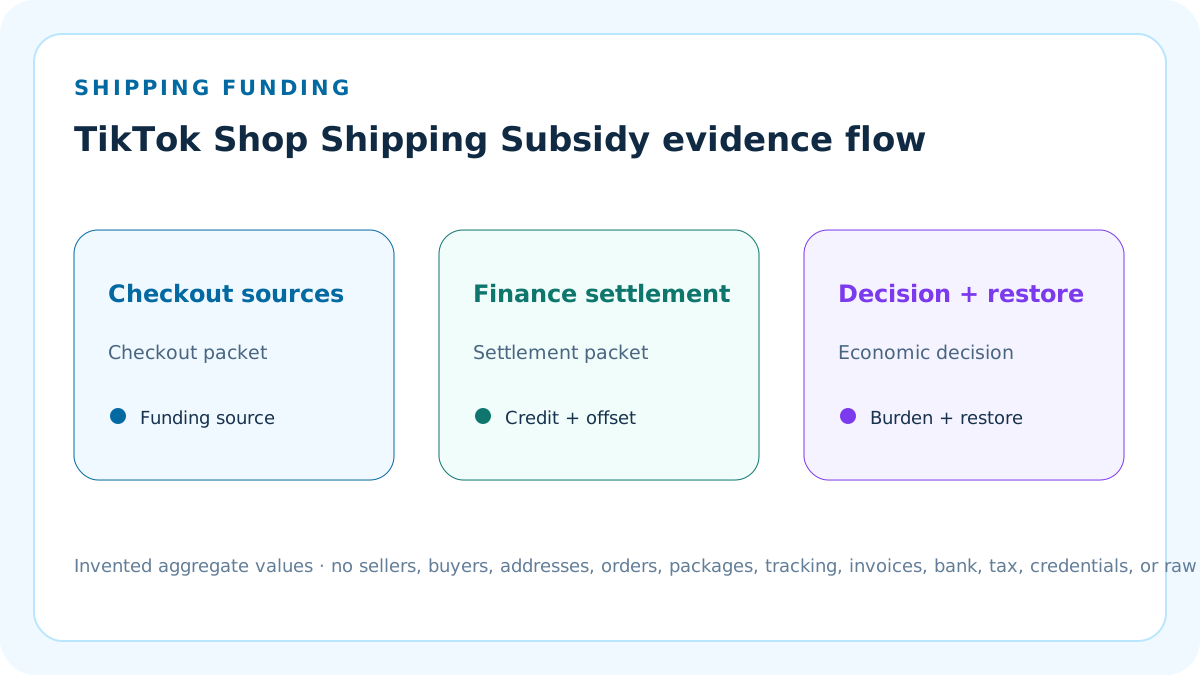
Separate checkout discount from seller settlement
A buyer-facing shipping discount is not automatically money retained by the seller. Record checkout funding and Finance settlement lines separately before calculating seller-funded shipping.
The calculator therefore keeps buyer shipping, platform checkout discount, seller checkout discount, retained platform shipping credit, and shipping offset debit in different fields.
Name the market and fulfillment path
Shipping programs, thresholds, fees, reimbursements, and display treatment can differ by market, TikTok Shipping, Seller Shipping, FBT, package, product, and date.
Record the exact market, fulfillment path, region, package basis, source version, and data-through date. Do not transport a US example into another market as a current rule.
Reconcile the checkout shipping amount
Checkout funding gap equals listed shipping before discounts minus buyer-paid shipping, platform-funded checkout discount, and seller-funded checkout discount.
A nonzero gap means the customer-facing packet does not explain the displayed shipping amount. Correct the packet before using its economics.
Keep buyer-paid shipping explicit
Enter only buyer shipping that the seller's Finance evidence recognizes in the modeled order packet. Buyer payment shown at checkout may be paired with an offset or retained by the platform.
Do not assume every customer-paid shipping amount increases seller revenue. Verify the corresponding credit and debit lines.
Keep platform checkout support explicit
Platform-funded shipping discounts can reduce the buyer's checkout charge under an eligible promotion. The amount and eligibility may differ by program, fulfillment path, product, threshold, or event.
Treat the checkout discount as customer-facing funding. Do not call it retained seller reimbursement unless the Finance packet supports that interpretation.
Keep seller checkout support explicit
Seller-funded shipping discount is the portion of the listed buyer shipping amount waived by the shop after platform support is applied.
This field explains checkout funding. Its economic effect appears through lower buyer-paid shipping, not as a duplicate cost line.
Use retained platform shipping credit
Enter a platform shipping incentive or reimbursement only when a dated Finance or settlement record shows that the seller retains it for the modeled order grain.
A badge, campaign promise, or buyer discount is insufficient evidence of seller-retained funding.
Subtract shipping-related offsets
Some fulfillment statements show a shipping credit and a matching customer-shipping or incentive offset debit. Net platform shipping funding equals the retained credit minus the entered offset debit.
Preserve both lines. Netting them before review can make an offsetting display pair look like profit.
Enter the actual shipping charge
Use the actual carrier, TikTok Shipping, Seller Shipping, or FBT fulfillment charge borne in the modeled packet. Keep package, dimensional weight, service, zone, surcharge, and settlement date attached.
Do not substitute a customer-facing shipping price for the seller's actual logistics charge.
Include packaging and handling
Packaging, label preparation, pick-pack, handling, and other shipping-specific seller cost can remain outside the carrier or fulfillment charge.
Include only costs not already embedded in the entered shipping charge, and record the allocation method.
Calculate seller-funded shipping
Seller-funded shipping equals actual shipping charge plus packaging and handling minus buyer shipping retained by the seller minus net retained platform shipping funding.
The result can differ from the seller checkout discount because one is an economic burden and the other explains customer-facing price funding.
Calculate contribution after shipping
Contribution equals item revenue plus retained buyer shipping plus net platform shipping funding minus actual shipping, packaging, platform fees, creator commission, ads, product cost, return reserve, and other variable cost.
Tax, accounting income, fixed overhead, and unsupported funding remain outside unless the evidence packet explicitly defines them.
Use a platform-supported example
The invented supported packet lists USD 8 shipping, charges the buyer USD 0, shows USD 6 platform checkout support and USD 2 seller checkout support, and records USD 4 retained platform shipping credit.
With USD 7 actual shipping and USD 1 packaging, seller-funded shipping is USD 4. Contribution is USD 25 on USD 50 item revenue.
Use a seller-funded example
The invented seller-funded packet lists USD 8 shipping, charges the buyer USD 0, records no platform support or retained credit, and assigns the full USD 8 checkout discount to the seller.
With the same USD 7 actual shipping and USD 1 packaging, seller-funded shipping is USD 8. Contribution is USD 21 on USD 50 item revenue.
Set a seller-owned burden limit
The default fixture uses USD 10 as the maximum seller-funded shipping per order. Review occurs when a structurally complete packet exceeds this declared limit.
The limit is not a TikTok rule. Set it from product contribution, package mix, service targets, conversion evidence, cash needs, and escalation authority.
Set a contribution target
The default fixture requires at least 35% contribution margin on item revenue after the complete entered shipping packet and other variable costs.
Use a seller-owned target and a consistent denominator. Do not call a platform GMV or gross-revenue metric contribution margin.
Model FBT credit and offset pairs
FBT statements can expose fulfillment fees, customer-paid shipping credits or TikTok Shop shipping incentives, and customer shipping fee offsets.
Enter each observed line independently. A credit paired with an equal offset produces zero net shipping funding even though both statement lines are nonzero.
Model promotion changes as new packets
A free-shipping threshold, product promotion, TikTok-funded program, FBT policy, region, weight, service, or eligibility change opens a new evidence packet.
Do not overwrite the prior accepted packet. Preserve the before/after shipping burden and contribution.
Block incomplete shipping evidence
Block missing market, currency, scenario label, positive item revenue, valid checkout amounts, confirmed configuration, sufficient context, evidence period, ownership, backup, stop rule, or restoration.
A favorable contribution cannot repair an unexplained checkout gap or settlement conflict.
Use Review for economic threshold misses
Review means the checkout and settlement packet calculates but seller-funded shipping exceeds the burden limit or contribution margin falls below target.
Review is not an instruction to opt out, raise prices, change fulfillment, or remove free shipping. Investigate the drivers and test a reversible alternative.
Interpret Ready narrowly
Ready means two invented packets reconcile within the entered checkout tolerance, shipping-burden limit, contribution target, and evidence controls.
It does not prove eligibility, reimbursement, program permanence, payout, conversion lift, profitability, or that a seller should change a shipping setting.
Protect private shipping data
Use invented examples or approved aggregates. The browser-local calculator does not connect to TikTok Shop or upload seller, buyer, address, order, package, tracking, invoice, bank, tax, credential, or raw export data.
Never publish shipment-level records, labels, addresses, tracking IDs, order IDs, disputes, invoices, or screenshots containing private identifiers.
Version and reconcile the packet
Record prior value, new value, reason, checkout evidence, Finance evidence, fulfillment path, package basis, owner, reviewer, expected effect, actual effect, backup, stop rule, and restoration result.
After settlement, compare modeled and realized buyer shipping, platform funding, offsets, shipping charge, contribution, and variance.
Release the complete cluster
Index the working calculator and ten dedicated guides together only after source, functionality, content, originality, image, accessibility, test, backup, release-mode, deployment, purge, and live-verification gates pass.
Search signals are measurements after release, not a publication prerequisite. Ordered release and rollback safety still control production mutation.
Reject coercive numeric input
Amounts and thresholds accept plain finite decimals only. Strings with currency text, exponent notation, infinity, or hidden suffixes are structural errors rather than values to coerce.
This prevents a malformed export cell such as 50usd or 1e2 from silently changing shipping burden, contribution, or threshold headroom.
Validate evidence dates
Record a real YYYY-MM-DD source review date and seller shipping-policy effective date. The seller policy date cannot be later than the source review that supports it.
A date-shaped but impossible value such as February 30 blocks the packet. Program notices and rate cards must be re-reviewed when their effective dates change.
Require nine confirmations
The packet requires affirmative controls for synthetic aggregates, checkout funding, Finance maturity, program version, fulfillment grain, actual charges, variable costs, independent review, and restoration authority.
A missing confirmation is structural. It cannot be repaired by a favorable contribution result or by assuming that an earlier program version still applies.
Separate display from settlement maturity
Checkout proves what the buyer saw and which party appeared to fund the discount. A matured Finance packet proves whether a shipping credit, reimbursement, incentive, or offset was retained.
Do not use a campaign badge or estimated funding line as settled seller revenue. Age the order to the documented settlement cadence and preserve later adjustments.
Version eligibility without predicting it
TikTok-funded programs, FBT rules, thresholds, inventory paths, regional availability, and product eligibility can change. Save the market, source access date, effective date, and entered eligibility state.
The calculator never determines eligibility. It only evaluates a seller-entered packet after current platform evidence and human review are attached.
Match fulfillment, package, and region
A comparison is valid only when the product, package dimensions and weight, region, service, fulfillment path, and charge basis are held constant or the differences are separately modeled.
FBT, TikTok Shipping, and Seller Shipping can expose different charges and credits. Never transfer one path's reimbursement or rate-card line into another path.
Quarantine structural outputs
When any structural control fails, sixteen scenario-derived values and the cross-scenario contribution difference display Unavailable.
Labels, equations, confirmation coverage, evidence dates, seller thresholds, conflicts, and repair diagnostics remain visible so a reviewer can fix the packet without relying on contaminated economics.
Keep authority human-only
Ready does not authorize a shipping-setting, program, product, price, fulfillment, or customer change. The accepted packet names the owner, independent reviewer, protected backup, stop rule, and tested restoration.
Any production action remains a separate human decision with current Seller Center context, permission, customer-impact review, and a reversible change record.
Review current FBT economics
TikTok Shop's current US FBT materials describe no-threshold free shipping by default, opt-out conditions, per-unit reimbursement limits, and 2026 fulfillment, weight, return, and service-fee updates.
Treat those details as dated first-party inputs, not universal constants. Recheck the active rate-card section for the modeled order date, unit count, chargeable weight, and return path.
Reconcile official Finance fields
The official settlement-report documentation distinguishes shipping subsidy, customer shipping fee offset, FBT fulfillment fee, and return shipping fee.
Preserve those observed line labels in the evidence packet, then map them transparently to credit, offset, actual fulfillment cost, or return reserve. Do not collapse unlike lines before review.
Sources and further reading
- TikTok Shop: Free Shipping FAQ Guide: Official US free-shipping program transition, seller-funding, threshold, fulfillment-path, and visibility context.
- TikTok Shop: TikTok Funded Program: Official TikTok-funded shipping-fee discount sequence, seller-balance treatment, participation, and withdrawal guidance.
- TikTok Shop: Seller Shipping Fee Discount: Official seller-funded shipping promotion, eligibility, threshold, product, region, and stacking context.
- TikTok Shop: FBT Rate Card and FAQ: Current official 2026 FBT free-shipping, fulfillment-fee, chargeable-weight, reimbursement, return, and billing context.
- TikTok Shop: Free Shipping Page Feature Guide: Official Seller Center shipping-settings, targeted-promotion, product-level, threshold, and measurement context.
- TikTok Shop: Settlement Report: Official Finance field definitions for shipping subsidy, customer shipping fee offset, FBT fulfillment fee, and return shipping fee.
- Seller Profit Guard methodology: Evidence, privacy, deterministic calculation, release, monitoring, and restoration controls.
Related Seller Profit Guard tools
- TikTok Shop Return Reserve Calculator: Carry a matured return allowance into shipping contribution.
- TikTok Shop GMV vs Profit Calculator: Bridge the accepted shipping packet into retained contribution.
- Shopify Free Shipping Threshold Calculator: Compare a platform-neutral threshold model.
- Shipping Price Helper: Model shipping-price recovery outside TikTok-specific programs.
- Methodology: Review evidence, privacy, validation, release, monitoring, and restoration.
- Data Privacy: Protect seller, buyer, address, order, package, tracking, invoice, and raw export data.
- How do you calculate TikTok Shop seller-funded shipping?: Reconcile listed shipping with buyer payment, platform checkout support, and seller checkout discount. Then calculate net retained platform funding from verified shipping credits minus offsets. Seller-funded shipping equals actual shipping plus packaging minus retained buyer shipping and net platform funding. Keep checkout and settlement evidence separate.
- How does a platform-supported TikTok Shop shipment affect margin?: In the invented supported packet, USD 6 platform checkout support and USD 2 seller checkout support explain an USD 8 free-shipping display. A separately verified USD 4 retained platform credit reduces USD 8 of shipping and packaging cost to USD 4 seller-funded shipping, producing USD 25 contribution.
- What happens when a TikTok Shop seller funds all shipping?: In the invented seller-funded packet, the shop waives the full USD 8 listed shipping amount and receives no platform shipping credit. USD 7 actual shipping plus USD 1 packaging creates USD 8 seller-funded shipping and USD 21 contribution, four dollars below the otherwise matched supported packet.
- What makes a TikTok Shop shipping subsidy calculation wrong?: Common errors include treating a buyer discount as seller-retained cash, counting the same platform support twice, ignoring offset debits, substituting listed shipping for actual logistics cost, mixing FBT with seller shipping, omitting package cost, using stale program rules, and calling an estimated promotion a settled reimbursement.
- Where should TikTok Shop shipping subsidy inputs come from?: Use current Seller Center shipping and promotion settings for checkout rules; completed checkout evidence for buyer, platform, and seller funding; Finance or billing lines for retained credits and offsets; carrier, TikTok Shipping, Seller Shipping, or FBT records for actual charges; and seller ledgers for packaging and other costs.
- When should a TikTok Shop shipping packet be blocked or reviewed?: Block when checkout funding, settlement lines, fulfillment path, evidence ownership, or restoration does not reconcile. Review a complete packet when seller-funded shipping exceeds the declared limit or contribution margin misses target. Ready only means the entered packet passes those seller-owned controls; it does not prove program eligibility.
- How should platform-supported and seller-funded TikTok Shop shipping be compared?: Hold item revenue, actual logistics charge, packaging, fees, commission, ads, product cost, return reserve, currency, period, and package constant. Change only checkout funding, retained shipping credits, and offsets. Compare seller-funded shipping and contribution, then identify whether platform funding is truly retained or only displayed.
- How often should TikTok Shop shipping subsidies be reconciled?: Review active shipping settings and program notices weekly, then reconcile completed checkout funding with settled Finance credits, offsets, and logistics charges on a documented maturity cadence. Segment by fulfillment path, package, region, threshold, and promotion; log owners, exceptions, realized variance, stop rules, and restoration tests.
- What does a TikTok Shop shipping subsidy result prove?: It proves only that entered checkout funding, settlement lines, shipping charges, seller costs, thresholds, and evidence controls reconcile under the displayed formula. It does not prove promotion eligibility, reimbursement, permanence, payout, conversion lift, accounting profit, tax treatment, or authority to change fulfillment or free-shipping settings.
- What belongs in a TikTok Shop shipping subsidy audit?: Record market, fulfillment path, product and package scope, region, threshold, listed shipping, buyer payment, platform and seller checkout support, retained shipping credits, offset debits, actual shipping, packaging, fees, costs, return reserve, contribution target, sources, owner, reviewer, conflicts, prior result, backup, stop rule, realized variance, and restoration.
- How do you calculate a TikTok Shop promotion stack?: Reconcile customer item payment to original item amount less seller product discount, seller coupon, platform incentive, and platform coupon. Reconcile listed shipping to buyer, platform, and seller funding. Then add only verified platform settlement credits, subtract promotion fees and every seller cost, and calculate retained contribution.
- What is the contribution after an organic TikTok Shop promotion stack?: In the invented organic packet, USD 30 of seller and platform item discounts reduce USD 100 to USD 70 customer item payment. Platform shipping support covers USD 5. A verified USD 20 platform promotion credit less USD 1 fee produces USD 89 retained revenue and USD 34 contribution.
Use the interactive tool
Enable JavaScript to open the calculator and process browser-local inputs. The explanatory content and source links remain available without JavaScript.
Related guide: Define checkout funding, Finance settlement, seller shipping burden, contribution, thresholds, evidence, and restoration.
This tool provides operating estimates, not tax, accounting, legal, financial, or marketplace-policy advice. Verify current official sources and your own records before changing prices or operations.