Seller Profit Guard · How it works · CSV privacy
Marketplace export schema checker
Compare two invented marketplace export contracts before an automation run. Enter expected and observed headers, field types, required fields, approved one-to-one aliases, allowed additions, and version dates. The browser-local checker returns compatibility counts plus Ready, Review, or Block without uploading a CSV, reading private rows, or approving production processing.
Maintained by Seller Profit Guard Editorial Team. Last reviewed: 2026-07-31.
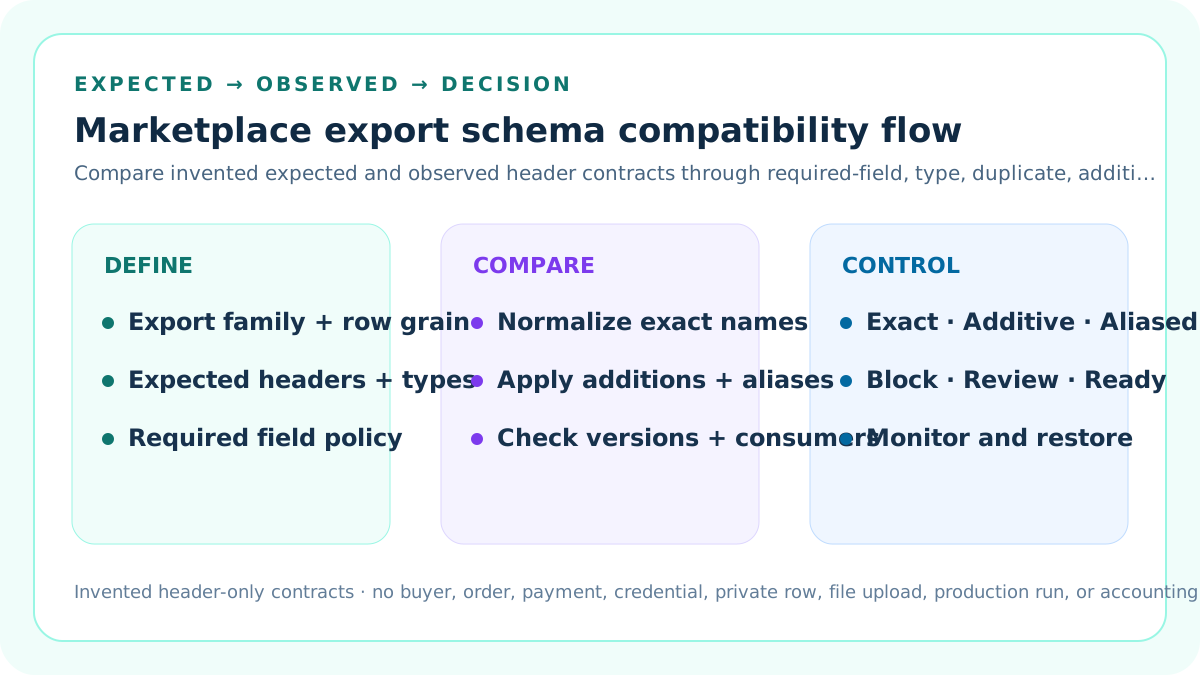
Define an export schema contract
An export schema contract names one platform export type, row grain, delimiter, encoding, normalized header set, header order policy, field types, required fields, allowed additions, approved aliases, and version date. Validate that contract before an automation reads values.
Do not treat every CSV from one marketplace as interchangeable. Etsy exposes several seller export types, and Shopify separates order exports from transaction-history exports.
Use invented header contracts only
This browser-local worksheet accepts invented header names, type declarations, version dates, and review context. It never uploads, reads, stores, transforms, or approves a production file.
Never paste buyer names, emails, addresses, phone numbers, payment references, notes, order identifiers, messages, credentials, bank data, private rows, or a complete seller export.
Separate schema compatibility from data validity
Schema compatibility asks whether a parser can identify the expected fields under a reviewed contract. It does not prove that row values are complete, correctly typed in practice, unique, balanced, private, or safe to process.
Run row-level validation, count reconciliation, monetary reconciliation, privacy minimization, and business-rule checks as separate gates after the schema passes.
Normalize headers without erasing meaning
Trim leading and trailing space and compare headers case-insensitively for this fixture. Preserve the original display name and source order in the evidence log.
Do not remove punctuation, collapse distinct names, translate labels, or apply fuzzy similarity automatically. Those transformations can merge fields that carry different meanings.
Reject duplicate normalized headers
Two observed headers that normalize to the same key Block the contract because a name-based parser cannot choose one deterministically.
Column position is not a safe silent tie-breaker. Preserve the source and require an explicit corrected export or unique canonical names.
Declare expected field types
Pair each expected header with a narrow semantic type such as text, integer, decimal, boolean, date, datetime, or currency code. Use the same vocabulary for observed types.
A spreadsheet display format is not type proof. Sample and validate protected values separately before relying on a declared type.
Treat required type drift as incompatible
A required amount declared as decimal but observed as text can change parsing, null handling, signs, grouping, and calculations. This checker Blocks required type drift.
Do not coerce a required field silently. Add an explicit, tested normalization step only after source examples, failure cases, ownership, and rollback are documented.
Route optional type drift to review
An optional field type change does not automatically destroy the minimum contract, but it can break downstream enrichments or monitoring. This checker sends it to Review.
Name every consumer of the optional field and retest them before accepting the new type.
List required fields explicitly
Required fields are the minimum columns without which the declared automation cannot produce a trustworthy result. Keep the list smaller than the entire export and tie each field to a consumer.
A field is not required merely because the platform exports it. Buyer contact or payment data should not enter a profit workflow without a documented purpose and access basis.
Block a missing required field
If a required expected header is absent and no approved one-to-one alias resolves it, the automation must stop before reading rows.
A default zero, empty string, previous-column position, or nearest-looking label can create plausible but false outputs.
Review a missing optional field
An absent optional field can preserve the core parser but weaken enrichment, diagnostics, or monitoring. Record the affected output and decide whether degraded operation is acceptable.
Do not let optional become invisible. The compatibility report should count and name the omission.
Allow additive columns narrowly
A new observed column can be compatible when it is explicitly listed as an allowed additive field and the parser ignores unknown positions safely.
The allowed list is versioned. An unreviewed addition enters Review because it may change column-position parsers, privacy exposure, or downstream wildcard selection.
Model a safe additive fixture
Scenario A expects Name, Created at, Currency, Total, and Lineitem SKU. The observed fixture adds Risk Level, which is declared as an allowed text field.
The result is Compatible additive change: six observed headers, one approved addition, no missing required field, and no type mismatch.
Approve aliases one to one
A renamed field may be compatible only when one expected header maps to one present observed header and no other alias consumes that target.
Store the expected name, observed name, reason, source version, reviewer, effective date, affected consumers, tests, and rollback reference.
Reject ambiguous alias maps
Two expected fields cannot point to the same observed header, and an alias cannot refer to a header absent from either side of the contract.
Fuzzy matching and first-hit selection are not approvals. Ambiguity Blocks deterministic automation.
Model a reviewed rename fixture
Scenario B expects Created at but observes Order created at. A declared one-to-one alias preserves the required datetime field without pretending the names are identical.
The result is Compatible through approved alias. Removing that alias exposes a missing required field and Blocks the run.
Record header order separately
Name-based parsers can permit order changes; position-based imports cannot. State which behavior applies and test both the header set and the expected order when position matters.
Do not infer that identical names guarantee an identical file layout, delimiter, quoting rule, encoding, or repeated-line behavior.
Record delimiter and encoding
A header contract should state delimiter, quote behavior, line endings, byte-order mark policy, and encoding before field comparison.
A visually correct header row can still fail when commas, semicolons, tabs, embedded line breaks, or encoding differ.
Preserve row grain
Shopify documents that additional line items can appear on separate rows and many order-level fields may be blank on those rows. That grain belongs in the contract, not just the header list.
A schema match cannot justify counting every row as a unique order or forward-filling values without an explicit rule.
Separate export families
Etsy order items, orders, Etsy Payments sales, deposits, listings, privacy downloads, settings, and reviews have different purposes. Shopify order and transaction-history exports also differ.
Fingerprint the exact export family and acquisition path. Never route a nearby file into an automation because its extension is also CSV.
Version the expected contract
Record the expected contract version date and the observed export date. Contract age equals observed date minus expected version date.
A version date is an evidence-review marker, not proof that the platform changed on that date or that the contract remains current.
Review stale contracts
When contract age exceeds the seller-declared maximum, the structure may still parse, but the source and assumptions require renewed review.
Do not update a version date merely to clear the warning. Compare current official documentation and a protected header-only sample.
Block impossible version order
An observed export dated before the expected contract version cannot prove compatibility with that later contract.
Correct the evidence dates or select the matching historical contract instead of reversing time.
Reconcile counts before values
Count expected, observed, required, missing, added, aliased, duplicate, and type-mismatched fields before reading any row values.
A parser that produces a monetary total can still be wrong if one missing field and one unrelated added field happen to occupy the same position.
Use a three-state decision
Block covers missing required fields, required type drift, duplicates, malformed pair declarations, ambiguous aliases, invalid version order, or incomplete governance. Review covers optional drift, unreviewed additions, optional omissions, or stale contracts. Ready clears only the entered contract.
The state controls an automation gate; it does not certify platform correctness, privacy compliance, accounting treatment, tax treatment, or business outcomes.
Keep privacy minimization upstream
A schema checker should see only the header and type contract needed for compatibility. Sensitive row values remain in protected systems and should be excluded from public fixtures and screenshots.
After compatibility, run a separate approved privacy schema that removes unnecessary contact, address, note, device, and payment fields before analysis.
Assign named authority
Name the export owner, contract owner, privacy owner, automation owner, independent reviewer, stop authority, and restoration owner.
Ready cannot authorize an account export, production import, data retention, buyer contact, file rewrite, accounting entry, or platform correction.
Fingerprint every accepted contract
Preserve the protected file fingerprint, header-only fingerprint, source path, export family, acquisition time, expected contract hash, checker version, output hash, and reviewer decision.
A later file with the same name is not automatically the same source or schema.
Retest counterexamples
Keep invented fixtures for missing required fields, duplicate headers, optional omissions, unreviewed additions, required and optional type drift, alias collisions, invalid dates, stale contracts, short context, and open conflicts.
A gate is trustworthy only when unsafe fixtures demonstrably fail or route to review.
Require complete type coverage
Every present expected and observed header needs exactly one semantic type declaration from the approved vocabulary. Reject missing, extra, duplicated, or unknown type rows.
A type table that silently omits Total or declares a type for a nonexistent column cannot support deterministic compatibility.
Bound header and evidence volume
Declare a maximum header count per invented scenario and a minimum closed evidence duration. Apply both with strict whole-number parsing rather than accepting decorated strings.
The public limits are deterministic safety contracts, not marketplace guarantees or universal schema sizes.
Close the schema evidence timeline
Require the evidence month to contain every observed export date, the source-review date to cover the latest observation, the policy date to be no later than the earliest expected contract, and the inclusive contract-to-observation span to meet the stated minimum.
Valid date syntax alone does not prove that the governance packet covers the versions and observations being compared.
Date and confirm governance
Record real export-source review and schema-policy effective dates, then require nine confirmations for header-only fixtures, export grain, encoding, type coverage, required/alias/addition rules, thresholds, counterexamples, restoration, and authority.
A future-dated policy or missing confirmation Blocks even when the visible header counts balance.
Quarantine blocked compatibility outputs
When any structural, source, privacy, date, confirmation, or restoration gate fails, show Unavailable for all compatibility classifications, header counts, aliases, additions, omissions, type mismatches, and contract ages.
Do not pass a plausible count from a blocked contract to an importer, mapper, reconciliation, or reporting workflow.
Stage changes before production
Run the new contract and affected consumer tests against a protected copy. Compare counts, nulls, types, key uniqueness, totals, exceptions, and output hashes with the last accepted baseline.
Never test a schema migration by overwriting the only production export or import target.
Monitor accepted drift
After acceptance, monitor source fingerprints, header sets, field types, null rates, row grain, record counts, key uniqueness, currency units, and downstream exceptions.
Any unexplained change reopens the contract and stops unattended processing.
Design a reversible correction
Preserve the old contract, alias map, consumer version, output baseline, exception log, backup, and restoration command before changing a parser.
A correction is complete only when the new contract passes, affected outputs reconcile, and the old version can be restored.
Release through ordered gates
Index only after working logic, focused tests, current sources, independent support pages, direct answers, diagrams, metadata, privacy, similarity, mobile, backup, deployment, and live verification pass.
Search signals are measured after release and are not prerequisites for a quality-passed cluster.
Sources and further reading
- Etsy Help: download sold transactions: Official CSV export types for listings, order items, orders, Etsy Payments sales, and deposits, with example seller fields.
- Etsy Help: download Etsy data: Official distinction between privacy data downloads, order exports, shop settings, and reviews.
- Shopify Help: exporting orders: Official order-export and transaction-history structures, repeated line-item behavior, documented headers, and deprecated or replacement fields.
- Seller Profit Guard methodology: Deterministic fixtures, source precedence, privacy, release, monitoring, correction, and rollback controls.
Related Seller Profit Guard tools
- Seller CSV Column Mapper: Map approved source fields only after schema compatibility passes.
- CSV Import Validator: Validate protected file structure and aggregate import readiness in a separate gate.
- Seller CSV Privacy Redactor: Minimize the approved header set before using private rows.
- CSV Date and Currency Normalizer: Normalize invented date and money examples under explicit conventions.
- Methodology: Review evidence, calculation, correction, release, monitoring, and rollback controls.
- Data Privacy: Keep operational seller exports and buyer data outside public fixtures.
- Export Schema Contract: 9 Inputs Before Automation: Define expected and observed headers, types, required fields, aliases, additions, version dates, row grain, and rollback before automating an export.
- Export Schema Checker Example: One Added Column: Work a complete export schema example where an optional field is added without breaking a name-based parser or exposing seller rows.
- Required Column Renamed: Controlled Alias Example: Handle a renamed required export column with an explicit one-to-one alias, affected-consumer tests, version evidence, and rollback.
- 11 Export Schema Checks That Fail Quietly: Diagnose schema-check mistakes involving normalization, duplicates, aliases, types, row grain, versions, privacy, and false compatibility.
- Export Schema Evidence Without Sharing Private Rows: Build a reliable source register for expected contracts, observed header fingerprints, types, versions, consumers, privacy, and restoration.
- Ready, Review, or Block for Schema Drift: Define decision thresholds for additive fields, optional omissions, type changes, required fields, aliases, version age, and governance gaps.
- Added Column vs Renamed Required Column: Compare additive and rename drift at the same contract grain so field count, required coverage, aliases, and consumer risk remain visible.
- Weekly Export Schema Drift Routine: Turn schema compatibility into a recurring header-fingerprint, consumer-test, exception, monitoring, and restoration workflow.
- Read a Schema Compatibility Report Correctly: Interpret field counts, missing required fields, aliases, additions, type drift, version age, and decision state without claiming row correctness.
- Export Schema Audit Checklist and Change Log: Provide a reusable audit checklist and dated change log for source fingerprints, contracts, aliases, consumers, exceptions, approvals, and rollback.
Use the interactive tool
Enable JavaScript to open the calculator and process browser-local inputs. The explanatory content and source links remain available without JavaScript.
Related guide: Define expected and observed headers, types, required fields, aliases, version dates, decisions, monitoring, and restoration controls.
This tool provides operating estimates, not tax, accounting, legal, financial, or marketplace-policy advice. Verify current official sources and your own records before changing prices or operations.