Seller Profit Guard · How it works · CSV privacy
TikTok Shop listing QA checker
Audit two TikTok Shop product-detail packets for category accuracy, title and description quality, image coverage, category attributes, variation SKU coverage, packaged weight and dimensions, box contents, claims, restricted-category evidence, ownership, and Ready, Review, or Block.
Maintained by Seller Profit Guard Editorial Team. Last reviewed: 2026-07-29.
Use this as a listing packet audit
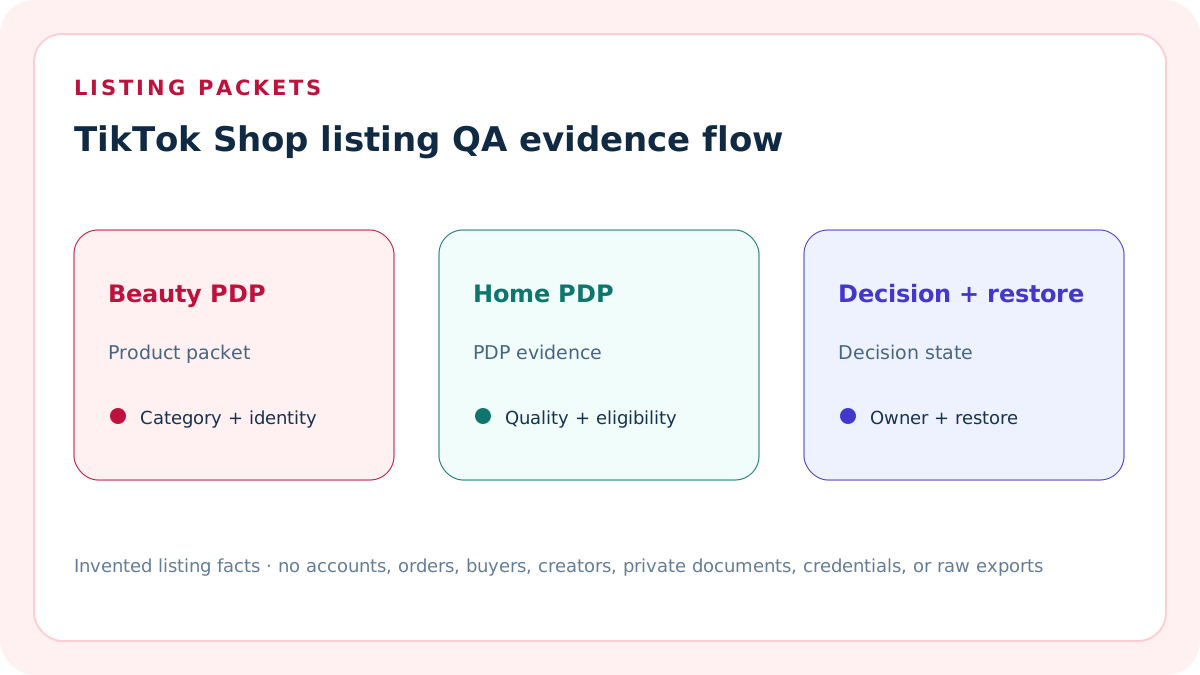
The checker compares one beauty and one home-product packet across product identity, category, title, description, images, attributes, variations, package evidence, contents, claims, approvals, ownership, and restoration.
It does not submit a listing or predict TikTok Shop review. Ready, Review, and Block are local evidence states built from seller-entered summaries.
Separate listing quality from eligibility
Quality checks ask whether the PDP is complete, specific, consistent, and useful. Eligibility checks ask whether the product is prohibited, restricted, miscategorized, unauthorized, or missing required approval.
A polished title and five images cannot repair a prohibited product, wrong category, missing brand authorization, or unresolved restricted-category qualification.
Identify the exact product first
Record brand only when authorized, product type, distinguishing details, application scope, main function, quantity, model, and other facts needed to identify the item.
Do not keyword-stuff, add irrelevant brands, imply official affiliation, or use a title that conflicts with images, description, attributes, variations, packaging, or the physical product.
Use a concise factual title
The fixture treats 25–255 characters as the broad evidence band and expects a readable title that includes product identity rather than promotion, urgency, or unverifiable superiority.
Character limits and best-practice guidance can vary by workflow and region. Verify the current Seller Center field instead of trimming only to satisfy this model.
Confirm the category deliberately
Use the most accurate category and preserve the Seller Center suggestion, seller decision, reason, category-specific attributes, and any restricted-category approval.
Do not test multiple inaccurate categories for exposure. Category mismatch can affect discovery, required fields, qualification, and enforcement.
Measure category-specific coverage
Category coverage is the share of required product facts represented in approved attributes, images, or description: ingredients or quantity for beauty, and material, dimensions, capacity, or application for home goods.
A generic description cannot produce a Good-quality packet when category-specific information is absent. Record the checklist version behind the percentage.
Require useful image coverage
The Good-tier fixture expects at least five main-product images, with the minimum entered width and height above 600 pixels, a clear main image, no watermark or promotional overlay, and useful angles or details.
Image count is not quality by itself. Duplicates, broken files, low resolution, irrelevant digital renderings, borders, and misleading before-and-after presentation remain defects.
Write a substantive description
The fixture expects at least 80 characters and checks that the description contains relevant product benefits, scope, size, material, specifications, instructions, limitations, and contents without broken links or copied clutter.
Do not paste supplier text blindly, make medical or guaranteed-result claims, redirect buyers off-platform, or contradict category attributes and creator content.
Treat every variation as a SKU
Record each variation combination, seller SKU, price, inventory, media, attribute value, package implications, and product relationship. The coverage percentage must reach 100 for Ready.
Do not hide different products under one anchor, reuse one SKU across distinct variants, or claim coverage when combinations are missing, impossible, or unsupported.
Confirm package evidence
Package weight means the packaged product including wrapping. Dimensions must reflect the shippable parcel and current Seller Center units, and every material variation needs an appropriate packet.
Do not use bare-product weight, decimal or unit assumptions that the form rejects, or copied dimensions that change the shipping method and fee calculation.
List exactly what is in the box
The contents packet identifies the main product, quantity, accessories, inserts, power supplies, replacement parts, samples, and exclusions the customer will receive.
Do not show an accessory in images or content when it is not included unless the distinction is explicit. Contents must reconcile with price, quantity, variation, packaging, and fulfillment.
Review claims against the PDP
Promotional content, title, images, description, and attributes must describe the same product. Claims about function, origin, guarantee, warranty, certification, endorsement, quantity, and price need accurate support.
Avoid exaggerated comparisons, unsupported awards, regulated physiological claims, false urgency, best-price guarantees, and disclaimers used to rescue otherwise misleading content.
Calculate the beauty fixture
The invented beauty packet has a specific authorized title, correct category, 120-character description, six 1200-pixel images, complete ingredient and quantity facts, three fully mapped shades, package evidence, contents, and reviewed cosmetic claims.
No real listing, seller, brand, creator, buyer, certification, or restricted-category record is used. The packet is a deterministic quality fixture.
Calculate the home fixture
The invented home packet has a distinct category, material and capacity facts, six images, a complete description, two fully mapped sizes, packaged weight and dimensions, contents, and non-regulated function claims.
This is not the beauty example with renamed labels. Its category evidence emphasizes material, dimensions, capacity, assembly, use environment, and included hardware.
Score completeness transparently
Each packet receives checks for title, description, image count and resolution, main-image quality, required attributes, category-specific facts, SKU coverage, package evidence, box contents, claim review, and source context.
The score supports prioritization only. It is not TikTok's internal listing-quality tier, review score, Shop Health score, eligibility result, or enforcement prediction.
Block structural conflicts first
Block when category or required approval is unresolved, prohibited or restricted conflict is declared, claims are unreviewed, package evidence is missing, ownership and restoration are absent, or private-data handling is unsafe.
Structural Block overrides a high completeness score because a visually rich packet can still be ineligible, misleading, or unrecoverable.
Use Review for quality gaps
Review means structural evidence is present but one or more quality targets—title band, description length, five-image coverage, resolution, main-image quality, attributes, category facts, or SKU coverage—miss the declared standard.
Review does not mean rejected. It identifies the exact PDP evidence that should be corrected and rechecked before submission or promotion.
Protect seller and buyer data
Use invented copy and approved aggregate counts. The tool runs locally in the browser and does not connect to Seller Center, inspect media, or upload listing, account, order, customer, creator, or enforcement data.
Public evidence must not include seller identifiers, buyer details, private brand documents, unpublished SKUs, order IDs, messages, credentials, raw exports, or appeal records.
Version the listing packet
Record product, market, policy version, category, approval, title, description, media set, attributes, variations, SKUs, package, contents, claims, owner, reviewer, prior result, backup, stop rule, and restoration test.
A material product, policy, title, category, image, attribute, price, variation, package, or claim change opens a new packet rather than overwriting accepted evidence.
Test adverse states
Test a short title, thin description, fewer than five images, low resolution, promotional main image, missing attributes, partial SKU coverage, missing package evidence, claim conflict, restricted approval failure, and restore fixture.
The quality gate also checks Ready, Review, Block, reset, mobile layout, sources, images, links, metadata, privacy, noindex staging, and strict route behavior.
Interpret Ready narrowly
Ready means both invented listing packets reconcile under the declared evidence, completeness, category, claim, ownership, backup, stop-rule, and restoration controls.
It does not create, submit, approve, edit, publish, promote, advertise, synchronize, or appeal a product listing and does not guarantee visibility, review, conversion, sales, or compliance.
Use strict listing input grammar
Image count, image dimensions, variation count, coverage percentages, and evidence duration accept plain decimal input only; count and pixel fields must be bounded safe whole numbers.
Values such as five images, 1,200px, 100%, NaN, Infinity, fractional counts, impossible dates, or a policy date later than the reviewed source Block rather than being rounded or coerced.
Declare eligibility before completeness
Each fixture declares permitted, restricted, or prohibited. A restricted product must use category-level, product-level, or invite-only qualification; the permitted fixture uses not-required in this deterministic contract.
A prohibited product always Blocks. A complete PDP, high QA score, submitted document, or prior approval cannot convert the prohibited state into a quality Review or narrow Ready.
Apply current qualification levels
TikTok Shop's current Restricted Products Policy distinguishes category-level qualification, product-level qualification, and invite-only qualification, and notes that approval is not guaranteed.
Record the applicable path rather than using one generic approval checkbox. The checker verifies packet consistency only and cannot validate a Qualification Center decision or supporting document.
Confirm unique and accurate variations
The current Product Listing Policy treats each variation as an individual SKU and prohibits duplicate or inconsistent variations. Every declared combination must represent the same anchor product accurately.
Confirm unique seller SKUs, attributes, media, price, inventory, dimensions, and included quantity. A 100% coverage entry cannot override duplicated, impossible, or mismatched child records.
Match the physical product and label
TikTok Shop's Product Quality Policy requires the product to match listing descriptions, images, and specifications and to meet applicable safety, compliance, and labeling requirements.
The checker therefore requires a separate product-match confirmation. It cannot inspect the physical item, packaging, safety evidence, supplier, laboratory result, or fulfillment condition.
Use beauty-specific evidence
The beauty fixture records ingredients, net contents, label information, shade facts, intended cosmetic use, warnings, remaining shelf life where applicable, qualification path, and claims substantiation.
Medical, drug, instant-effect, permanent-result, whitening, recall, unsafe-ingredient, or exaggerated before-and-after claims require separate qualified review and may be prohibited or restricted.
Mask eighteen derived values on Block
A structural failure masks nine derived QA values per scenario: score, title length, description length, image coverage, required attributes, category information, SKU coverage, package/contents, and claims/match/approval.
Packet name, category, eligibility, qualification, confirmation coverage, evidence dates, hierarchy, quality target, and conflicts remain visible so reviewers can diagnose the structural fault without trusting completeness calculations.
Require nine evidence confirmations
Exact yes confirmations cover synthetic-only data, US policy scope, prohibited/restricted boundaries, current quality rules, product evidence, media/SKU/package evidence, claims and qualification, two-person review, and restoration with human-only authority.
Any missing confirmation Blocks both packets. These attestations document review discipline; they do not grant permission to access Seller Center, submit documents, publish, promote, or appeal.
Release the complete cluster
Index the working tool and ten dedicated support pages together only after content, originality, official sources, images, links, accessibility, tests, backups, deployment, and live verification pass.
Search signals are later measurements rather than a release prerequisite. Quality, ordered production, rollback, and policy correctness still control publication.
Sources and further reading
- TikTok Shop Academy: Product Detail Pages and Listing Quality Guidelines: Official Poor, Fair, and Good listing-quality tiers; title, image, description, and category-specific information guidance.
- TikTok Shop Academy: Product Listing Policy: Current official title, description, category, brand, media, box contents, package, pricing, language, bundle, and unique variation requirements.
- TikTok Shop Academy: Select the right product category: Official category accuracy, attributes, approval, review, and incorrect-category boundaries.
- TikTok Shop Academy: Product Quality Policy: Current official physical-product, label, description, image, specification, safety, inspection, and corrective-action requirements.
- TikTok Shop Academy: Restricted Products Policy: Current official category-level, product-level, and invite-only qualification boundaries.
- TikTok Shop Academy: Prohibited Products Policy: Current official US prohibited-product policy and seller compliance boundary.
- TikTok Shop Academy: Beauty and Personal Care Requirements: Current official beauty qualification, label, shelf-life, prohibited-product, safety-substantiation, and documentation boundaries.
- TikTok Shop Academy: Beauty Listing Guidelines: Current official beauty title, attribute, ingredient, use, warning, image, and non-exaggerated-claim guidance.
- Seller Profit Guard methodology: Deterministic evidence, privacy, validation, correction, release, monitoring, and restoration controls.
Related Seller Profit Guard tools
- TikTok Shop Listing QA Checklist: Use the legacy lightweight checklist for a fast title, claims, media, SKU, package, and shipping preflight.
- Image Specification Checklist: Review media dimensions and format in a separate asset packet.
- Variation SKU Generator: Build and inspect a synthetic variation matrix before listing QA.
- Shipping Price Helper: Check shipping economics separately after package evidence is confirmed.
- Methodology: Review evidence, privacy, validation, release, monitoring, and restoration.
- Data Privacy: Keep accounts, listings, orders, buyers, creators, documents, and raw exports protected.
- TikTok Shop Listing QA Formula and Inputs: Define the PDP, category, title, description, image, attribute, variation, package, contents, claim, approval, and evidence checks.
- TikTok Shop Listing QA: Beauty Example: Reperform a complete invented beauty-product packet with ingredient, quantity, shade, media, package, contents, and claim controls.
- TikTok Shop Listing QA: Home Product Example: Audit a distinct home-product packet emphasizing material, dimensions, capacity, assembly, use environment, package, hardware, and claims.
- TikTok Shop Listing QA Mistakes: Diagnose title stuffing, wrong category, repeated images, thin descriptions, missing attributes, merged products, package errors, and unsupported claims.
- TikTok Shop Listing QA Data Sources: Map every QA field to Seller Center, policy, product specification, media manifest, SKU matrix, package test, claim file, or explicit assumption.
- Safe TikTok Shop Listing QA Thresholds: Separate prohibited and approval Blocks, completeness Review items, and narrowly defined Ready evidence before a product packet moves forward.
- Beauty vs Home TikTok Shop Listing QA: Compare category-specific evidence at one PDP grain while preserving the distinct facts, claims, package data, and qualification needs of each product.
- Weekly TikTok Shop Listing QA Review: Turn listing edits, policy versions, category changes, media, attributes, SKU, package, claims, exceptions, and restoration into a recurring control loop.
- Interpret TikTok Shop Listing QA Without False Approval: Explain what Ready, Review, Block, and completeness scores establish, which claims remain unverified, and when a seller must escalate the evidence.
- TikTok Shop Listing QA Audit Template: Provide a reusable checklist and change log for PDP facts, category, media, attributes, variations, package, claims, decisions, and rollback.
Use the interactive tool
Enable JavaScript to open the calculator and process browser-local inputs. The explanatory content and source links remain available without JavaScript.
Related guide: Define TikTok Shop listing quality, category, media, variation, package, claim, evidence, decision, and restoration controls.
This tool provides operating estimates, not tax, accounting, legal, financial, or marketplace-policy advice. Verify current official sources and your own records before changing prices or operations.