Seller Profit Guard · How it works · CSV privacy
Refund to order matcher
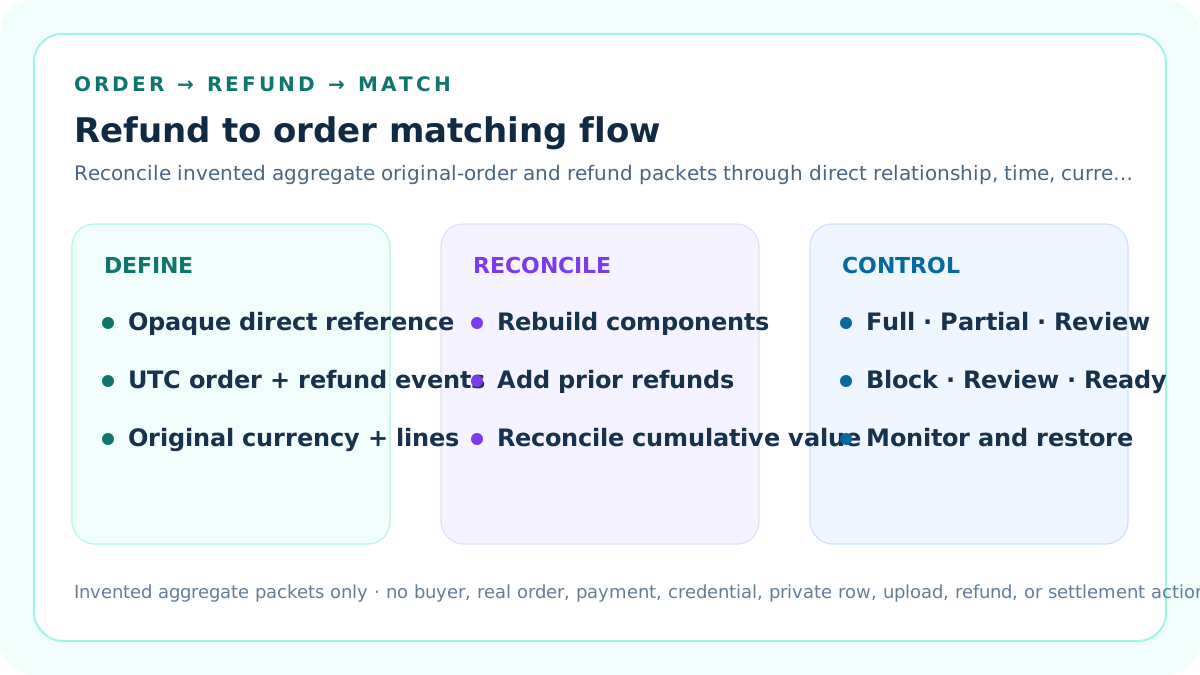
Match two invented aggregate refund packets to original orders using direct references, UTC event order, currency, item, shipping, tax, signed adjustments, prior matched refunds, and line coverage. The browser-local worksheet returns full, partial, review-candidate, or unresolved classifications plus Ready, Review, or Block without uploading a CSV or exposing private data.
Maintained by Seller Profit Guard Editorial Team. Last reviewed: 2026-07-31.
Declare one refund-event grain
Match one invented refund event to one invented original-order aggregate. Keep item, shipping, tax, adjustment, prior-refund, and line-count evidence at the same declared grain.
Do not mix an order header total with item-level refunds, payout deposits, fee credits, chargebacks, returns, or support tickets.
Use invented aggregate packets only
The worksheet accepts opaque fixture references and aggregate amounts. It does not upload, read, transform, store, or rewrite a CSV file.
Never paste buyer, customer, order, address, message, payment, card, bank, credential, private export row, or complete production file.
Preserve a direct order reference
Record the original-order reference and the order reference carried by the refund event. A direct equality supports the strongest deterministic match in this worksheet.
Use invented tokens such as ORDER-A-FIXTURE publicly; operational references remain protected and should never appear in screenshots or articles.
Validate reference shape
The fixture accepts bounded uppercase letters, digits, and hyphens so empty, tiny, or malformed references Block instead of becoming accidental matches.
Reference shape is not identity proof. A syntactically valid token still requires the correct protected source and event grain.
Record UTC order and refund events
Use explicit YYYY-MM-DDTHH:mm:ssZ timestamps for both events. The refund must not precede the original order.
Normalize source timestamps before matching when exports use different local formats or offsets.
Apply a bounded match window
Calculate the elapsed days between original order and refund. A direct reference beyond the seller-approved window returns Review rather than automatic acceptance.
The window is an evidence-review policy, not a platform refund deadline or legal limitation period.
Keep original and refund currencies
Both packets carry a three-letter currency unit. A mismatch Blocks direct amount reconciliation until a separate documented conversion contract exists.
Never compare 94 USD with 94 EUR as if the numerals established monetary equivalence.
Rebuild the original eligible amount
Add original item, shipping, tax, and signed adjustment components. Preserve each component rather than relying only on a displayed order total.
A platform may treat discounts, credits, fees, gift cards, duties, tips, or store credit separately; extend the protected contract when those fields apply.
Rebuild the current refund amount
Add refunded item, shipping, tax, and signed adjustment components for the current event.
Do not assume a partial refund contains the same component mix as the original order.
Include prior matched refunds
Cumulative refund equals previously matched refund amount plus the current refund. This prevents a second valid-looking partial refund from exceeding the eligible order amount.
The prior ledger must share the same order, currency, component policy, source version, and review status.
Calculate remaining eligibility
Remaining eligible amount equals original eligible amount minus cumulative matched refunds. The public output floors only the displayed remainder at zero after a Block decision.
Do not treat remaining eligibility as permission to issue another refund; platform state and human authority remain separate.
Block cumulative over-refunds
When cumulative refunds exceed the original eligible amount beyond the declared tolerance, the packet Blocks.
Investigate duplicate events, reversed signs, missing prior refunds, wrong references, currency conversion, store credit, chargebacks, and platform adjustments before changing data.
Declare amount tolerance
Use a small documented reconciliation tolerance from zero to ten currency units. It absorbs only a known rounding contract, never missing components or unexplained money.
A large tolerance can hide incorrect matches and must not replace component-level reconciliation.
Record line coverage
Compare refunded-line count with original order-line count. Full coverage plus reconciled cumulative amount can support a full-refund classification.
Line count is not quantity, SKU identity, or unit allocation. Operational matching needs protected line keys when multi-quantity items exist.
Classify a matched full refund
A full match has a direct reference, same currency, valid event order, acceptable window, complete line coverage, and cumulative amount within tolerance of the eligible original amount.
The classification does not prove the buyer received funds, seller fees were credited, inventory was restocked, or the order was canceled.
Classify a matched partial refund
A partial match has a direct reference and valid evidence while cumulative refund remains below the eligible original amount or line coverage remains incomplete.
Record which components and lines were refunded so later events do not double-allocate the same value.
Classify a review candidate
A structurally valid packet becomes Review when the direct reference differs or the event gap exceeds the declared window.
A reviewer may inspect protected secondary evidence such as platform transaction relationships, line keys, exact amounts, timestamps, status, and source fingerprints.
Classify an unresolved packet
Invalid references, timestamps, currencies, amounts, event order, line counts, tolerance, scope, or declared conflicts produce Block and an Unresolved classification.
Repair the source contract rather than forcing a nearest match.
Work the full-refund fixture
Scenario A rebuilds an original total of 82.00 items, 7.00 shipping, and 5.00 tax: 94.00 USD. The current refund uses the same components, no prior refund, and two of two lines.
The direct reference matches, the event occurs 5.1 days later, cumulative refund is 94.00 USD, and remaining eligibility is 0.00 USD.
Work the partial multi-item fixture
Scenario B rebuilds an original total of 75.00 items, 8.00 shipping, and 6.00 tax: 89.00 EUR. The current refund contains 30.00 items and 2.40 tax.
With no prior refund, cumulative refund is 32.40 EUR, remaining eligibility is 56.60 EUR, and one of three lines yields 33.3% coverage.
Separate refunds from cancellations
Etsy documents cancellation as separate from issuing a refund. Store an order-cancellation state independently from the money event.
A matched refund must not be relabeled as proof that the sale, fulfillment, listing quantity, or customer agreement was canceled.
Separate refunds from returns
Shopify documents that refunds and returns can be distinct workflows. Preserve return authorization, receipt, inspection, restock, disposal, and inventory evidence separately.
A money match does not prove goods were returned or recoverable.
Separate refunds from chargebacks
Etsy documents chargeback-related Payment account debits separately from order refunds. Do not merge them merely because both reduce seller funds.
Chargebacks require their own dispute, source, status, amount, and outcome contract.
Separate refunds from fee credits
A platform may credit some fees after a refund according to current rules. Match the customer refund first, then reconcile fee credits as separate Payment account or transaction events.
Never inflate the refund amount with a seller fee credit that was not returned to the customer.
Separate platform settlement
A platform refund status, payment-processor result, buyer receipt, bank posting, store credit, and seller balance can have different timestamps and references.
Ready proves only the entered matching contract, not settlement or receipt.
Version source schemas
Fingerprint each order, refund, transaction, statement, and line-item export. Record field names, grain, sign convention, currency, timezone, status semantics, and extraction time.
Schema drift can turn a formerly correct reference or amount field into a misleading match.
Reconcile counts before totals
Compare order count, refund-event count, direct-match count, review count, unresolved count, duplicate count, and rejected count before comparing monetary totals.
A balanced total can conceal one missing refund and one duplicate of the same amount.
Reconcile totals by currency
Sum original eligibility, current refunds, prior refunds, cumulative refunds, and remainders separately by currency and status.
Do not convert or combine currencies merely to make a batch appear balanced.
Assign human authority
Name the order-source owner, refund-source owner, matching-rule owner, privacy owner, independent reviewer, stop authority, and restoration owner.
Ready cannot issue a refund, alter a platform record, contact a buyer, close a case, or post an accounting entry.
Back up and restore
Preserve protected source fingerprints, event versions, prior matches, rules, code version, output hashes, exceptions, approvals, reconciliation baselines, and restoration commands.
Never overwrite the only order or refund record.
Retest counterexamples
Test malformed references, invalid UTC timestamps, currency mismatch, refund-before-order, zero refund, excess cumulative refund, impossible line coverage, stale window, short context, weak scope, and open conflict.
Every public counterexample remains invented and non-identifying.
Require nine release confirmations
Confirm synthetic-only input, common reference grain, UTC and currency controls, component allocation, prior-refund ledger completeness, bounded thresholds, counterexamples, backup restoration, and the refund-authority boundary.
A missing confirmation Blocks interpretation even when the visible arithmetic happens to balance.
Date source and policy authority
Record a real order/refund source-review date and a refund-matching policy effective date that is not later than that review.
This prevents a future-dated or malformed policy claim from validating older source evidence.
Bound every entered magnitude
Declare the maximum absolute component, maximum order lines per scenario, match window, tolerance, and minimum closed evidence duration. Reject permissive strings such as 94 USD or 14 days.
Strict finite decimal and safe-integer contracts keep UI convenience from silently changing the calculation.
Close the temporal evidence contract
Require the evidence month to contain every entered order and refund event, the policy date to be no later than the earliest event, the source-review date to cover the latest event, and the inclusive event span to meet the declared minimum.
A syntactically valid month or date is not sufficient when it does not govern the actual packet chronology.
Quarantine every blocked output
When a structural, evidence, privacy, date, confirmation, or restoration gate fails, display Unavailable for classifications, totals, gaps, and coverage.
Do not reuse a plausible-looking derived value from a packet whose governing contract is blocked.
Release through ordered gates
Index only after working calculations, current sources, direct answers, independent pages, metadata, diagrams, links, privacy, similarity, mobile, backup, deployment, and live checks pass.
Search signals are measured after release and are not a prerequisite for a quality-passed cluster.
Sources and further reading
- Etsy Help: issue a full or partial refund: Official seller workflow for full and partial refunds, Payment account effects, fee credits, timing, and the separate cancellation step.
- Etsy Help: refunds, returns, and exchanges for sellers: Official boundaries for seller policies, return agreements, and Purchase Protection.
- Etsy Help: download sold transactions: Official CSV export types for order items, orders, Etsy Payments sales, and deposits.
- Etsy Help: manage the Payment account: Official context for statements, fees, credits, shipping, reserves, and deposits.
- Etsy Help: chargebacks: Official distinction between an order refund and a chargeback-related Payment account debit.
- Shopify Help: exporting orders: Official transaction-history CSV fields for order, name, payment method, kind, gateway, timestamp, status, amount, and currency.
- Shopify Help: refunding orders: Official full, partial, multi-transaction, store-credit, shipping, fee, return, and restock considerations.
- Seller Profit Guard methodology: Deterministic fixtures, evidence precedence, release, monitoring, correction, and rollback.
Related Seller Profit Guard tools
- CSV Date and Currency Normalizer: Normalize invented timestamp and money fields before matching.
- Seller CSV Column Mapper: Map approved order and refund source columns to canonical fields.
- Duplicate Order Checker: Separate duplicate source events from legitimate split records.
- Marketplace Payout Anomaly Checker: Reconcile aggregate refund and fee effects in a separate payout bridge.
- Methodology: Review evidence, calculation, correction, release, monitoring, and rollback controls.
- Data Privacy: Keep operational orders, refunds, payments, and buyer data outside public fixtures.
- Refund to Order Matcher Formula Contract: Define direct references, UTC events, currency, original and refund components, prior refunds, line coverage, tolerance, match window, and evidence.
- Refund to Order Matcher Full-Refund Example: Reperform a 94.00 USD original order and full refund using direct reference, UTC events, components, zero prior refunds, and complete line coverage.
- Partial Multi-Item Refund Matching: Match a 32.40 EUR partial refund to an 89.00 EUR three-line order while preserving allocation, remaining eligibility, and future events.
- Refund Matching Mistakes That Create False Links: Diagnose nearest-amount guesses, omitted prior refunds, mixed grain or currency, reversed signs, duplicate events, and chargeback confusion.
- Reliable Refund and Order Matching Sources: Map each field to first-party order, refund, transaction, statement, line, status, currency, and schema evidence without exposing private records.
- Safe Refund Matching Thresholds: Set structural blocks, amount tolerance, match-window review, cumulative-refund limits, line coverage, exceptions, monitoring, and rollback.
- Full vs Partial Refund Matching: Compare closure, component allocation, line coverage, remaining eligibility, later-event risk, match class, monitoring, and restoration.
- Refund Matching Operating Routine: Build a repeatable workflow for source intake, normalization, direct matching, component reconciliation, exception review, monitoring, and rollback.
- Interpret Refund Matcher Results: Explain what full, partial, review-candidate, unresolved, remaining amount, event gap, line coverage, Ready, Review, and Block prove and cannot prove.
- Refund to Order Match Audit Template: Provide a standalone order, refund, reference, time, currency, component, cumulative, line, source, exception, monitoring, and restoration record.
Use the interactive tool
Enable JavaScript to open the calculator and process browser-local inputs. The explanatory content and source links remain available without JavaScript.
Related guide: Define direct-reference, time-window, currency, component, cumulative-refund, line-coverage, evidence, monitoring, and restoration controls.
This tool provides operating estimates, not tax, accounting, legal, financial, or marketplace-policy advice. Verify current official sources and your own records before changing prices or operations.